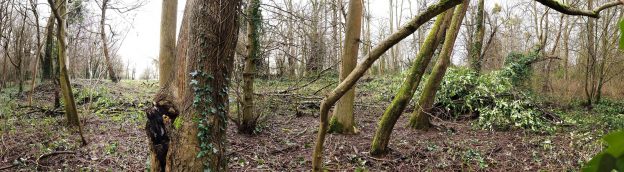
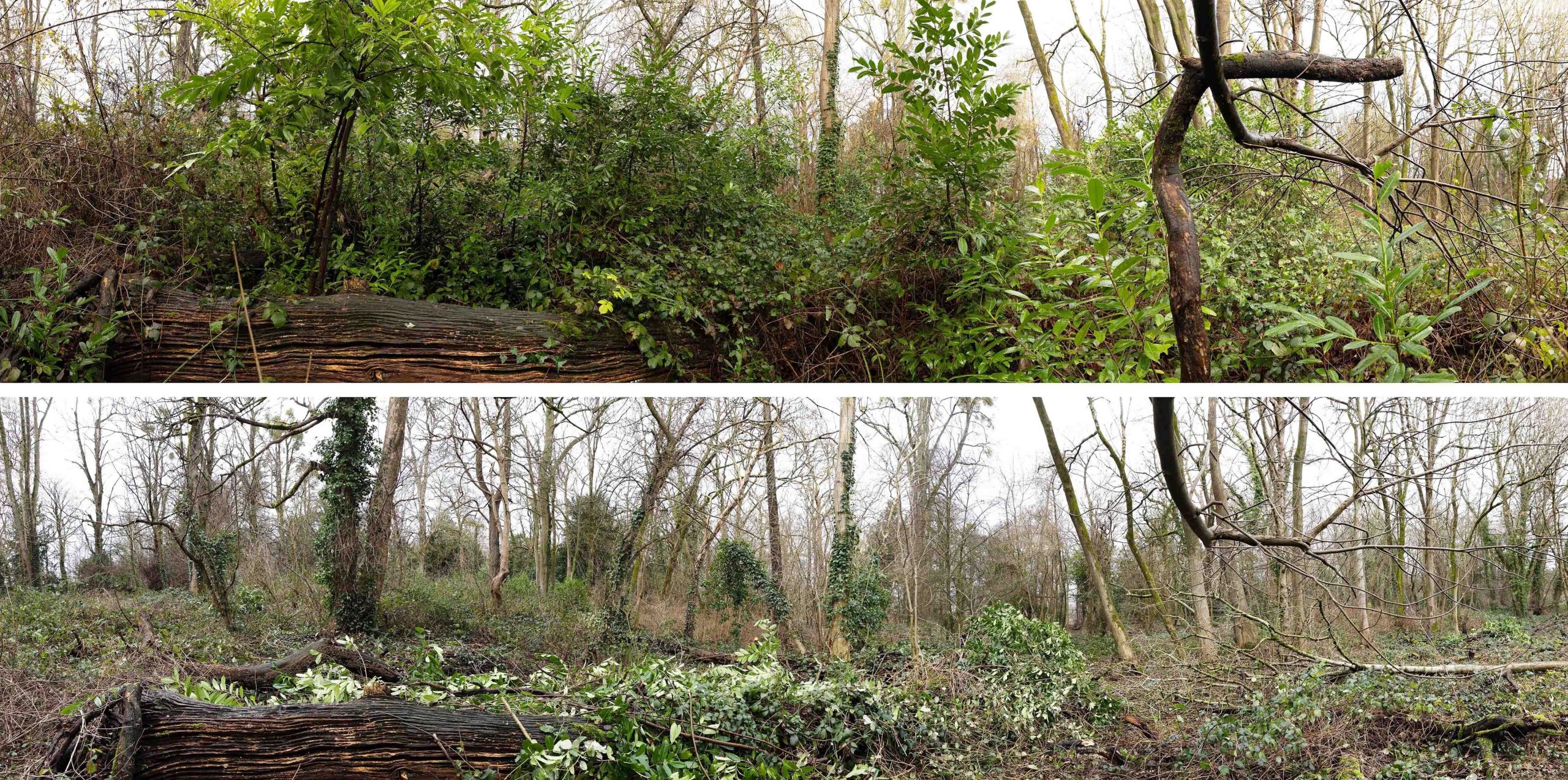
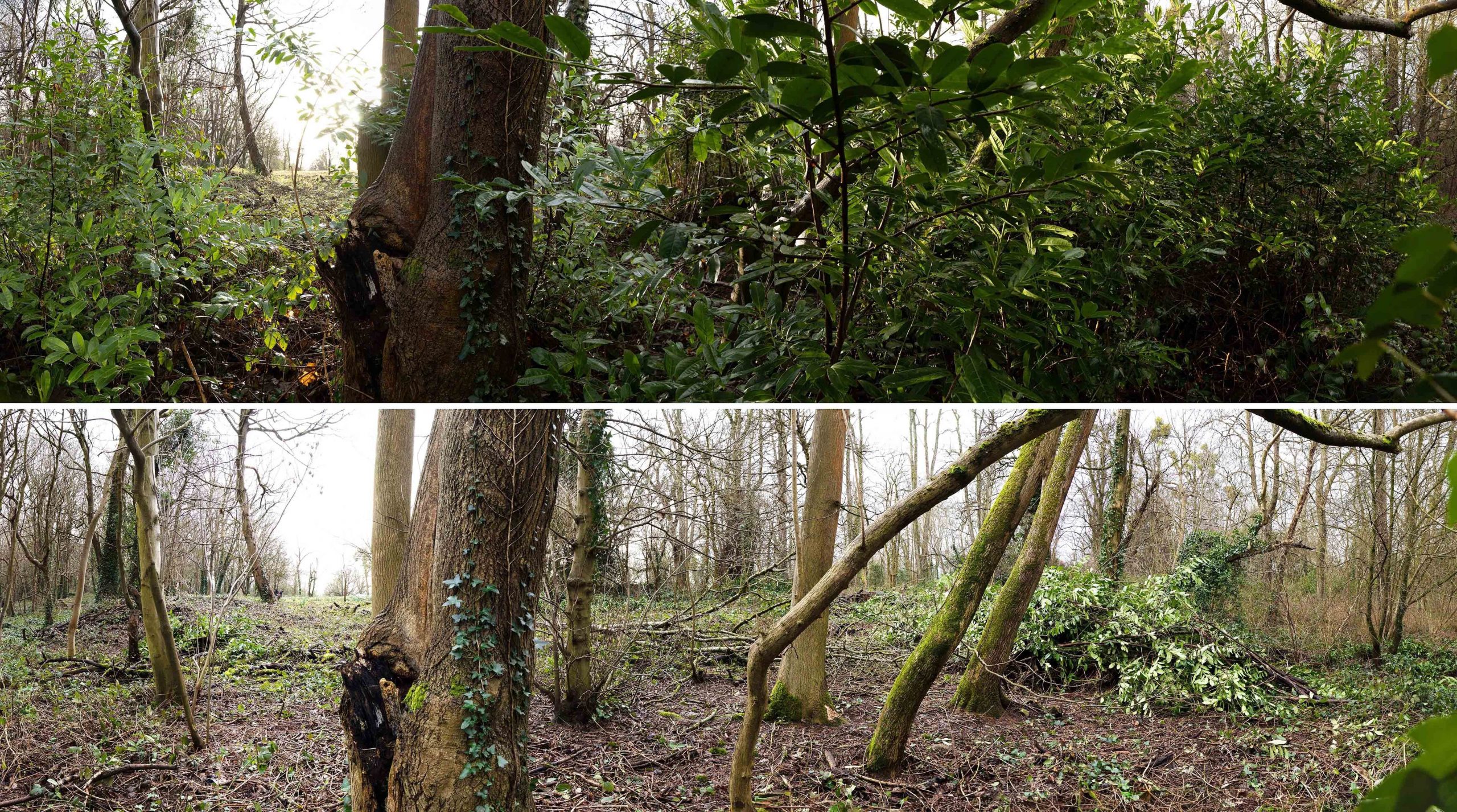
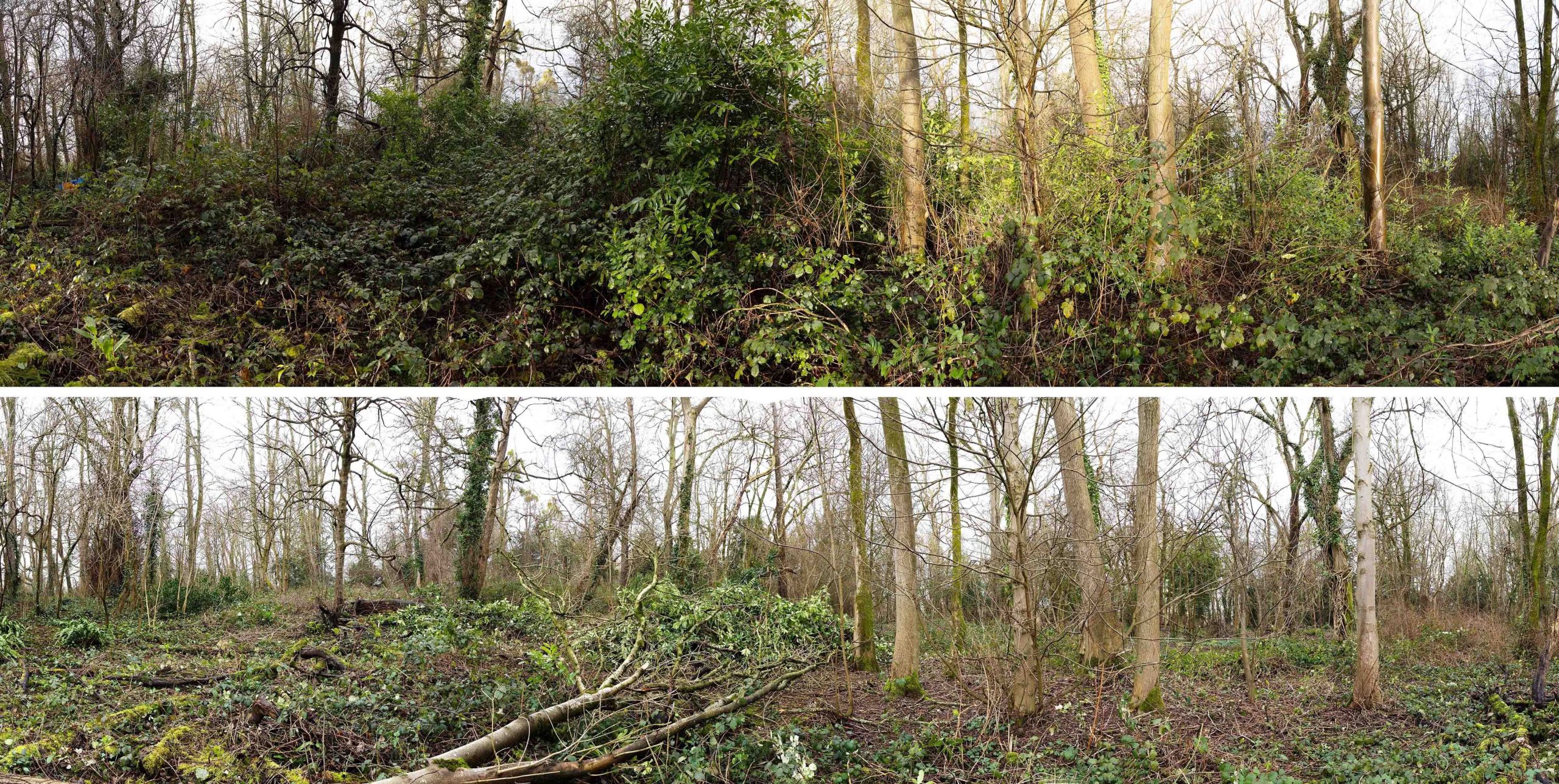
It was invigorating to see so many new volunteers join us in January to re-cut cherry laurel regrowth close to The Circle. It was 2016 when we last went through the compartment to fell the forest of laurel that had grown to choke out natural species. Gratifyingly, it’s been slow to try making a comeback, mainly due to the Council following through with poisoning at the time.
Above: Looking into the woods westward from The Circle
However, the laurel remains a persistent weed and has begun to get going again, so last month’s work helps to knock it back again.
The area sits at the northern, back, side of The Circle, a patch lined on the south with the Avenue to Penpole and the north by the main path to the Point. Most of the work could be done with loppers, but there were a few extra bits that needed the saw taken to them again.
Looking back to The Circle in the direction of the car park from the main path through the woods.
We also took the opportunity to get back on top of some natural spacing, clearing competing saplings around trees that stand a better chance of maturing. This should keep the avenue to Penpole clear and in good shape for a little longer.
A huge thank you to everyone who helped out, and we hope to see you all this month.
A broad panorama from The Circle looking west towards Penpole
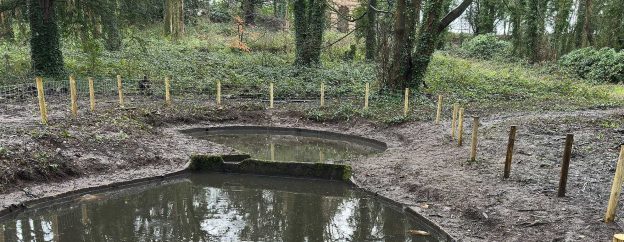
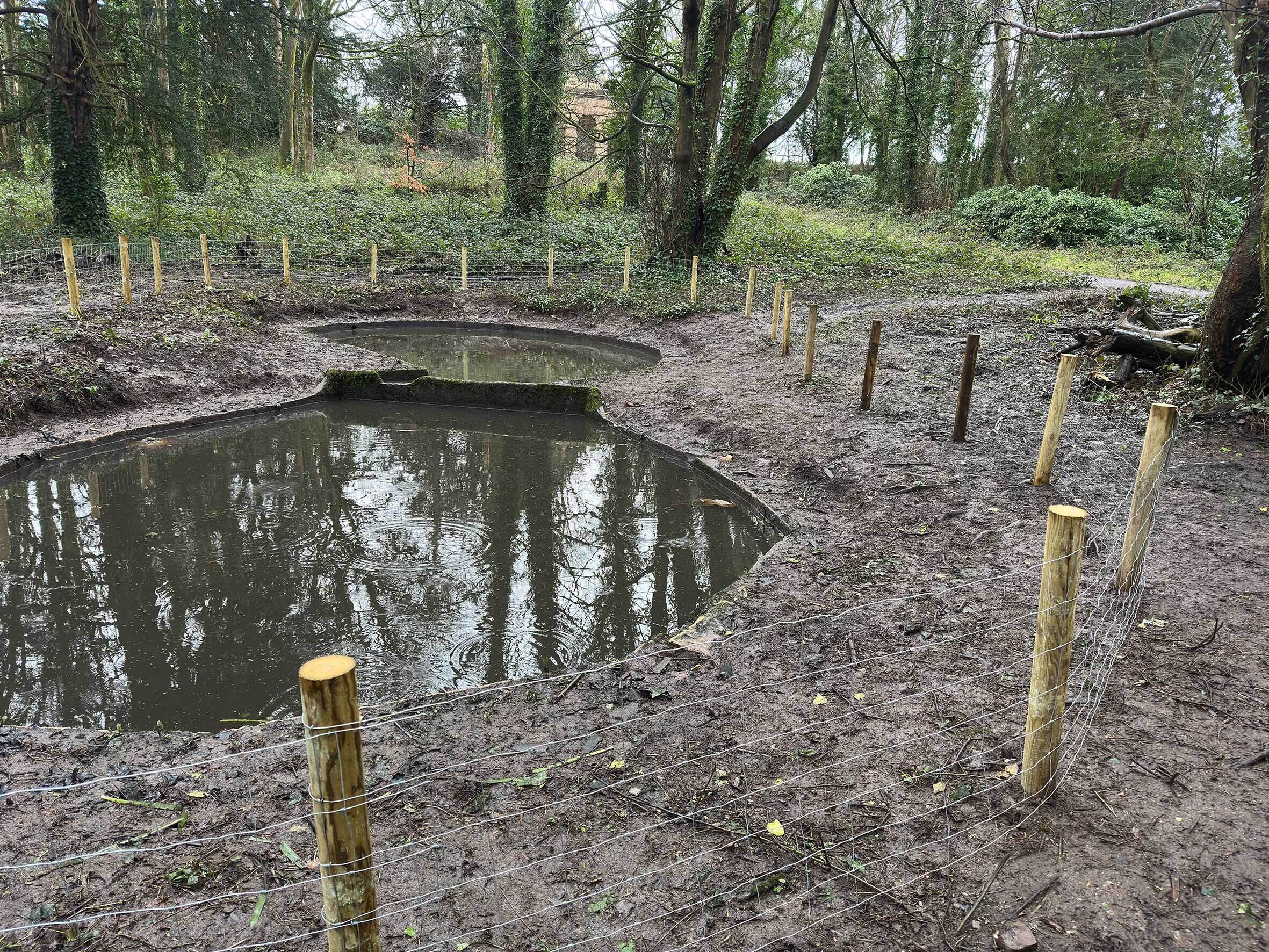
At the end of January, Bristol City Council park rangers held true to their promise to provide a fence around the recently cleared ponds close to the Echo. This is to ensure the progress made in emptying it of mud and logs is not undone as it was after we last cleared it.
Unfortunately, silt, sticks and logs thrown in for fun, and dogs regularly enjoying a dip prevented earlier work from flourishing. This, and the regular autumn dump of leaves and a large dead tree finally finished any aspiration to revive it.
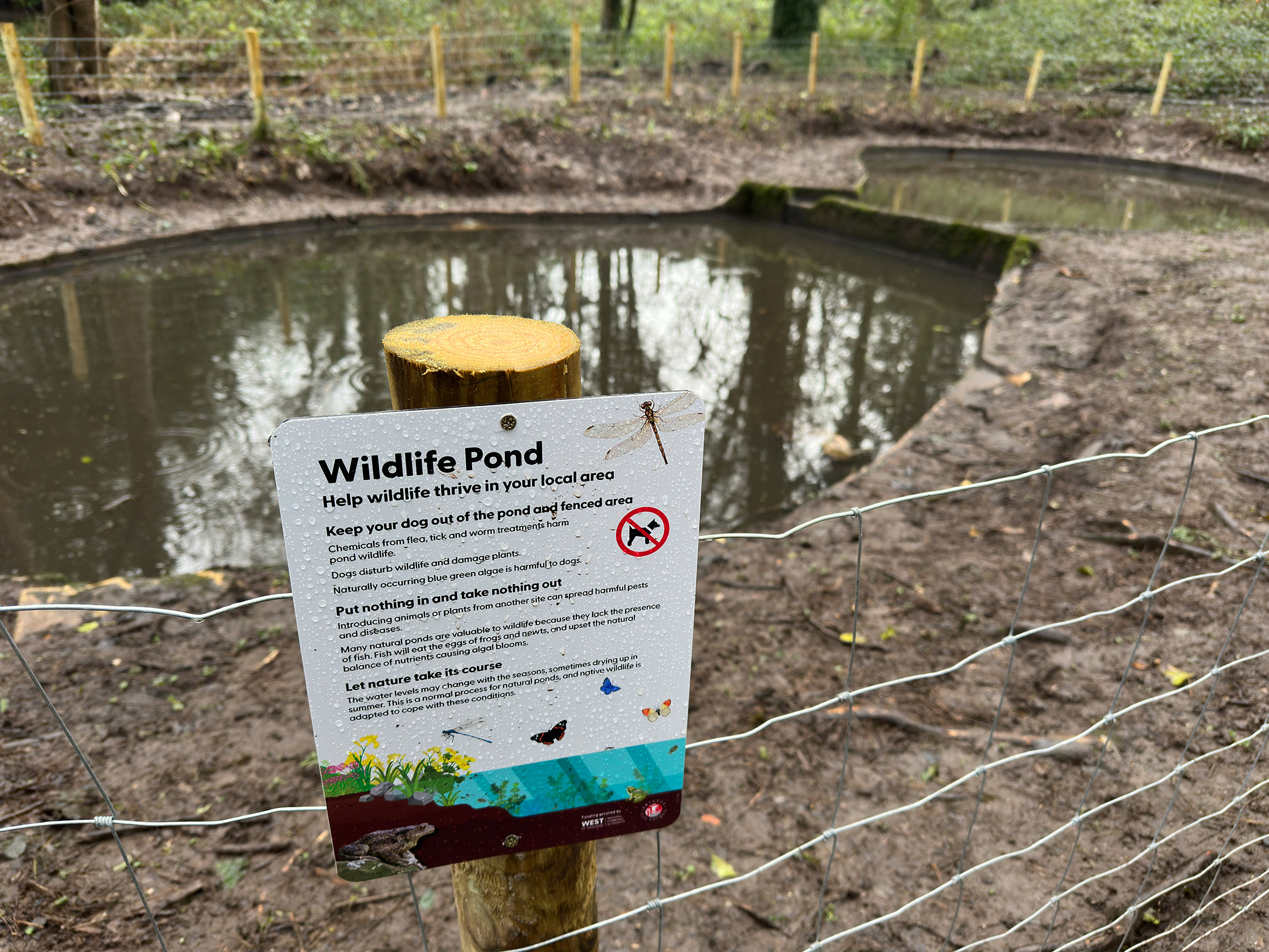
Now, a fence with timber posts and large gauge mesh fence should help protect the wildlife and give the ponds a chance to thrive. They’ve now filled-up with water very nicely after the recent wet weather, and are brim-full, ready to start receiving some native pond plants the Council will be providing soon.
We look forward to Spring when the project should be finished, and we hope wildlife will begin to make its return.
Both notable families of Kings Weston, the Southwell’s in the eighteenth Century and the Miles’s in the Nineteenth, were heavily involved in politics. As might be expected from any wealthy landholder, they were keen to protect their own interests as much as serve in the country’s interests. It’s not surprising therefore, to find that five owners of the estate would serve in the House of Commons, and two in the House of Lords.
Members of the Southwell family were also involved in court life and as part of Government outside of their constituency responsibilities. What’s perhaps odd to us today is that many communities they were elected to represent were very remote from their home.
Edward Southwell II of Kings Weston (1739-1754), MP for Bristol 1739-1754
Sir Robert Southwell retired to Kings Weston from Court life in London in 1679, relinquishing his Government roles and choosing not to stand again for elected as MP for Penryn in Cornwall where he’d served for six years. After William III took the throne he returned to government and was elected for Lostwithiel in 1685.
In 1702 his Son, Edward (1671-1730) was put forward as a candidate at Rye. The election went against him, but after a legal hearing in the elections committee the vote was overturned in his favour because of ‘illegal’ interference in the election. Again, Rye was very far from the Southwell’s interests and was probably what we’d consider a safe seat. Similar might be said for later elections as MP for Tregony in 1713, where he served a matter of months before a General Election, before finding favour in Preston.
As the 18th century progressed, power gradually transferred from the monarch to the House of Commons. Politics came more polarised, voters expected better representation, and political parties were a growing force. The importance of local people representing local interests also increased. Edwad Southwell II (1739-1754) was the first of his family to represent a local constituency.
When Edward was 33, one of the two MPs for Bristol, Thomas Coster, was reported in ill health and subsequently died. Even before the death was announced, Edward had already determined t throw his lot in and seek election to the vacant seat.
We’re fortunate to have a journal he kept, detailing the various machinations in the lead-up to the election in December. This gives a fascinating insight into the process and how Edward built alliances to gain support.
At the start of October, he begins:
“I had private acts and many affairs to settle to my steward Francis Benning at Kingsweston which inclined me to undertake the journey from London, but on the news he sent me of Mr Coster’s (The member of parliament) desperate state of health, I determined upon the journey after consulting my wife at how I should act in case of being invited to stand at the election, who freely bid me neither regard her nor her condition (she being then 6 months gone with child) nor my son, whereover my honour or credit or the service of my Country required my absence of stay. “
Kings Weston house in 1746, during which time Edward Southwell II was MP for the city.
On arrival in Bristol 6th October he headed directly to the Tolsey on Corn Street where the magistrates of the city sat and much business where:
“Mr Berkeley stand me and I promised him and Mr Chester my Interest for the County which being so publick was much taken notice of. NB. Mr Coster was buried the night before at the Cathedral abd every bell in the City tolled for him from morning till night.”
He was disappointed to find that there was initially a lukewarm response to his interest, his closeness to Government and court life being held in some suspicion:
“Upon finding the name of a courtier was so obnoxious, I cooled much in my ambition of standing, I considered I was the King’s Servant, I had ever owed and paid him a personal duty and had ever gone to his court, and that I had my own principles and character to maintain as well as my duty to my country, and determined I would never yield up my respect to the King”
A handbill printed for Southwell’s supporters to circulate around the city.
This might not have been an attractive attitude for the former supporters of Mr Coster, who were clearly looking for a more liberal representative in line with Whig politics. The Whig’s opposed absolute monarchy, championed parliamentary power, and individual liberty. He was forced into a position of defending his independence in order to find favour with them. Edward wrote,
“that if Mr Coster’s friends set up a man in my station, the magistrates could be able to make no opposition and that the party would take a moderate man, and were not as violent as I imagined. I told him I ever had and ever would pay a personal duty and respect to his Magesty and his Royal Family, that my place of Secretary of State for Ireland was for life and worth little more that 200 guineas per annum, and that I had refused applying for my father’s additional sallery of £300 pounds because I never would accept aan pension, but I would live independent.”
Mr Coster’s friends came round to the prospect of a gentleman of status representing them, declaring him their candidate albeit cautiously.
By November, election fever had taken over the City and Southwell found himself campaigning against Henry Coombe. Naturally, every opportunity was taken by candidates to influence voters and their supporters. Handbills and pamphlets were common, usually from alleged anonymous advocates of the candidates, particularly if they were more vicious in nature.
The punch bowl made at Brislington pottery in 1739, probably used to curry favour and influence voters.
The house at Kings Weston came into its own at these times, offering the perfect showcase of the Southwell’s taste wealth, and influence, where voters could be entertained on a lavish scale. The Gloucester Journal reported “The Honourable Mr Southwell has kept open house at Shirehampton ever since he has declared. There are constantly employed a baker, a butcher, and two brewers to provide for the reception of all comers and goers”
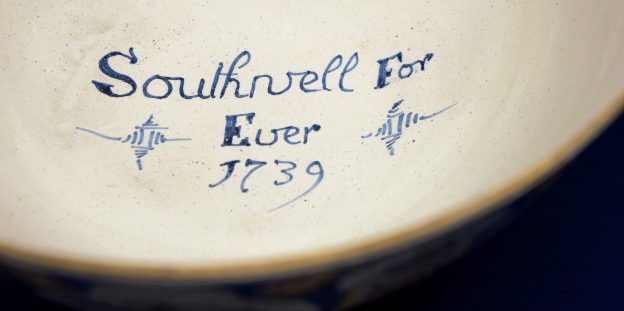
Another testament to the interest the election created is a punch bowl now in Bristol’s Museum and Art Gallery. It was commissioned from the Brislington pottery, famed for their tin-glazed ‘delft’ wares, and would have been recognisable as an expensive item at the time. Decorated in rich colours in the Chinese style of the outside, it’s only when the guests would have drained most of the contents they would discover the slogan “Southwell for ever” and the election date inside the bowl. Perhaps once they’d drunk so much, they might have been more susceptible to the political message held within.
Inside the punch bowl, the political motivation behind its manufacture becomes clear
He was declared winner on 12th December, 2651 votes to Combe’s 2203. His journal, now held in Bristol Archives, then transforms from a record of the campaign to a catalogue of the petitions and constituency work that were the inevitable outcome of political position.
Southwell remained true to his promise of independence, showing no consistency in supporting either Whig or Tory, Administration or Opposition, positions. Although perhaps true to the wishes and interests of Bristol, Southwell’s unreliability attracted few friends in the House. The 2nd Lord Egmont, related to Southwell by marriage, wrote dismissively of his kinsman:
“Southwell is a weak man. Has an affectation of being supposed to act according to his conscience, which directs him to vote one day for a proposition in a committee, and the very reverse the next day and in the House. They think him an honest man at Bristol but they have no opinion of his understanding and I believe if occasion were, he might be easily changed—But if not he will be as often for us as against us!”
Despite frustrating other politicians, Southwell maintained support from Bristol’s voters, representing the city until 1754, when, due to ill health, he chose not to stand. He died the following year.
It would be the same 2nd Lord Egmont who’d criticised him who would support Edwards son, Edward II (1738-1776) for election to Bridgewater in 1761. Seeing an opportunity to represent his native Gloucestershire, he declared as candidate two years later. He represented the county for thirteen years before being elevated to the House of Lords in April 1776 and vacating the seat.
December might not be the favoured time of year to be splashing about in ponds, but that’s just what we did at the tail end of last year. Our plan was to continue work that the Council had begun with a mini-digger, but by hand. It hadn’t been possible for the digger to reach into the middle of the pond and so the Council turned to our volunteers for help.
The two ponds are concrete-lined and probably date to the 1960s or 70s. The lower pond, the larger of the two, had to be emptied of water so people could get in to do the dirty work of shovelling-out mud and hauling branches away. In the event it worked out easy to scoop the water up into the top pond, from where it would need to be transferred back afterwards.
There was a great turnout for the event with some new faces, so a big thank you to everyone for making this such quick work. The lower pond was certainly an easy job and was finished in a brief space of time. The debris was carried away as far as possible, continuing piles already set up by the Council workers.
The top pond, however, was more of a challenge. Once most of the water had been thrown back to fill the lower pond, there was a dirty sloppy silty mess that was more challenging to scoop out. With most of it poured into buckets and taken away we called it a day at about 1pm, a job well done.
The next phase in the restoration of these ponds as natural habitat will be the erection of a small fence to prevent dogs disturbing the wildlife and discourage rubbish being thrown in again.
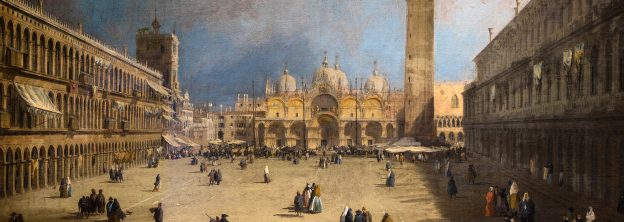
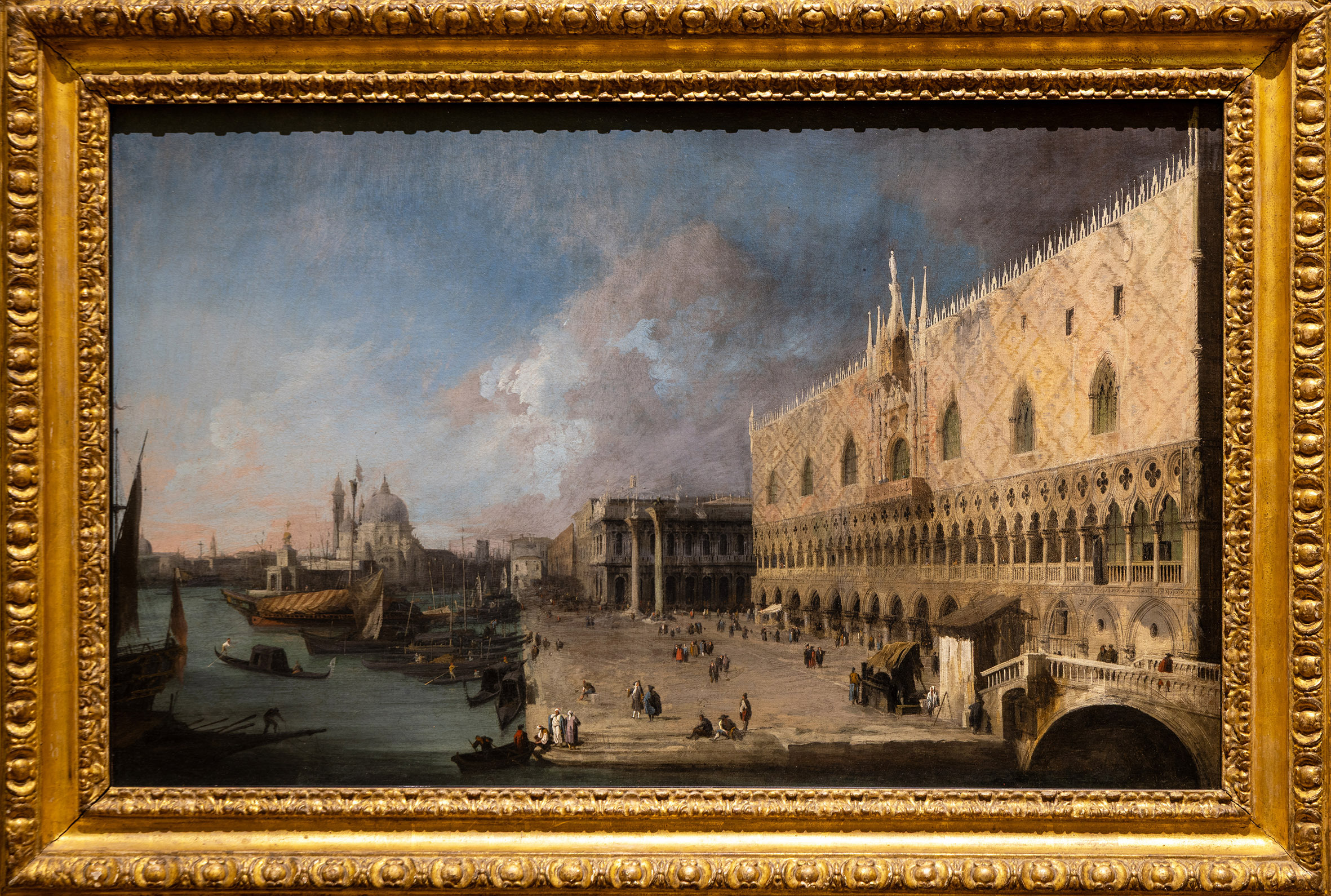
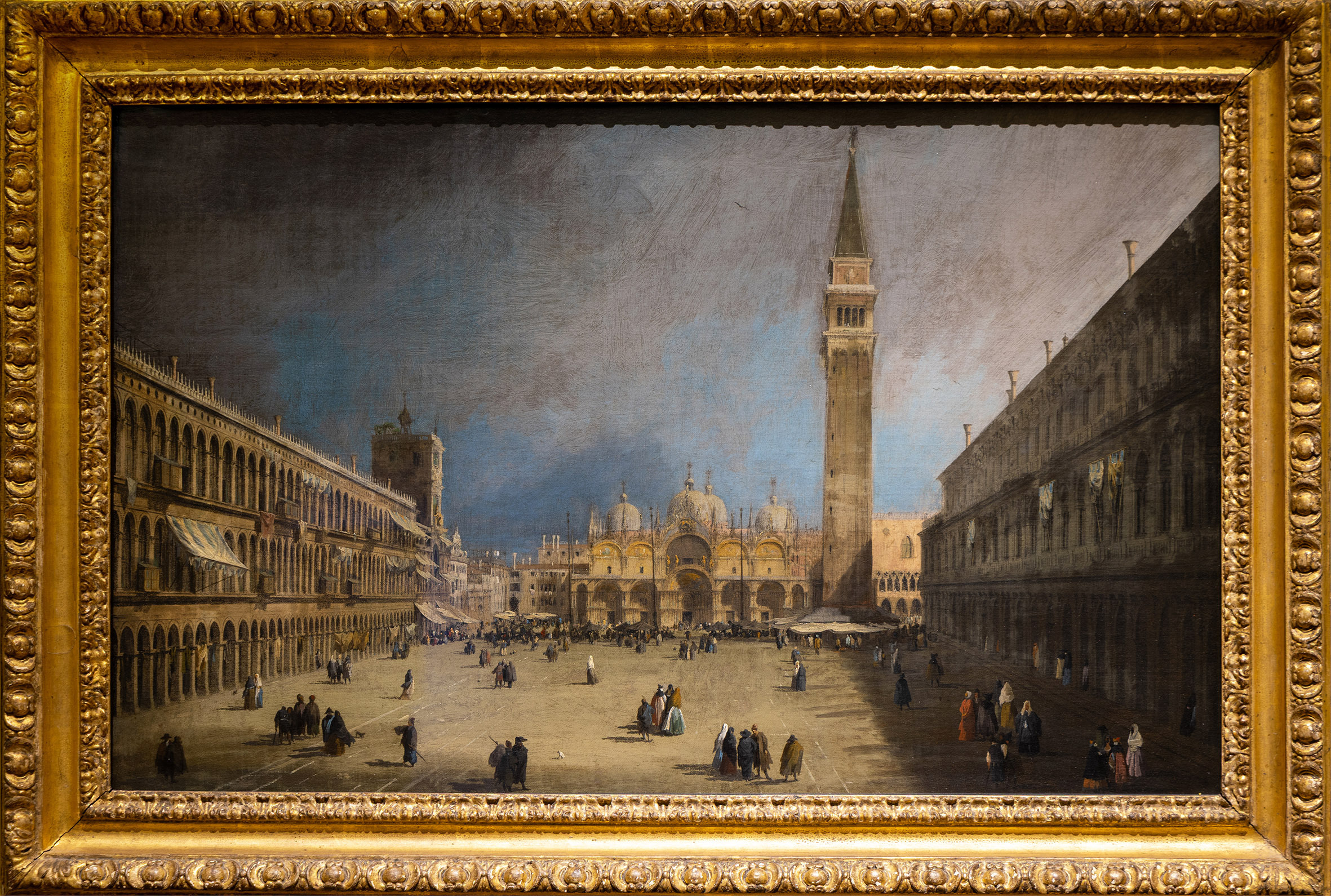
A recent visit to Bristol Museum and Art Gallery came with something of a surprise. Hanging on the wall of the British and European Art: The Age of Enlightenment and the Birth of Romanticism gallery is a pair of paintings we recognised immediately as being from Kings Weston!
Venice, the Molo by Canaletto, now at Bristol Museum and Art Gallery
The paintings are by none other than Canaletto, and it’s after them that the Canaletto Room in Kings Weston house was named. The two paintings were auctioned in 2002 from the collection of Southwell family portraits still in the ownership of the family trust. The sale paid for the expensive restoration of the rest of the collection, but the two Canaletto’s went into private hands. They are now hanging in the museum on a five-year loan from a private collection.
The two paintings were originally bought for Kings Weston by Edward Southwell II. At 21 the young Southwell had been dispatched to the Continent on his grand tour, returning home in August 1726. It appears that it was only in the following year that Southwell purchased the first two paintings through Owen Mc Sweeney (or Swiny). Mc Sweeny had become resident in the Italian city in 1721, becoming agent for several artists and selling his works to English gentlemen on the Grand Tour. It may be that Southwell placed orders for the paintings when he was in Venice in early summer 1726, for them to be sent to him the following year.
Venice, Piazza San Marco by Canaletto, now at Bristol Museum and Art Gallery
The latter wrote to the Duke of Richmond in 1727: “The pieces which Mr. Southwell has, (of Canals painting) were done for me, and they cost me 70 sequeens. The fellow is whimsical and vary’s his prices every day: and he that has a mind to have any of his work, must not seem to be too fond of it, for he’ll be ye worse treated for it, both in the price and in the painting too. He has more work than he can doe, in any reasonable time, and well: but by the assistance of a particular friend of his, I get once in two months a piece sketch’d out and a little time after finished, by force of bribery. l send yr Grace by Captain Robinson [ … ] who sails from hence tomorrow, Two of the Finest pieces, I think he ever painted and of the same size with Mr. Southwell’ s little ones (which is a size he excels in)”.
It’s worth noting that Mc Sweeney was an Irishman and Southwell maintained strong links with his ancestral homeland, shortly to become Secretary of State to that Kingdom in succession after his father. The pair may have connected in Venice over a patriotic bond.
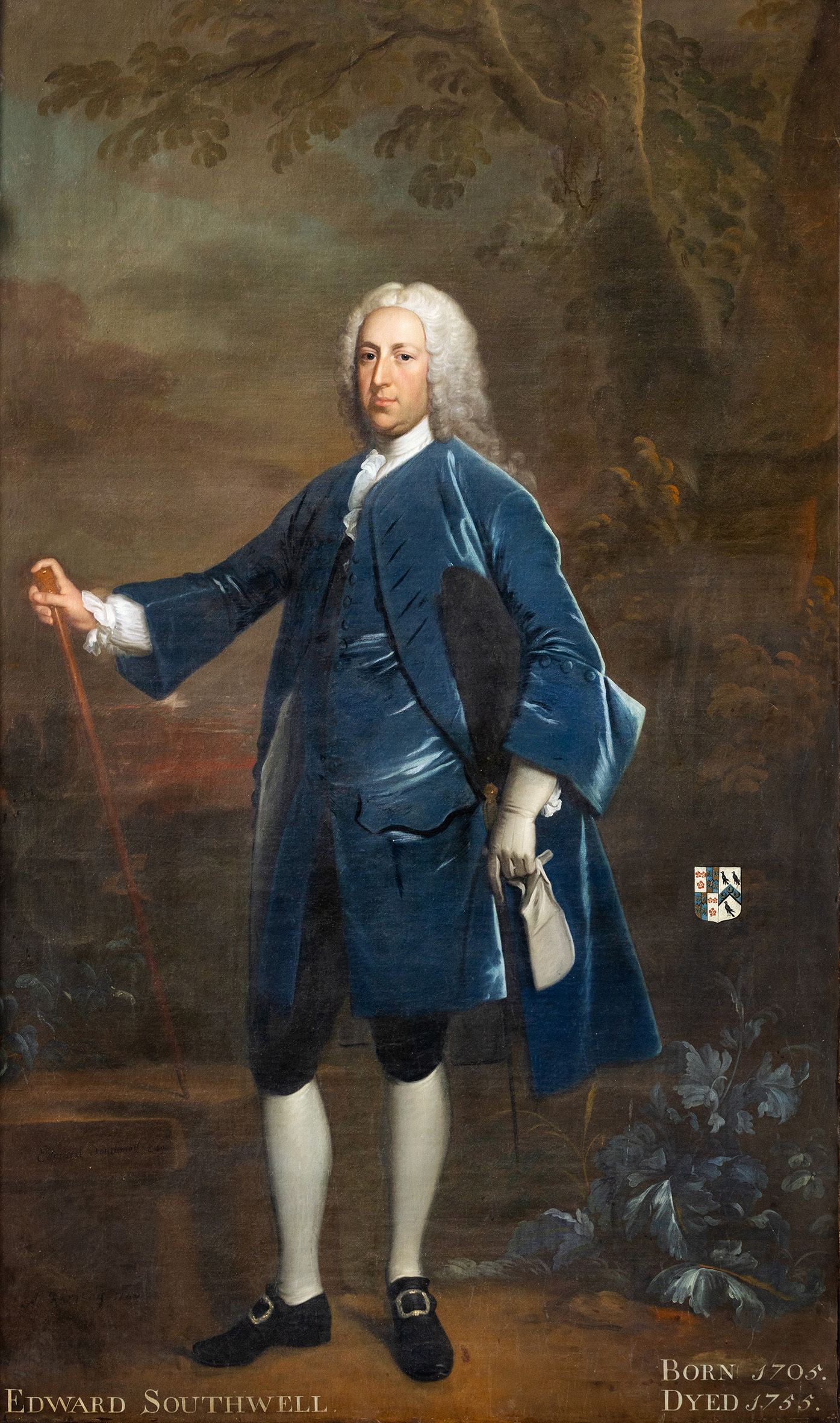
Edward Southwell II, 1705-1755, who commissioned Canaletto’s paintings.
Edward Southwell became one of the earliest gentlemen to boast Canaletto’s amongst their collections, at the forefront of a trend that would eventually see the artist coming to England to satisfy demand for his paintings.
By 1777 there were four paintings by Canaletto hanging at Kings Weston. Is it possible that Southwell had returned from Venice with a pair in 1726, the two commissioned through Mc Sweeney adding to the collection?
The four views of Venice were hung together in the Dressing Room of Lady de Clifford, a large first floor reception room with a bay window overlooking the Severn. Here, most of the family’s best and most intimate paintings were to be found, those intended to be seen by the family’s closest friends and most important guests. They were clearly held in high regard.
When the last in the line of Southwells, the 21st Baron de Clifford, died and his property was sold in a series of London Auctions, the paintings were described and “St Mark’s Quay” and “St Mark’s Place – the companion”. The original attribution to Canaletto was later amended in the catalogue to name Guardi, another Venetian artist, as their creator. They sold for £31 and £25 respectively, possibly bought back by family members. But what of the other two recorded in the house a generation before?
In a year when a number of other paintings that once hung at Kings Weston have gone to auction, it’s gratifying to find two such important paintings being shared with the public so generously.
For the first time, the history of Kings Weston house has been accurately delineated in print. A new biography of the architect Sir John Vanbrugh has just been published, one that finally sets out the dates for design and construction accurately.
Author and former director of the National Gallery Sir Charles Saumarez Smith, has been in dialogue with KWAG for the last couple of years, sharing research and thoughts on the book. We have been delighted to support his work and have been kindly mentioned in the acknowledgements.
The book focusses on Vanbrugh’s architectural work in the context of his life experiences and personality. It adds colour to the man’s character and shows how he used his charm and enthusiasm to convince patrons of his ability to execute extraordinary projects with relatively little experience.
Kings Weston is well covered in the book, with seven whole pages. With the accurate start-date of the house finally confirmed in print as 1712, this is the first book to be able to show how the design and construction fits into the wider picture.
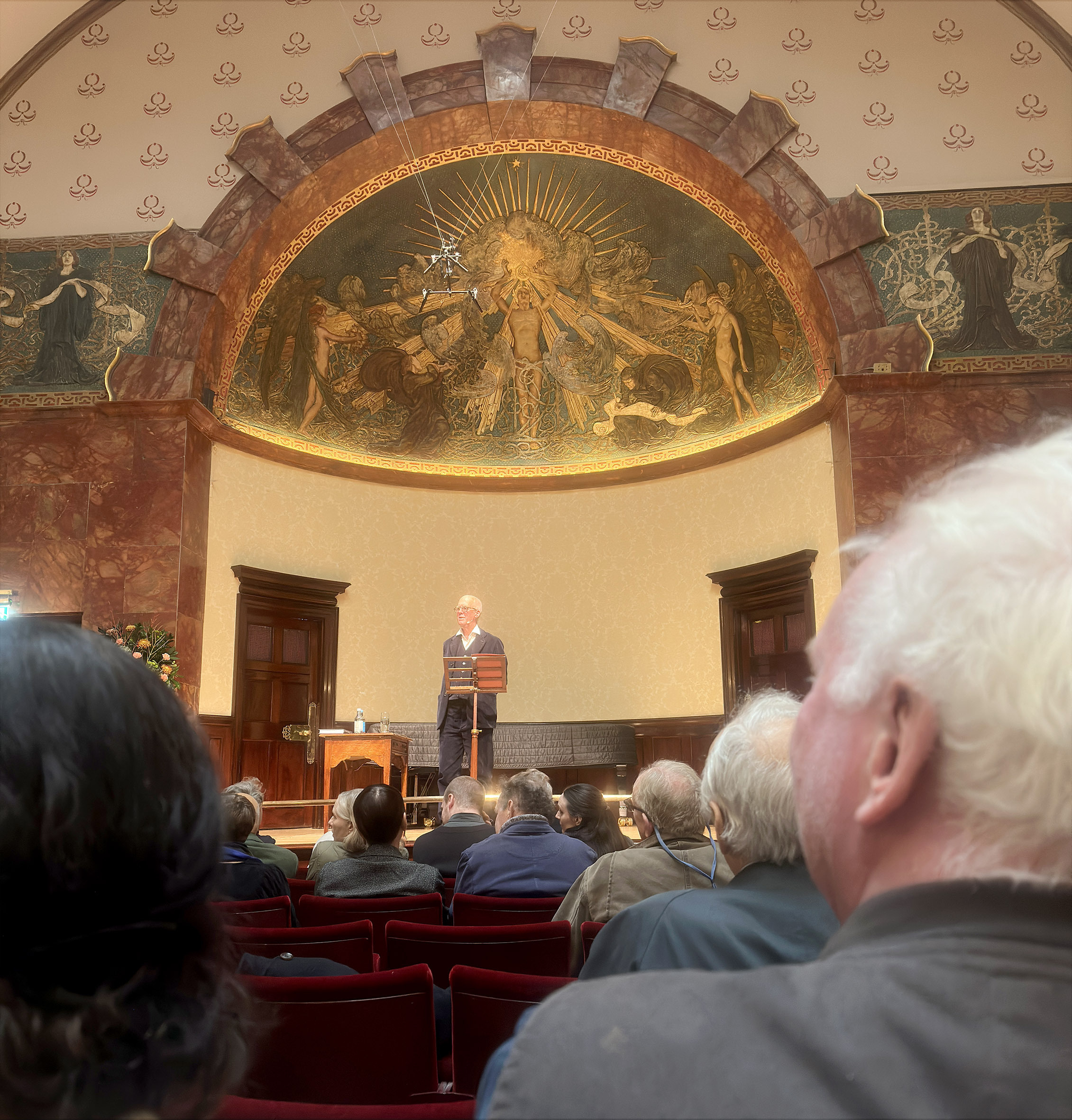
We were delighted to be able to attend the book’s launch at Wigmore Hall in London, where Charles Sumarez Smith gave a fascinating and illuminating lecture on Vanbrugh’s transformation from playwright to architect.
The book is published by Lund Humphries and would make an ideal Christmas present for anyone interested in Kings Weston’s famous designer and the backdrop against which it was built.
Sir Charles Sumarez Smith presents a lecture on Vanbrugh at the launch event at Wigmore Hall, London
We focussed on a key spot in Penpole Wood in November 2025, one where the middle path had become heavily overgrown with cherry laurel. The steep hillside along the north edge of the woods results in cherry laurel growing lanky and drooping in much the same direction. The thin soils here see the overgrown shrubs pull out by their roots and fall downhill, often continuing to grow when they have.
Before and after work along the Middle Path in November, looking eastwards.
The spot we started work on in November had all of these issues and had resulted in low-growing laurels threatening to block the route completely. Our volunteers worked hard in slippery conditions on steep inclines to cut and fell the laurel, using fallen boughs to line the lower edge of the path and reduce erosion; here, it had been undermined by roots pulling-out the ground where trees have fallen downhill.
The results have been transformative, and have ensured the area is safer and more accessible for a few years yet. A surprising change resulted from relatively few volunteer hours, and the results speak for themselves we hope.
en transformative, and have ensured the area is safer and more accessible for a few years yet. A surprising change resulted from relatively few volunteer hours, and the results speak for themselves we hope.
A view opens up along the path looking towards Penpole Point.
Kings Weston was the country estate of the Southwell’s from 1675 to 1832, but every landed family of note also maintained a London address. The Southwell’s were no exception, and their interest in London pre-dated their acquisition of Kings Weston.
Sir Robert Southwell, 1635-1702
Sir Robert Southwell made himself indispensable to the government of King Charles II on his return from his Grand Tour of Europe in 1662. By 1665 he had been knighted and held important government and diplomatic roles. Four years later he was sufficiently well off to purchase a lease from the Crown for his own property close to the heart of Court life in Whitehall.
He bought the reversionary lease on a parcel of land called Spring Gardens that backed on to St James’s Park. There was a brick-built house here, around 20 years old, and a small park, where he set up home.
Sir Robert’s circle of friends was drawn heavily from other members of the Royal Society. His interest in the Natural Sciences had encouraged him to become an early member of this auspicious group of learned gentlemen. One of his closest friendships was with Robert Hooke; Southwell was noted for his outgoing and genial character whilst Hooke was a man noted for his difficult and irritable temperament, but the two bonded over their interest in science.
Hooke was one of the most important and prolific scientists of the era. As well as interests in astronomy, geology, mechanics, and microscopy, Hooke was an accomplished architect, perhaps second only to Sir Christopher Wren at the time. Indeed, he succeeded Wren as Surveyor of the Royal Works in 1670. Perhaps his best known work is the monument to the Great Fire of London, still standing close to the site where the fire began. It was to his friend that, in 1674, Southwell turned to provide drawings for the rebuilding of his Spring Gardens house and paid him 5 guineas for his trouble.
The plans of Spring Gardens house in the Kings Weston Book of Drawings (Bristol Archives)
A drawing survives today in Bristol Archives that likely represents Hooke’s plan for the building. It was a substantial town house for the era, its status marked by being set detached in its own grounds. It was designed with two wide frontages of seven bays each, set out over four floors, with the semi-basement housing services and the attic of garret floor being the usual servants’ accommodation. The family rooms occupied two floors: ground floor elevated above the street by nine steps and ’piano nobile’ at first floor equipped with a large dining room where grandstand views across St James’s Park could be obtained.
Spring Gardens house seen from the west, roughly from above where Buckingham Palace is today
The external appearance of Sir Robert’s new house is detailed in an engraving of 1720, after his son Edward had inherited it but largely unchanged. Here it is in its ‘perfect’ state, before alterations and development around it. It was a smart but unostentatious building, brick-built but with stone quoins at its corners. As was fashionable at the time, it had a modillion course (a projecting cornice) supporting a hipped roof. The engraving shows a balustrade around the leads of the roof, providing an elevated position for guests to enjoy distant views across the park. The gardens around the house are depicted behind high walls, formally arranged, and with ornamental garden buildings dotted about.
The location of Spring Gardens house in 1730 and in 1778, showing the Southwell’s own development gradual encroaching on their house and garden.
As might be expected, land in London was valuable. Even though much of Court life moved away after Whitehall Palace burned, Westminster remained the seat of Government, and at the periphery of the Royal Park, land was in demand. The Southwell’s had begun capitalising on their central-London estate by gradually developing it with new houses. Already, in 1668, in Sir Robert’s time, new houses were built to let.
Initially, new houses were large, detached, and with their own gardens, but made inefficient use of the land. By the early 18th Century the market demand for courtly town houses had waned, replaced by a demand from politicians and civil servants for houses close to their places of work. Sir Robert’s grandson, also Edward (II), quickly reordered the London estate when he inherited in 1730. He set out a formal new street of smart terraced town houses preluded with a new chapel for its residents. He also allowed the gradual encroachment of buildings on the family’s home.
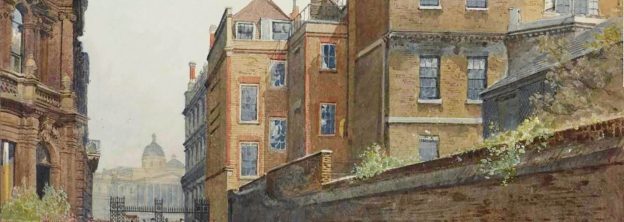
The back of the house is seen on the right in 1884, Over the garden wall, the additional storey and polygonal bay can be seen. The National Gallery can be seen across Trafalgar Square in the background.
Spring Gardens house remained the family’s primary London residence, the family alternating between here and Kings Weston seasonally, or when business or society dictated. Significant sums were invested on extensive renovations in the early 1750s. It’s not clear who the architect of these works would have been, but both the interior and exterior were modernised in fashionable taste; hipped roofs were done away with or hidden behind Palladian parapets; an additional storey was added to the garden front; a new polygonal bay in the same elevation became its focal point, its crown ornamented with a stone balustrade.
Another view of the garden front of Spring Gardens when the stone balustrade still topped the bay window. c.1880s.
Eventually, the street frontage of the house was bookended by more Georgian town houses, the only indication of its higher status being its set-back from the street. A rather unsightly high wall created some privacy from the pavement, whilst a long single-storey passage and pedimented entrance brought the front door directly to the street.
The northern, street frontage, of the house in 1886. The historic volume of the 1674 house is dwarfed by later Georgian development. A late-19th Century photograph recording the house before demolition. The front door was extended to the street from the original building line
With Edward Southwell III’s elevation to the House of Lords as Baron de Clifford in 1776, the house now lacked the social status appropriate to his station, but on his untimely death the year later he left it to his wife Sophia; she appears to have been the last of the family to live there. Their son, Edward, 21st Baron de Clifford, the last of the Southwell’s of Kings Weston, built himself a new London residence in Carlton House Terrace in 1827.
The old house survived, converted to offices for the Admiralty, but was finally erased in favour of new purpose-built Admiralty offices. Today, the site lies beneath the northern wing of Admiralty Arch spanning The Mall connecting Buckingham Palace with Trafalgar Square.
The rough location of Spring Gardens house on the modern layout of central London.
In July this year, we made a start on clearing laurel from an area at the foot of the steps down through Penpole Wood, close to the Point. This location is at the far eastern end of the Eighteenth Century pleasure walks through the woods, an important route long-neglected. Last month we returned to continue efforts to stem the tide of this invasive species.
a wide panorama looking up the slope from the Middle Path, before and after volunteer work.
We were a little depleted in numbers in October, but set ourselves clear targets of two areas either side of the path. The steep slope here proved challenging and sapped energy in requiring a steady footing and the transport of the cut material towards waste piles.
Cherry laurel is pushed back from assailing a beech tree along the Middle Path.
With just seven volunteers, we managed to achieve most of the task at hand. Unfortunately, by the time everyone’s energy had lapsed, we were left with a mess. Having managed at least to clear the path, it was down to the efforts of one of our volunteers to tidy everything into piles over the following weeks; a huge effort that we’re enormously grateful for.
Perched on the slope and looking westwards, with the Middle Path leading into the distance.
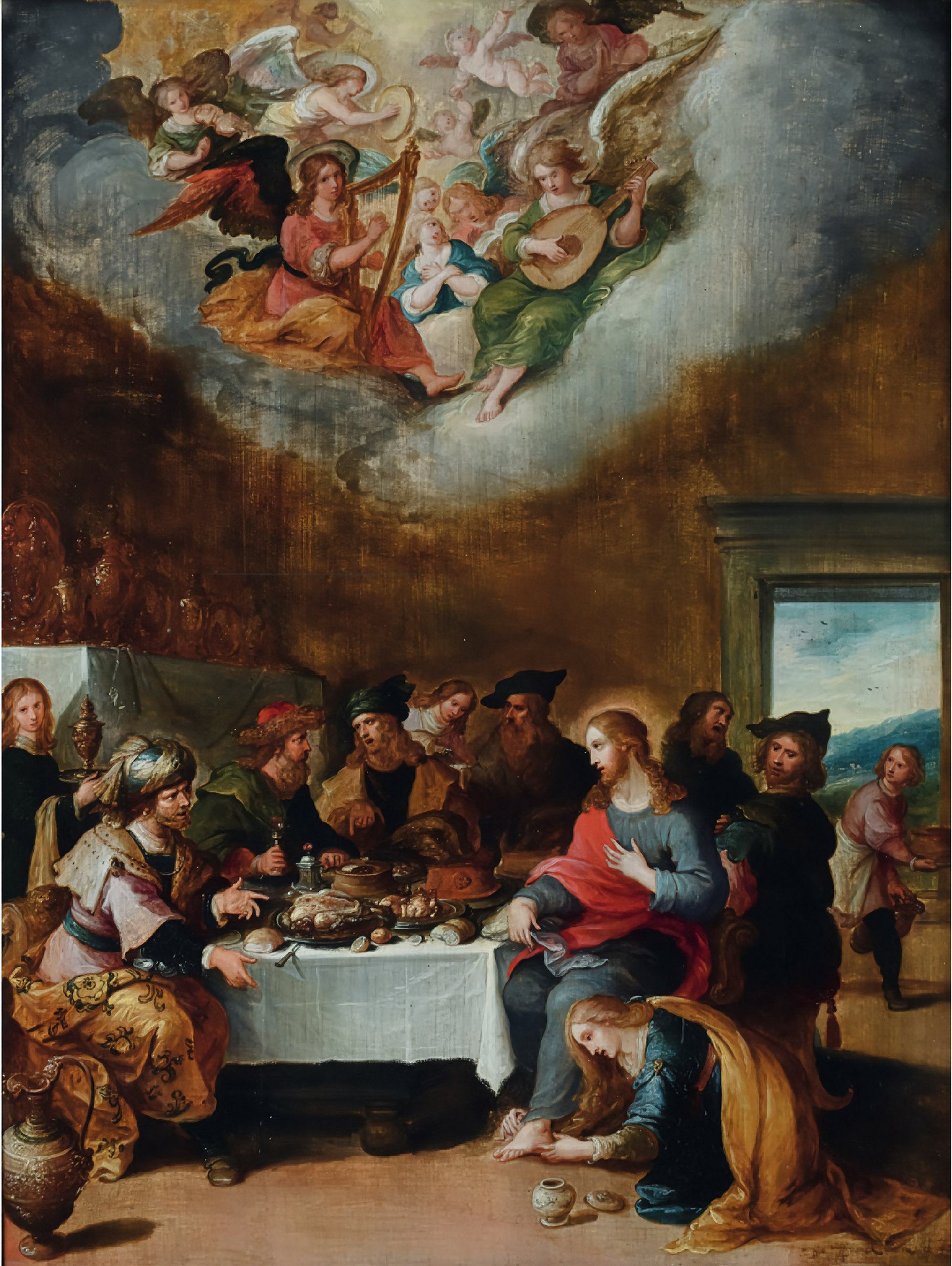
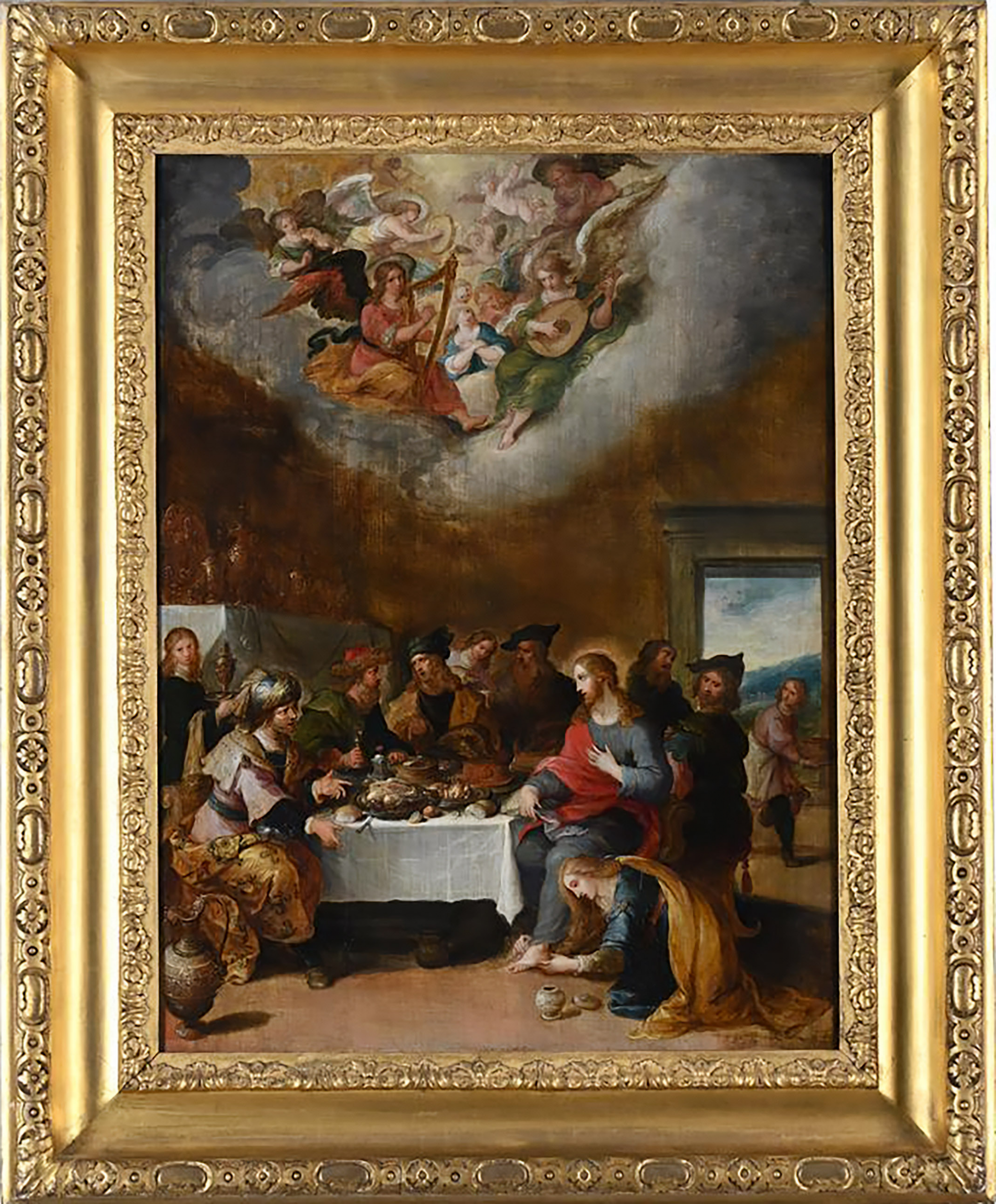
An old master oil painting, once the collections of the Southwell family of Kings Weston house, has recently been advertised for auction. We note, with disappointment, that it has recently been released from the large collection of historic Kings Weston paintings held in trust by the descendants of the Southwell’s, later Barons de Clifford.
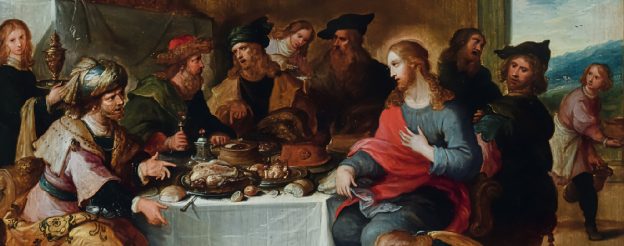
Christ in the House of Simon the Pharisee, one of the Old Master paintings once given pride of place in Lady de Clifford’s private chambers.
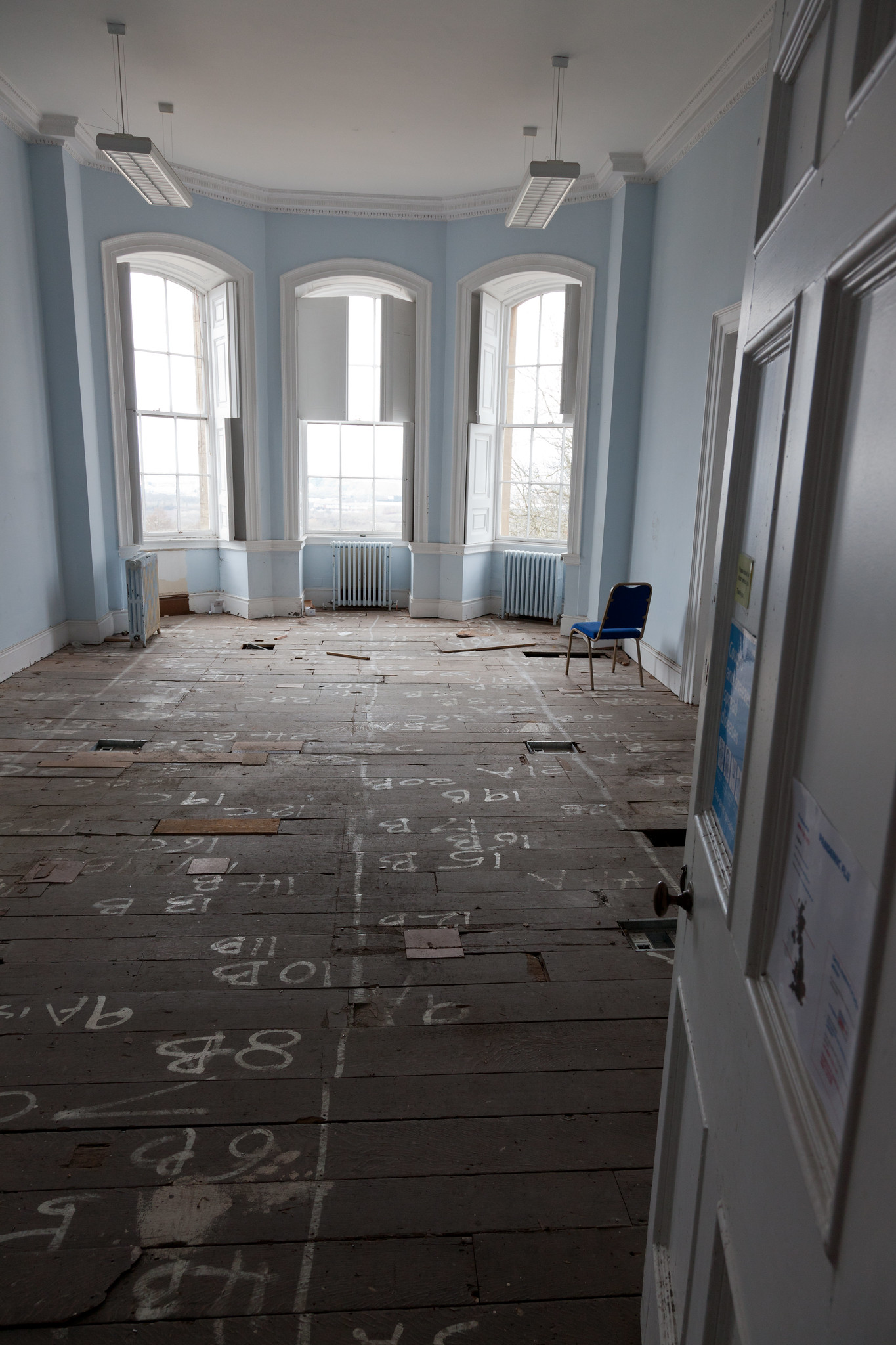
Formerly Lady de Clifford’s Dressing Room, this “long and lofty” space once had “no equal in the Kingdom” and was hung with paintings “the subjects in general are small, but they are of the first excellence” . Seen during work in 2014.
The painting, Christ in the House of Simon the Pharisee, is first recorded hanging in Lady de Clifford’s dressing room decorated in blue silk damask. This room is now the first floor room with the bay window overlooking the Severn. Here it accompanied some of the best of the family’s collection of paintings, the most intimate, and intended only for view by them or their most special guests. On the surrounding walls were works by Claude Lorrain, Nicolas Poussin, Annibale Carracci, Pietro da Cortona, and four paintings by Canaletto.
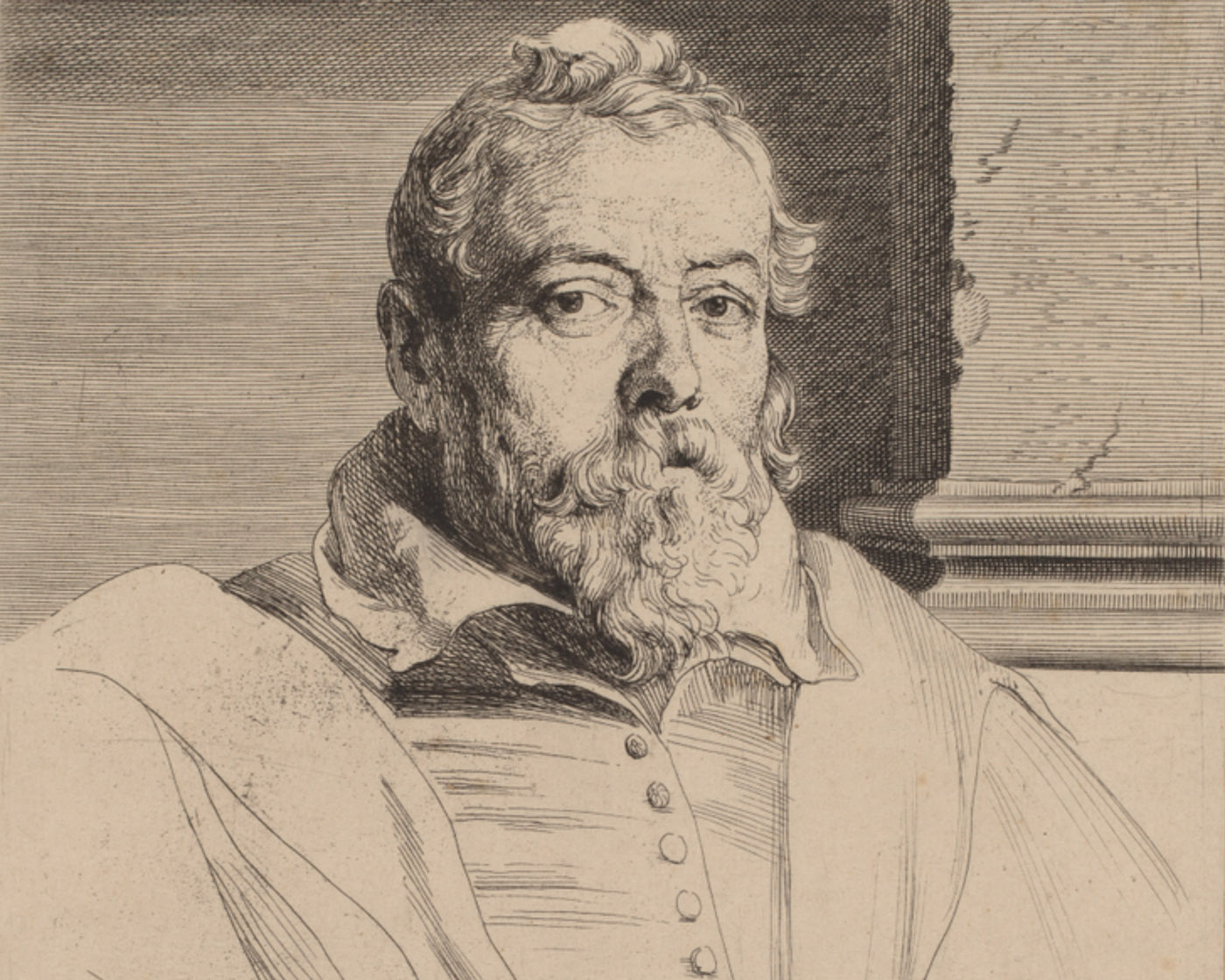
An inventory of the contents of the house in 1777 describes the painting as “The washing of our saviour’s feet” and the artist as “Old Frank”. This attribution has now been revised and is now considered to be by his son, Frans Francken the younger (1581-1642). The 18th-century attribution to Francken the Elder likely stems from the signature “D.o. ffranck,” where “D.o.” stands for the Flemish de oude, meaning “the Elder.” However, this signature was actually used by Frans Francken the Younger from the late 1620s. Prior to the death of his father in 1616, he had signed his works as “the young Frans Francken.”
Engraving of the artist Frans Francken the Younger ( 1581-1642) by Van Dyke.
Whilst the auctioneer suggests that it come to Kings Weston courtesy of the second Edward Southwell (1705-1755), it’s more likely to have been during one of Sir Robert Southwell’s journeys across the Low Countries that it was purchased or perhaps his son, Edward’s travels in 1697; it’s not included in an inventory of pictures at Kings Weston from 1695, so perhaps the latter is more probable.
The framed painting shortly to be sold
The painting remained at Kings Weston until the last of the direct line of the Southwell Family, The 21st Baron de Clifford, died in 1832. With no direct heir, he willed that the contents of the house be sold in its entirety. The painting, by this time described as Mary Magdalen washing the feet of Christ and attributed to Old Franks, sold for £10 10 shillings, as much as a painting by the more famous Poussin. As was common, it’s likely that a family member bought back a number of paintings, perhaps one of the nieces who were the ultimate beneficiaries of the sale.
We last saw the painting just outside Taunton where the family trust stored much of the collection of paintings. The circumstances and reason for it leaving such an important private collection are unknown, but we’ll endeavour to find out. If anyone were interested in returning it to Kings Weston, it will be sold via Dreweatts auction house on November 4th and the current estimate is £20-30,000!