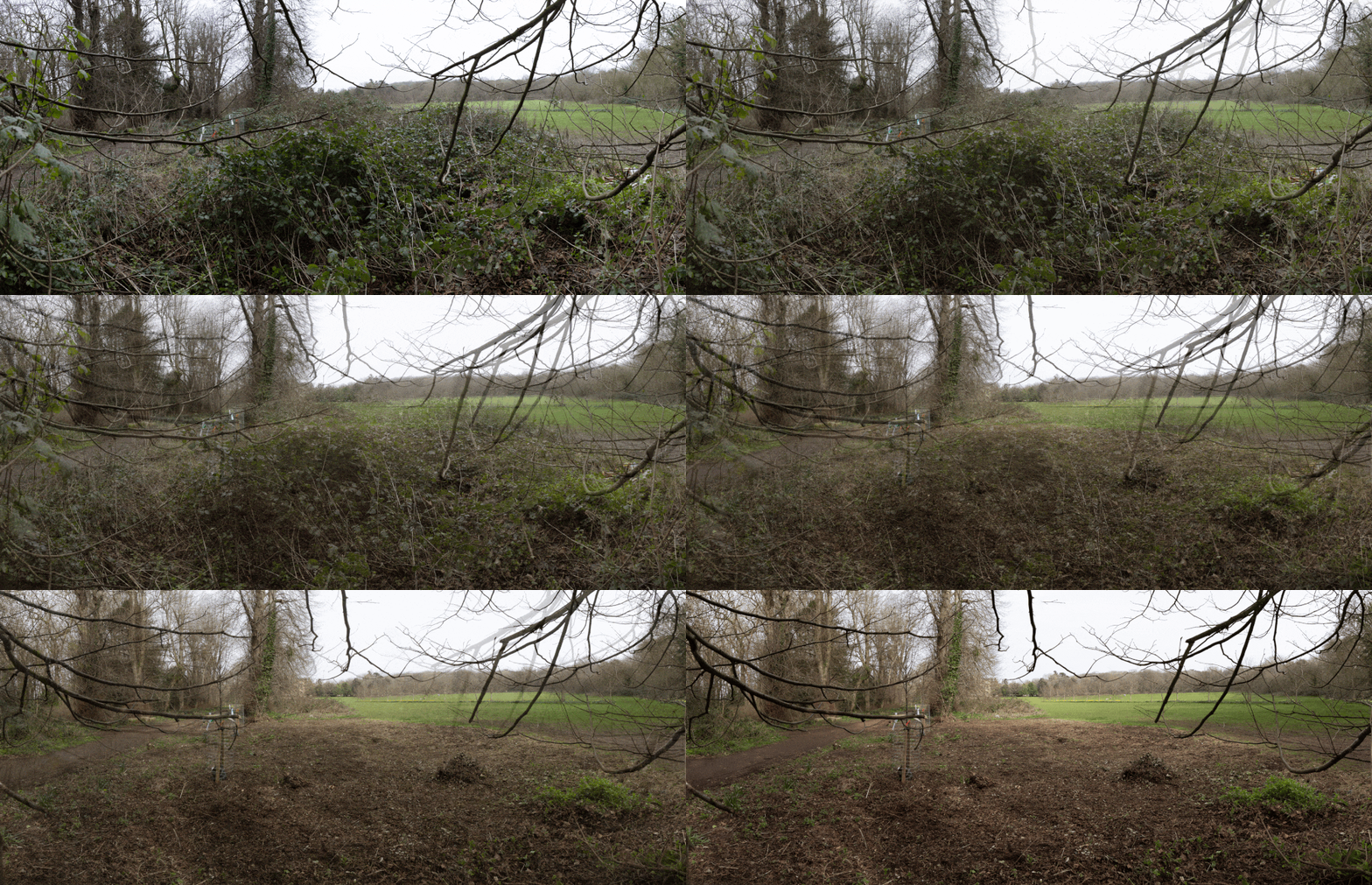
In retrospect, perhaps February’s working party was a bit of a challenging job. We hoped to root out a large patch of brambles, the first along the ancient avenue of lime trees leading towards the house. Through a combination of limited resources and tools that were less than ideal, we struggled to meet the target we’d set for ourselves. The poor ground conditions, clinging wet mud, and rain hardly helped matters.
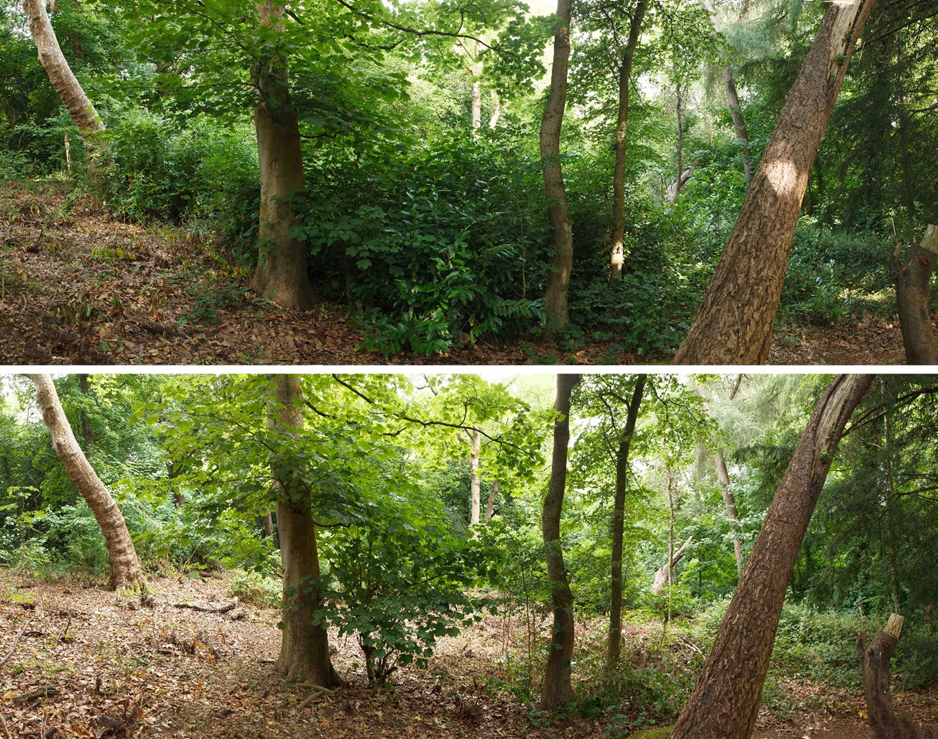
Animated image showing the scene before and after work. The drive down the lime avenue is on the left.
We did manage to complete a significant part of the work on the day, but had to admit defeat when the rain began in earnest later on. Fortunately, a few volunteers were able to donate more of their time a couple of weeks later to complete the job.
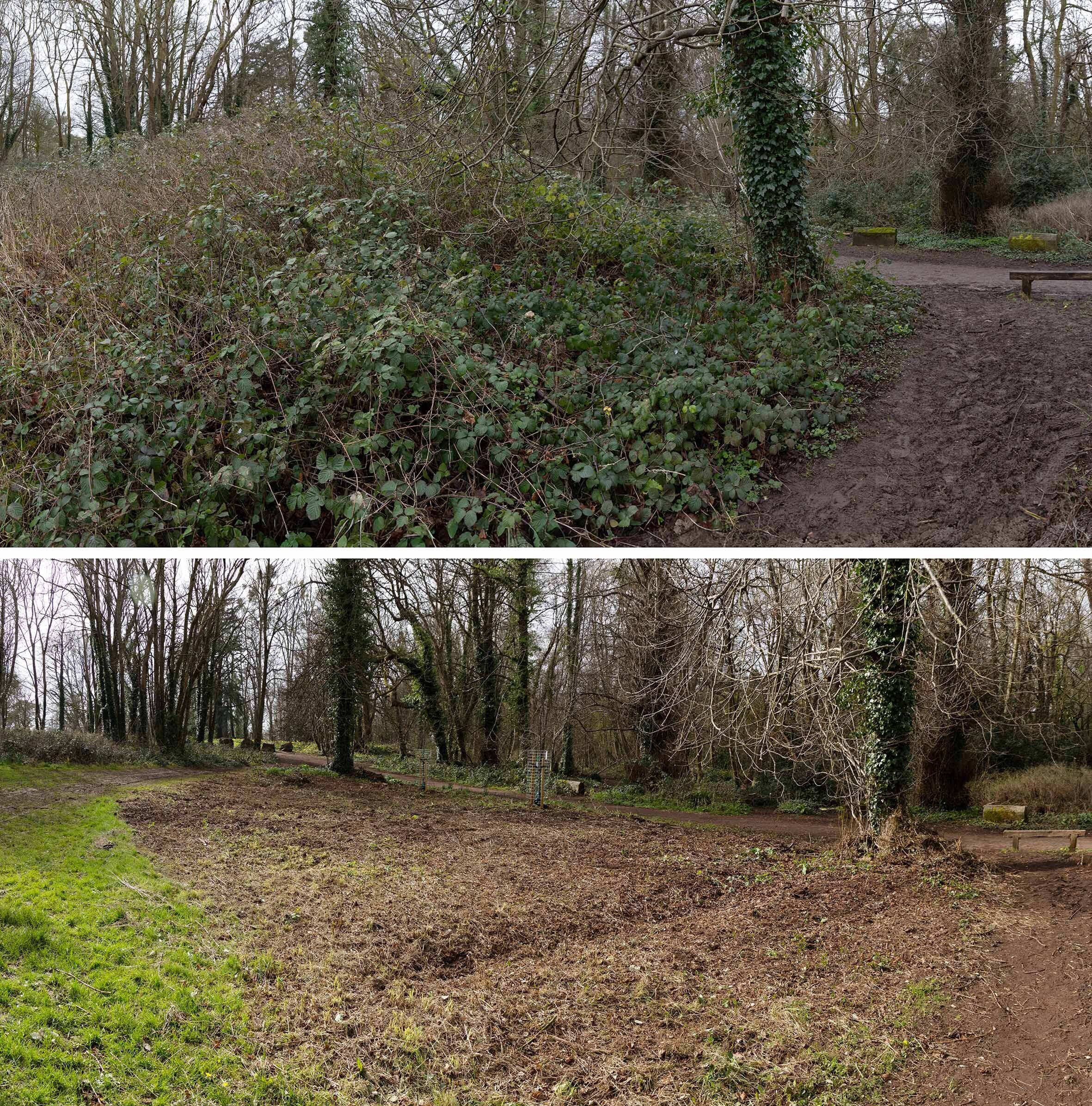
Now the two recently replanted trees on the avenue are better revealed, and there’s a definite improvement in the open character between the main drive and the open lawns leading to the house. It’s our hope that, having taken the brambles out by the root, we’ll have a much better chance of them not returning with such vigour this year.
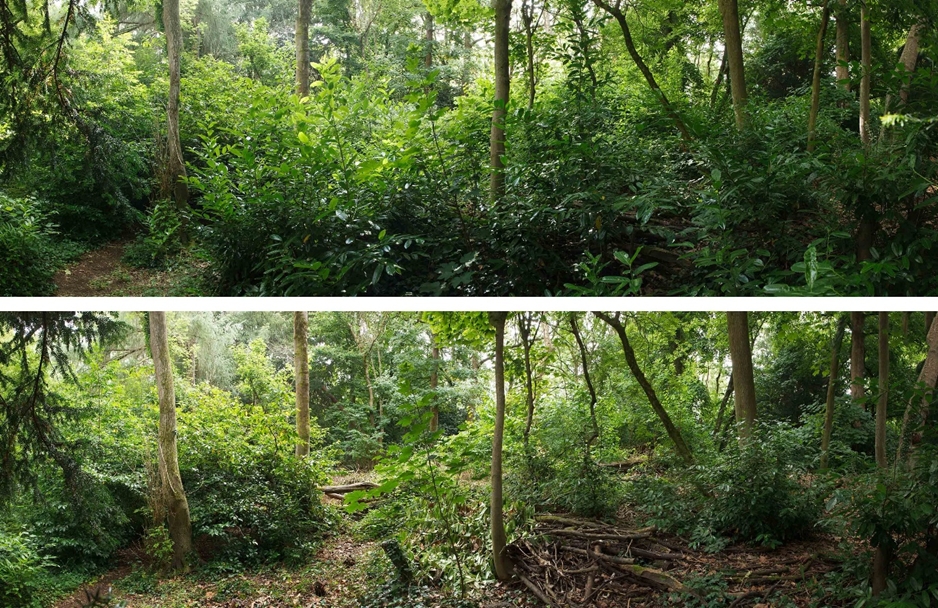
Before and after work on the brambles looking from the lawn back towards the drive and the Circle beyond it.
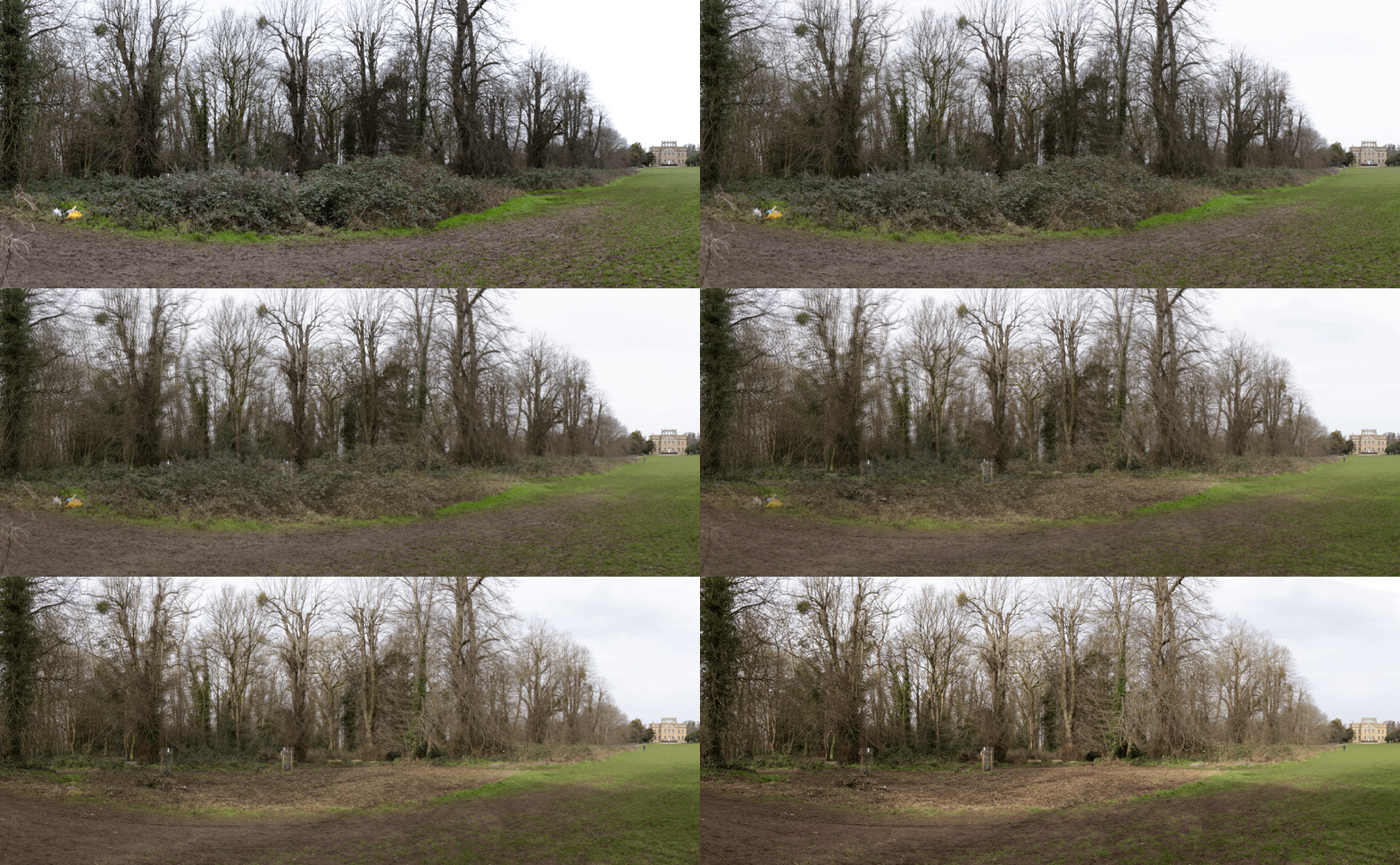
Whilst this will stem the encroachment of only a small part of the avenue, we’ll be unable to continue this work during bird nesting season. This will also give us time to rethink how we approach the job.
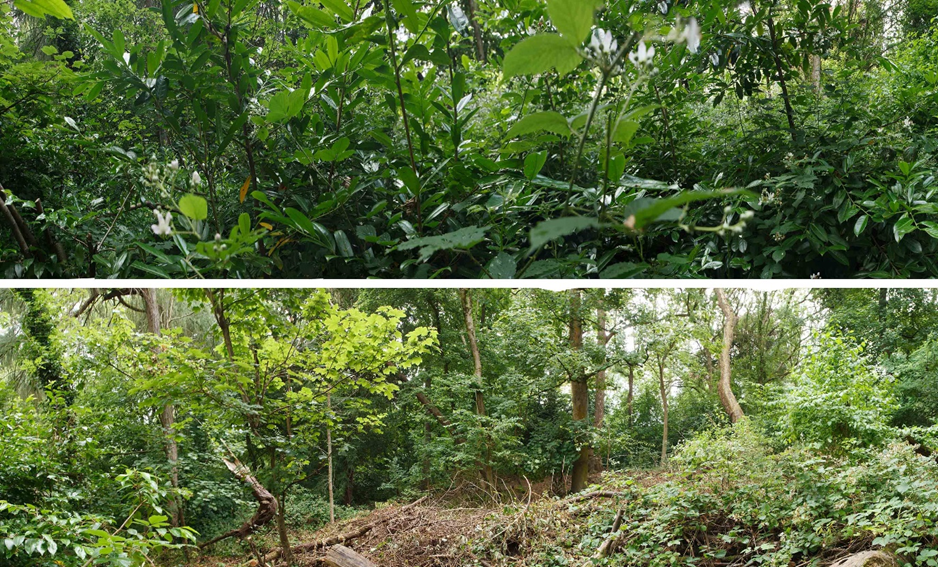
Animated image showing the work on the lime avenue looking towards Kings Weston house on the right.
December might not be the favoured time of year to be splashing about in ponds, but that’s just what we did at the tail end of last year. Our plan was to continue work that the Council had begun with a mini-digger, but by hand. It hadn’t been possible for the digger to reach into the middle of the pond and so the Council turned to our volunteers for help.
The two ponds are concrete-lined and probably date to the 1960s or 70s. The lower pond, the larger of the two, had to be emptied of water so people could get in to do the dirty work of shovelling-out mud and hauling branches away. In the event it worked out easy to scoop the water up into the top pond, from where it would need to be transferred back afterwards.
There was a great turnout for the event with some new faces, so a big thank you to everyone for making this such quick work. The lower pond was certainly an easy job and was finished in a brief space of time. The debris was carried away as far as possible, continuing piles already set up by the Council workers.
The top pond, however, was more of a challenge. Once most of the water had been thrown back to fill the lower pond, there was a dirty sloppy silty mess that was more challenging to scoop out. With most of it poured into buckets and taken away we called it a day at about 1pm, a job well done.
The next phase in the restoration of these ponds as natural habitat will be the erection of a small fence to prevent dogs disturbing the wildlife and discourage rubbish being thrown in again.
We focussed on a key spot in Penpole Wood in November 2025, one where the middle path had become heavily overgrown with cherry laurel. The steep hillside along the north edge of the woods results in cherry laurel growing lanky and drooping in much the same direction. The thin soils here see the overgrown shrubs pull out by their roots and fall downhill, often continuing to grow when they have.
Before and after work along the Middle Path in November, looking eastwards.
The spot we started work on in November had all of these issues and had resulted in low-growing laurels threatening to block the route completely. Our volunteers worked hard in slippery conditions on steep inclines to cut and fell the laurel, using fallen boughs to line the lower edge of the path and reduce erosion; here, it had been undermined by roots pulling-out the ground where trees have fallen downhill.
The results have been transformative, and have ensured the area is safer and more accessible for a few years yet. A surprising change resulted from relatively few volunteer hours, and the results speak for themselves we hope.
en transformative, and have ensured the area is safer and more accessible for a few years yet. A surprising change resulted from relatively few volunteer hours, and the results speak for themselves we hope.
A view opens up along the path looking towards Penpole Point.
In July this year, we made a start on clearing laurel from an area at the foot of the steps down through Penpole Wood, close to the Point. This location is at the far eastern end of the Eighteenth Century pleasure walks through the woods, an important route long-neglected. Last month we returned to continue efforts to stem the tide of this invasive species.
a wide panorama looking up the slope from the Middle Path, before and after volunteer work.
We were a little depleted in numbers in October, but set ourselves clear targets of two areas either side of the path. The steep slope here proved challenging and sapped energy in requiring a steady footing and the transport of the cut material towards waste piles.
Cherry laurel is pushed back from assailing a beech tree along the Middle Path.
With just seven volunteers, we managed to achieve most of the task at hand. Unfortunately, by the time everyone’s energy had lapsed, we were left with a mess. Having managed at least to clear the path, it was down to the efforts of one of our volunteers to tidy everything into piles over the following weeks; a huge effort that we’re enormously grateful for.
Perched on the slope and looking westwards, with the Middle Path leading into the distance.
It was one of the hottest days of the year when we met in July for volunteer work in Penpole Woods. Not only was it hot, but the chosen location was distant from all of the usual meeting points. The area, deep in Penpole Wood, was at the bottom of the steps we rebuilt about ten years ago. Until last month they deposited the visitor into a thicket of cherry laurel.
Animated transition showing the view from the bottom of the Penpole Wood steps.
Already, someone had been trying to keep the paths there open, taking out branches overhanging the path, but our ambitions were somewhat greater. Considering the forecast, we had a good turnout, and thank you to all our regulars who made it. We started with the knowledge we’d cut things short to avoid the worst of the heat, but the shady area on the north-facing slope gave us some respite from the worst of it.
The impact of work turned out to be more incredible than expected. A relatively dense cherry laurel gave way quickly, revealing a number of handsome mature trees that hadn’t really been noticeable at the start of work; If we’d have spotted them earlier, we might have been a bit more careful over the location of spoil piles and their visibility.
Animated transition showing the view eastwards along the middle path.
By the end of the day, the section of the middle path we worked on was unrecognisable. Now, coming off the end of the steps, the scene opens out into a light clearing with a backdrop of fine trees. The route up from Lawrence Weston has been cleared of a lot of obstacles and joins the middle path at a junction at the stone steps. Hopefully the path remains traceable through the stone rubble.
We had planned to return here this month to continue work, but an urgent matter has cropped up at the Lilypond. September will be Heritage Open Day, and October is usually the Big Bulb Plant, so continuing the work may take longer than planned.
Looking west along the middle path before and after work clearing cherry laurelThe three stone steps between the middle path and main steps appear from beneath the cherry laurel.
Worked carried on into July to clear the regrown cherry laurel in Penpole Wood. Most visitors will see little change from the recent work much is hidden well back from the main path through the woods. However, the impact of cherry laurel on the native woodland is severe if it’s let get out hand.
looking west through the wood before and after the re-trimming of the cherry laurel.
Since we cleared the area in 2016 there has been a lot of regrowth, particularly on the harder to reach area along the top of the former quarry. Because the laurel has historically stunted tree growth in the area an opening had developed in the tree canopy and Brambles had begun to colonise the area aided by the catenary of laurel stems; in short, the area was in a big mess again.
the view east through the working party area.
A relatively small group of volunteers, a usual state of affairs for the holiday season, set about putting things in order and extending the areas cleared in the last few months. Cherry laurel has been felled again, untangled from the brambles and stacked out of the way. More of the saplings planted in 2016 have also been revealed again in thriving condition. Whilst there remain some laurel bushes to the periphery of the area, ones we had neither time nor energy to tackle on a hot day, there’s not enough to occupy a full working party. These will be left for the moment while we focus on new areas.
looking up slope from the edge of the old quarry and towards the main Penpole Wood path.
The issues of invasive cherry laurel are well known; outcompeting native species, leaching toxins into the soil, and contributing to soil erosion, are just three reasons that many hundreds of hours of volunteer work have been devoted to its removal. Whilst it was once maintained as a decorative landscaping plant, it’s now run wild and is having a seriously detrimental impact on the woodland and the soil.
the cherry laurel regrowth long the mid-18th Century pleasure walk
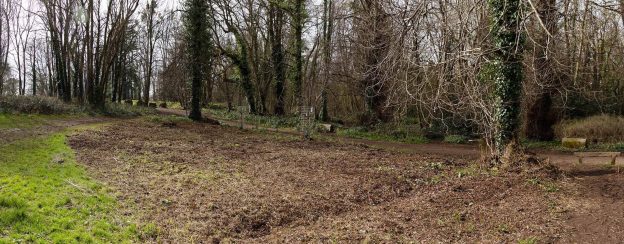
The last two working parties this year returned to the area on the north-east side of the Echo path, sections of the estate we originally felled laurel in around nine years ago. Whilst much was poisoned by the Council in the wake of our work, the areas closer to Kings Weston house weren’t treated and have more quickly regrown. This was the target of March’s working party.
With a good team of volunteers, we carried on the surgical removal of the laurel whilst leaving the native species that have begun to recolonise the area. Starting from the twin ponds, work progressed downhill throughout the day though, sadly, we didn’t manage to clear as far as the boundary with the house; this was left for a few volunteers to clear away later.
The area behind the two ponds before and after volunteer work. Many native bulbs were planted here in the autumn of 2014, many of which had been hidden.
In the process of opening the area back up many of the saplings and native bulbs planted in the area have been revealed. In February we found the snowdrops lost beneath the laurel growth, and last month the bluebells and miniature daffodils were rediscovered, now better able to reach the sun! Eventually, when the laurel toxins have eventually leached out of the soil and the forest floor has matured further, it will ensure that rainwater run-off from the slope will be more effectively captured.
the view from the pleasure walk along the garden edge looking towards the main Echo path and the lawns beyond.
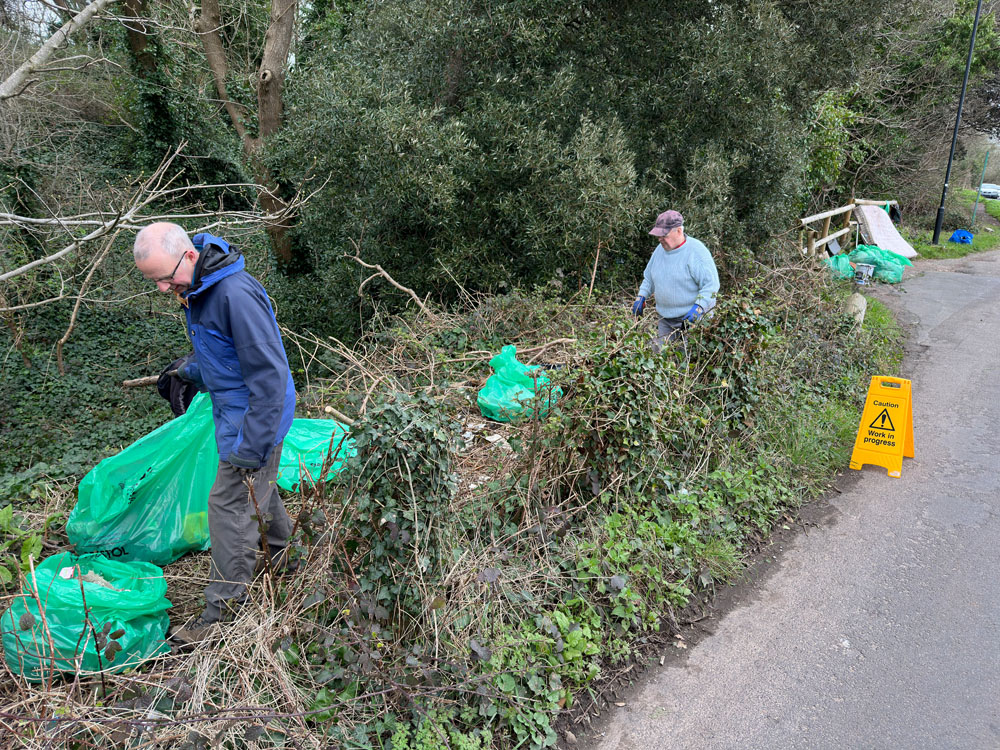
While the other volunteers work away in the woods a couple deal with the verge.
KWAG hasn’t often got involved in litter collection across the estate as we know there are locals and walkers who often do this, and the Probation service continue to carry out community service collections. However, one area has been a persistent pain: the layby on Penpole Lane. This regularly gets fly-tipped and the Council have recently erected a timber fence to try and inhibit illegal dumping. This, unfortunately, hasn’t worked, and one of last month’s working party aims was to clear the old quarry areas of rubbish.
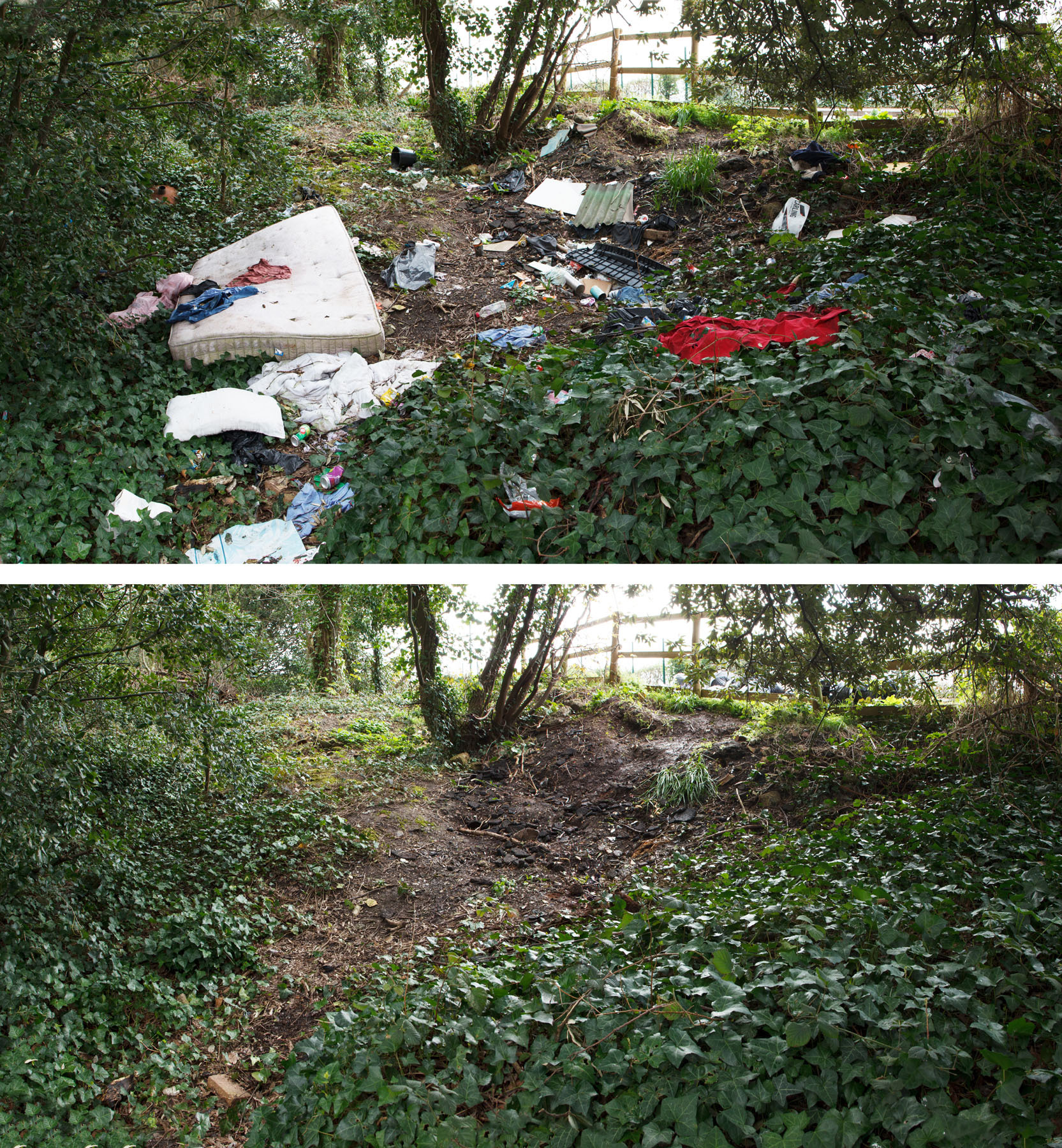
The flytipped area before and after work.
We found it in a poor state, with binbags, and loose waste strewn about as well as the ubiquitous used mattress! We had a great turnout for the event, so good that it only took just a couple of hours to bag-up everything and leave it for collection in the layby. Unfortunately, just a fortnight later, more flytipping had been dumped in the same area. This has also been cleared away and we aim to keep monitoring the area.
Thank you to everyone who came out to and contributed to one of our best ever attended sessions, especially the new faces who came to join working party efforts.
…and some tree trimming
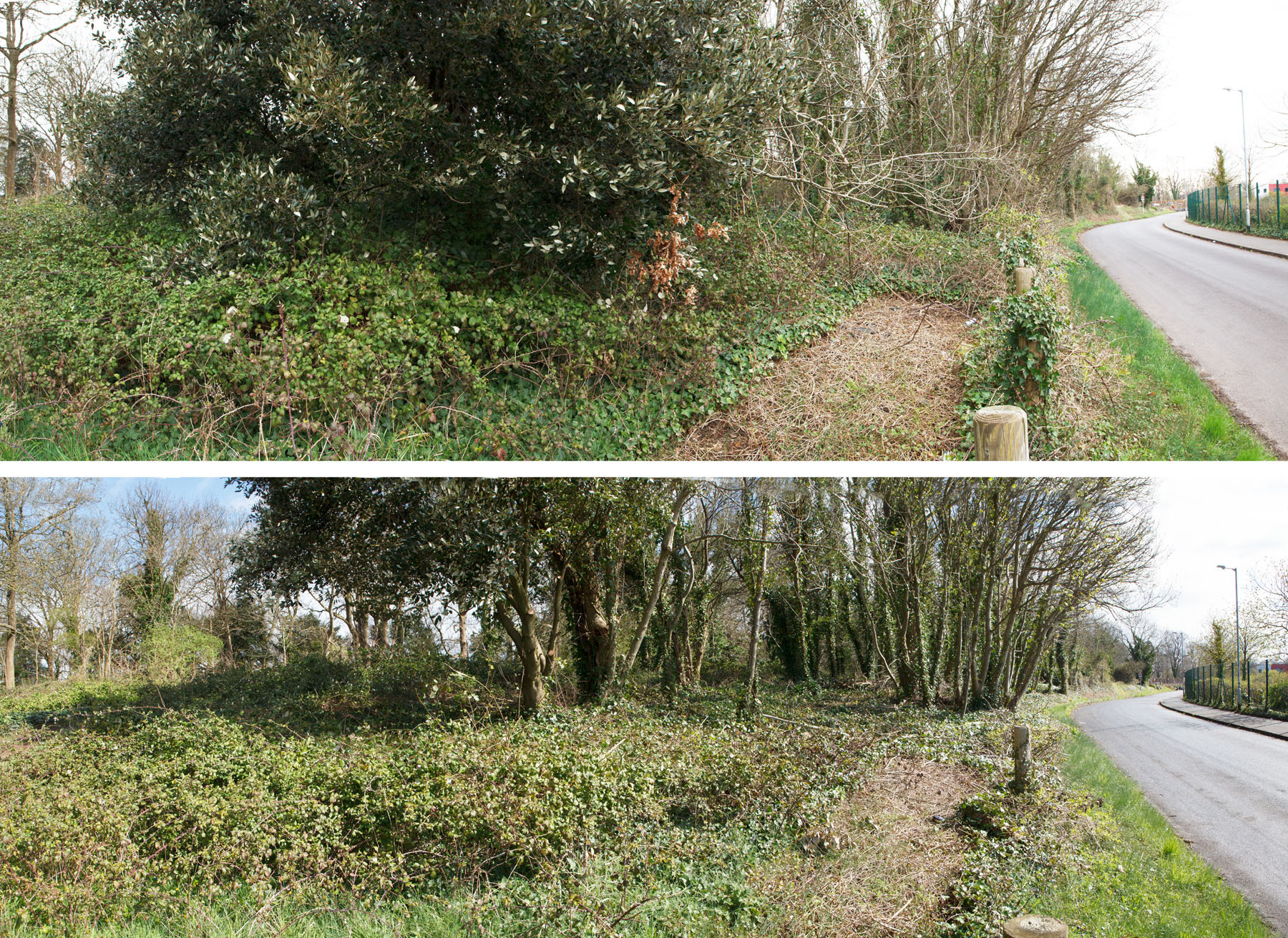
The second target for volunteers on our Working Party was a scrubby area alongside Penpole Lane, not far from the litter collection. Since the 1960s this area, once grassland, had been colonised by ash and sycamore. Most is in a poor condition, being multi-stemmed, damaged by cutting in the early years of their growth. Having persevered through many probable attempts to keep on top of them they have grown into a thicket along the roadside.
Looking south along Penpole lane showing the impact of recent work.
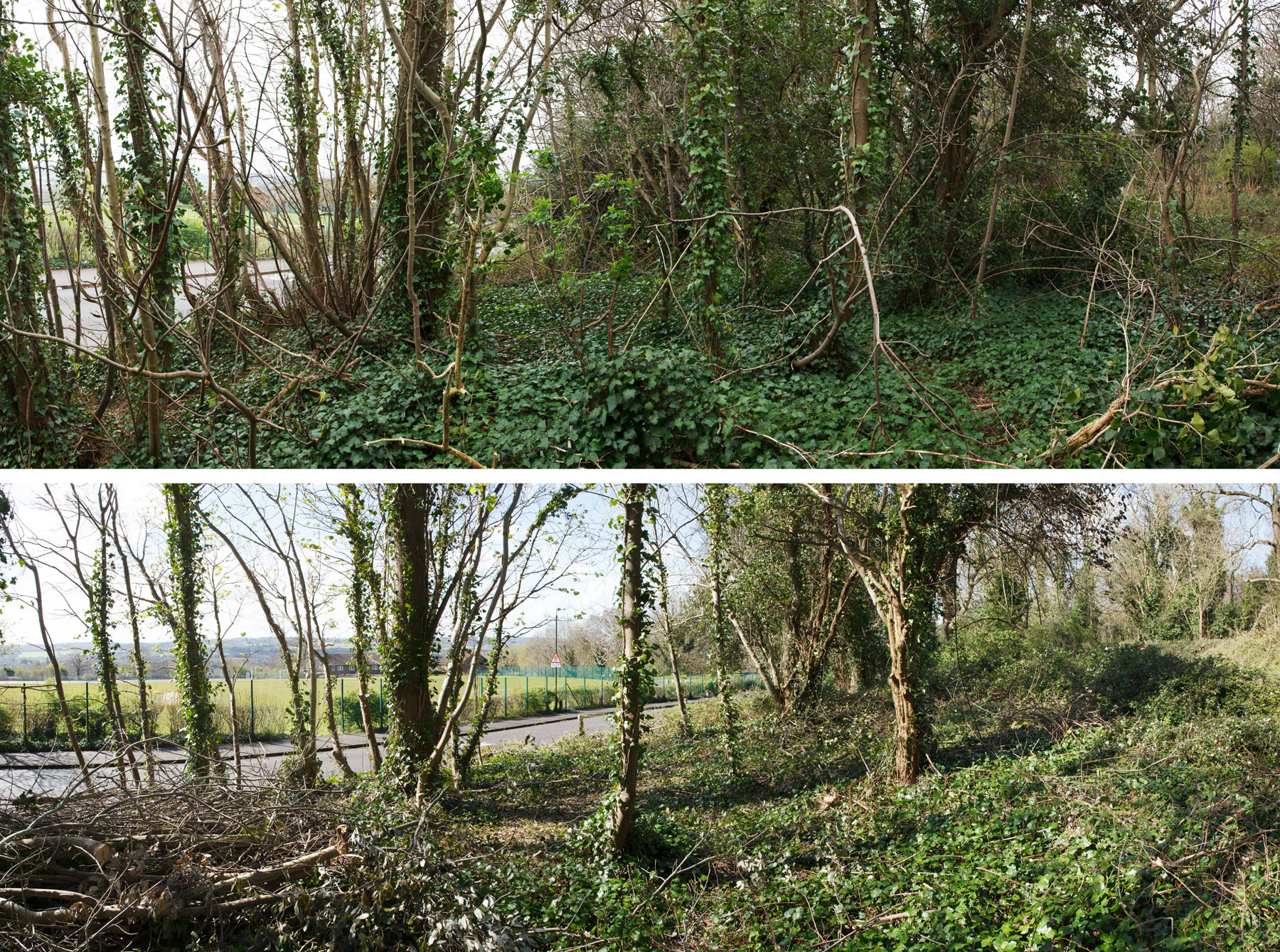
Our plans were to undertake “natural spacing” or “haloing” to thin out this area, cutting out the weedier and less healthy saplings to allow the better specimens to thrive. This has the secondary advantage of opening up glimpsed views from the main path along Penpole Point to the hills of Somerset to the west. From an historical perspective, these were once greatly admired by visitors to the estate.
Working carefully, warry of bird nesting season, we threaded through the copse gradually felling small saplings and raising the crown to allow sunlight in. Whilst the impact of the work might not be immediately obvious, it has helped open the area up and should prevent the further encroachment of scrub onto the remaining meadowland.
Looking across the area from the path to Penpole Point.
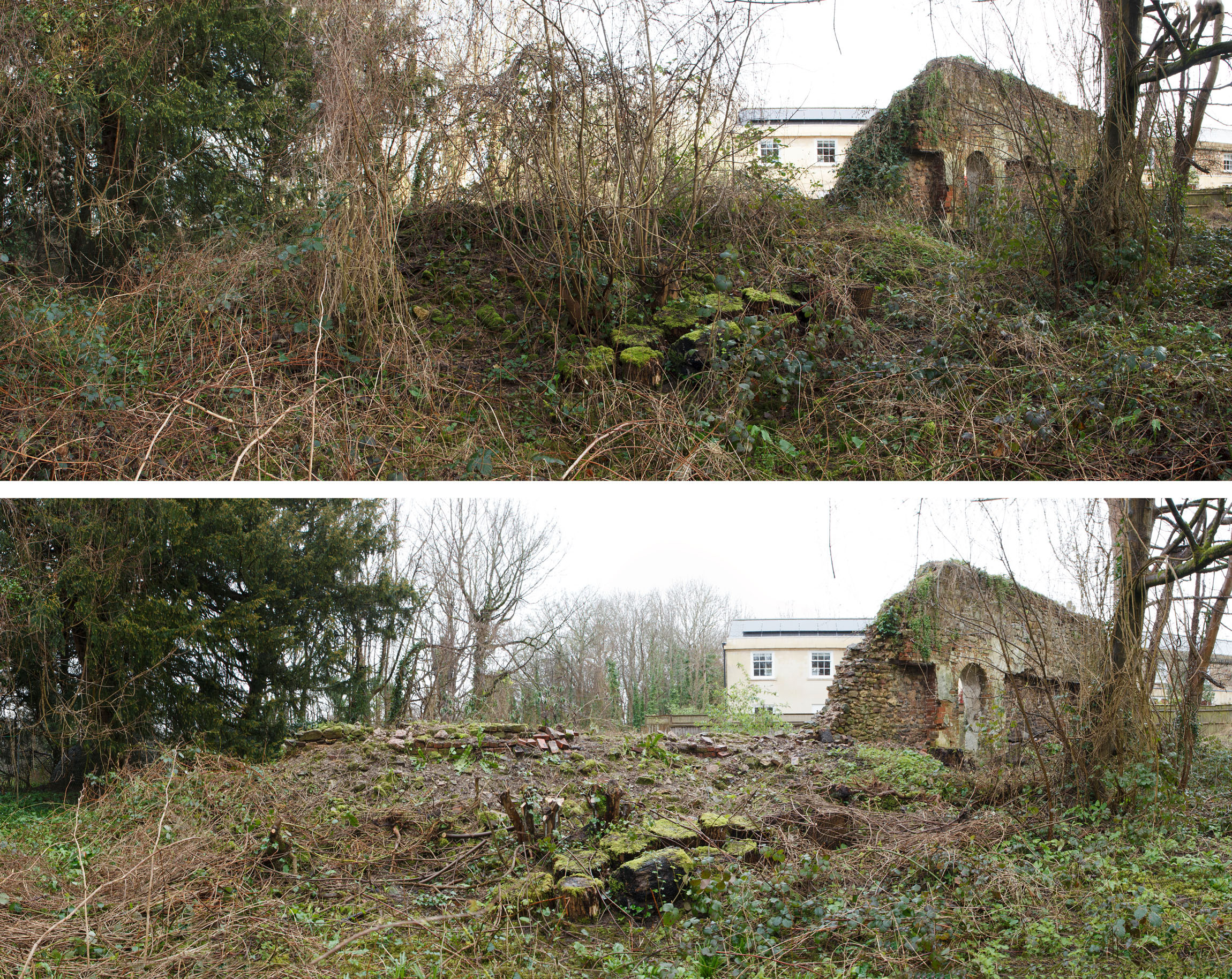
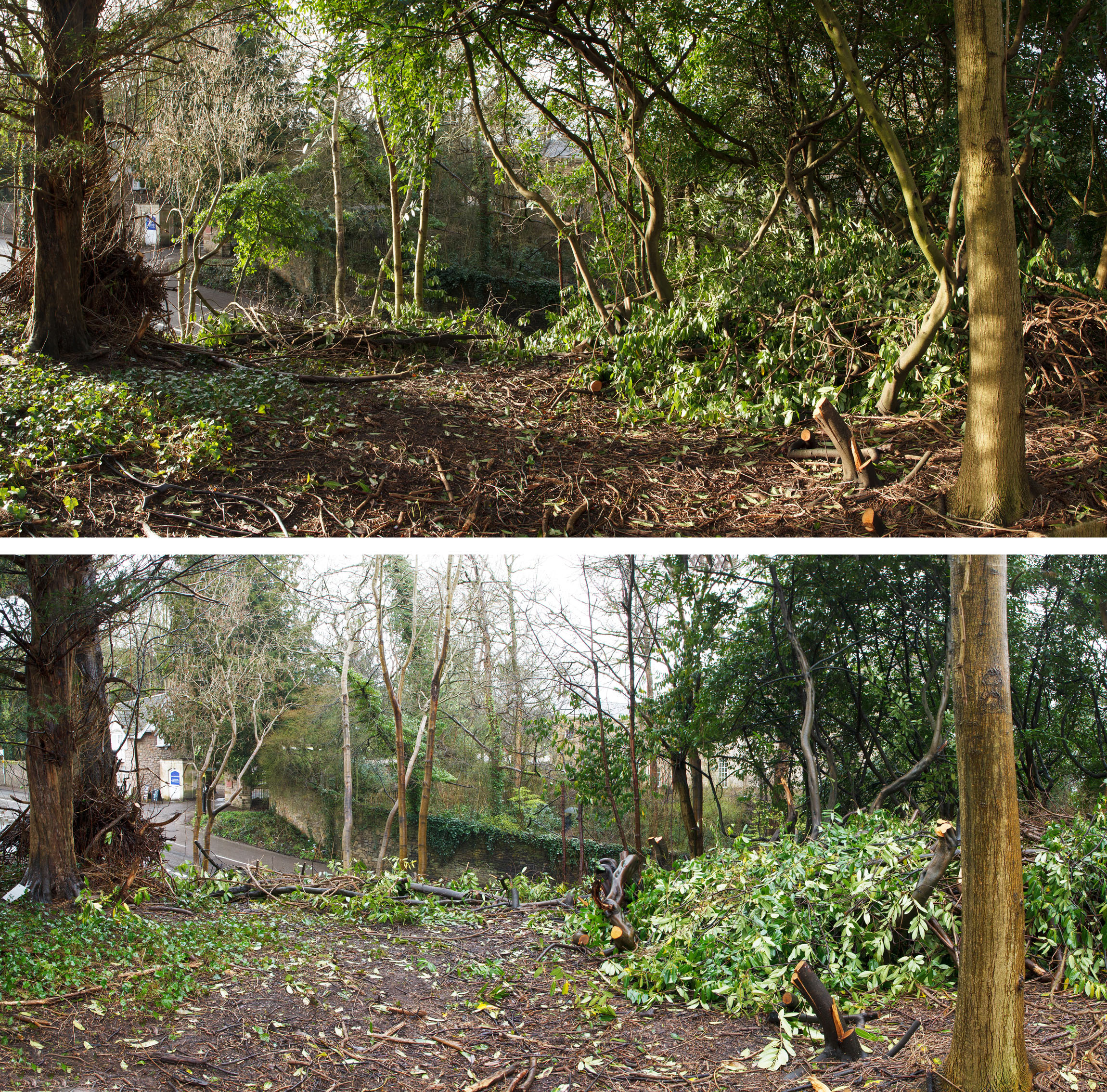
Volunteers concluded work on the old View Garden in February, with a final tidying-up of the laurels and woodland, and a focus on preparation for wildflower meadow planting. We undertook natural spacing with the woodland area, selecting the most viable saplings and shoots of trees and clearing around them to allow them to thrive in the future. This woodland management technique is the same as we started with the Forestry Commission in Penpole Wood in about 2015 and should ensure strong growth and positive regeneration of the woodland floor. We hope that this area, the glasshouse wall and verge, is back as it was when we last passed through in 2016.
incredible to think that it’s just been seven years since the glasshouse wall was last cleared by KWAG volunteers.
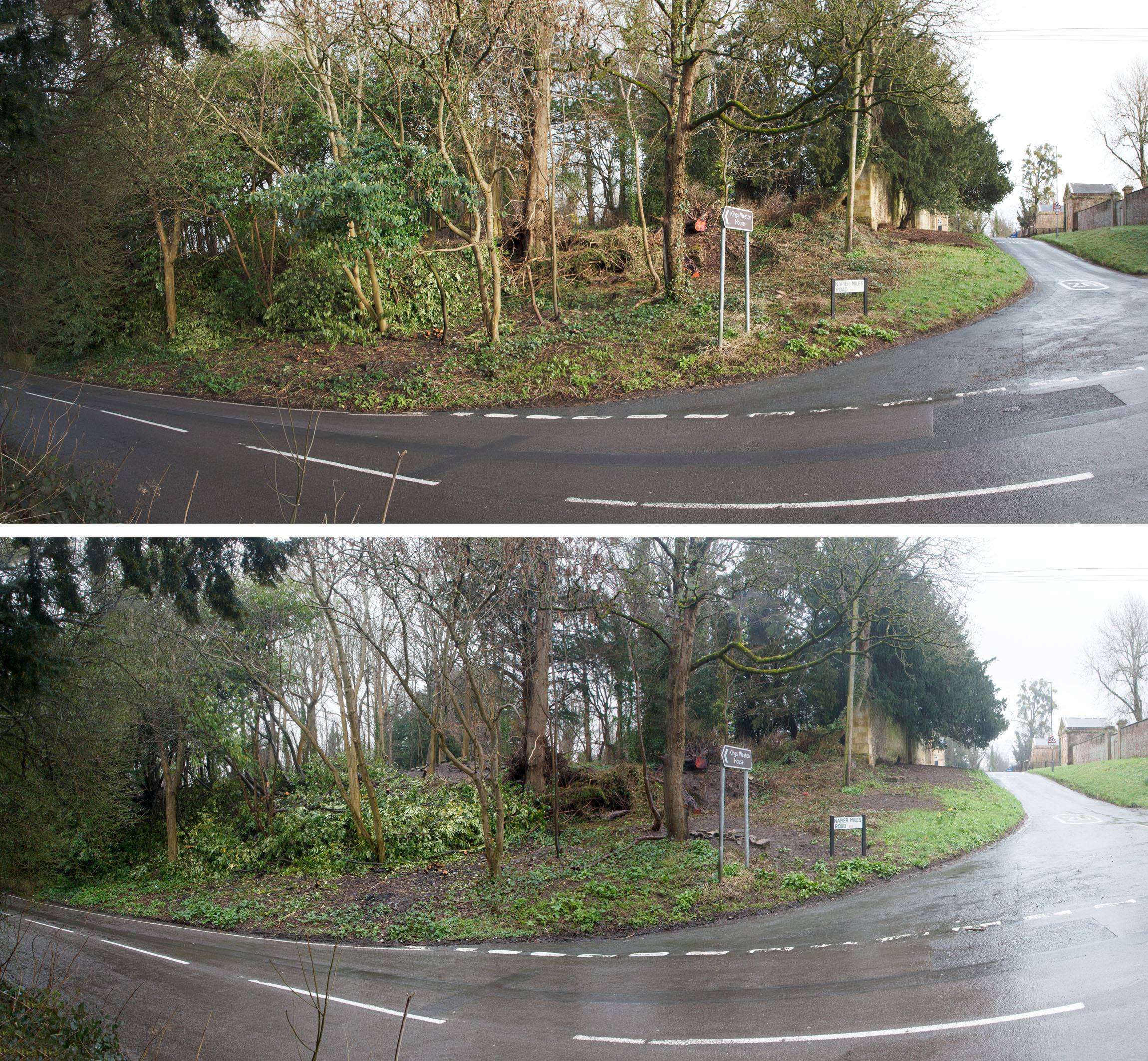
A few stray laurels were felled to complete work at the corner of Kings Weston Lane and Napier Miles Road, whilst around half of the volunteers took to digging out the roots of brambles long the verges. This will be critical in ensuring that the wildflower seeding planned for the end of this month has the best chance of thriving. We’re grateful to our regular volunteer Mike, who has undertaken to return week after week to get on top of the job and organised the specification and funding for the seeding project.
A couple more cherry laurels are cleared back from the edgeThe view from Kings Weston Lane showing the removal of laurels and the preparation work along Napier Miles Road, for the sowing of meadow seed.