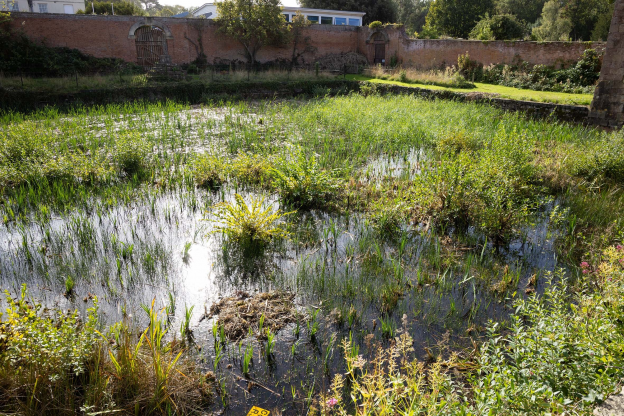
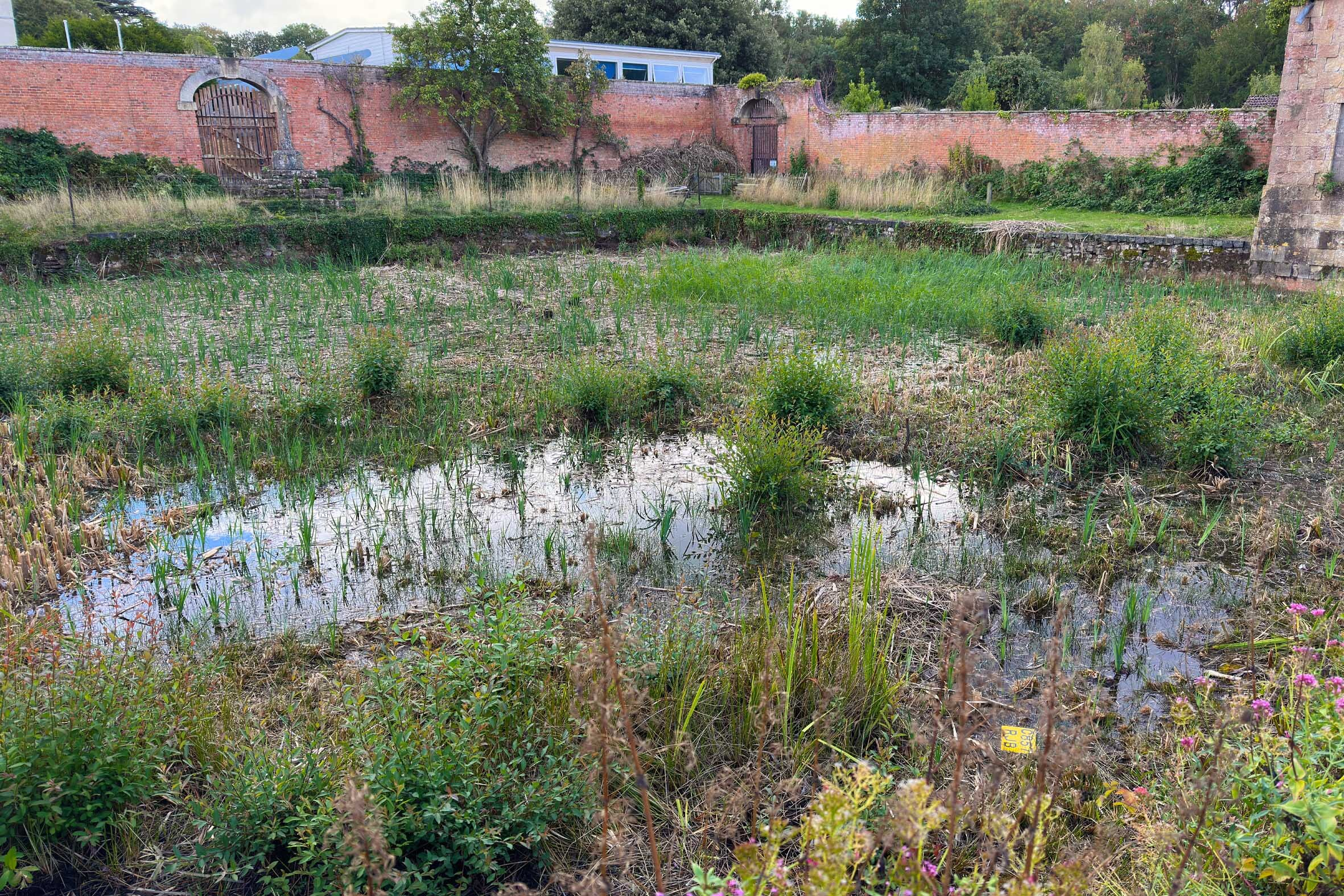
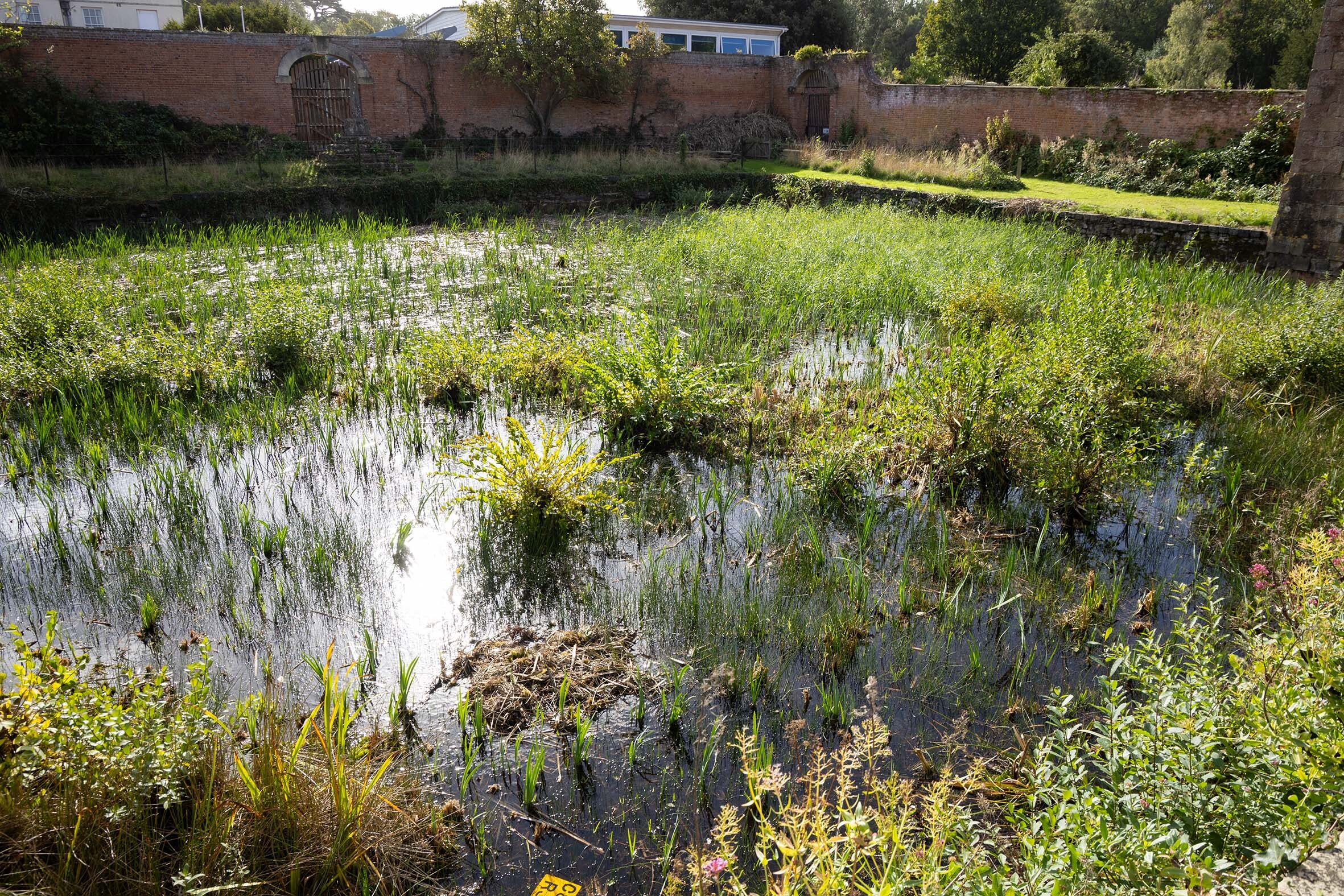
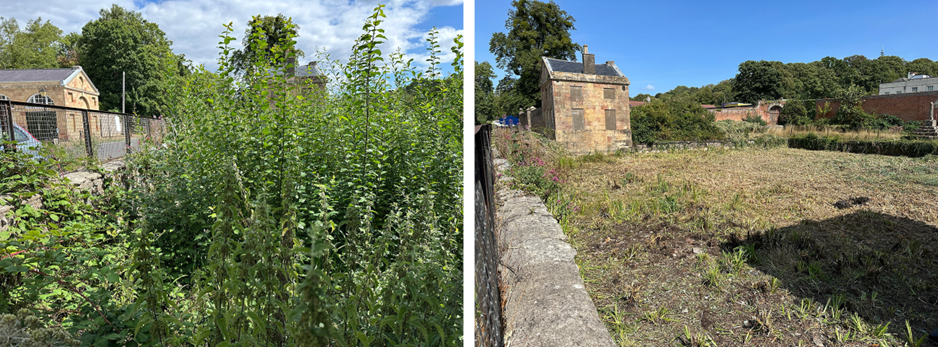
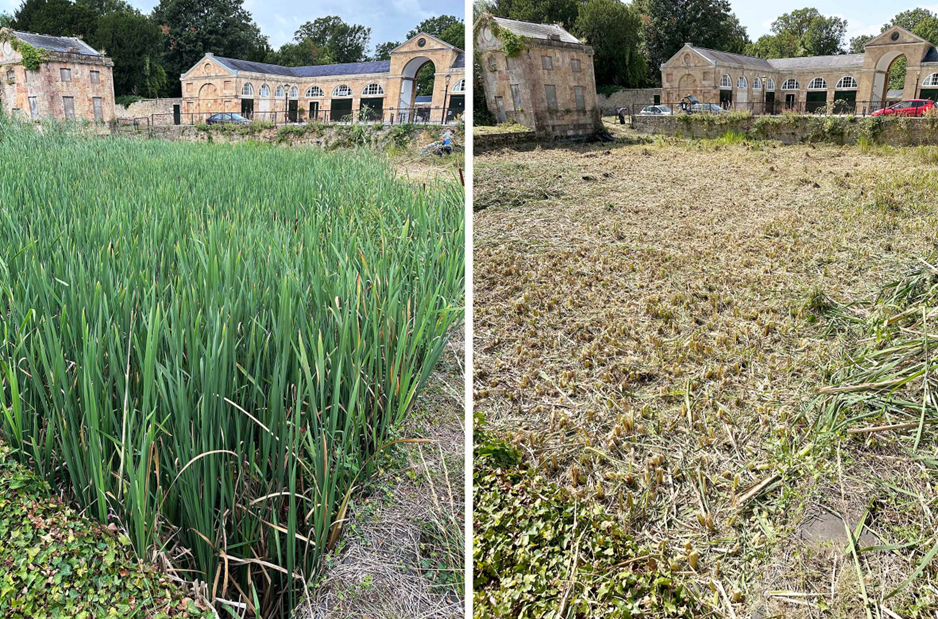
About a week after volunteer work at the lily pond in August, the heavens opened for days on end and helpfully began to complement our work on restoration. By the start of this month, the pond has really begun to recover some of its water, despite the reeds already having begun a resurgence. There was never an expectation, or immediate desire, to see the reeds eradicated, but they were in need of better management to help protect the pond. This and the removal of many of the trees has put the brakes on the speed of decline for a little while longer.
Fuller still, the level of the water on 4th October.
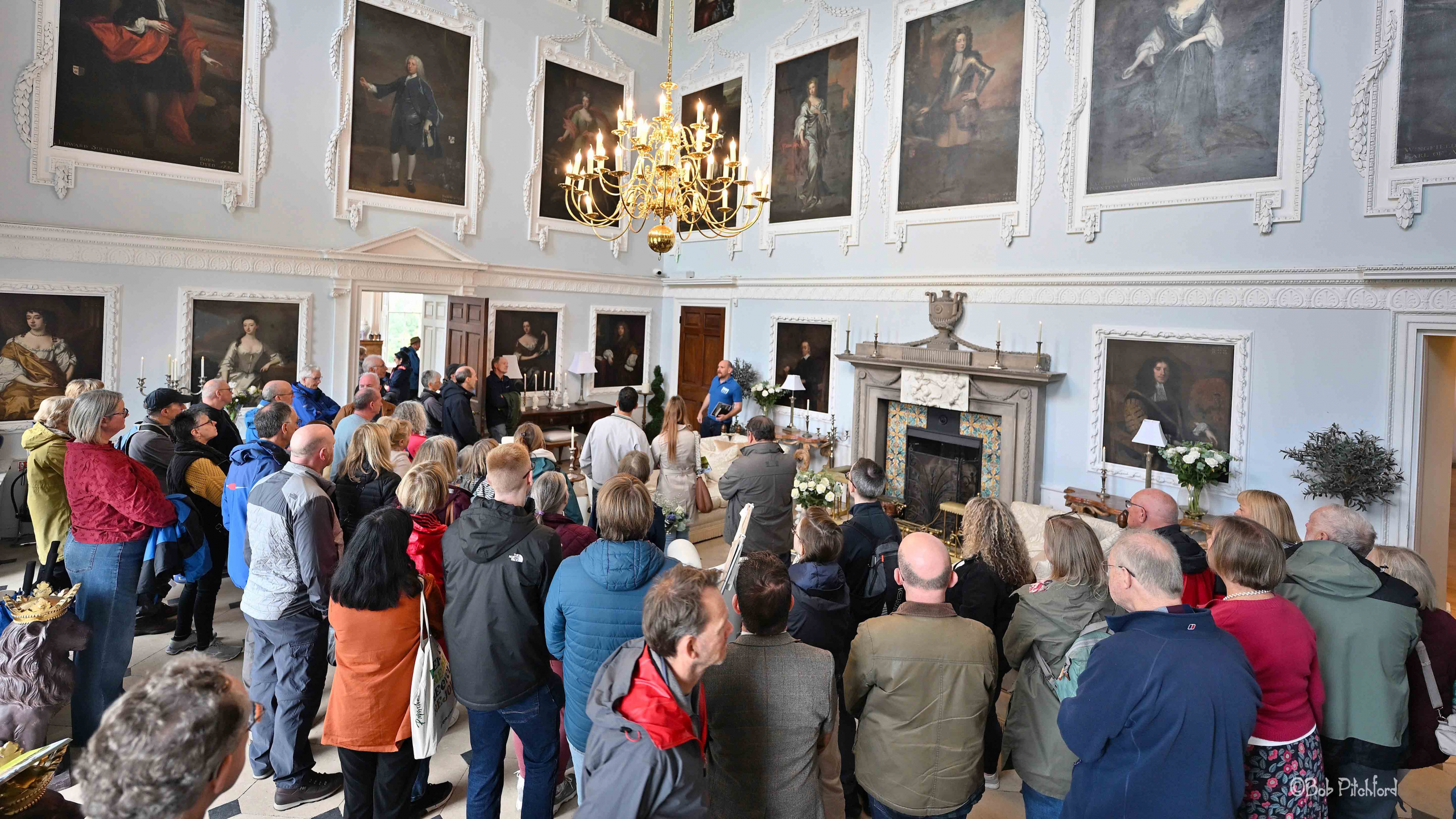
Firstly, thank you to everyone who helped make Heritage Open Day happen this year, our volunteers, Kings Weston house, and all the visitors who turned out to make it such a success. This year was a record-breaker, with over 860 visitors through the door on the day, and the most donations we’ve ever taken towards KWAG’s work. It was so popular that people were already queuing outside before doors opened at 10am.
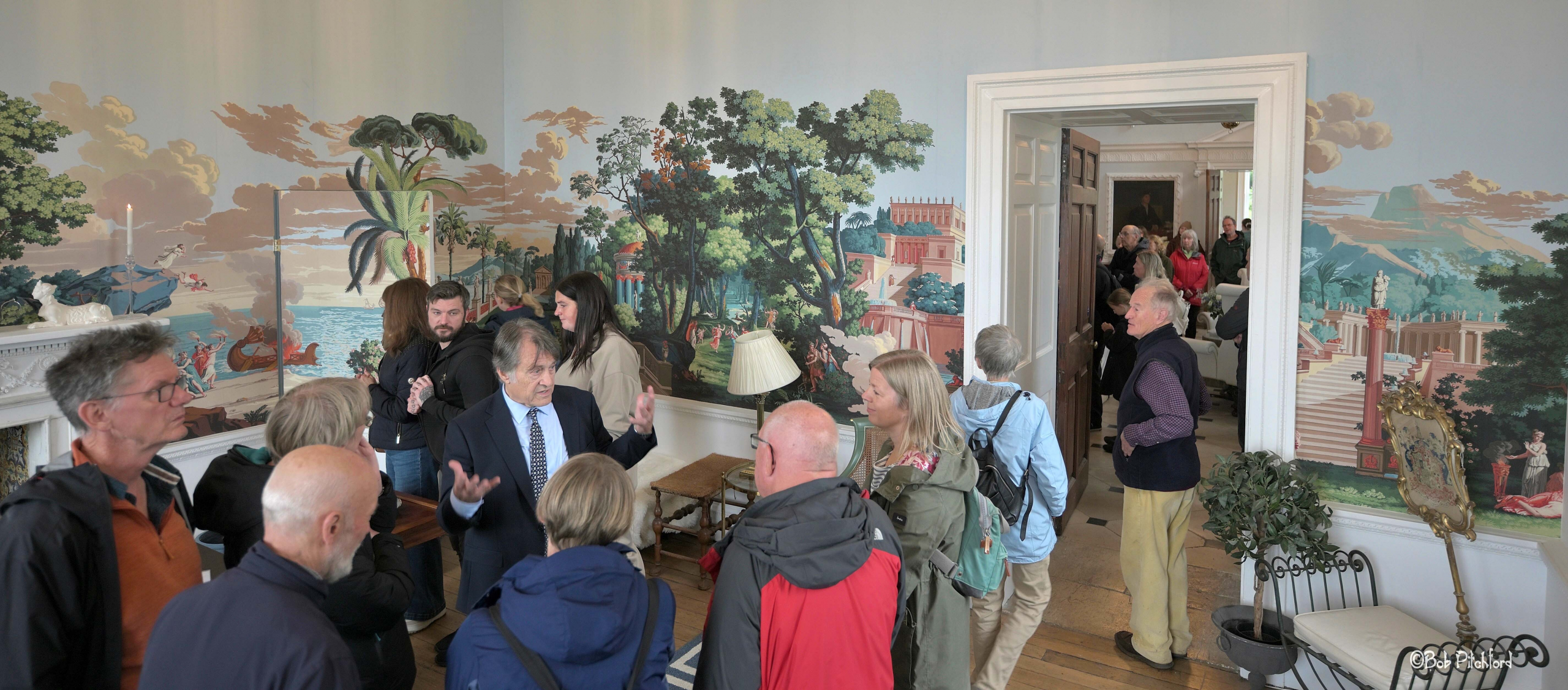
John Barbey captivates an audience in the former parlour. (Courtesy of Bob Pitchford)
Remarkable was the size of the groups attending the tours hosted by KWAG around the ground floor rooms. There were five held throughout the day, all of which, predictably overran; this is an inevitable consequence of shepherding such larger groups from room to room. We had some heart-warming feedback on these and the day as a whole.
One of the guided tours sets off from the Saloon. (Courtesy of Bob Pitchford)
The weather on the day was horrible, with torrential rain coming across during the afternoon that would have discouraged even the most intrepid from heading up to The Echo and exploring the wider estate. We’re not sure if the weather counted in our favour or against it, but it would have been difficult to manage many more visitors on the day.
We hope everyone who came enjoyed the event. If you did, we are still taking donations via our paypal link.
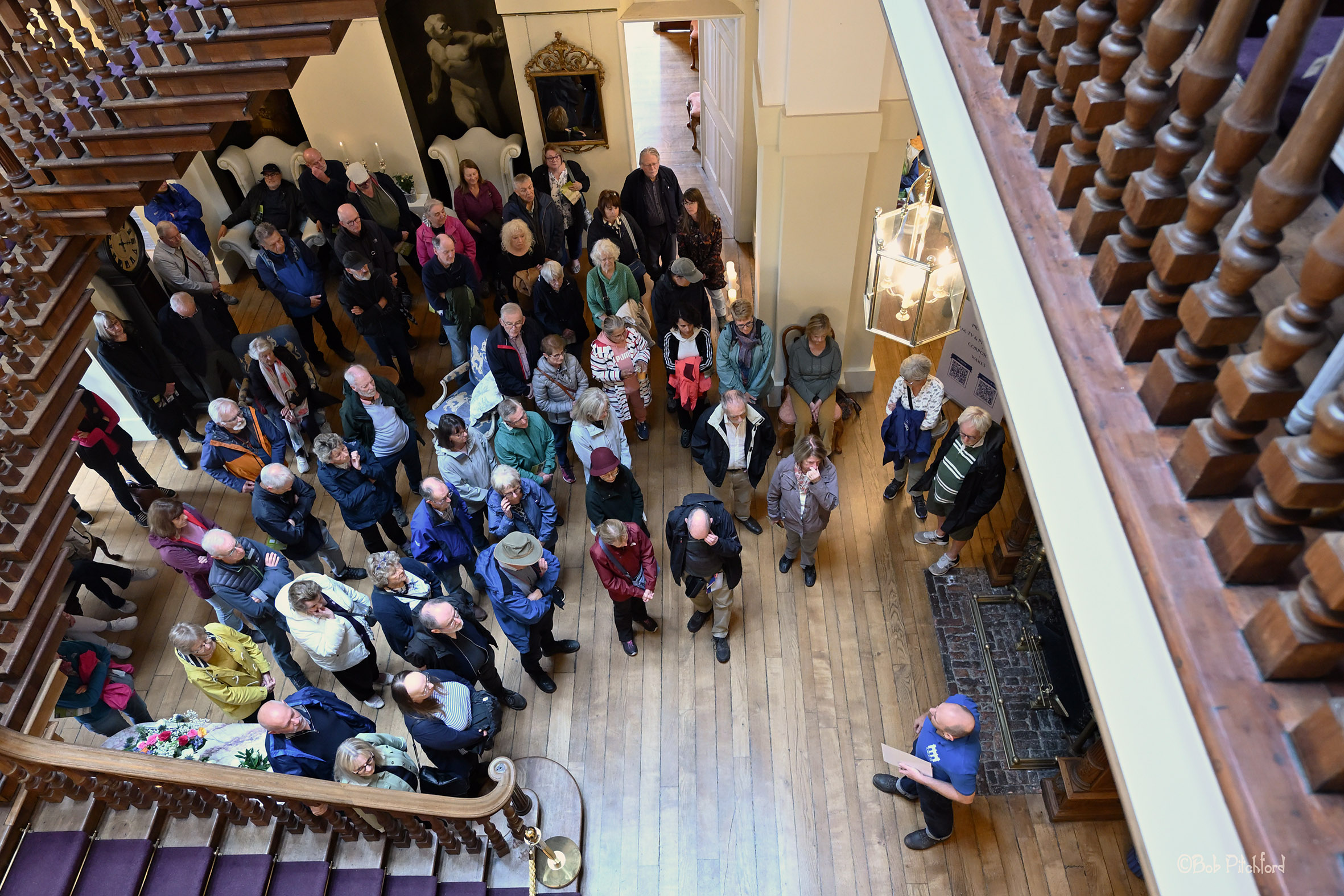
The stair hall gets explained during one of KWAG’s tours. (Courtesy of Bob Pitchford)
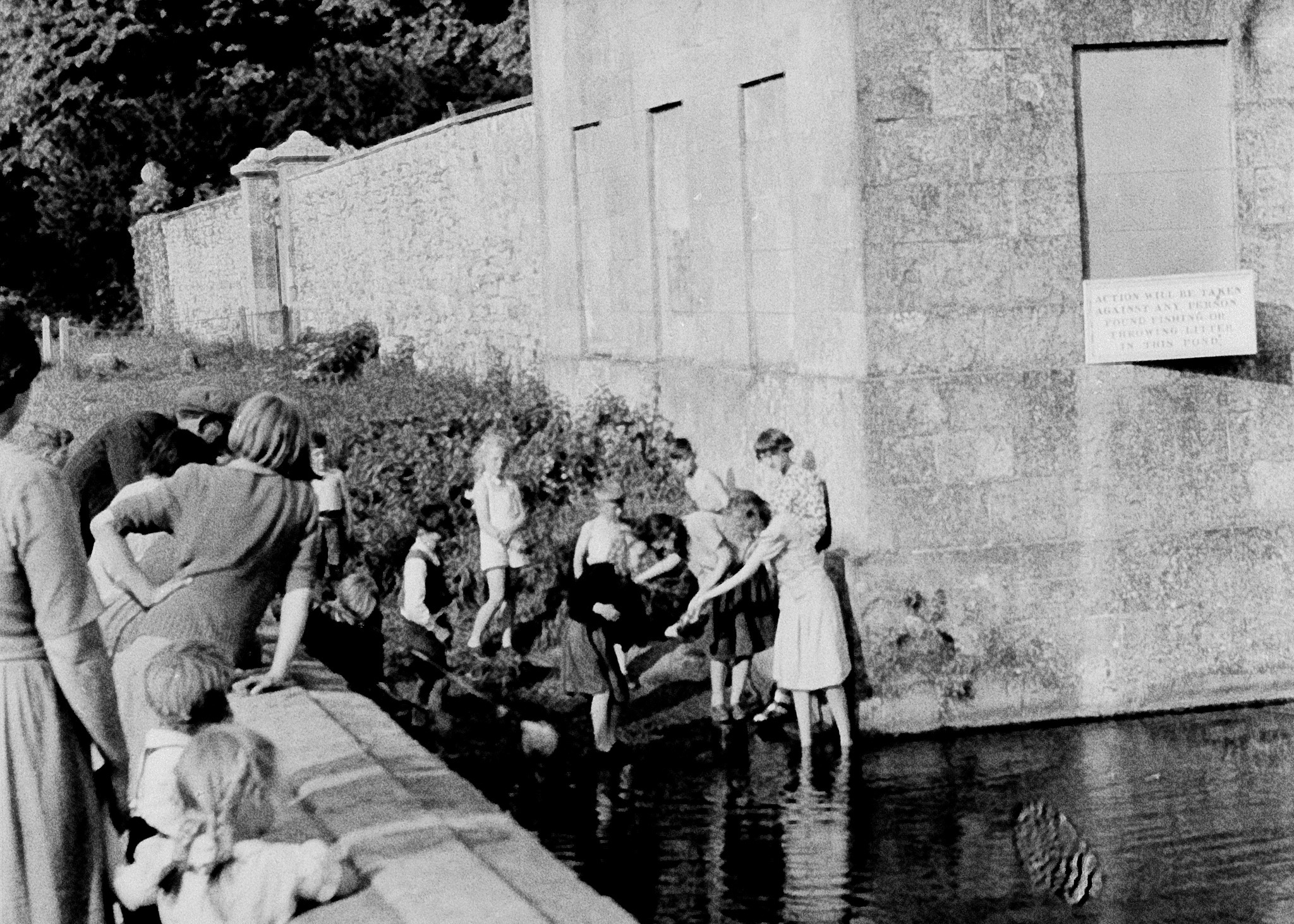
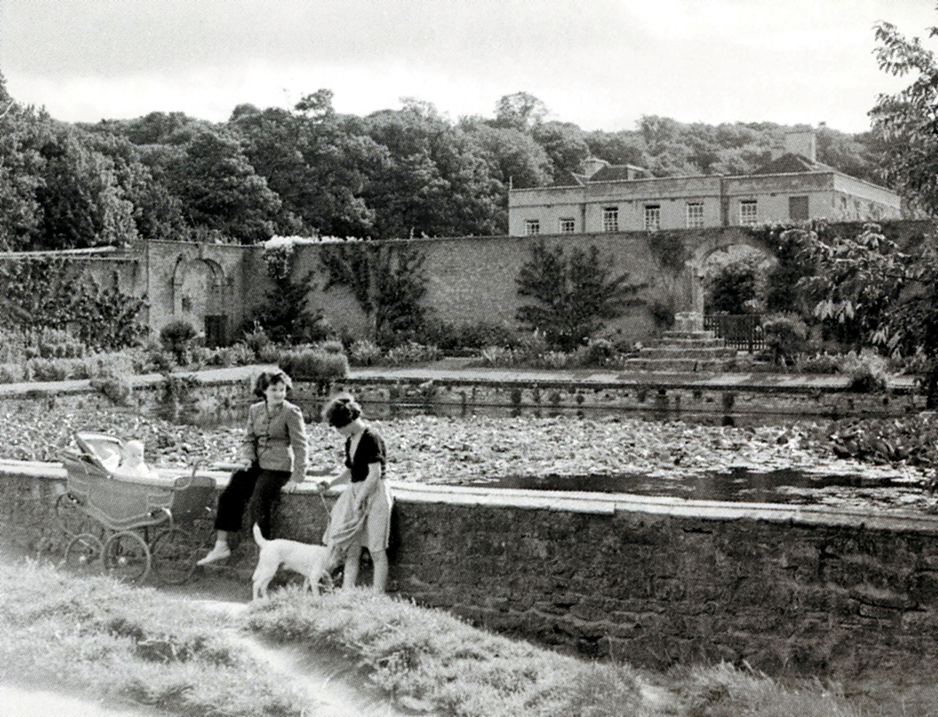
Following our focus on the Lily Pond, we were delighted to have some terrific photographs of it in happier times shared with us. Ken Osborne kindly directed us to these photos in his collection that show the pond in the 1950s.
In one, children take advantage of the open access at the west end to go pond dipping under the care of a couple of adults resting on the parapet wall; it certainly seems to have been a popular activity for a sunny afternoon. A notice attached to the lodge warns “action will be taken against any person found fishing or throwing litter in the pond”. We imagine the children will have got permission for their little ‘fishing’ even
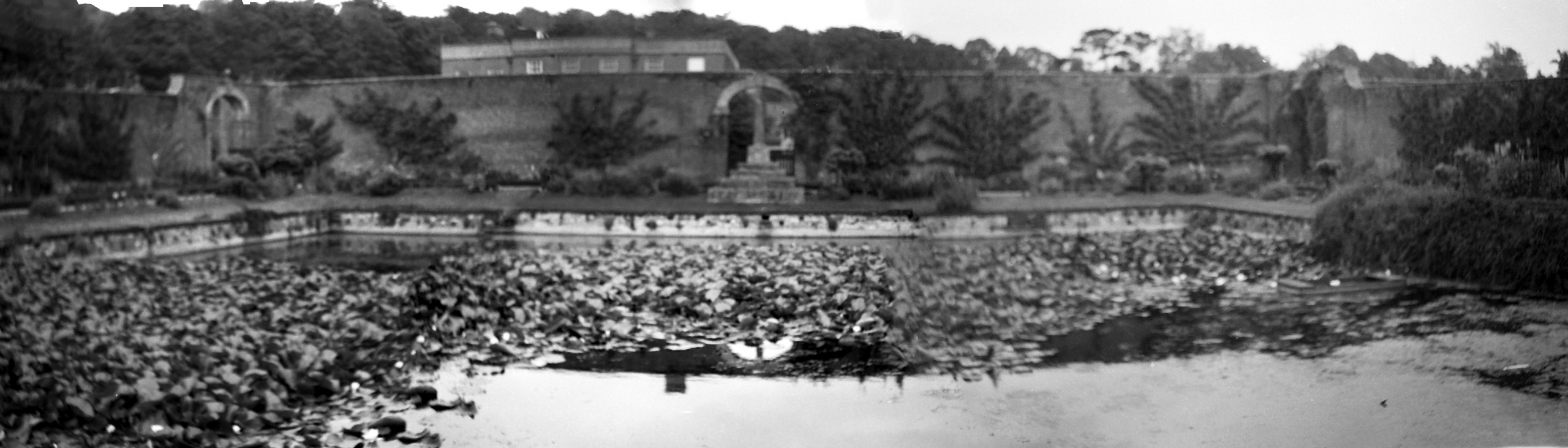
A panorama of photos stitched together to show the lilypond in the 1950s.
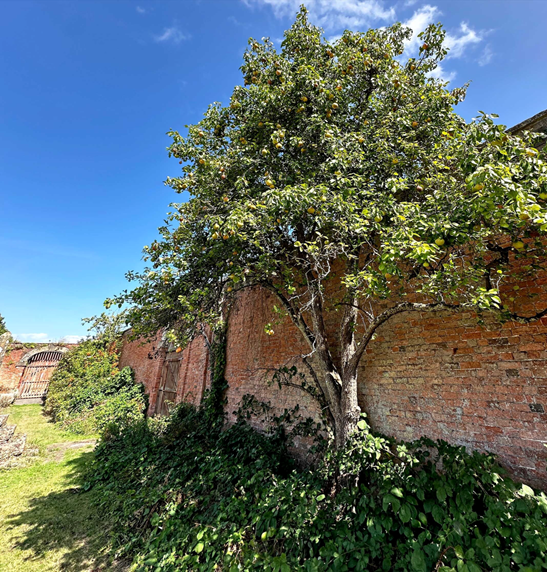
One of the surviving fruit trees, still with it’s fan-shaped branches, but now less formally trained.
We’ve managed to splice a few of these into a long panorama showing the view from Napier Miles Road, and the fruit trees still trained across the back walls in glorious fan patterns. Some of these trees still grow today, a delicious couple of pear trees have become unruly, but still fruit in abundance.
The gardens around the pond were noted for the abundance of their crop, and the excellent conditions they offered for even delicate fruit. An article in The Garden magazine in July 1900 remarks on the hardiness of fig trees here. Again, some of these survive in the grounds, and were noted then for “individual fruits attaining to a very large size and ripening perfectly”. The author writes that “there are few gardens in which figs thrive and continue productive over so many years” and that they were “enviable to visitors whose ambition in fig culture cannot be satisfied to anything like the extent which obtain here under the most simple rules of culture”.
A couple of young ladies pause on the parapet wall of the pond for a chat, some time in the 1950s.
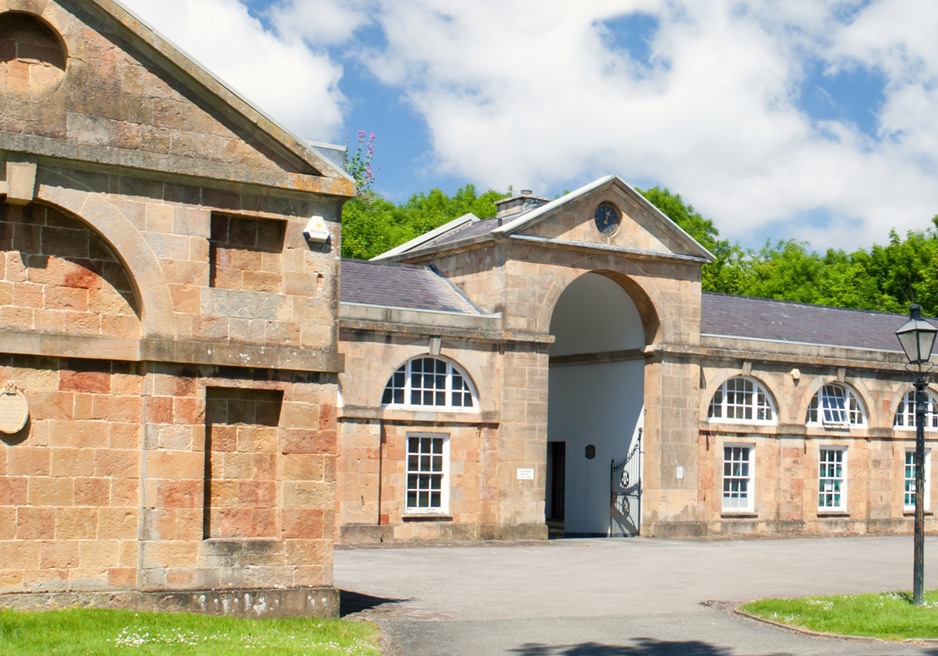
Across Napier Miles Road, the design of the Georgian stable block has led to a popular urban myth; this regards the keeping of giraffes by the owners of Kings Weston house, and the need of a particularly large arch in the centre of the building to accommodate this exotic species. This, to the very best of our knowledge, was not the case, but makes for a great yarn. On the other hand, there was a hippo…
The tall arch of the former stables, giving rise to rumours that giraffes were once housed there.
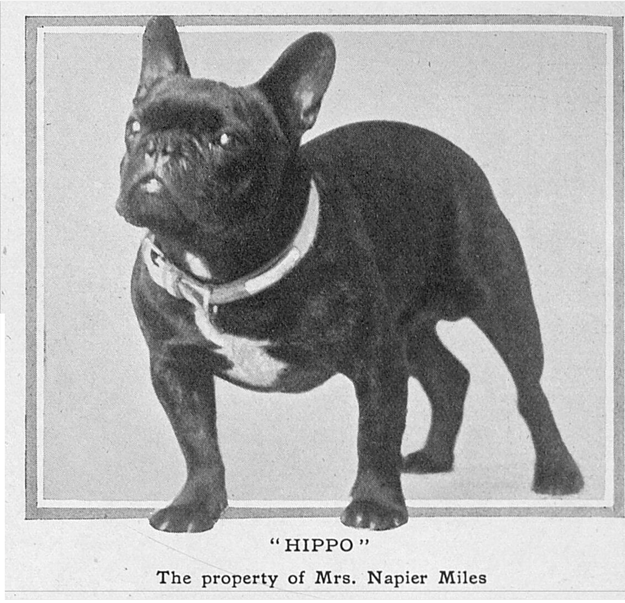
Like many visitors to the estate today, Sybil Napier Miles shared a love of dogs, and particularly pedigree French Bulldogs. She bred these in the early years of the 20th Century, adverts regularly appearing in the press for the sale of these pedigree pups at Kings Weston house. Her particular favourite, and award winning, dog was Hippo. The Tattler reported in 1916, that the two-year-old Hippo had been “quite a sensation” at the annual shows, a “wonderfully cloddy little dog”.
The real Hippo of Kings Weston house
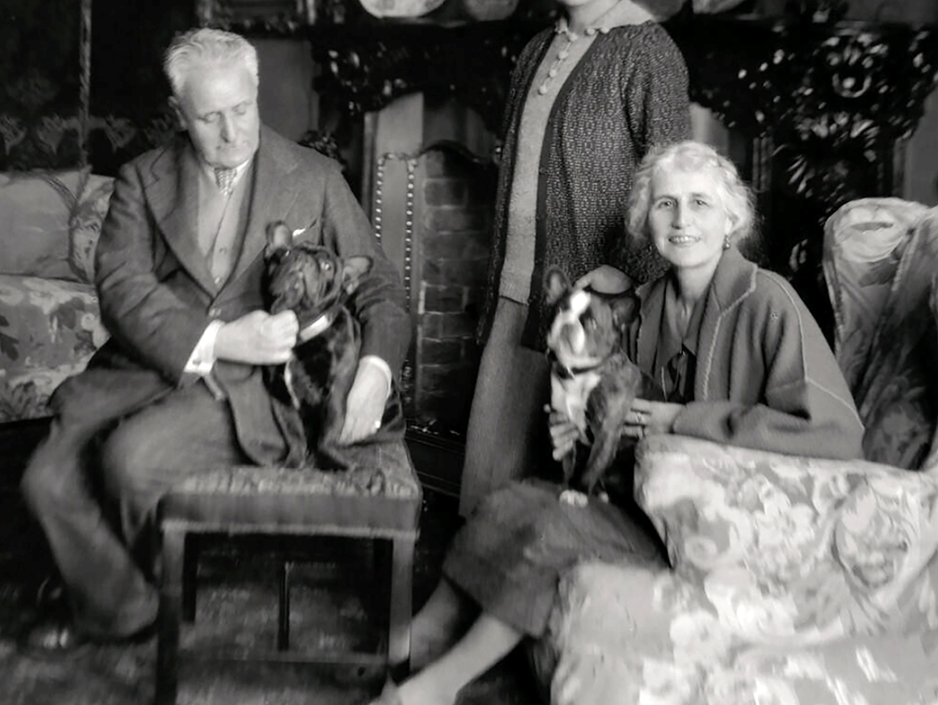
Hippo was clearly a much-loved pet, for he also managed to feature in portrait photos taken of Philip Napier Miles and Sybil a decade later, no doubt in his dotage. So, Hippo can now join the list of illustrious past residents of Kings Weston house.
Philip Napier Miles makes a fuss of Hippo, whilst another of the couple’s French Bulldogs poses on the lap of Sybil Napier Miles.
Charles Saumarez Smith with a copy of his new book.
Back in June 2024, we were delighted to have been able to share some of our research and time with Sir Charles Saumarez Smith, distinguished British cultural historian and curator known for his leadership of national institutions including the National Gallery and the Royal Academy. We spent an enjoyable time with him on his tour of Kings Weston house as part of his research into its architect Sir John Vanbrugh. Now, after a long wait, his new book on Sir John Vanbrugh to be launched in November!
We hope there will be some good coverage of Kings Weston and its buildings. Charles will be the first author to correctly document the dates and construction of the house in any book. We were pleased to be able to share our own research with him and support his own archival investigations.
The book, titled John Vanbrugh: The Drama of Architecture, will be launched on 20th November with a lunchtime talk to be held at Wigmore Hall, London. Copies of the book will be available at discounted prices after the event. If you would like to attend, full details are available here.
The cover of John Vanbrugh: The drama of architecture.
Also coinciding with the tercentenary of the death of Sir John Vanbrugh, Charles will be co-curating an exhibition on the famed architect at Sir John Soane’s Museum. Organised along with the V&A, the exhibition will open in February and feature many of Vanbrugh’s drawings, and, we hope, some Kings Weston exhibits.
These events are all part of a national celebration of the work of Sir John Vanbrugh. The Georgian Group have been fortunate to receive a six-figure grant from the National Lottery Heritage Fund to coordinate a series of events and commemorations across six of the architect’s most famous sites (though sadly not Kings Weston) throughout 2026. Dr Anya Lucas, Director of the Georgian Group, says “The tercentenary of Vanbrugh’s death represents an important opportunity to celebrate and bring to the fore the story of one of our period’s great architects, a bold and theatrical figure who is sure to have broad appeal and who should be better known.VANBRUGH300 will bring the life, stories, and work of Vanbrugh together for a wide range of audiences.”
We hope to share more of the commemorative events when they’re launched, and perhaps will be able to organise our own celebrations at Kings Weston.
There were some herculean efforts put in last month from a crowd of volunteers, over a dozen, and we managed to make serious restoration progress on the historic lily pond on Napier Miles Road. There were two objectives the work; firstly, the cutting-down or rooting-up of trees and vegetation that has grown to suffocate the pond, and to enable a clearer survey of the condition of the pond walls and bottom.
Even after a long dry Summer, it was a surprise to find no open water at all in the pond tank! The vegetation has acted to soak up much more water than would be usual, and the ground was relatively firm across the whole area.
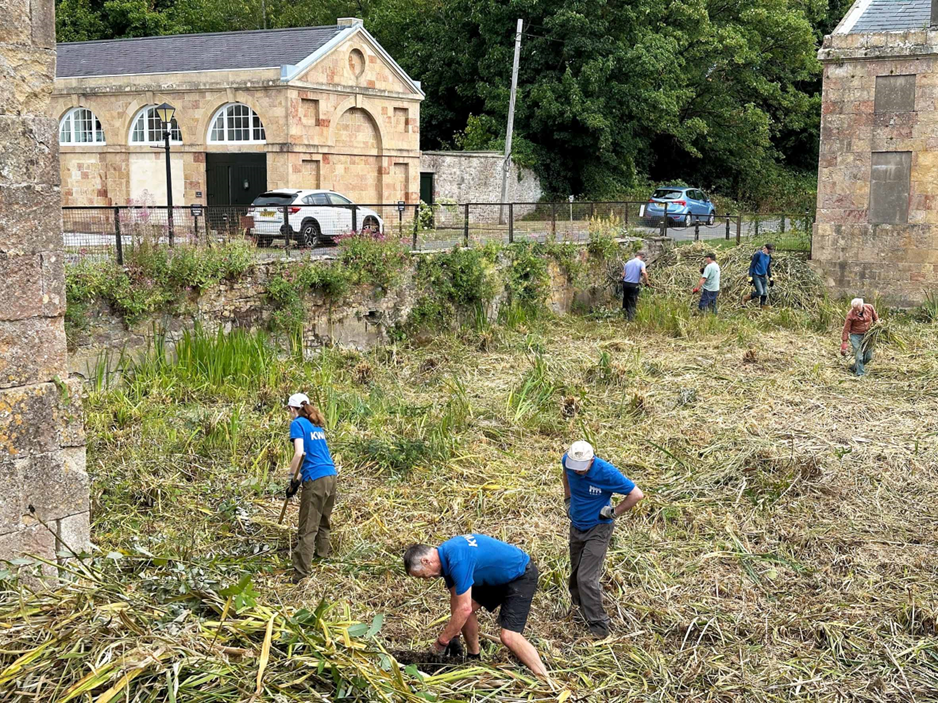
Volunteers rake-up the cut rubbish in an effort to clear the historic lily pond.
The target to cut and remove the vegetation was only just met by the end of the day, the hot conditions meaning volunteers tired quickly despite the great turnout. The waste was lifted to the pond edges and stacked in existing piles of debris up and away from the water line. Sadly, there was little sign of any of the 49 individual native pond species recorded here in 2012 as part of our Bioblitz. There were two types of reeds, sporadic water lily plants, some froglets, and an invasion of sallow trees, but nothing that indicates a thriving environment.
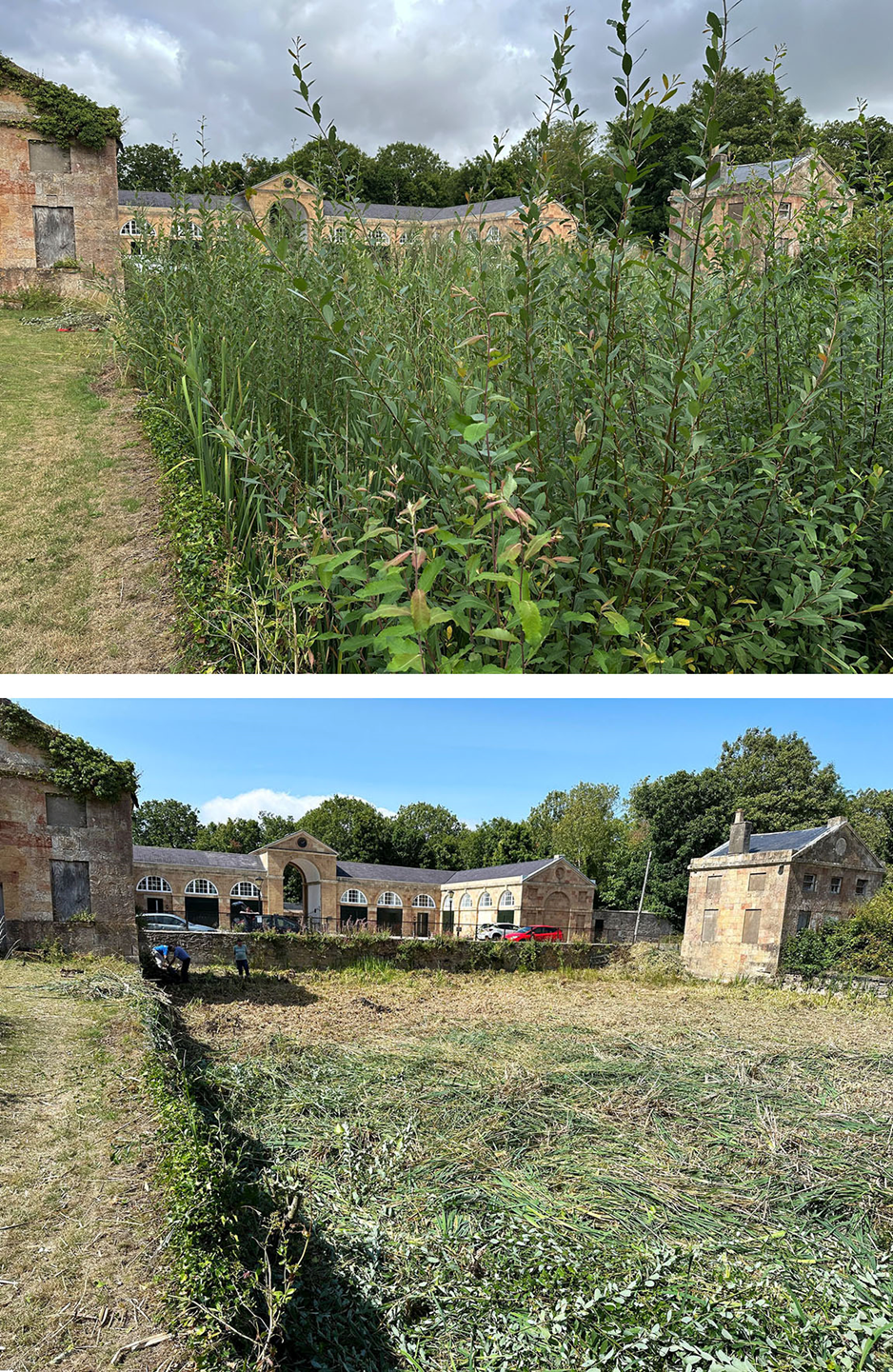
Before and after work focussed on reversing the decline of the Georgian pond.
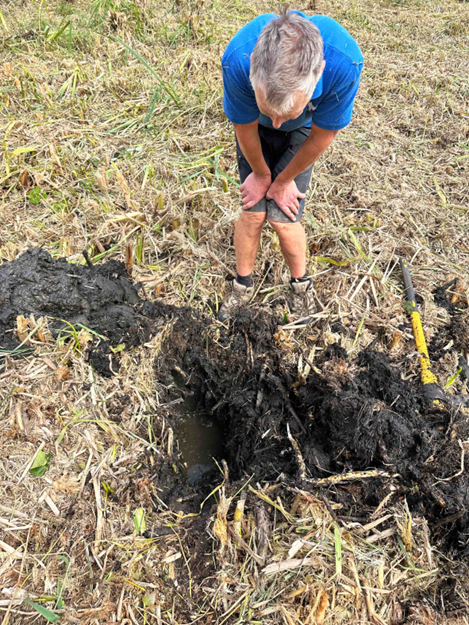
A volunteer inspects the trial hole dug through the decaying vegetation to find the pond base.
Initial review showed the original hydraulic lining applied to the pond walls has dried and begun disintegrating, allowing water to leak away around the edges. We dug a small trial hole to establish the depth and condition of the lining of the pond. Digging down through an astonishing 18 inches of black sloppy rotting organic material, we encountered the original clay bottom of the pond.
In the area inspected, this looked to be in a decent wet condition, but where areas dry out in the summer, any cracked clay base or root damage will also be letting the water leak away. The hole we dug filled with water during the afternoon, showing that even though it looks like a field right now, the water is still close to the surface.
A quick calculation suggests there are around 350 cubic metres of mud needing clearing out to start restoration of the pond lining. This could equate to about 340 tons of black gunk that need removing from the pond!
We’re grateful too for the incredible positive reaction to this work, and the kind words of support we’ve received; more than for any other project we’ve undertaken on the estate!
The view from the road before and after restoration workThe dense monoculture of reeds is cut out to slow the decline in the pond’s condition.
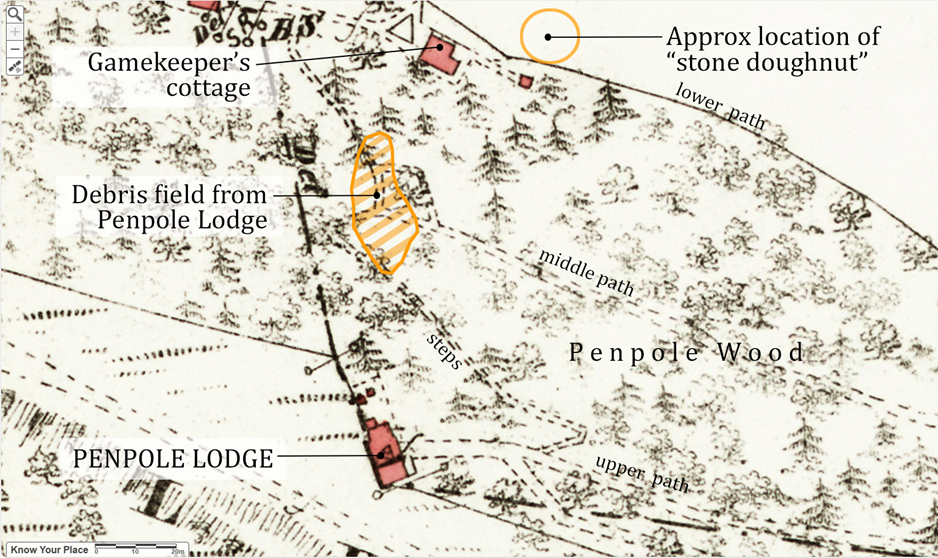
July’s working party location coincided with a large pile of rubblestone strewn down the hillside at the foot of the steps through Penpole Wood. It’s an area we’ve explored before, with the knowledge that the stones are some of the last remnants of Sir John Vanbrugh’s Penpole Lodge that once stood immediately above.
Victorian map of Penpole Wood annotated to show the debris field of rubble from Penpole Lodge.
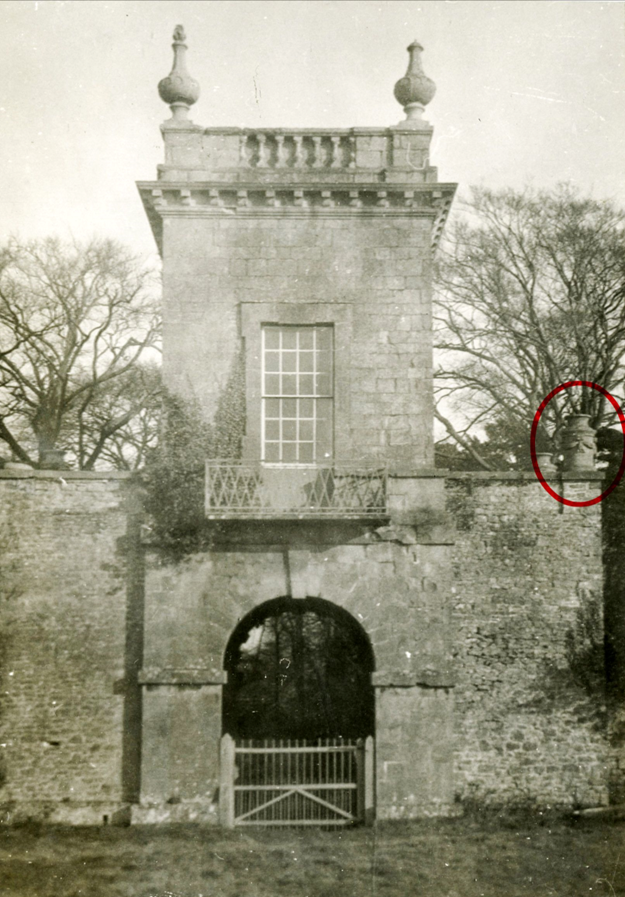
The landmark lodge, built around 1724, survived in good condition until the last private owner of the estate, Philip Napier Miles, died in 1936. It was kept in good condition too by Bristol Scouts who bought the woods as a campsite shortly after, but decay set in during WWII, accelerated through vandalism in the years following, and finally succumbed to demolition teams in 1951.
Penpole Lodge in the 1920s showing the cylindrical altar-like urns.
It’s not known whether all the rubble arrived at its present location hurled from the building by vandals or simply by labourers, but both were probably responsible. It looks as though the stones settled naturally in the location rather than being dumped deliberately, though the area is well defined and localised amongst the trees.
Having hunted through the pile for architectural artefacts before and been disappointed, it was a surprise that working party volunteers began discovering some interesting fragments as they worked. Other pieces have since been recovered.
So far, five individual stones have been salvaged, four of which have since been identified as having been parts of monumental urns from the flanks of the 18th Century building. There were two types of urns on the building, four on the central tower, and four squatter cylindrical ornaments lower down on the supporting piers; in their general form these were designed to evoke ancient roman temple altars. The fragments come from these
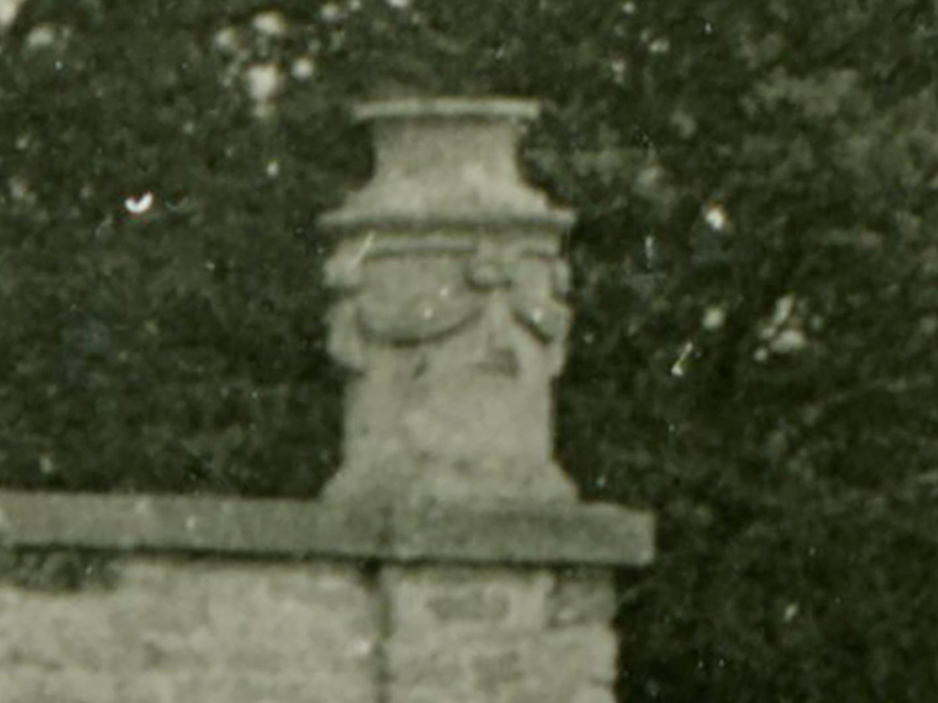
A clearer detail of one of the lower urns illustrating the gathered and draped swags
A photograph taken shortly before Penpole Lodge was demolished shows it in a derelict condition and from the angle taken three of the cylindrical urns had already been toppled and lost. The fragments now discovered are most likely to have been from the most northerly corner, out of view from the photographer here. The other urn on the western corner had vanished much earlier, and the location of fragments close to the surface suggest they arrived there at about the time the building was disintegrating by one means or another.
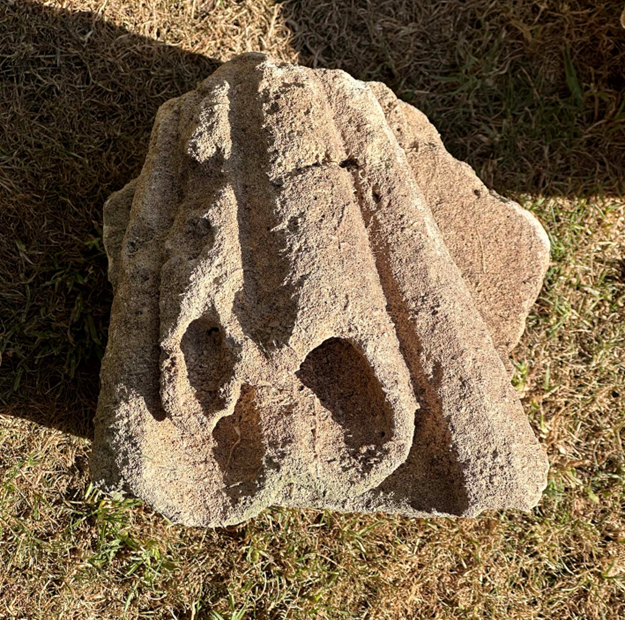
A fragment of hanging drapery carved with delicate folds.
It’s been possible to identify the source of these stones by carved details still preserved and recognisable through comparison with historic photos. Fragments are curved and carry carved swags replicating textiles that are seen decorating four sides of each cylindrical urn. One represents the gathered rosette or knot, another the end of the cloth hanging loose beneath it, whilst two are sections of the intermediate swags.
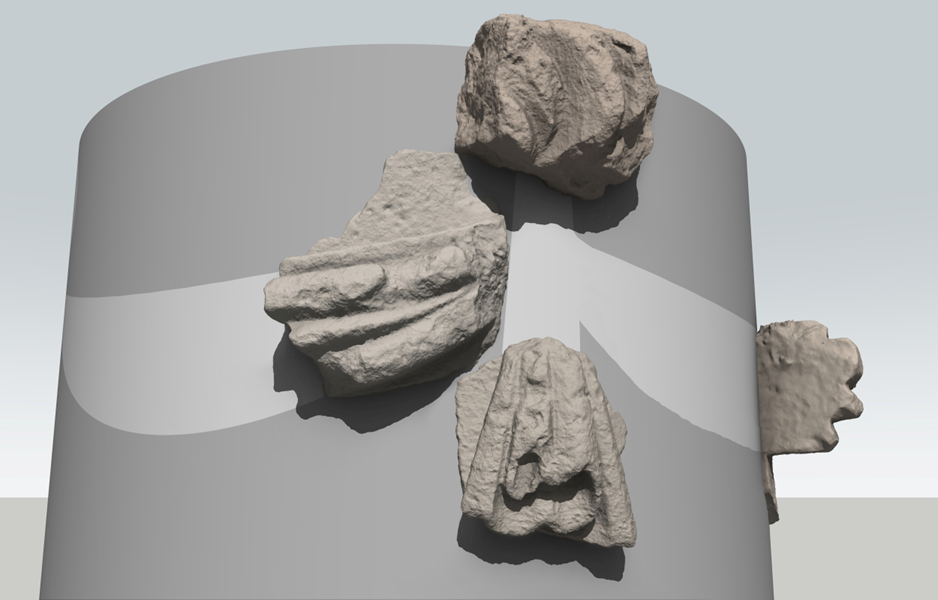
Having scanned the stones using photogrammetry, it’s been possible to arrange them to suggest how they might have fitted together. But, we’re far from certain whether the fragments were in this actual configuration, as none of them fit together. The two swags are from similar locations from two of the swags.
The four fragments scanned in 3D an arranged to give an impression of the location on the drum of the urn.
What is odd is that the urn has been so comprehensively destroyed, broken into such small pieces. Whether the drums were solid or hollow, a great deal of effort must have been expended in rendering them down to a collection of such similar sized pieces. Surely this was a deliberate reduction to rubble?
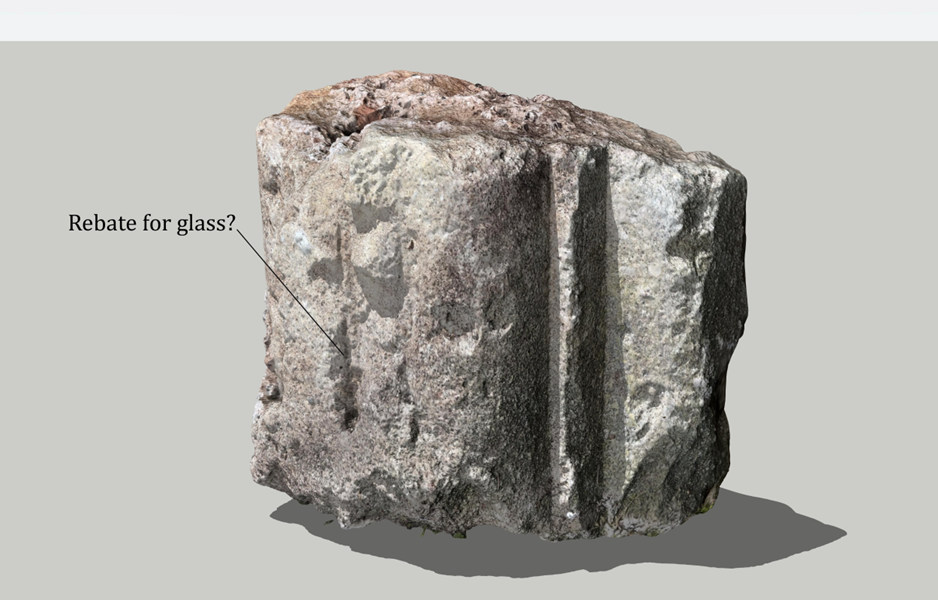
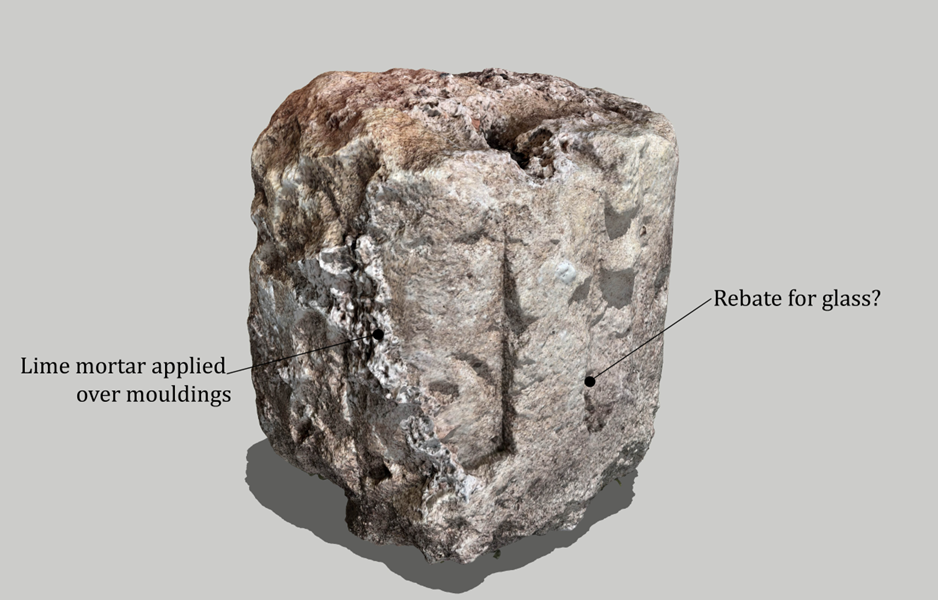
A fourth stone is more of a puzzle. It doesn’t correspond with any known detail of Penpole Lodge, either from photos or recorded in survey drawings made in 1947. One side of it has white mortar applied over its carved detailing, suggesting it was re-used from elsewhere. The carving is regular and linear, and has convex and corner mouldings on two of its outer edges. A rough slit runs up most of the ling edge, suggesting it was a rebate for glazing. The mouldings stop close to the bottom, suggesting it connected with something at its lower edge.
Two angles on the fourth fragment showing some of its key features.
It’s likely to have been part of a window surround. It’s location in the debris field suggests it came from the rubble fill of the walls of Penpole Lodge, but this can’t be proven. Neither can the original source of the stone be confirmed. However, there was an earlier ornamental belvedere on the same site, known from engravings, estate plans, and other illustrations. It was a hexagonal structure, perhaps a banqueting house, and would have been demolished to make way for Vanbrugh’s more ostentatious Baroque building. Perhaps this is a fragment of that earlier structure?
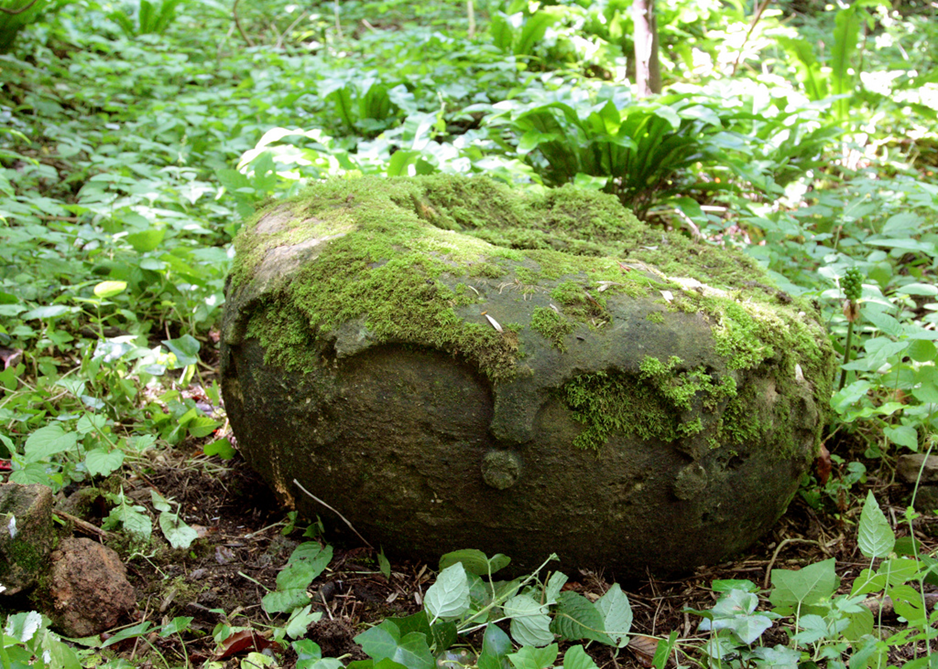
One final artefact is worthy of note – referred to as the stone doughnut. This is the last portion of one of the other urns, the larger structures from the very top of the lodge. These urns were formed with great bulbous centres surmounted by tapered pinnacles from which stone flames once emitted. At some point one of these urns fell from the lodge, shed its pinnacle, and rolled like a wheel much further than any of the other debris, finally coming to a rest at the very edge of the woods. There is survives today, too massive an heavy to move, but, hopefully, salvageable someday.
The “stone doughnut”, the major portion of one of the upper urns, now to be found at the foot of Penpole Wood.
The Council’s Nature Nurture events happen across parks in the north of the city every Friday. A number of these have focussed on nature conservation work around the Kings Weston estate and included several opportunities for scything.
A few regular KWAG volunteers came out for the two events last month focussing on the grassland on Penpole Point, joined by Council rangers and new volunteers.
Scything isn’t something KWAG has put on before, so it was interesting learning to use different tools and techniques to help maintain the important grasslands. Over two of the Friday sessions we got to grips with the area sown with wildflower meadow five years ago, raking-off the cut material to keep the grassland healthy. The area around the ruins of Penpole Lodge were also tended to, but the encroachment of brambles and elm runners remains an issue.
the area around the 17th Century dial before and after scything and raking.
The Nature Nurture team also hope to focus on the two ponds close to the Echo, brining a corporate group of volunteers to help clear in and around it, and set up a post and wire fence to keep dogs and debris from finding their way into the pools instead of the wildlife hoped for.
The Council are also looking at thinning some of the self-seeded trees from around the pond, trees that undermined KWAGs last effort to clear them by overshadowing them and filling them with dead leaves in Autumn. We hope everyone will appreciate the efforts now being put into increasing the biodiversity of this part of the historic parkland. If you have any concerns or queries, please email us and we can pass them on.
The current sorry state of the ponds below the Echo.
It was one of the hottest days of the year when we met in July for volunteer work in Penpole Woods. Not only was it hot, but the chosen location was distant from all of the usual meeting points. The area, deep in Penpole Wood, was at the bottom of the steps we rebuilt about ten years ago. Until last month they deposited the visitor into a thicket of cherry laurel.
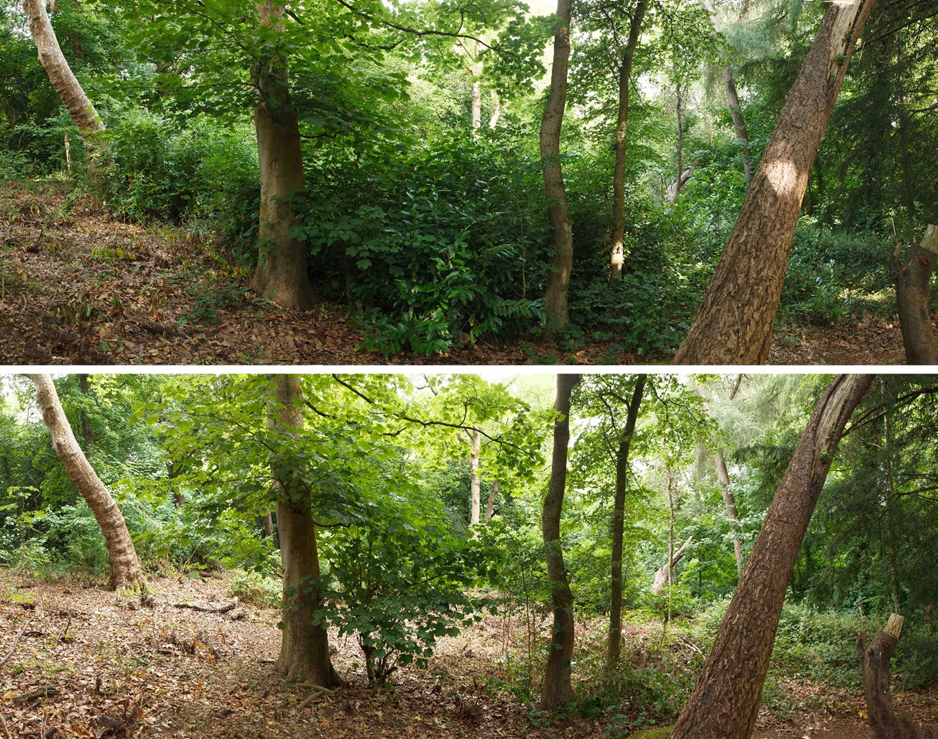
Animated transition showing the view from the bottom of the Penpole Wood steps.
Already, someone had been trying to keep the paths there open, taking out branches overhanging the path, but our ambitions were somewhat greater. Considering the forecast, we had a good turnout, and thank you to all our regulars who made it. We started with the knowledge we’d cut things short to avoid the worst of the heat, but the shady area on the north-facing slope gave us some respite from the worst of it.
The impact of work turned out to be more incredible than expected. A relatively dense cherry laurel gave way quickly, revealing a number of handsome mature trees that hadn’t really been noticeable at the start of work; If we’d have spotted them earlier, we might have been a bit more careful over the location of spoil piles and their visibility.
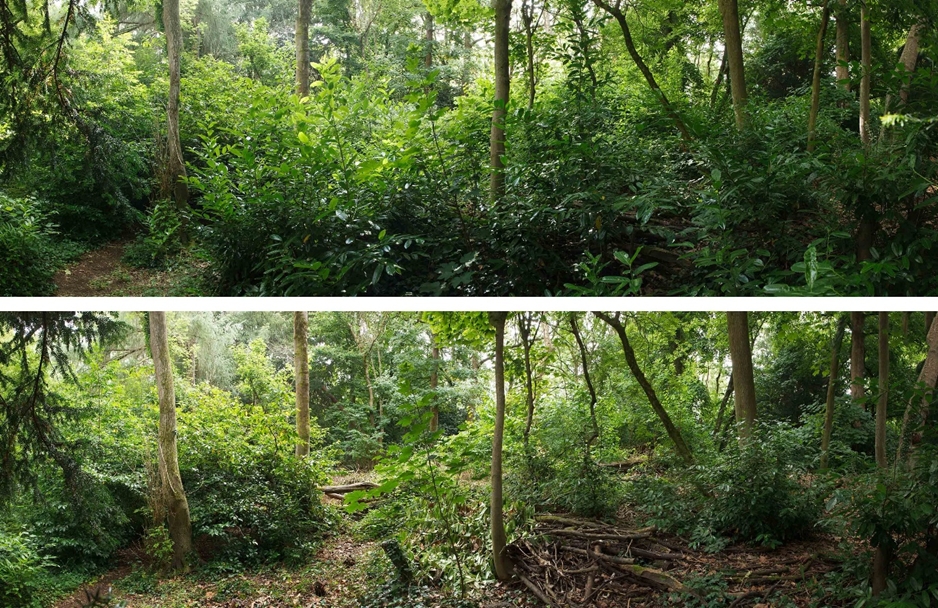
Animated transition showing the view eastwards along the middle path.
By the end of the day, the section of the middle path we worked on was unrecognisable. Now, coming off the end of the steps, the scene opens out into a light clearing with a backdrop of fine trees. The route up from Lawrence Weston has been cleared of a lot of obstacles and joins the middle path at a junction at the stone steps. Hopefully the path remains traceable through the stone rubble.
We had planned to return here this month to continue work, but an urgent matter has cropped up at the Lilypond. September will be Heritage Open Day, and October is usually the Big Bulb Plant, so continuing the work may take longer than planned.
Looking west along the middle path before and after work clearing cherry laurelThe three stone steps between the middle path and main steps appear from beneath the cherry laurel.
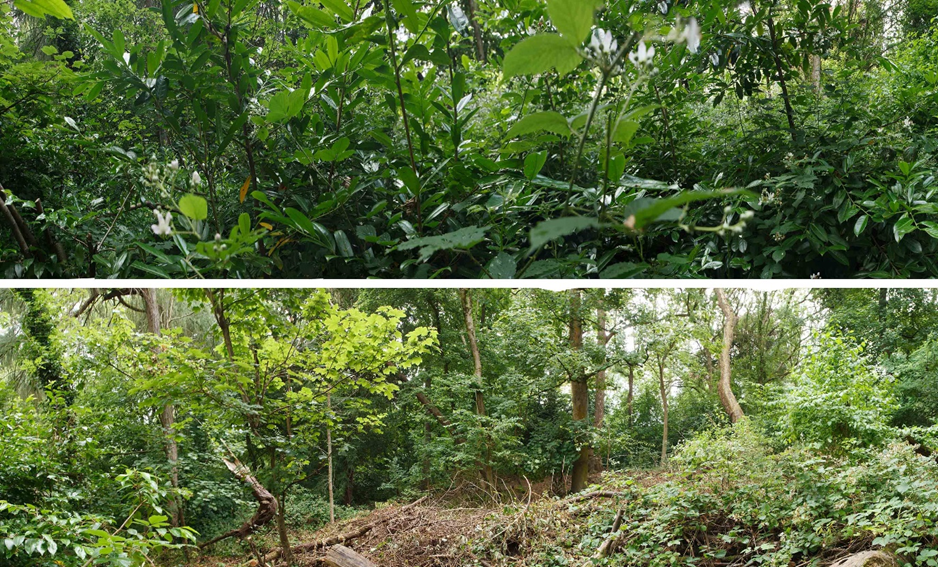
Worked carried on into July to clear the regrown cherry laurel in Penpole Wood. Most visitors will see little change from the recent work much is hidden well back from the main path through the woods. However, the impact of cherry laurel on the native woodland is severe if it’s let get out hand.
looking west through the wood before and after the re-trimming of the cherry laurel.
Since we cleared the area in 2016 there has been a lot of regrowth, particularly on the harder to reach area along the top of the former quarry. Because the laurel has historically stunted tree growth in the area an opening had developed in the tree canopy and Brambles had begun to colonise the area aided by the catenary of laurel stems; in short, the area was in a big mess again.
the view east through the working party area.
A relatively small group of volunteers, a usual state of affairs for the holiday season, set about putting things in order and extending the areas cleared in the last few months. Cherry laurel has been felled again, untangled from the brambles and stacked out of the way. More of the saplings planted in 2016 have also been revealed again in thriving condition. Whilst there remain some laurel bushes to the periphery of the area, ones we had neither time nor energy to tackle on a hot day, there’s not enough to occupy a full working party. These will be left for the moment while we focus on new areas.
looking up slope from the edge of the old quarry and towards the main Penpole Wood path.