Since 2022, one corner of the Sir John Vabrugh designed Echo has been held aloft only by means of a nylon strap. This was attached during urgent maintenance work when the dilapidated condition of the cornice was first raised as a concern. At the same time, the brambles and other weeds whose roots were penetrating the mortar joints were cleared off. However, it’s taken a considerable time for the Council conservators to return.
The Echo takes on the appearance of a sentry box with the restorers scaffolding and palisades erected.
Last month we had the first reports that the long-promised scaffolding was being erected, along with a palisade protecting it from any abuse or vandalism. The whole structure took on a formidable appearance while contractors worked to re-mortar and repair the stonework. At the same time, some of the overhanging trees that were threatening to knock down the decorative urns were also trimmed back.
Hopefully, perhaps even by now, the work will be finished and the building revealed again to the public.
The Echo in 1927. Philip Napier Miles enjoyed a rustic garden style that saw him allow plants to spring up out of the building’s stonework and steps. The two chairs inside are hollowed out from fallen tree trunks!
October’s Big Bulb Plant at the Iron Bridge has come good with a sensational display this Spring. The heavy work preparing the ground and digging holes through rubble was definitely worth the effort; the visual impact speaks for itself!
A panorama looking down and across the slope towards Shirehampton Road with the bridge on the left. The City boundary marker is now surrounded by flowers.
Both sides of the Iron Bridge looked phenomenal in the Spring sun during March, though flowers are just going over now. We hope that everyone who contributed to the bulb plant will have had the chance to go up, take a look and enjoy the display. It certainly seems to have attracted a lot of attention.
John Loudon McAdam’s iron bridge is now set in a sea of gold on the Kingsweston Hill side
This October we hope to give daffodils a rest. The cultivated blooms are not suitable for many parts of the historic estate and we’re keen to diversify into more native species. As part of the Nature Conservation plan being developed by the Council we hope to agree suitable species and locations that will both ornament the estate and improve its appeal for nature.
The northern approach to the bridge on the Kingsweston Hill side.
Sir Robert Southwell when President of the Royal Society.
The Bristol Records Society has recently published its 78th volume, one with some Kings Weston associations. The new publication, edited by Anthony Turner, catalogues the correspondence between William Cole, a gentleman and customs official in Bristol, and Sir Robert Southwell of Kings Weston and his son Edward. The letters exchanged between them largely relate to their mutual interest in natural history and associations with the Royal Society. Sir Robert was elected President of the Society in 1690, a position he was re-elected to five times.
There are few insights into Kings Weston, but a short series of letters are particularly fascinating. They describe the discovery of some crystals Cole had discovered on Sir Robert’s estate and presented them to him and his family as a gifts. The “topaz” stones were made up into five rings, one for Sir Robert and Edward, and the remaining three for each of his surviving daughters.
It’s not clear where the stones were found on the estate, but crystals are not uncommon in the rocks of the Avon Gorge. Known since the Seventeenth Century as “Bristol Diamonds” they became popular as souvenirs. Dug out of iron ore veins, or found in nodules and geodes they were actually quartz crystals. The “topaz” Cole found are likely to be similar stones.
Both the main stone types within the Kings Weston parkland, limestone and Dolomitic Conglomerate, could have produced these gems. KWAG has come across them before now during excavations for steps, or mixed in topsoil, but none appear to have the same clarity encountered by Cole. What became of the Southwell’s rings is, sadly, unknown.
Quartz crystals of a very flawed quality found during KWAG work in Penpole Woods. Perhaps the Kings Weston topaz stones were finer quality than these.
The following excerpts are taken from the recent publication and give extra colour and depth to the story:
William Cole to Edward Southwell, 5 May 1694
“Honoured & deare Sir I have forborne to write to you since your last of the 27 March for that I was desirous in my next to make good my promise of sending you some of the Topaz stones of Kings Weston which I have att length and without much difficulty procured and now send you…
Now concerning the stones it may not be impertinent to give you a particular account that about 10 or 12 yeares since I procured many of them from Kings Weston and among them all there were not above 5 or 6 which were very good, and these I parted from to gratifie the earnest desires of some particular freinds not keeping anie for myselfe (being a stone I always fancied above others) presuming to have gotten more but never could till your last time being heere and when I had gotten severall hundred of them I caused the Jeweller to examine them and he pict out 22 of them (not finding any more that he thought good) which he carried with him to London to be cutt there but 12 of which found fitt to be cutt and returned the rest to me as defective, of which I chose out the 5 best and biggest to be set in Rings which are now sent by [….)
I did as well as I could by conjecture, direct the Jeweller in sizeing the ringes, 1st that for Sir Robert to be made a small size too big for me i.e. no 1. The next No 2 for yourselfe a size bigger then that supposing your finger to be somewhat bigger then your fathers, and N° 3 for Mm H[elena] & M E[lizabeth] neere of the same bignesse and N° 5 the least for M K[atherine]. I presumed the stones would have beene bigger, but he that cutt them assured me that when the topps of those which are crystalline the rough side & both are ground of The Topaz in the midle would be noe bigger soe as to be cleane and pure.
These 5 taken out of the aforesaid 12, the remaining 7 are not soe big nor indeed soe good as these. He further assured me that in grinding them he found them harder than the common Topazes, tho not as the Orientall hard Topazes which are neer in value to dyamonds, which are allsoe called yellow dyamonds. The foile under the stones is the common looking glasse foile. It hath been my designe some years past to procure some of theise stones to the end they may be worn not onely, rudely cut enough as they are, but as such found in S’ Roberts owne mannor. If these several tokens of gratitude find acceptance with the same [illegible interlined word replacing”
An example of Bristol Diamonds from the Gorge area, now in the M-Shed museum
Sir Robert Southwell to William Cole, London 2 July 1694
“Wee lately had the effects of your favour in five Rings you told us indeed of Topazes of our own Growth but I little thought you would have improved them as you have done. But you have at the same time improved our value of Kings Weston. for we newe not before we were so rich. Mr Woodward a great Judge of these things admires them very much, and hath obleiged me to furnish his collection with 2 or 3 Rust ones when I gett downe.”
William Cole to Edward Southwell, 23 aug 1694
“Besides these thinges I was requested by him in his letter & […] to imploy the stone digger to find some of the rough topaz stones for Mr Woodward which I proposed to doe this weeke, but before that spoken with him he came this morning to offer some other sorts of stones to me; and told me that he was yesterday att Kings Weston digging in Sir Robert’s land and forbidden by one of his servants. I examined him what answer he made him, and he told me that he said I had procured leave for him from Sir Robert but I never spake with him nor sent to him since I went into Wilts in May last. He offers to ingage not dig in any place to the damage of the Land and to suffer punishment if he doth not levell the holes where he shall dig for stones which he sayth lye neere the surface if your father think fitt that he shew the places where he supposeth to find them to one of his servants that he may be first satisfied that it may be don without damage to the land, he hath one large peec of a hollow rock of about half hundred within which are found good stones which I presume will be pleasing to Mr Woodward tho not of the right Topaz colour which if your father please to accept it I shall ingage the stone digger to present to your father being found in the same Mannour and to search for such as are of the true colour.”
the Kings Weston estate in about 1710. It’s not known where in the grounds the crystals were discovered.
The War Memorial after the inauguration crowds had receded on 4th September 1921.
A new photo has come to us that will be of interest to many of you. The unveiling of Shirehampton’s War Memorial was held on Sunday 4th September 1921. Designed in the manner of a medieval wayside cross, it was given a dignified position at the top of Park Hill. The site at the corner of Shirehampton Road and Penpole Lane was once more prominent than it is today, and on the edge of the landscaped parkland nestled between long avenues of trees.
The land had been donated by Kings Weston’s owner, Philip Napier Miles, who also chaired the committee tasked with the memorial’s erection. It was his estate architect, Ernest Newton, who had been given the task of designing a fitting memorial to carry the 57 names of local men lost in the war.
The newly discovered photo records the scene of the unveiling from the Shirehampton Park side of the road, the cross surrounded by sun-bathed spectators keen to mark their respects. Ropes that may have released some sort of curtain still hang from the crosshead. It’s also a tantalising glimpse of the timber building set up over the new reservoir built by the Bristol Water Co.
A bill was set before parliament in June 1920 to enable the company to build several new works, including a new reservoir to serve the growing Bristol suburbs of Shirehampton and Avonmouth. As originally planned, this was to be in a field west of the cricket club, but at some point the site changed to a spot on the north side of Penpole Lane. Sadly, this required part of the landscaped grounds to be compulsorily purchased for the deep tank and the incongruous-looking large sheds protecting the water from contamination. The Bill was passed in May 1921, so it looks as though work was quick to start, or had already begun before the new facility was photographed in September that year. It’s not clear what Napier Miles thought of this intrusion into the landscape, but challenging a Government Bill would have been a financially challenging prospect.
The reservoir survives today, emptied, and converted as the Karakal works, albeit now with a steel shed covering. Strange as it seems, the reservoir is now over a century old!
The newly discovered view with the twin roofs of the newly-built reservoir seen beyond the crowds. The War Memorial stands proud in the centre.
The Kings Weston estate was extensive, with landholdings well beyond the confines of the parkland surrounding the house. Some of this land was framed directly by the estate from the Home Farm, but hundreds of acres of it were separated into farms rented from the estate. Whilst many of these pre-existing the arrival of the Southwell’s at the house in 1675, successive family members sought to improve the land and build substantial farm premises to support their tenant farmers
Campbell Farm, one of numerous estate farms, seen in sales particulars from 1937. Today, Longcross would pass accross the pasture in front.
The third Edward Southwell, the 20th baron de Clifford, (1738-1777) appears to have had a particularly improving impact on his estates. He came into his inheritance at an early age and the estate was placed in the hands of trustees while he was in his minority. He returned from a Grand Tour of Europe to take control of Kings Weston in 1762, immediately turning his attention to refurbishing the house and rebuilding the out-buildings for his new wife, Sophia, but appears also to have focussed investment on rebuilding a number of his agricultural holdings.
A pastel portrait of Sophia “Sophie” Southwell (Nee Campbell) and her children, circa 1775
Most of the farms were spread out below Kings Weston house on the Severn plain, running up to the estuary banks. Centuries of drainage works and flood defences had created fertile fields which were packaged into farms of varying size. Southwell built, and rebuilt the majority of these on modern models, both farmhouses and yards. Many buildings from this period survive today, but perhaps the best preserved is Campbell Farm in Lawrence Weston. It was originally the lowermost collection of buildings that constituted Kings Weston as a hamlet, strung out down the lane before the open agricultural land commenced.
Buildings of Campbell Farm today
All of the farms were given family names related to Southwell’s ancestors, such as Ardglass and Katherine farms after his mother and her line. In an unlikely romantic gesture, Campbell Farm was named after his wife’s family name. It was perhaps the finest of the farms on the Kings Weston estate, more extensive even than the Home Farm and with an impressive series of barns, byres, and out buildings rebuilt in the 1760s.
Detail of a plan of Kings Weston estate showing the location of Campbell Farm in relation to the rest of Kings Weston.
The farm remained intact even after sale in 1937 following the death of the last private owner of Kings Weston house, Philip Napier Miles, but it was not to last. After WWII much of the land was requisitioned by the city Council for the building of Lawrence Weston Estate. Many of the other cottages and buildings of Kings Weston hamlet were demolished, but Campbell Farm was spared. Miscategorised by Historic England when it was Listed as “Mid-Nineteenth Century”, its importance has been somewhat overlooked. Now sandwiched between the post-war housing and the hinterland of motorways and slip-roads that border it to the north, the buildings survive, converted to homes and small businesses, but still with some of the charm of the Georgian era.
A fine building portrait of the main farmhouse, dating to the 18th Century, but with Victorian modifications. It survives today largely unchanged from this 1937 photo.
After the war, the declining condition of house and grounds at Kings Weston was the source of national concern. In fact, the architectural history of Bristol in particular was brought into sharp focus by wartime losses. The author Simon Harcourt-Smith clearly had a spirit inclined towards the romantic lure of the ruin, indeed, his own book “The last of Uptake” is an atmospheric story about the last days of a great mansion in decline, and its ultimate fall. Fortunately, unlike so many country houses, Kings Weston survived the decline many estates suffered in the three decades or so from the 1930s onwards, but only just.
Harcourt-Smith visited Bristol in October 1946 and wrote a lyrical piece for the high-society magazine The Tatler and Bystander that included his great admiration for Kings Weston even in it’s war-worn state. It’s worth recounting here as a
“How strange it is that Vanbrugh, who made his name as a writer of successful comedies, should have created an architecture which thrives in tragic circumstances. We can thank Providence that neither Blenheim nor Kimbolton nor Grimsthorpe have yet fallen into ruin. But ruin seems to be the proper mood of a Vanbrugh palace. I cannot believe Seaton Delavel was ever as moving in the days of its beautiful crazy owners as it is today, with the miners’ cottages creeping up the drive, and doves cooing among the Caesars in their alcoves, and a great purple cloud coming up out of the North Sea. I suspect that Castle Howard may have gained in drama from its fire; certainly Eastbury for Bubb Doddington now a mere fragment of a great house which should stir even a blind heart.”
A jolly sketch, but jolly inaccurate, accompanying Simon Harcourt-Smiths article. One that perhaps evokes rather than records the impression of army huts in the park.
“And now King’s Weston turned into a school, then befouled by the military during the recent war: dormitories in the garden, an outer defilement of Nissen huts round the park, the servants’ quarters pulled down and littered on the terrace, the mantelpieces gone from the great saloons, temples chocked with old litter. Here is but a skeleton of grandeur; but for that very reason it makes one see as never before how great a genius Vanbrugh was. This is an idiom entirely personal and in heroic strains. Gaze at one of his slender, elongated arches. It is unlike anything else in our architecture. Wren may be a perfect artist, but one feels him to be the conventional man raised to the height of the angels. Vanbrugh’s art, never perfect, needs no elevation to the clouds. For it began there. . . . “
A fascinating series of slides has recently come on the market showing Shirehampton in the early years of the 20th Century. Amongst this treasure-trove were a number of interest to Kings Weston and that we’ll detail here. Fortunately, each was recorded by the original owner with the date and location, without which their value might have been lost to posterity.
The first is something of an alternative angle on Shirehampton Park captured in 1904. Rather than the once-famous views over Horseshoe bend the picturesque scene is stolen by a young gentleman in a straw boater poised atop the trunk of an elderly oak tree. The broken fence and pile of branches in the foreground suggest it’s recently succumbed to age and the saw, the young man using the opportunity for a unique and novelty photograph. The dramatic view of Horseshoe Bend and Sea Mills is no longer easily obtained. The location has vanished, possibly impacted by the enlargement of the railway cutting below the view, but certainly lost when the Portway was driven through the estate.
The next three slides are all geographically clustered around what’s now Shirehampton Cricket Club ground, sandwiched between Shirehampton Road and Penpole Lane. Indeed, a “comic cricket match” is the subject of the first. Some research was needed in uncover what this involved and answers were provided from the Western Daily Press on 26th August 1904. It describes:
“ A fancy cricket match took place in Shirehampton Park on Wednesday between the members of the local club and the Tradesmens’ Association. The characters of the various players were unique and highly amusing, A procession started from the George inn, and went to Avonmouth accompanied by the Shirehampton brass band, and collections were taken en-route and in the field, the proceeds going to the Bristol Royal Infirmary. Besides the comic cricket match various old English sports were indulged in”.
The slide is somewhat blurred, but the costume efforts of the players are on show, many seemingly sporting top hats. The view looks across the cricket pitch towards Shirehampton Road and the rush pool, though both are out of sight in the view.
The cricket ground appears to have hosted other sports, with it being described as an athletics ground on some later ordnance survey maps. A small shed on the far west of the field looks to have been a store for other club’s use and is the backdrop to a slide taken in 1906. This is titled Bristol Athletic Club, Easter, Shirehampton. Newspaper’s don’t record the meet, but one from June the same year describes the club at Shirehampton and hosting a series of events, mainly running races, but also tug-o-war. Sadly, none of the names from the Easter meet are recorded. One hopes that the gun brandished by one chap with a tobacco pipe is in fact a starting pistol!
Bounding the cricket pitch along Shirehampton Road was once the Rush Pool. A natural pond, it was an attractive local landmark once used by cattle and horses. Rather than its usual visitors we have here Jack the dog posing for the camera in 1905. Jack, identifiable from other slides in the series, looks quite unimpressed with situation he’s found himself in. Behind him Shirehampton Road winds through the park passing the site of today’s war memorial in the centre of the view. Beyond it, too distant to be made out clearly, would be Kings Weston house itself. Today, this scene has changed entirely through road widening, infilling of the pond, and the growth of many trees.
the dining room with crowds enjoying the day. (Photo, Bob Pitchford)
This year’s September open day must rank amongst one of the best in recent years. With fine weather and a sense of occasion the day attracted just shy of 600 visitors between opening at 10am and half-four. Five busy tours were hosted by KWAG throughout the day taking visitors through each of the state rooms on the ground floor including the former Drawing Room where our usual exhibition was held. Noticeably, the sun encouraged may people to explore more of the estate, with a constant stream of people seen walking up the path to The Echo and back.
This year the exhibition was augmented by a new display cabinet where we were able to show some of the smaller artefacts we’ve not previously been able to. As with the last couple of years, we were selling the KWAG Christmas cards to help support our work around the estate. Perhaps because of the fine weather or new postal costs these weren’t as popular as previous occasions. However, the day attracted around £500 in cash and digital donations; this will help go towards offsetting the cost of the Big Bulb plant to be held this month.
The Drawing Room, now the Oak Room, hosts KWAG’s exhibition in the middle of a house tour. (Photo Bob Pitchford)
As usual, huge thanks must go to KWAG volunteers who gifted their time staffing the event, greeting visitors, and manning the exhibition. Our thanks also go the team at Kings Weston house for hosting the event and allowing KWAG to play such a large part in showcasing it.
In many ways this piece follows on from last months article about the original interior of Vanbrugh’s Kings Weston house. It comes after we discovered another mansion, Gloster House, in Ireland, with some interesting similarities. The architectural history of England and Ireland are rarely studied together, yet national distinctions were less prominent during the Eighteenth Century when the two kingdoms fell under a single ruler.
The distinctive original appearance of the Saloon at Kings Weston reconstructed. Reconfigured, the room is now known as the hall or gallery.
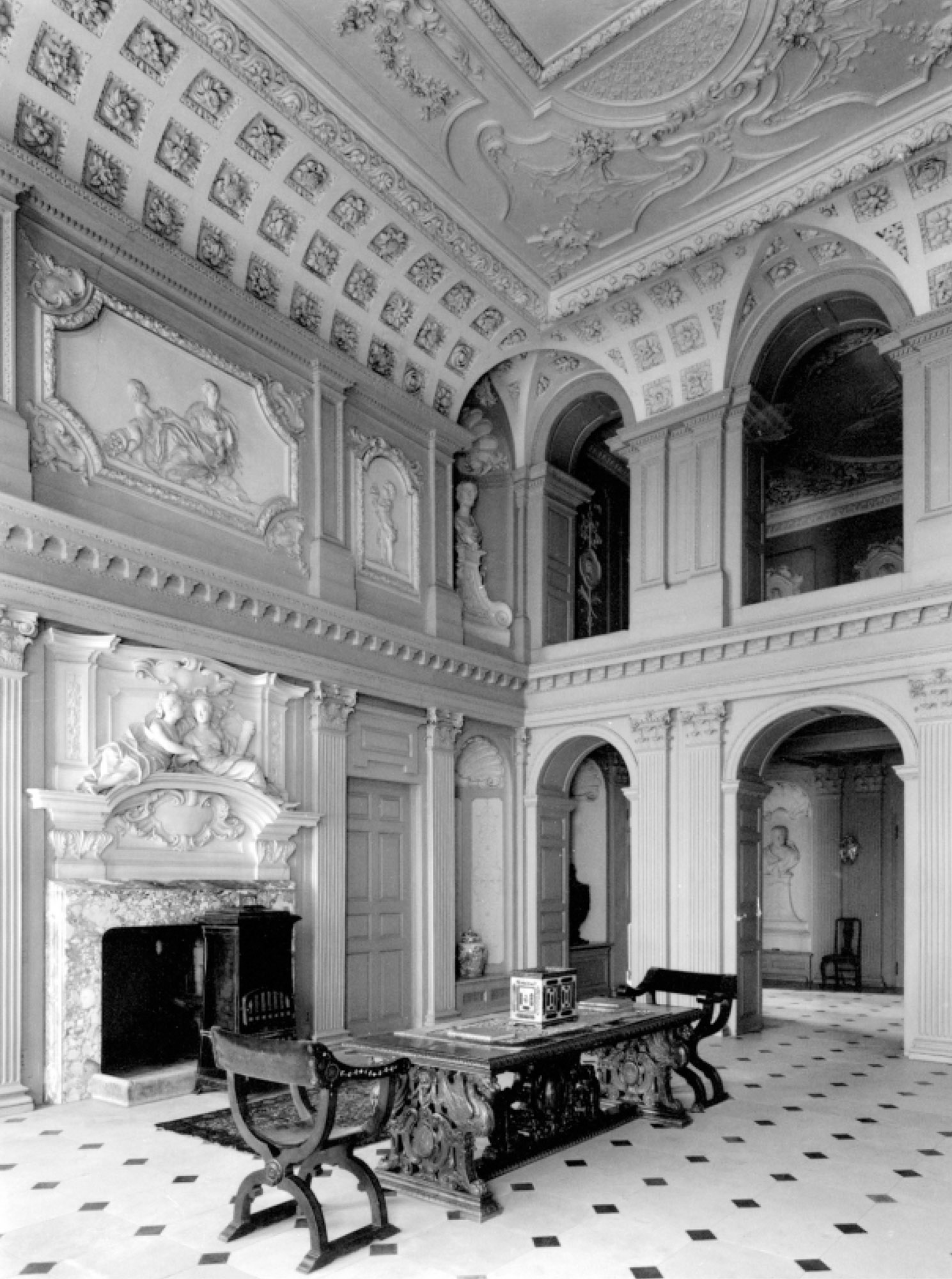
Gloster House, County Offaly, is a long low-lying mansion built from around 1700 onwards. The two later wings rather upset the balance of the original nine-bay façade in the middle, an exterior that perhaps looks a little earlier than what lies within. Entering through the front door there is a spectacular double-height space and immediately in front of the visitor are two tiers of arches, the upper being an open gallery like that which once existed at Kings Weston. The main hall gives onto an inner hall from which a pair of staircases take you up to the gallery level from where views back into the hall can be enjoyed. Alcoves line the side walls in a similar way as drawings suggest was the case at Kings Weston. There are some key differences of course, there are no fireplaces in this space, and the overall impression is more decorative and ornamental than similar spaces designed by Vanbrugh.
Ground floor plan of Gloster House, County Offaly. Later extensions shown in light grey and double-height space in paler blue.
These works at Gloster House, dating probably to the 1720s, have been attributed to perhaps Ireland’s most important architect, Edward Lovett Pearce. He’s a figure we’ve brought into Kings Weston’s story before. Born into an Irish family, Edward was a cousin of Sir John Vanbrugh and, at 16 years old, was apprenticed to him after the death of his own father in 1715. This was a period during which Vanbrugh’s office was still overseeing works at Kings Weston. Whilst other works would have become familiar to the young pupil, it appears as though Kings Weston’s interior made an impact.
The entrance hall at Gloster House, County Offaly. (Gloster House website)The gallery, with arches on the left overlooking the hall. (Gloster House website)
After a brief time in the army in 1717 Lovett Pearce returned to architecture and to his homeland. It is during this early period that the Gloster House work is supposed to have been completed. The similarity between the lost Saloon at Kings Weston what Pearce later achieved in Ireland is most marked. Pearce increasingly moved away from Vanbrugh’s Baroque style to the developing Palladian movement, but at Gloster House he combines Vanbrugh’s dramatic and playful use of space with more modern ornamentation. The tight cage of stone arcades constricting the staircase that was built at kings Weston is transformed in Gloster House into a light open gallery with a single freestanding colonnade and classical-inspired vault.
Gloster House is not the only building that seems to owe Kings Weston its inspiration. Dated 1720, a design for stables survives in the Kings Weston Book of Drawings authored by a Mr Price. Although this is the only known reference to this gentleman it shows he was a competent architect. Though the context in which the drawing was created are not known, Mr Price is likely to have been familiar enough with Kings Weston to be able to supply designs complementary enough to Vanbrugh’s house. It’s likely that Price was “John Price of Richmond” (sometimes “of Wandsworth”). Price has the strongest claim to be architect of Barnsley Park, Gloucestershire, where works were ongoing in 1720.
The entrance front of Barnsley Park, Gloucestershire.
Just a glance at the entrance front of Barnsley Park and one can see similarities. The composition of the temple frontage, bold keystones, arched windows, weighty attic storey and pediment all feel familiar. The other elevations are all entirely different, a feature shared with Kings Weston, but entirely individual in character. We have to go within to see how exposure to the unique Saloon of Kings Weston might have translated into Price’s work. The entrance hall repeats Kings Weston’s double-height space and uses an open arcaded back wall to introduce a dramatic visual connection between it and the inner hall and gallery beyond. Unlike Kings Weston or Gloster House, the inner hall isn’t a showcase for a grand stair, this is set off to one side. Another oddity is that the first floor gallery doesn’t take advantage of the open arcades for a grandstand view, instead allowing the arches to stand as little more than a room divider. Instead, the gallery bridges the inner hall along its back wall.
The ceilings to the two halls at Barnsley Park are the reverse of the arrangement at Kings Weston; the heavily coved front Hall is like the one formerly in the stair hall at Kings Weston, and the flat ceiling with a central oval compartment more like the surviving Saloon ceiling. Could the coved ceiling existing at Barnsley Park show us what might have been lost to the Victorian refurbishment of the stair hall?
The hall at Barnsley Park, Gloucestershire, with its own version of the arcaded end wall.
Like Gloster House, much of the effect at Barnsley Park arises from thickly applied decorative embellishments rather than simple architectural form, and, in that, they likely differ from Vanbrugh’s intentions at Kings Weston. This was a building Vanbrugh referred to as a “chateau” and clearly hoped it would assert a masculine, martial, presence on landscape and occupants alike. This perhaps proved to be the undoing of the Saloon and stair hall. No longer in line with the developing direction in architecture, lacking in domestic comforts, and otherwise inhospitable, it’s unsurprising that they were remodelled by later generations. However, these two surviving interiors, one by Pearce and the other by Price, might allow us a glimpse of what was lost.
Ground floor plan of Barnsley Park, the paler blue denoting the double-height spaces.
Ahead of Heritage Open Days, and to accompany our history of the stair hall last year, here’s a short history of the mighty room variously known as the Picture Gallery or Hall, but perhaps more properly called the Saloon. It’s always been intended as the most impressive of the rooms in the house, where important guests could enter and find themselves in a space designed to impose itself on the visitor through its great scale. Despite many changes in appearance from the original design by Sir John Vanbrugh, even today the hall has that power.
An original plan for Kings Weston house with annotations.
Today, what we see on entering by way of the front door is a comprehensive redecoration of the 1760s. As designed in 1712 for owner Edward Southwell, the walls were bare Penpole stone, with arches, alcoves, arcades, and other classical architectural detailing echoing that of the main facade. Visitors entering through the front door would have been greeted with two fireplaces before them, an expression of both hospitality and, in being able to afford fuel to keep both burning, wealth. Between them was a single arched door leading into the stair hall beyond, attention to which would have been drawn through glimpsed views through open arcades and a gallery at first floor level. Around the rest of the room were arched doorways and semi-circular alcoves, perhaps for the display of statues.
A Computer generated view of the Saloon at Kings Weston as originally designed in 1712.
A dramatic interplay of spaces was a familiar feature in Vanbrugh’s repertoire. The Hall at Blenheim Palace is the most ambitious of these theatrical spaces, but similar arrangements at Grimsthorpe Castle, Lincolnshire (design circa 1715), and Seaton Deleval, Northumberland (1718) repeated themes developed at Kings Weston. Even in its fire-damaged state, the entrance hall at Seaton Deleval gives the strongest idea of how Kings Weston’s Saloon might have looked when it was first occupied in 1716. The open arcades and high level galleries allow the visitor to experience the spaces from a variety of angles, passing from grand volumes into more intimate passages, from light airy spaces to dark and back again. Vanbrugh intentionally excited visitors by sculpting these contrasting and multi-layered spaces. He was ahead of his time in creating an experiential architecture, designed to provoke an emotional response from just air and stone.
The hall at Seaton Deleval with similar features to Kings Weston. (Jon Dalrymple)
Although architecturally impressive and grand in scale, the Saloon can hardly have been a practical or comfortable room to use. The stone walls would have been cold, and the open arcades would have promoted drafts to draw through the house. In 1769, by the time the Saloon was described in “A six week tour thru the southern counties of England and Wales” as “the only tolerable room, and that rendered totally useless, by a vast echo” its shortcomings had been addressed with new designs.
Cut-away of Sir John Vanbrugh’s original design for the Saloon and Stair Hall.
Edward Southwell’s Grandson, the third Edward Southwell, returned from his Grand Tour of Europe in 1762, a 24-year old with grand plans for his inheritance. Employing the architect Robert Mylne who, it is thought, he met in Rome, he set about modernising Kings Weston. Mylne was engaged in April the following year, but it wasn’t until four years into the project that work on the Saloon began. In November 1767 Mylne started sending Southwell a series of drawings for the room. General elevations of the walls, cornice details, fireplace, and “frames of the pictures at large”. Unlike a tradditional gallery the paintings were all integrated into their architectural setting rather than hanging in tradditional gilt frames; It’s this that ensured their survival in the house to today.
the Saloon with its decorative plasterwork framing the Southwell family portraits.
The carved stone architectural details were chiselled away and the room lined with timber studs and lath and plaster to improve both sound and warmth. The work in the Saloon was intended not just to improve its performance, but to display the large collection of family portraits as the lineage of a great family. The intention was to use each of the three blank walls to display the portraits of a particularly auspicious branch of the family. The Southwell’s themselves took the north wall, Edward’s mother’s side, the Watsons, took the wall opposite, but the wall confronting the arriving visitor was reserved for the most notable family: the Cromwells.
The ceiling appears to have been retained, only slightly altered from the original but receiving extravagant swags of flowers in plasterwork, all wrought by the famous Bristol workshop of Thomas Stocking. Mylne’s “drawing for a flower and urn in ceiling of saloon” apparently didn’t find favour. The redesigned Saloon was finished in 1768, with Mylne’s last correspondence on it being “patterns of water straw colours for the saloon”, presumably a yellow/stone colour paint for the walls.
Detail of the ornate plasterwork flowers and rose executed by Thomas Stocking in 1767-8