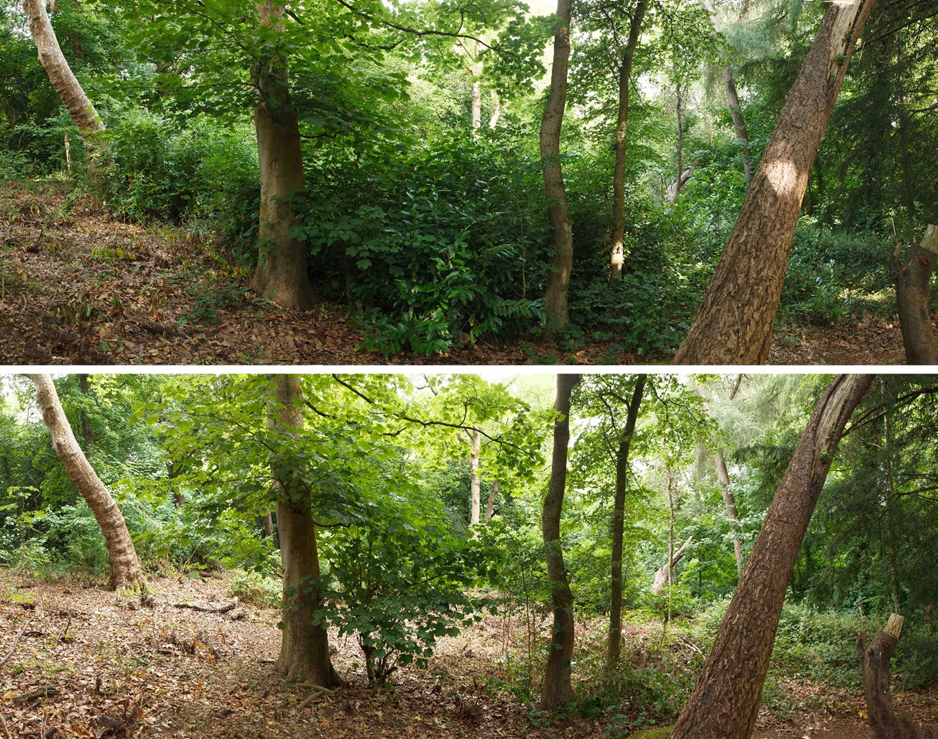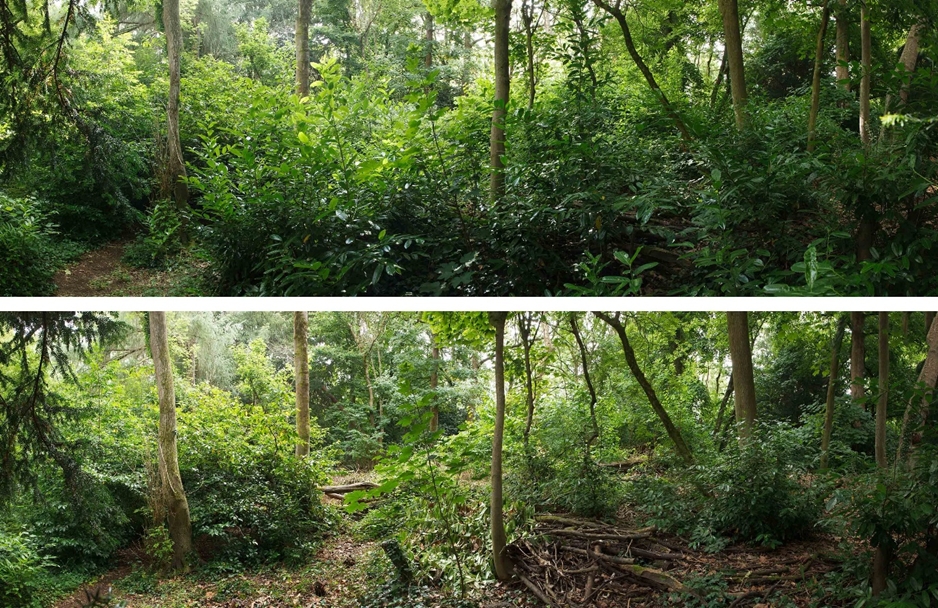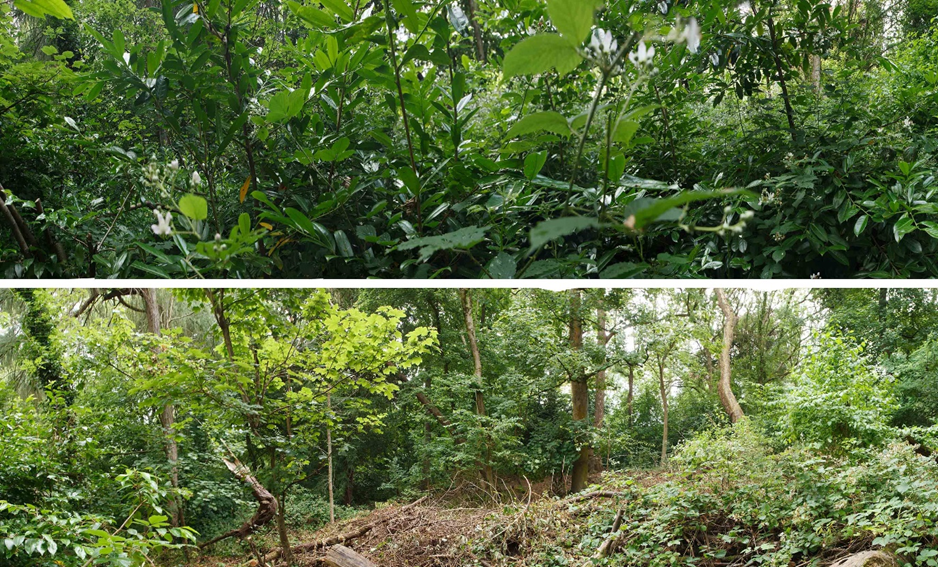
Worked carried on into July to clear the regrown cherry laurel in Penpole Wood. Most visitors will see little change from the recent work much is hidden well back from the main path through the woods. However, the impact of cherry laurel on the native woodland is severe if it’s let get out hand.
looking west through the wood before and after the re-trimming of the cherry laurel.
Since we cleared the area in 2016 there has been a lot of regrowth, particularly on the harder to reach area along the top of the former quarry. Because the laurel has historically stunted tree growth in the area an opening had developed in the tree canopy and Brambles had begun to colonise the area aided by the catenary of laurel stems; in short, the area was in a big mess again.
the view east through the working party area.
A relatively small group of volunteers, a usual state of affairs for the holiday season, set about putting things in order and extending the areas cleared in the last few months. Cherry laurel has been felled again, untangled from the brambles and stacked out of the way. More of the saplings planted in 2016 have also been revealed again in thriving condition. Whilst there remain some laurel bushes to the periphery of the area, ones we had neither time nor energy to tackle on a hot day, there’s not enough to occupy a full working party. These will be left for the moment while we focus on new areas.
looking up slope from the edge of the old quarry and towards the main Penpole Wood path.
Our gradual passage back through Penpole Wood continued last month, retracing our steps with removing cherry laurel. Having built-up momentum on this job since April we’ve continued westwards through the woodland, tracking along the top edge of the former quarry.
Animated image showing the same area before and after work. This view looks back towards Kings Weston house, with the main path just out of sight behind the trees on the right.
The sunnier Summer months are best spent labouring in the relative shade, the heat usually tiring our team of volunteers quicker. Despite the warm conditions, we tackled a large portion of the laurel that had regrown to considerable height in some areas. Over the last eight or nine years, the laurel had bushed-out with some areas with very dense coverage.
Looking south, upslope from the edge of the historic quarry. Many of the liberated saplings can be identified.
The are was planted with saplings following our original work, and we’re glad to say that there were many left, albeit somewhat overshadowed by their more established and overpowering neighbours. This work will help protect the progress we made and allow these saplings to bring greater biodiversity into this part of the woods.
The flat area adjacent to the main path through Penpole Woods was less choked than the top of the quarry. The path can be seen passing in the background after volunteers removed the invasive laurel.
As working parties draw to a close on a Saturday afternoon, sometimes we’ve not managed to complete what we might have hoped; bits get left behind as we move on to other parts of the estate. Last month’s volunteer work tackled three such areas at the very heart of the parkland close to The Circle.
We’ve had several working parties along the north edge of the ancient lime Avenue, mainly around 2016-17. These focussed on natural spacing and the chore of removing over-mature laurels. The areas left included some dense and challenging laurels, not reason for us to have neglected them the first time, but enough to keep us occupied for a full working party this time around.
With the cherry laurel removed, the woodland opens out onto the ancient lime avenue beyond.
One area was just to the north of the ancient Lime Avenue, and work here gave us the added opportunity to reinforce the line of the path through trimming snowberry bushes. The second area included a concrete base to a WWII Nissen hut, one that was joined formerly by many others hidden in the trees. The final area bordered the Quarry garden on its eastern end and a forest of mock orange bushes, part of historic planting, to the east. An added challenge in the last area was tidying a fallen tree that had blocked one of the well used paths in this area.
The central of three locations tackled last month, directly on the main path into the woods. The WWII base appears from below the invasive cherry laurel.
Split into three adjacent groups, a good turnout of volunteers saw work progress quickly from east to west. We usually lose people in the afternoons as they get tired or need to get onto other things but still managed to extend the area tackled westwards and begin trimming of laurel regrowth that has begun to regain a foothold above the quarry. By about 2pm we had achieved everything on our agenda and more!
It was interesting to uncover the base of the WWII Nissen Hut and its features, more of that later. The historic area of Mock Orange is now more visible, framed by the less invasive Portuguese laurels we’ve left in place. For the intrepid, there’s the opportunity to try and trace the line of the lost Victorian path that once ran through the back of this area, now freed from the choking embrace of cherry laurels.
The third location, close to the east end of the quarry garden, and looking up-slope towards the main path through the woods.
October’s Big Bulb Plant at the Iron Bridge has come good with a sensational display this Spring. The heavy work preparing the ground and digging holes through rubble was definitely worth the effort; the visual impact speaks for itself!
A panorama looking down and across the slope towards Shirehampton Road with the bridge on the left. The City boundary marker is now surrounded by flowers.
Both sides of the Iron Bridge looked phenomenal in the Spring sun during March, though flowers are just going over now. We hope that everyone who contributed to the bulb plant will have had the chance to go up, take a look and enjoy the display. It certainly seems to have attracted a lot of attention.
John Loudon McAdam’s iron bridge is now set in a sea of gold on the Kingsweston Hill side
This October we hope to give daffodils a rest. The cultivated blooms are not suitable for many parts of the historic estate and we’re keen to diversify into more native species. As part of the Nature Conservation plan being developed by the Council we hope to agree suitable species and locations that will both ornament the estate and improve its appeal for nature.
The northern approach to the bridge on the Kingsweston Hill side.
The issues of invasive cherry laurel are well known; outcompeting native species, leaching toxins into the soil, and contributing to soil erosion, are just three reasons that many hundreds of hours of volunteer work have been devoted to its removal. Whilst it was once maintained as a decorative landscaping plant, it’s now run wild and is having a seriously detrimental impact on the woodland and the soil.
the cherry laurel regrowth long the mid-18th Century pleasure walk
The last two working parties this year returned to the area on the north-east side of the Echo path, sections of the estate we originally felled laurel in around nine years ago. Whilst much was poisoned by the Council in the wake of our work, the areas closer to Kings Weston house weren’t treated and have more quickly regrown. This was the target of March’s working party.
With a good team of volunteers, we carried on the surgical removal of the laurel whilst leaving the native species that have begun to recolonise the area. Starting from the twin ponds, work progressed downhill throughout the day though, sadly, we didn’t manage to clear as far as the boundary with the house; this was left for a few volunteers to clear away later.
The area behind the two ponds before and after volunteer work. Many native bulbs were planted here in the autumn of 2014, many of which had been hidden.
In the process of opening the area back up many of the saplings and native bulbs planted in the area have been revealed. In February we found the snowdrops lost beneath the laurel growth, and last month the bluebells and miniature daffodils were rediscovered, now better able to reach the sun! Eventually, when the laurel toxins have eventually leached out of the soil and the forest floor has matured further, it will ensure that rainwater run-off from the slope will be more effectively captured.
the view from the pleasure walk along the garden edge looking towards the main Echo path and the lawns beyond.
It’s always lovely to meet new volunteers, and we welcome those who turned up last month to lend a hand with keeping on top of the cherry laurel regrowth close to the Echo. It’s been eleven years since we began cutting this invasive shrub away in this area. Thanks to the Council following-through with poisoning of the stumps the growth has been seriously retarded, but eleven years is still a long time to go without any re-cutting.
Looking downhill towards Kings Weston house, an area first cleared in 2014.
Some areas had started to become quite overgrown with laurel, and there was a need for care in cutting them out. Dozens of saplings, planted by KWAG not long after we cleared, survive and have begun to thrive. It was important that none were accidentally lopped off in the process!
The target was to clear everything between the Echo and the two ponds. Most of this was achieved, but we fell slightly short for want of volunteers to help in the afternoon. Nevertheless, only small areas immediately around the pond remain to be done this month.
Looking up the slope with The Echo revealed in the distance after laurel clearance work.
One unforeseen bonus of our work has been the revealing of some of the native bulbs planted in the area as part of one of our early big Bulb Plants. Groups of Snowdrops and native daffodils were discovered cowering under the cherry laurel and bramble, hopefully now more able to survive.
Another task performed on the day was the pushing back of the cherry laurel margins alongside the boundary wall and road. We’re keen not to lose all of these and expose walkers to the traffic, but there was a good deal to cut that had begun to grow back across the path again. Unfortunately, we have an incomplete set of before-and-after photos, but we’re returning this weekend, so we’ll provide more of an update next month.
The view looking back towards the house looking down the pleasure walk leading behind the woods from the Echo.
KWAG brings volunteers up to speed on the tasks for the day.
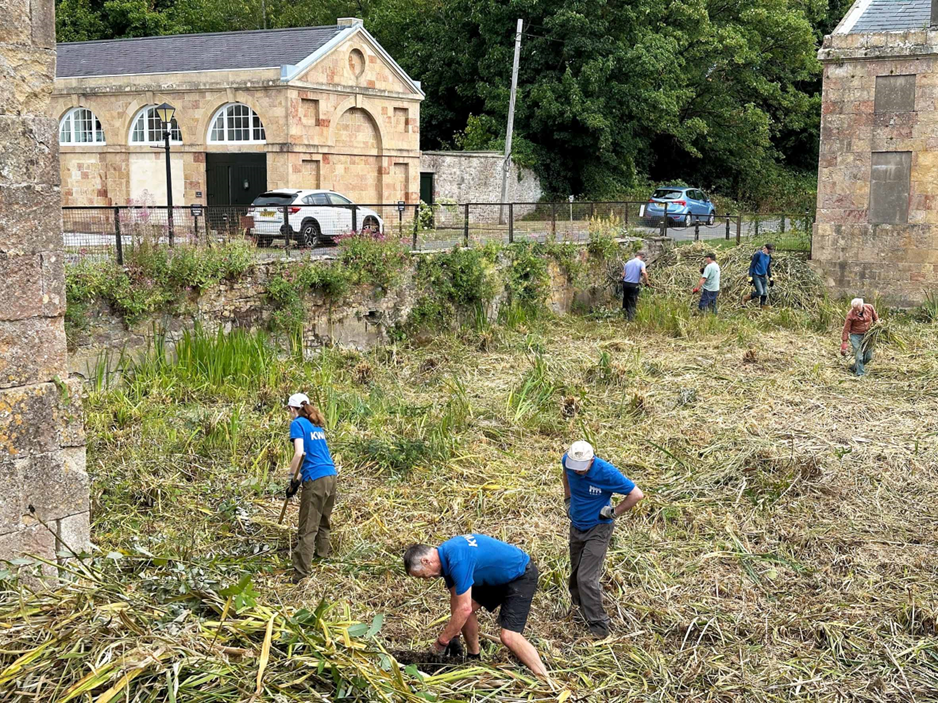
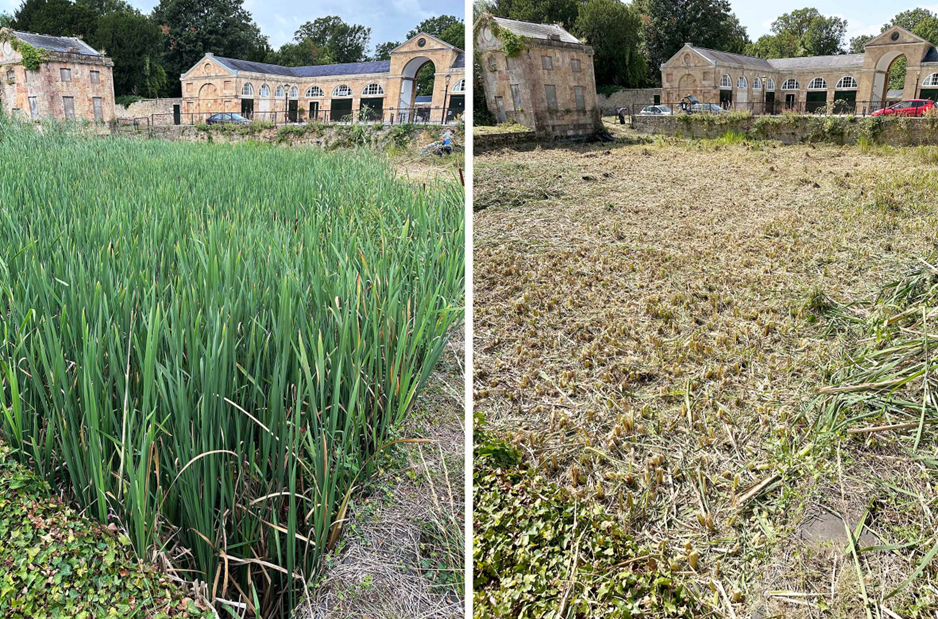
The estate and KWAG was fortunate to host a team-building event by officers of Bristol City Council Development Management team on Wednesday 25th October. We’d managed to arrange with Kingsweston School for a group of 25 volunteers to access the area of the Georgian walled gardens around the lily pond on Napier Miles Road as the latest in our campaign to stem the tide of neglect and restore the much-loved and historic site.
The work overseen by KWAG focussed on the three strips of garden surrounding the pond, the removal of the dead box hedging, digging-up of brambles, and the felling of self-seeded saplings and shrubs. The formal box hedges succumbed last year to an onslaught of box moth caterpillar that ravaged Bristol. Here it left just a single bush alive, and that just barely. The brambles and saplings have taken advantage of the lack of maintenance since the school returned the pond area to Council Property department.
The south walk along the pond before and after the day’s events.
We were lucky enough to take advantage of the west lodge at the pond for bag storage as the team were briefed on the tasks for the day and health and safety. It was impressive, the way that the volunteers engaged with the work and threw themselves into it. Despite an unpromising weather forecast, the rain held off until the dying minutes of the event before 4pm and we even enjoyed some sun.
Tired Council volunteers pose at the end of the day outside the lodge.
We were lucky to have one of the city ecologists and tree officers as part of the team who were able to advise us on the work. The ecologist was particularly in demand when digging disturbed dozens of Common Newts and other amphibians settling down amongst the roots. These were relocated to safe areas around the pond.
Huge inroads were made on clearance, massive progress in restoring the area. Whilst the job wasn’t completed in its entirely, the magnitude of the job was enormous and what was achieved was epic in scale. We are extremely grateful to all the Council officers who turned out for the event and made such an impact. Despite the wet finish everyone enjoyed the event and stuck with it until the very end. The space that’s been revealed is now a blank canvas to re-plan the gardens, and buys precious time for KWAG to plan a viable new future. Thanks too to Kingsweston School for hosting us, and parks and other departments of the Council for enabling the event.
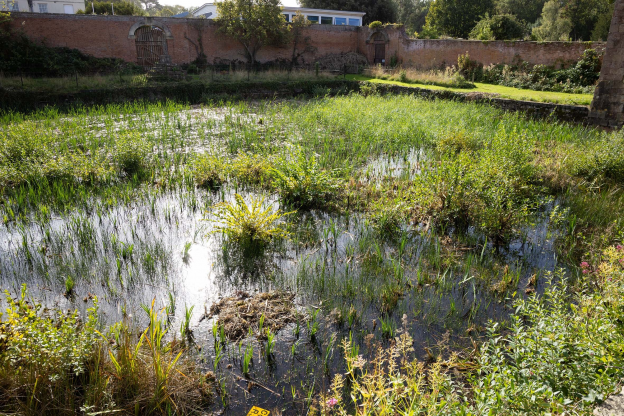
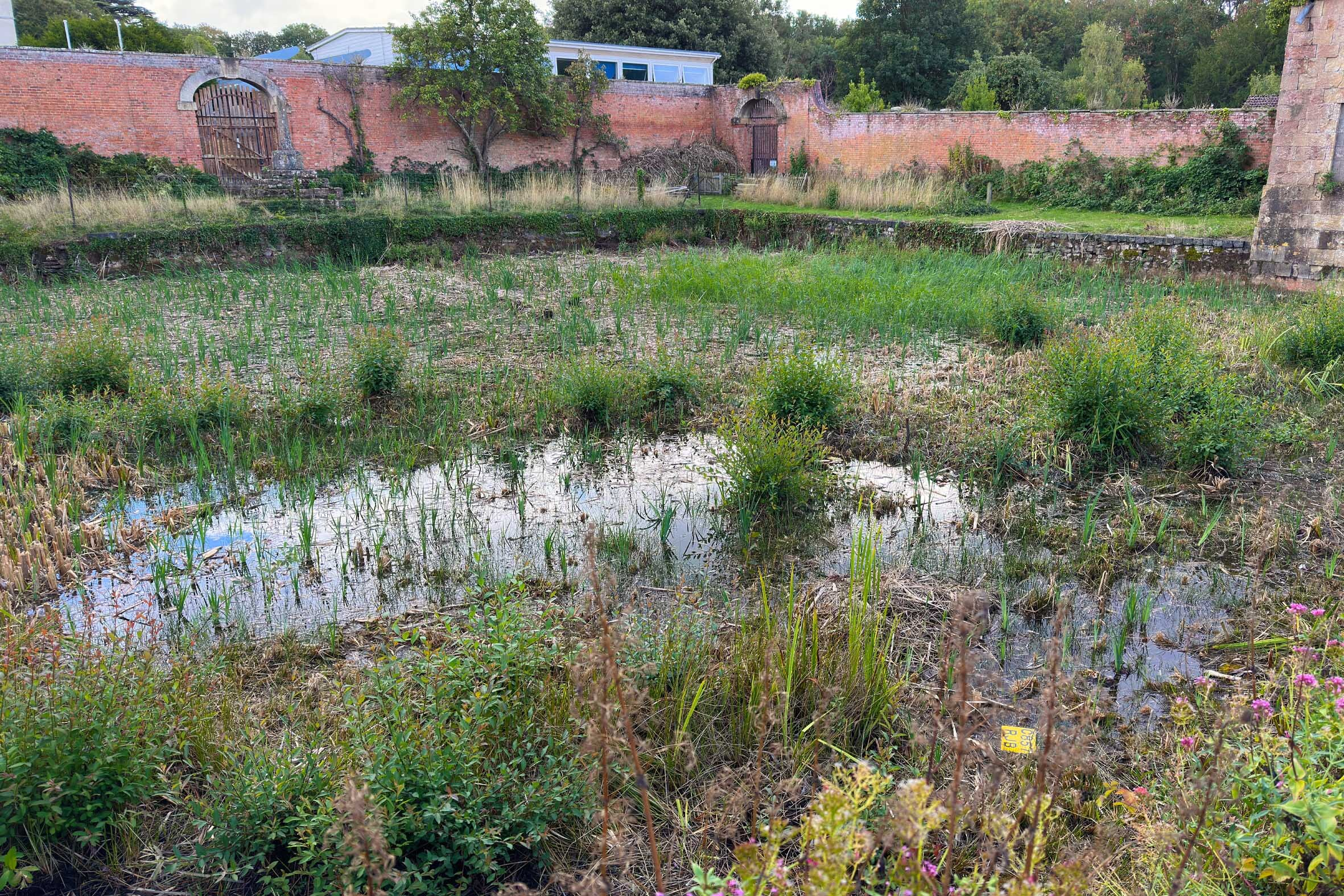
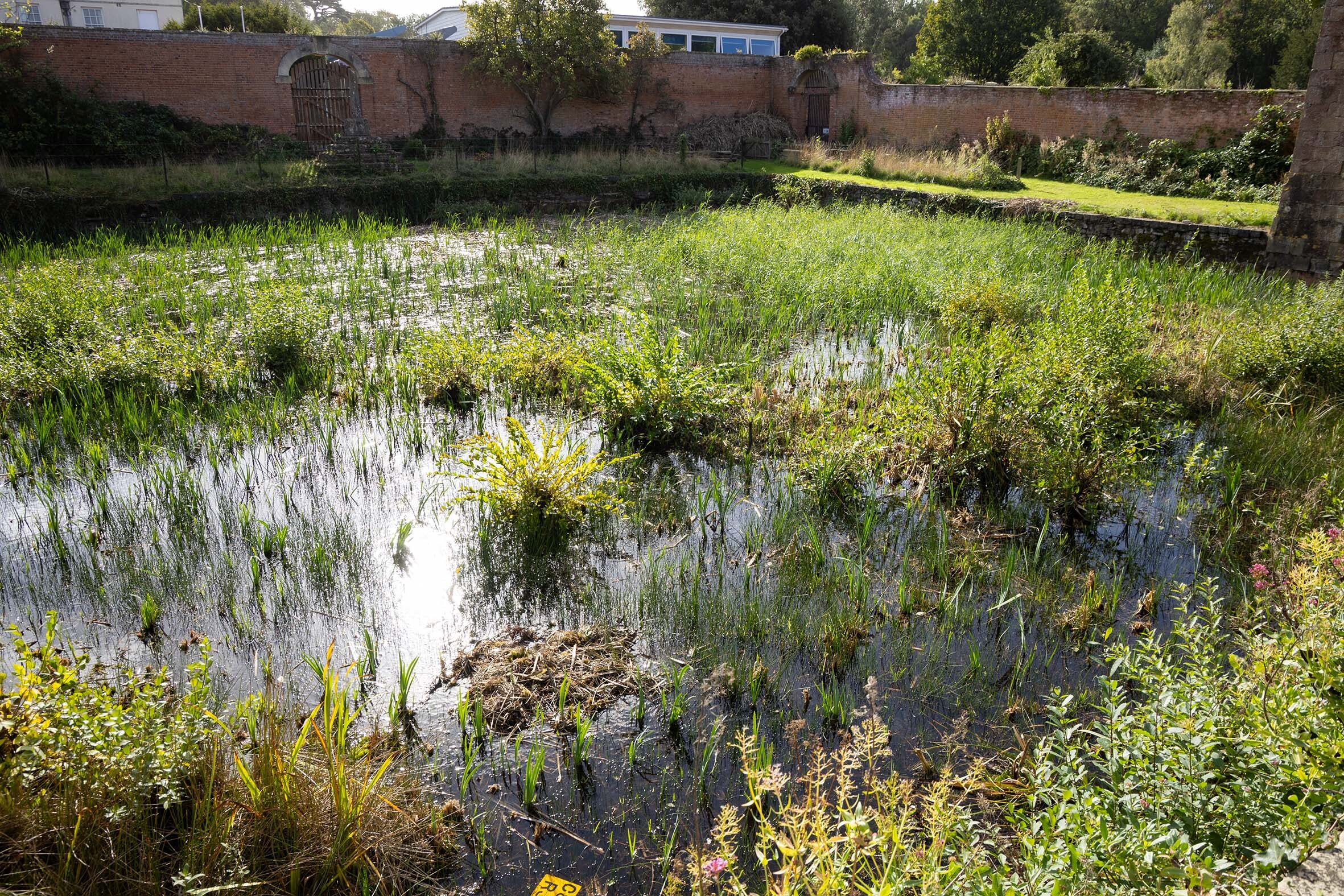
Similar views of the west side of the lilypond in 1898, and before and after recent volunteer work. The pond edge is again discernible and brambles threatening the lodge have been cut.
…As a postscript, KWAG returned to make some investigations of the pond and have managed to clear some of the saplings alongside the road so visitors can glimpse progress on the garden areas beyond.
Some clearance at the lilypond has allowed us to find the waterline and judge the extent of the tree growth.
We’ve noted before that the summer months make working parties much harder, and last month was no exception. Despite a good turnout and a couple of welcome new faces we didn’t manage to finish off the area as planned. This was more to do with the amount of work left being more than we first judged. Nevertheless, the last few months have seen a significant erosion of the cherry laurel’s dominance in this area.
The change in the view east, back towards the house, between May and this month.
It’s clear from historic maps of Penpole Wood where the problem stems. The area we’ve been tackling is just outside, to the east, of the historic boundary of Penpole Wood. Here the Southwell family sought to blend the landscaped parkland into the natural ancient woodland by planting specimen trees and between them fashionable laurel bushes. They were, it is believed, intended to create a continuous blanket of evergreens below the picturesquely scattered specimen trees. Some of those trees are likely to be those that still surround the area, but the cherry laurel has since grown wild, suffocating anything else in the area and even obscuring historic paths.
Diagram showing the 1772 estate survey with current features of the felling area annotated.
The slope now looks bare and barren where we’ve passed through, a legacy of around 250 years of laurel suffocating the area. We intend to replant trees in this area this autumn, to better integrate it back into the native woodland. So, back again this month to try and finish this tricky area! Thank you to everyone who came out to help last month and we hope to see you all again this weekend. Perhaps we will finally get it finished…
A big oak at the top of the slope remains as laurels retract over the last four months. The view up-slope from the middle path thorough Penpole Woods.
The area before final preparation and digging-over.
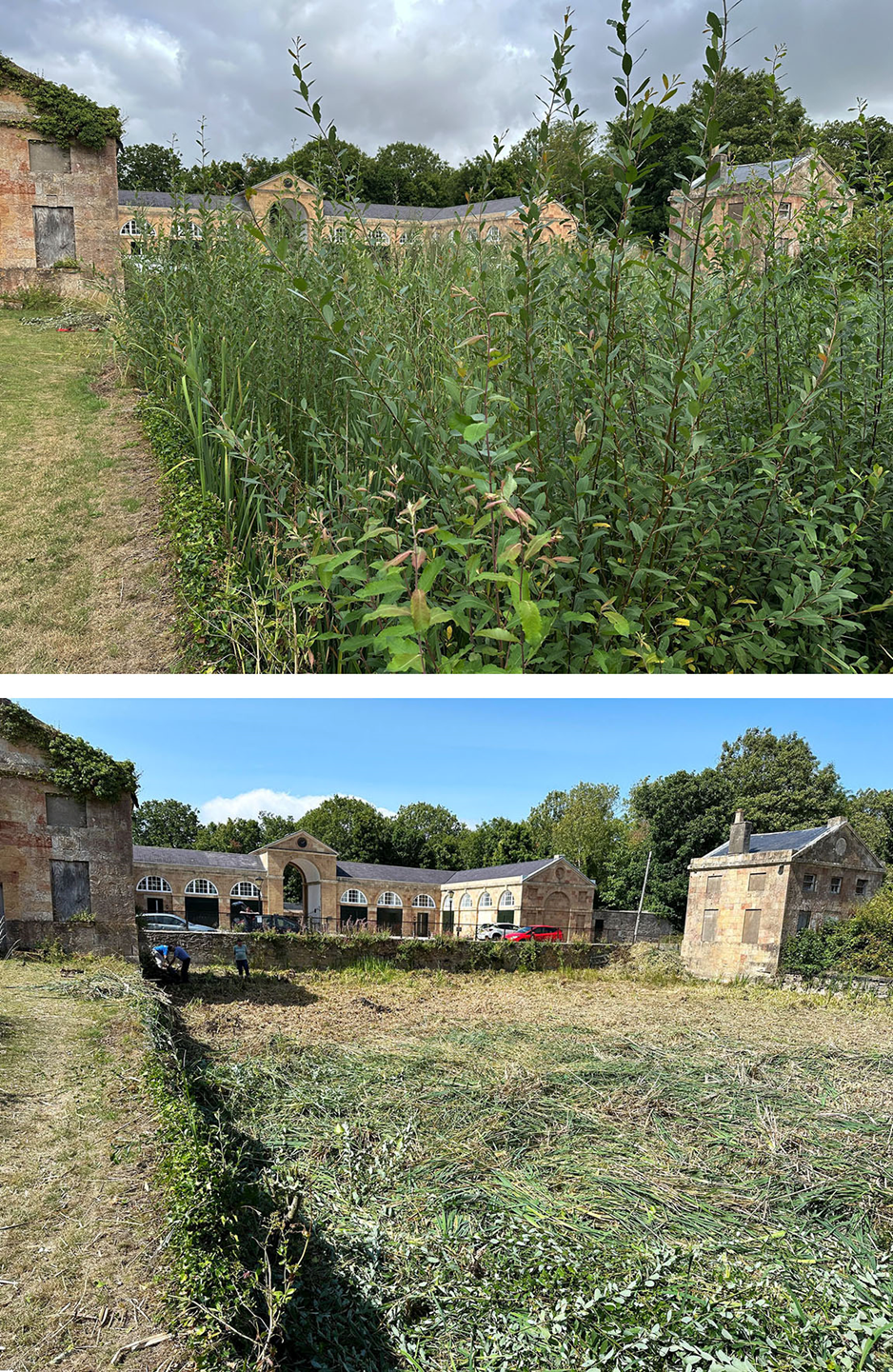
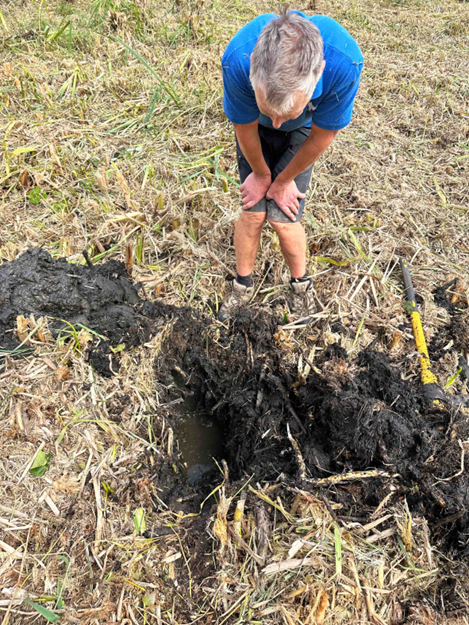
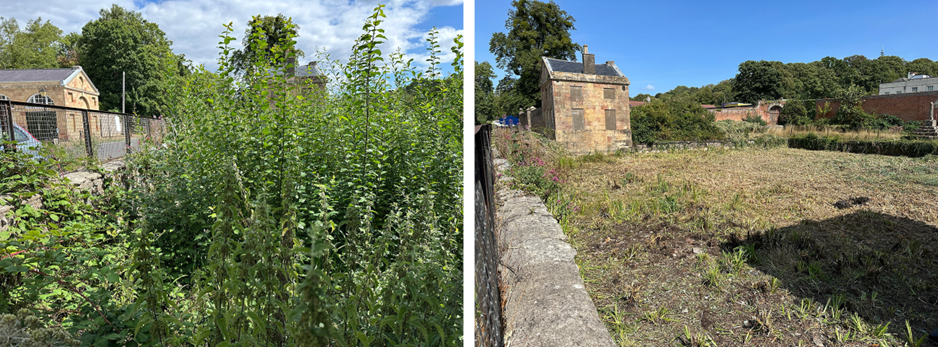
Since we started work on the View Garden area alongside Napier Miles Road a number of people have asked what we were going to plant there. Our initial ambition was only to get on top of the undergrowth that was threatening the wall, but ongoing work allowed us to think more ambitiously. Over the following months, one of our volunteers, Mike, has been diligently forking through the whole area getting rid of roots and breaking up the ground ahead of a planned seeding of the area as wildflower meadow. He was joined last month in a final push to get the ground prepared for sowing.
Because of the wet weather this year things had been delayed a little, but we had a good turnout of volunteers on Saturday 13th of May to dig over the whole area again and get rid of the last of the nettle and bramble roots that would have quickly undone any work on the new planting.
Volunteers dig-in with the task alongside Napier Miles Road.
By the end of the day we’d managed to dig and rake-over most of the area, but not quite all. Everything was finally polished off the following weekend and a specialist mix of wildflower meadow, and hedge mix for the shadier areas, was sown. The weather since proved providential, and the seeds were quickly watered in by the rain, with seeds already starting to germinate just a week later!
Thank you to all our volunteers on this, and thanks to Avonmouth & Lawrence Weston Wind Turbine Fund for grant funding the seed. We’ll try and keep you update with the results of this project as it develops.
The tilled ground a few weeks later. Look closely and you can see the green shoots coming up.
Two years ago KWAG built a new set of steps on the northern edge of Penpole Wood where the pubic right of way from Mancroft Avenue enters the historic estate. We’re glad to say this has held up well and has been welcomed and well used since we finished it. It’s an important link for students from Lawrence Weston heading from school on Penpole Lane. But the condition of the path below them had become horrendous, particularly this year where rain and mud had rendered it virtually impassable.
Recognising the issue we decided to extend our step work to connect back to Mancroft with a new well-drained path. A special project team was put together under the organisation of Jim Ellis, and materials bought. The first task involved digging out the old path, which came out easily. There was the unusual discovery of long sections of old carpet three inches under the mud, no doubt thrown down at some point to try and improve the muddy conditions. After cutting out another few inches of soil we constructed a timber structure to contain a hardcore and rubble base that will hopefully promote drainage. Gullies either side are hoped to allow water to drain away without collecting on the path. Everything was finished with a good covering of self-binding gravel.
We’ve had some positive feedback since the project was completed, but the litmus test will be next winter. Thank you to Ian, Simon, John, Colin, and of course Jim, who successfully project managed the whole thing.