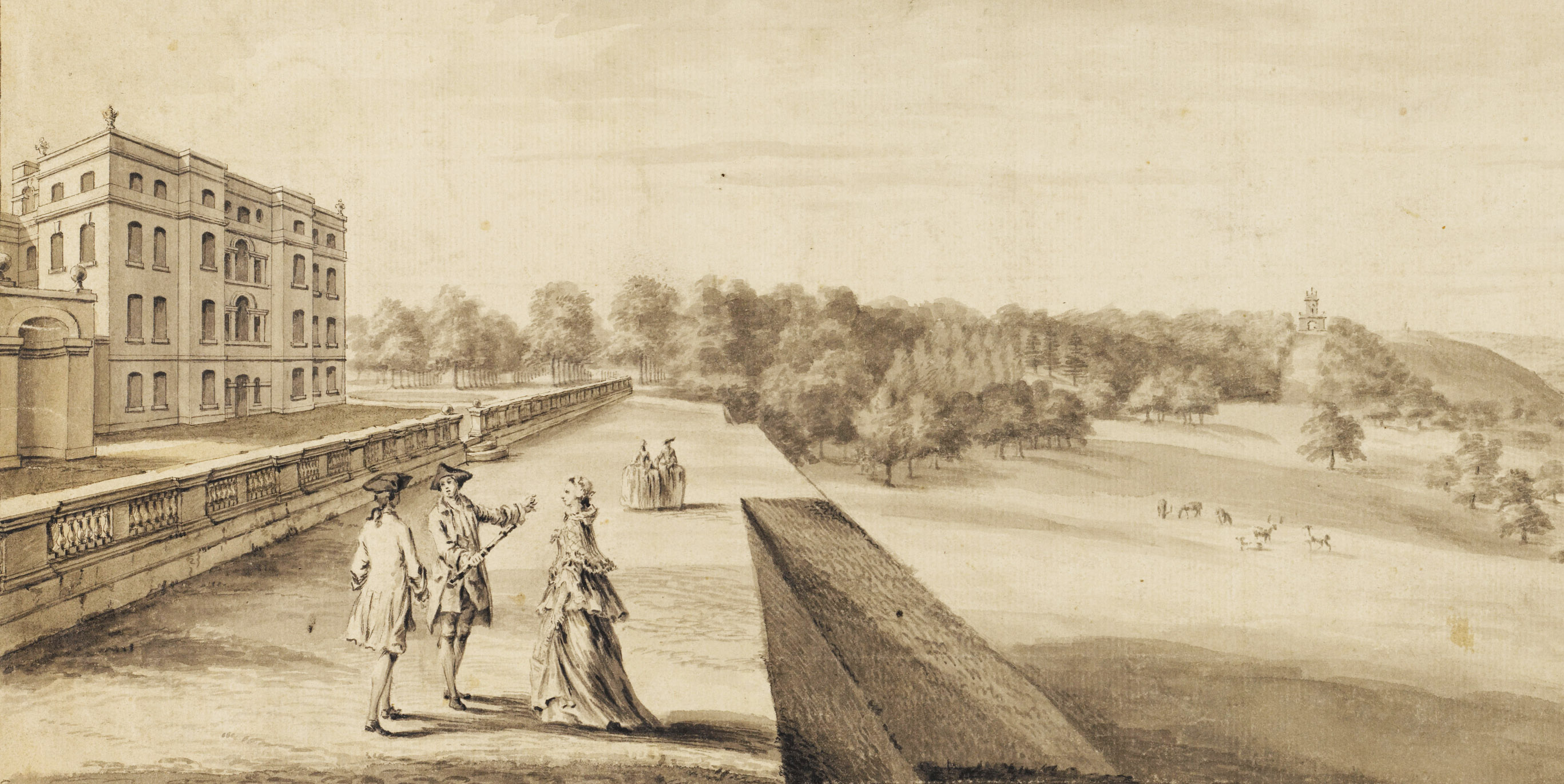
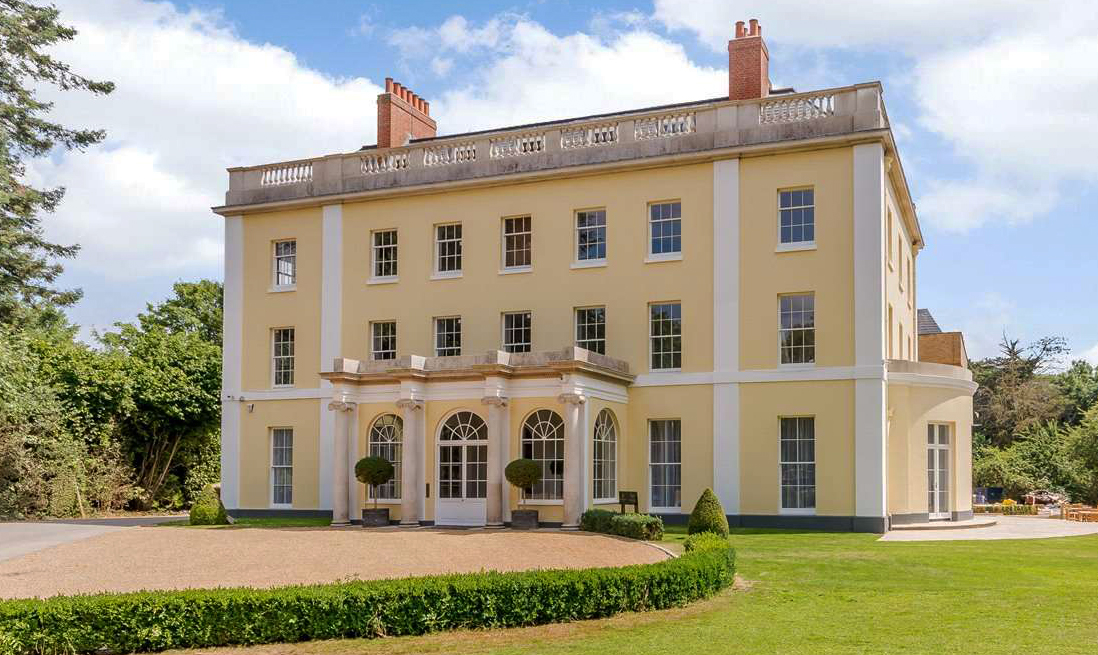
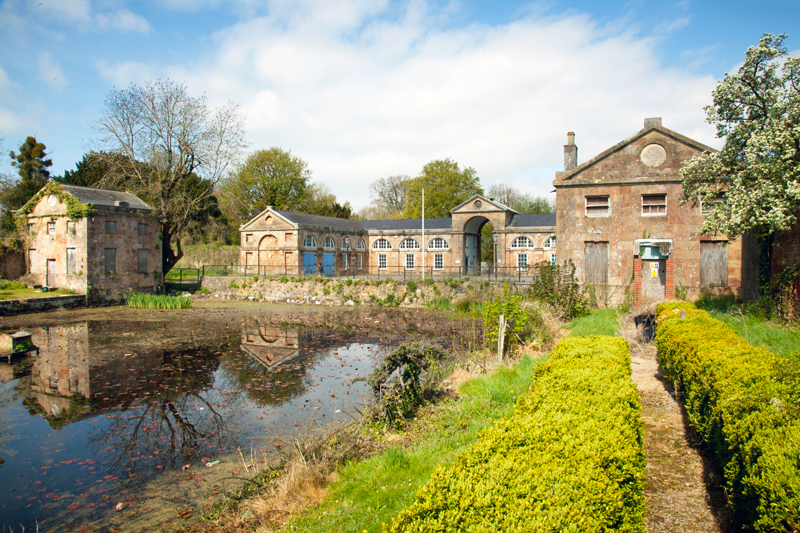
One historic feature of the estate remains shrouded in mystery: the lost windmill on Kingsweston Hill. By chance we rediscovered the remains on a recent walk across Kingsweston Hill, and they remain as a pronounced landscape feature. It’s often been mistaken for a burial mound, of which there are several across the hill, and occasionally as the remains of a Roman signal station or lighthouse.
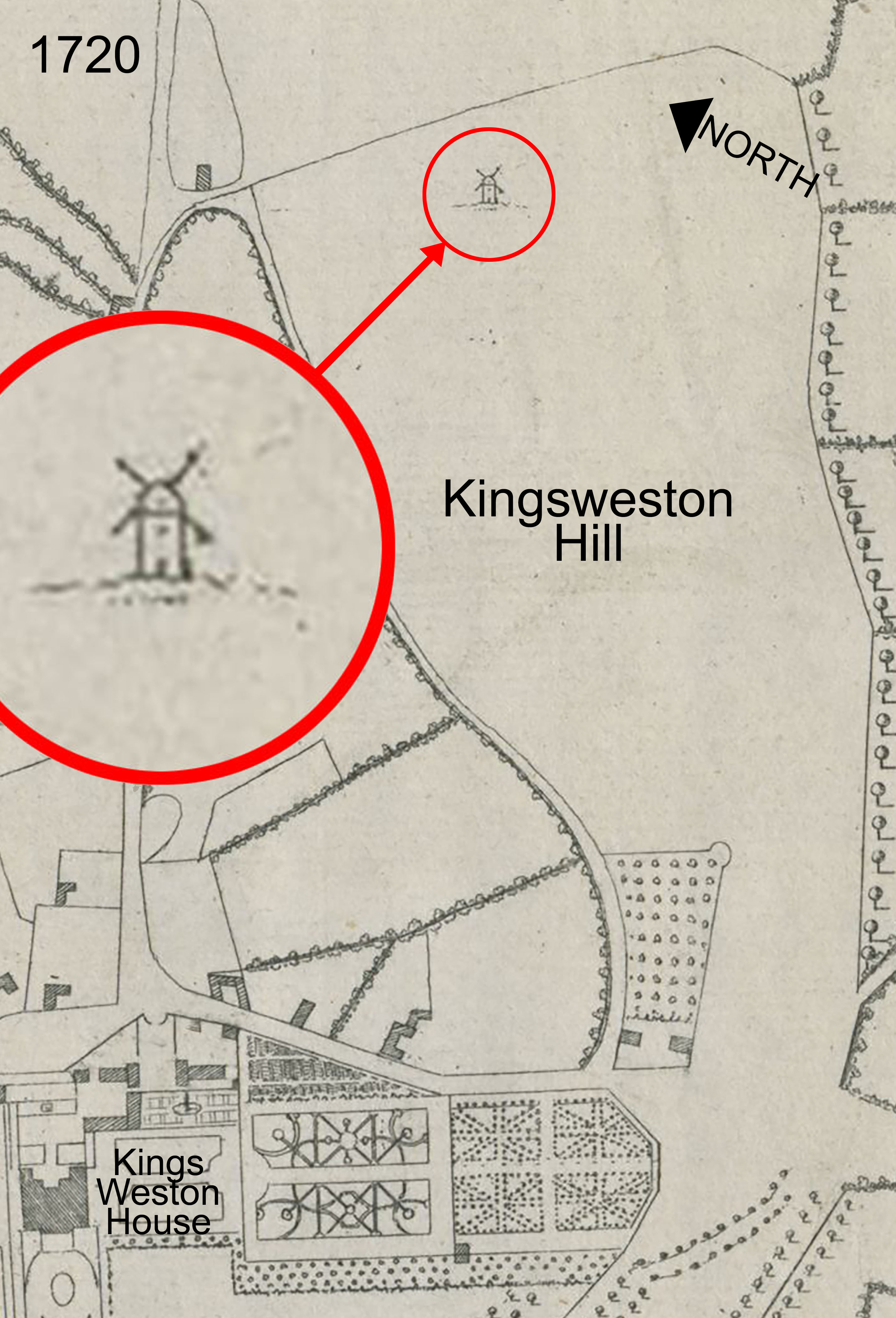
The location of the old windmill on Kingsweston Hill in relation to other features.
The windmill shown on the 1720 estate plan with a roof and sails.
Already, by 1772, it was described as an ‘old’ windmill and is shown on the estate plan of that date standing just within the boundary of the Tithing of Kings Weston. The earliest reference to it appears to be from an earlier such plan from 1720 where it’s shown, perhaps emblematically, as a tower with a rounded top and four arms for sails, but, surely an “old” building would have stood for more than 50 years? Had it already fallen into disrepair by 1772? The origins of the building are unclear.
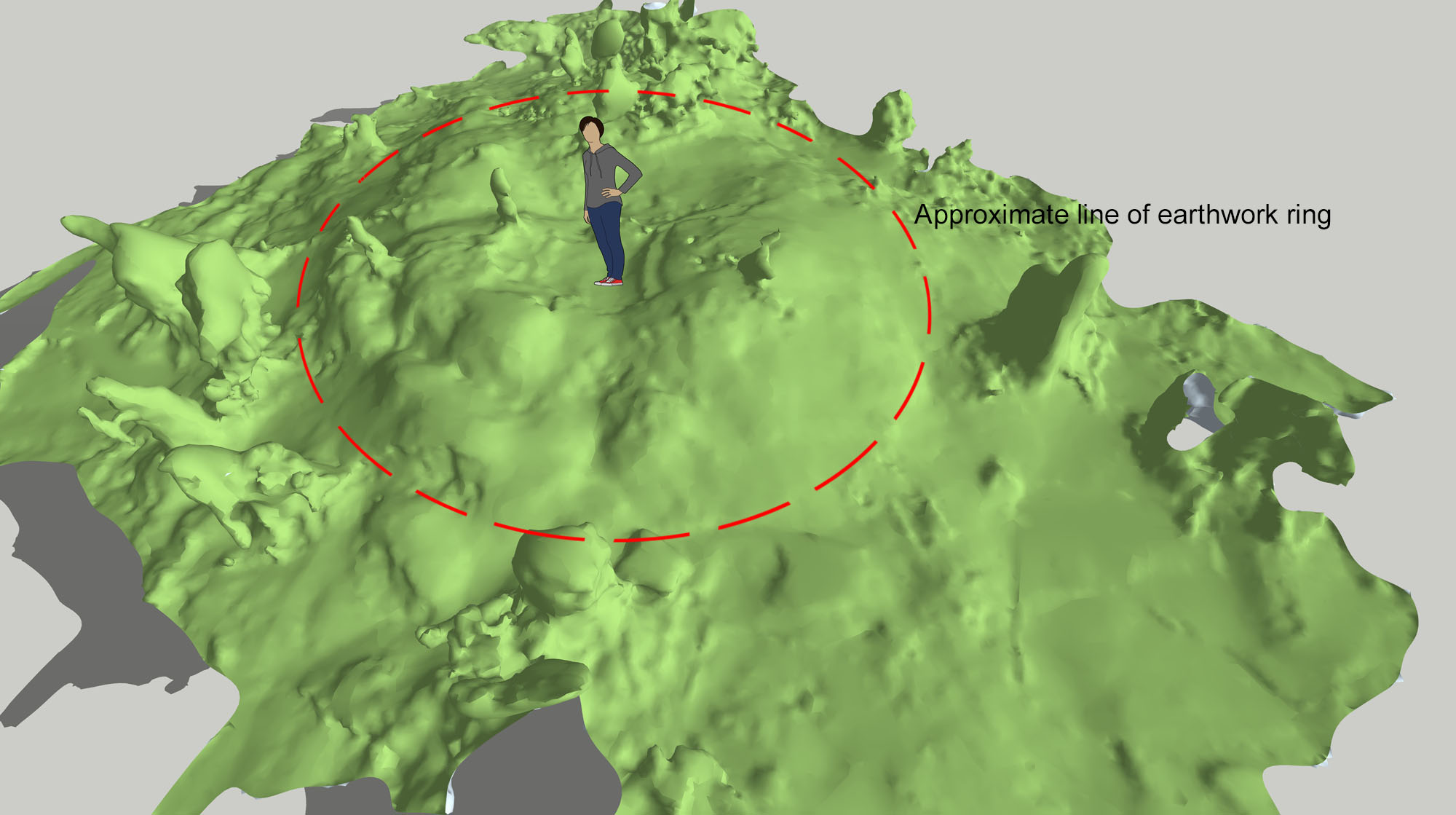
The remains surviving on the hill are now hidden somewhat by self-seeded trees that have scattered themselves across the site, but close inspection is worthwhile. There remains a significant mound with a hollow dip in the centre. Loose stonework sits half-buried around the remains and covered in ivy. The ring is about 7m in diameter and 1m in height, but the outline of the original building is likely to have been blurred by the walls falling outwards giving it a broader outline. It was clearly a circular masonry tower when first built.
It occupied a prominent and fittingly exposed location on the hill until trees grew up encroaching onto the open downland in the Nineteenth century. The wind coming up the Severn must have proven a regular if occasionally violent source of power. The mill had certainly fallen out of use by 1768 when a French Colonel was sent to spy on British interests. He recorded that the tower of the old mill was in use as a lookout in times of war, indeed, it was drafted into use for such in 1804 when a flagstaff was erected on it for signalling during the Napoleonic Wars.
The windmill is depicted punctuating the skyline of Kingsweston Hill in 1799. Blaise Castle is visible to the left of the foreground tree.
Several Georgian drawings and prints confirm that the tower remained to a substantial height and remained a significant feature, complementing the silhouette of Blaise Castle folly as an eyecatcher on the horizon. Perhaps its strategic military use ensured it was maintained at least as long as the country was threatened, but by about 1820 it vanishes. Its fate is as unclear as its origin; perhaps it was dismantled by the 22nd Lord de Clifford, robbed for its building material, or dismantled as a handy source of stone to burn in the nearby limekilns. Whatever happened to it, the surviving earthworks present an intriguing opportunity to excavate it and discover its secrets!
After it first featured in the popular BBC series in 2017, Kings Weston house again took a cameo role in the Doctor Who Christmas special last month. Much of the episode ‘The Church of Ruby Road’, the first full episode with new Doctor, Ncuti Gatwa, was filmed around Bristol, with the stair hall at Kings Weston the backdrop to a nasty accident involving Davina McCall and a Christmas tree. Fortunately, (spoilers) the Doctor returned through time to save her.
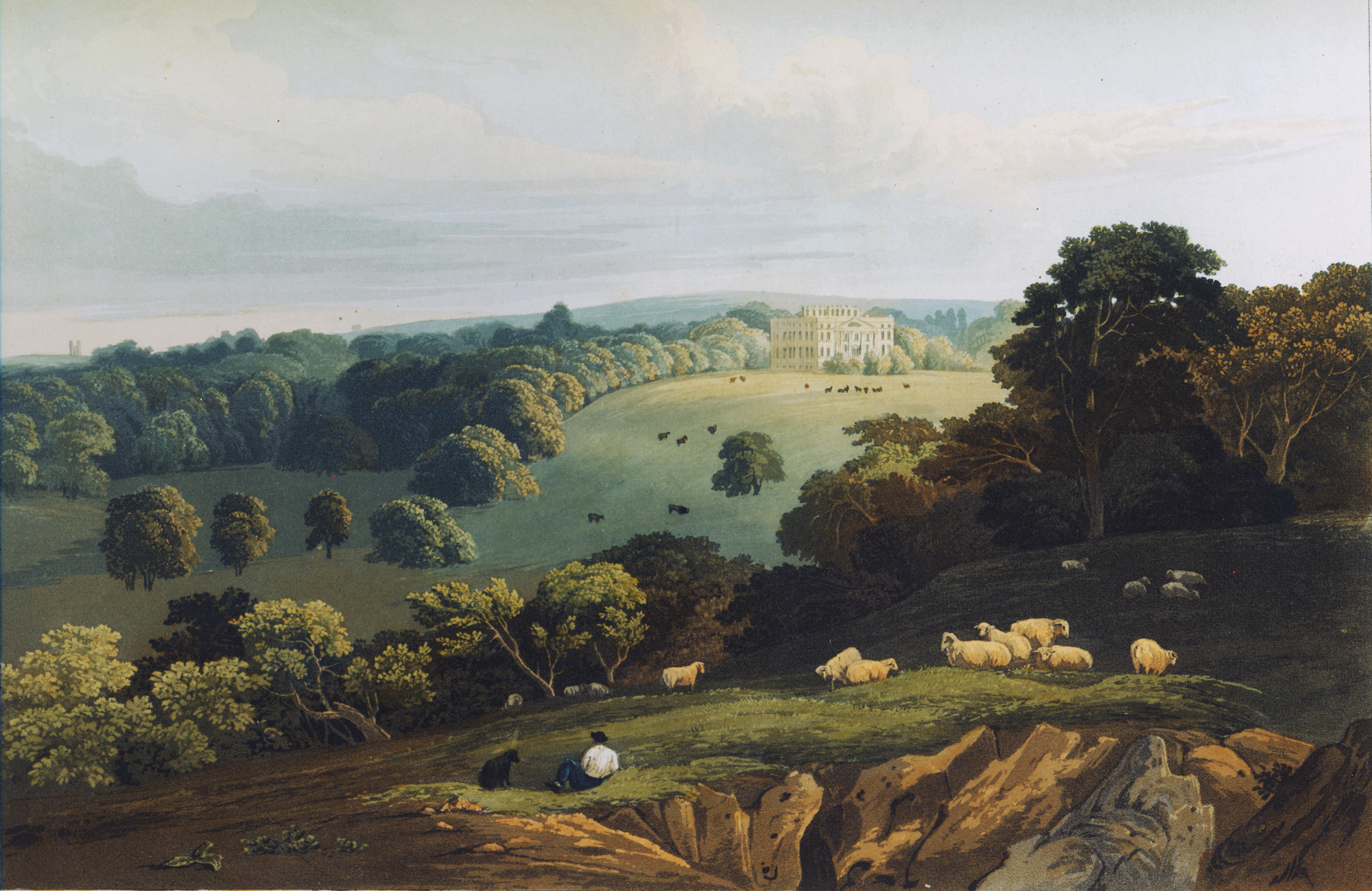
Another painting recently came to auction that’s of Kings Weston interest; it’s a watercolour of the house and park from Penpole Point. It’s a view that’s already familiar to us through one of the most widely published and most attractive prints of the park in the early 19th Century. The artist was the impressively named Anthony Vandyke Copley Fielding (1787-1855) who visited Kings Weston in 1816. It’s not clear whether it was intentionally painted as part of a larger project, but reproduced it found its way into a Series of Picturesque Views of Noblemen’s and Gentlemen’s Seats seven years later.
the original watercolour showing the view of Kings Weston house from Penpole Point. 1816, Anthony Vandyke Copley Fielding (1787-1855). One version of the print copied from the original painting.
This month the news has been filled with a number of serious storms that have brought winds and flooding to several parts of Britain, but 164 years ago Kings Weston also experienced a shocking gale.
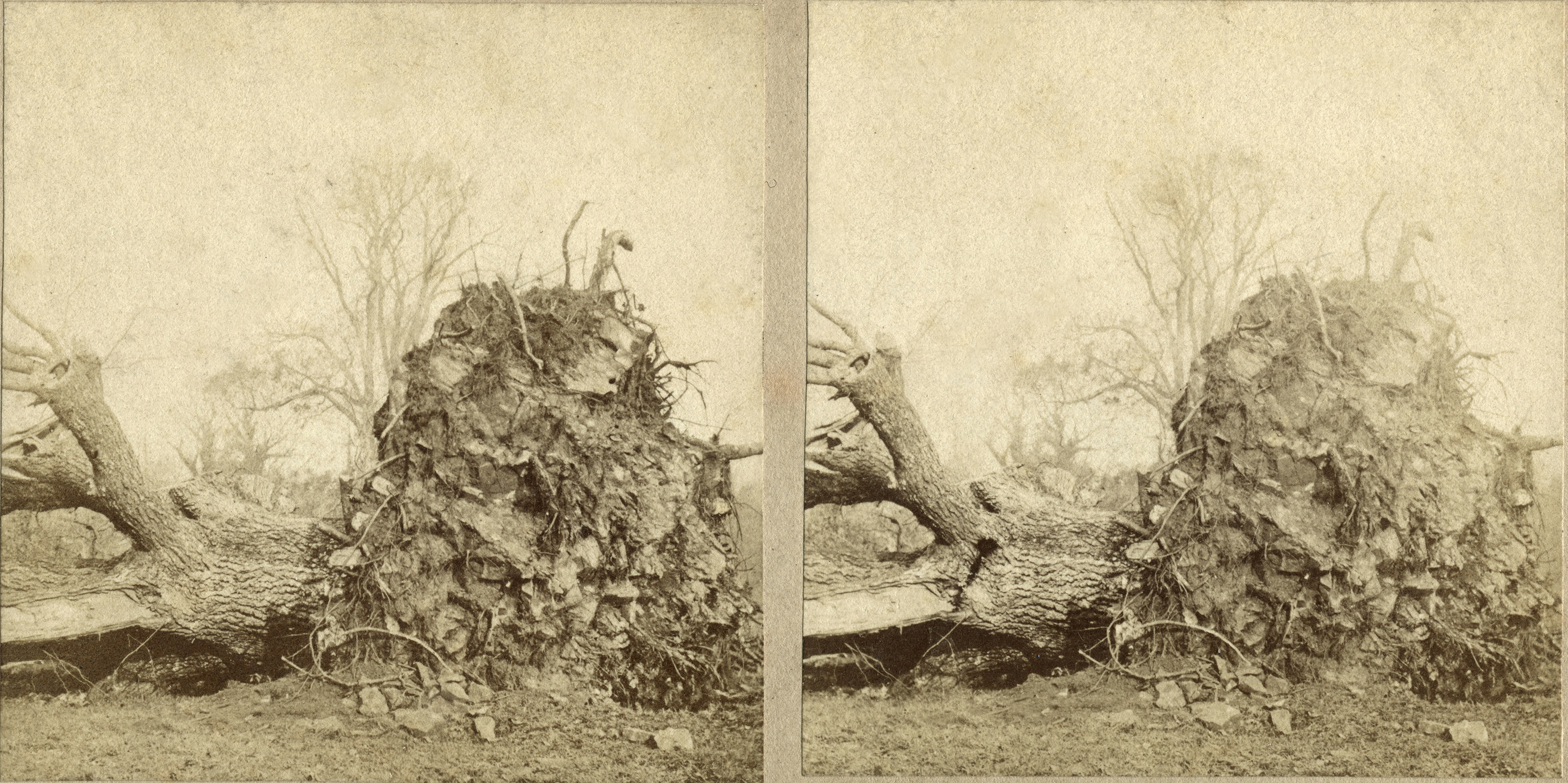
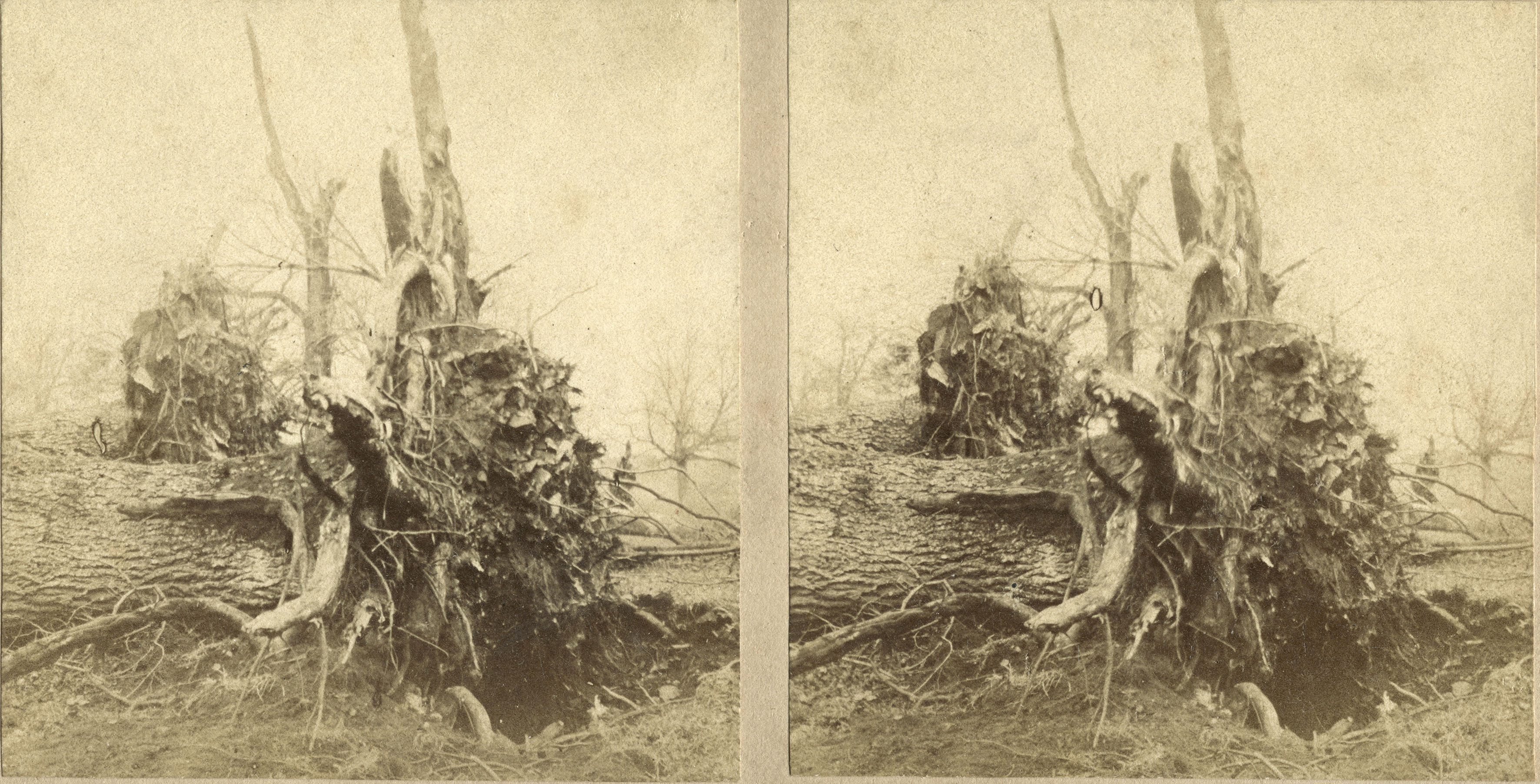
Two historic photographs (or perhaps four depending how you’d like to count) have come to us recently that mark a significant event in the history of the estate. The photos are extremely early, now thought to be the earliest photos of Kings Weston know, and are designed for use in a stereoscopic viewer; each of the two photos is taken using separate lenses set the same distance apart as the human eye; when seen through a viewer the eye sees a 3D impression of the view. Whilst the two photos on each card look the same at first glance, they are taken from fractionally different perspectives to create the effect.
One of the elms blown over on Penpole Lane on 1/11/1859. the location looks east from the current location of the Oasis Academy school.
The views focus on large a number of massive fallen trees pulled out by the roots and thrown over. On the reverse of each the location is identified as Kings Weston and dated as being from November 1859. They were taken following a violent storm that severely damaged Shirehampton and the Kings Weston estate on the first of that month. We’ve known of this event before, from newspaper articles that described the devastation, but these photos add incredible insight into the aftermath. The UK was subjected to a number of heavy storms around the same time in 1859, the most famous being the “Royal Charter” storm the week before Kings Weston’s. The Royal Charter sank off Anglesey on October the 25th with more than 400 fatalities and the loss of a substantial cargo of gold being brought from Australia. The sinking occupied journalists for days as details of the story became known, but Kings Weston would shortly join it in the national newspapers.
Three elms in a row are seen wrenched out of the ground. These trees may be on the avenue from the Circle into Penpole Wood, and the dark conifer in the distance may be either the Cedar tree at the east end, or the Wellingtonia at the west; both trees would have been young at this time.
Newspapers at the time describe the winds as arriving before dawn, sudden and ferocious, there’s even the suggestion that it was a tornado, considering the relatively localised trail of damage from Lamplighter’s, through Shirehampton, and into Kings Weston park it’s certainly a possibility. Reports suggest that in just seven minutes upwards of 300 trees brought down. They describe 20-30 trees lying on top of each other and thrown down some northwards but also eastwards. The lawns of the house were scattered with branches and timber and the whole scene became an unlikely public attraction the following day. Particular attention was made of the loss of many great old elms that lined Penpole Lane: it’s these trees that are shown in the recently discovered photos.
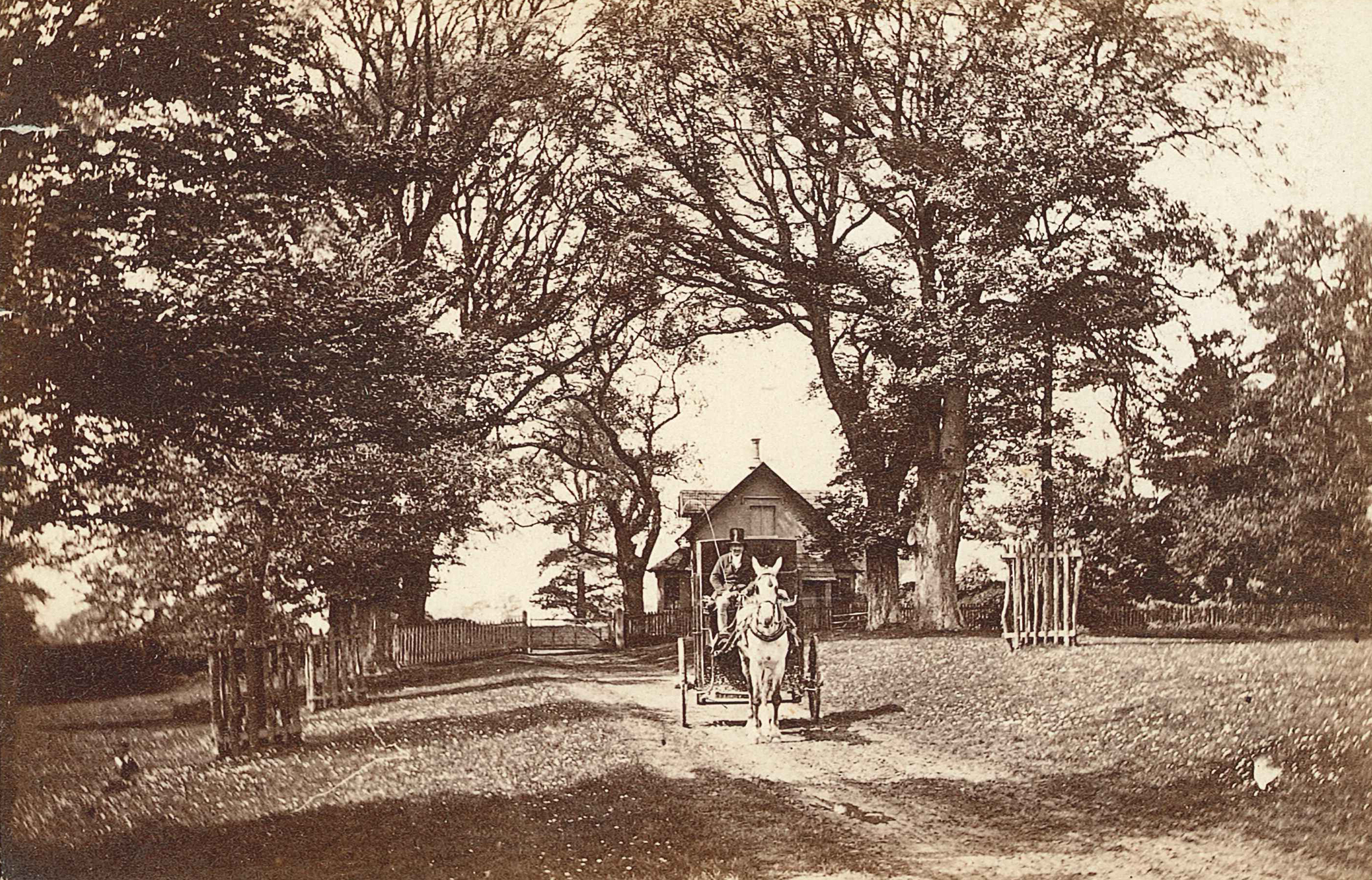
Philip William Skinner Miles, then owner of the estate, must have been faced with a huge challenge in cleaning up, and he appears to have quickly set to replanting many of the lost trees with new. A slightly later photo of Penpole Lane, from the 1860s, shows the replacement trees protected by paling fences and are already becoming well established. Opposite Penpole Lodge in this view can be seen one of the elms that survived the carnage, the branches of which are sufficiently distinctive to be recognised in the background of one of the storm photographs seen from the other side; a helpful landmark in locating the photographer’s position in 1859.
the scene on Penpole lane in around 1867, looking towards Penpole Lodge. Young trees replacing those fallen stand guarded by fences.
Thankfully, for the modern visitor, Skinner Miles chose lime trees instead of elm, or the estate would again have lost them all from Dutch Elm disease in the 1970s and 80s. Many of these lime trees can still be seen lining Penpole Lane and the avenue into Penpole Wood from the Circle.
One of the news reports detailing the course of the storm and its impact.
We’re grateful to Shirehampton resident and long-time supporter of KWAG, David Pickering, for his donation of a small set of photos to add to our permanent collection.
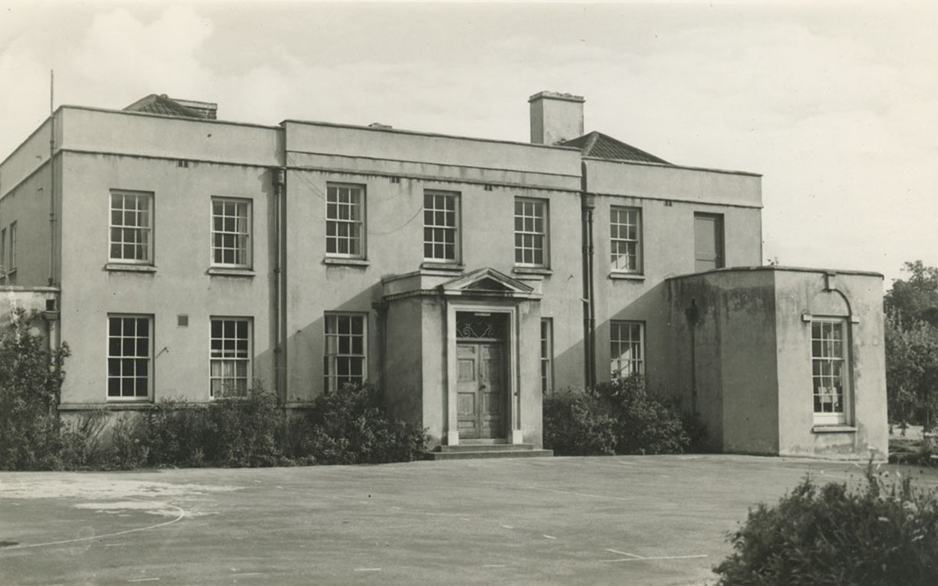
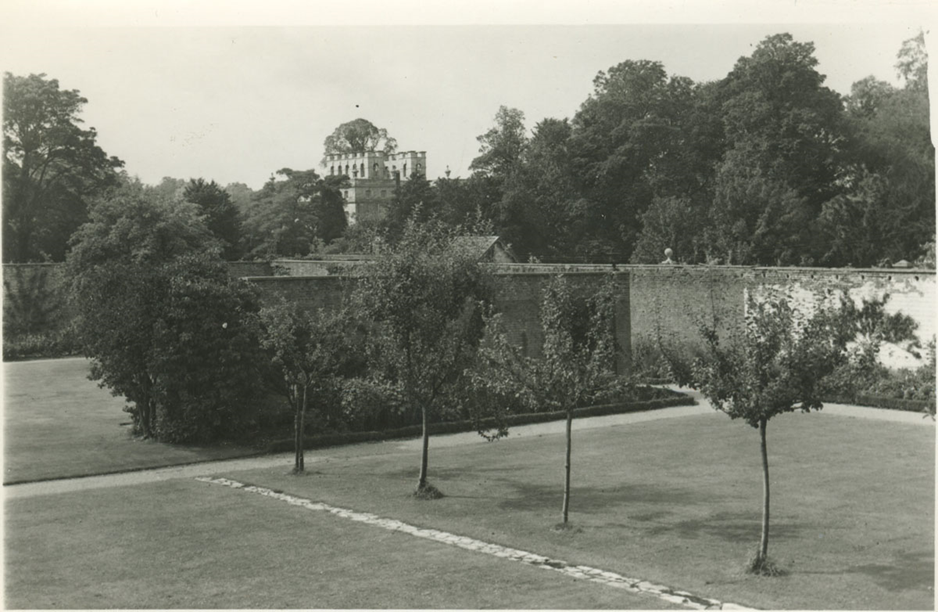
The photos are a record of the House in the Garden, and the Georgian walled gardens in which it sits. The original walled gardens were begun in around 1762, but when the last private owner of Kings Weston house, Philip Napier Miles, died in 1935 it became redundant for its original purpose. Here, in 1937, the widowed Sybil Napier Miles decided to build a smaller house for herself where she lived until her death in 1948.
The House in the Garden was built in 1938 for Sybil Napier Miles after the death of her husband.
She was a keen gardener and turned the flower and produce gardens within the historic walls over to a private garden for her new home, removing many greenhouses but retaining certain elements she thought useful or attractive. The gardens were already established by 1940, when they were opened to the public to raise funds for the Queen’s Institute for District Nursing.
the view of Kings Weston House across the walled gardens from an upstairs window in the House in the Garden .
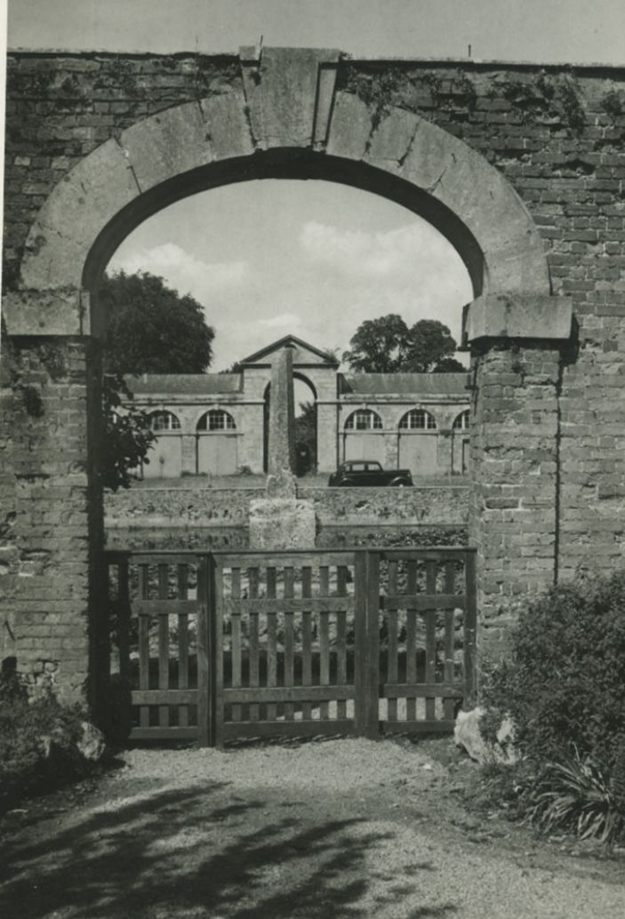
the view from the walled gardens across the lilypond towards the old stables on Napier Miles Road.
The exact date and circumstances of these photos taken by an official Western Daily Press and Bristol Observer isn’t known. The house and grounds were purchased in 1948 by the City Council to form a new primary school before new premises in Lawrence Weston were complete. They do not appear in the sales literature of that time, and there appear to be school sports court markings painted on the front drive, narrowing it down further. One source suggests 1954, which may be correct, as the condition of the old stables seen through the arch is better than when it’s next recorded, derelict, four years later. Regardless of when they were taken, they are a beautiful record of the house not long after it ceased as a private residence.
The Lilypond and Georgian Lodges have now been declared surplus to the needs of Kingsweston Special School, and we hope now to be able to discuss restoration with the Council more directly
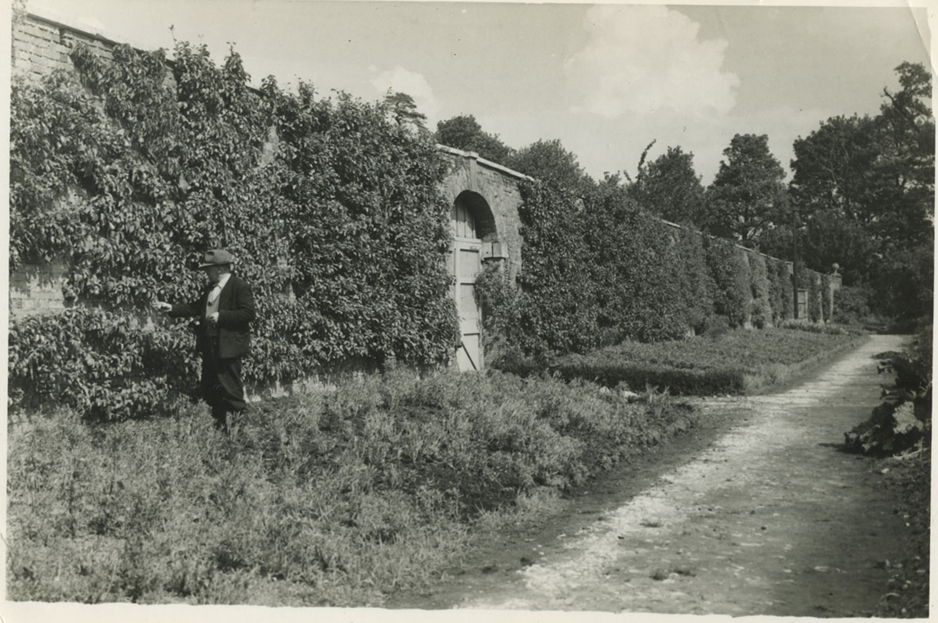
Fruit trees trained up the back wall of the walled gardens, with the beds gone to seed.
Last month we featured some of the Eighteenth Century letters written between Katherine Southwell and her son Ned Southwell; these mentioned the estate manager, or Steward, called Mr Nicholls. By chance an interesting snippet of history relating to him fell into our laps just recently.
We now know that Mr. Nicolls Christian name was Edward, and he was a Gloucestershire man born around 1723. He married Mary Churchill of Clifton in 1743, and is known to have held the key role of Steward at Kings Weston for at least 24 years, between 1755 and 1779. Whilst living and working at Kings Weston the couple had around 10 children. Katherine’s letters reveal that one of them, Ned Nicholls, had a nasty accident falling of a wall onto spikes behind the house, but was unharmed. She also mentions the eldest daughter, Betty, who she suggests might be available to act as her maid to attend her on a trip to Kings Weston, so was presumably also employed at the house. It was, however, another of their sons, Henry, who would go on to far greater things.
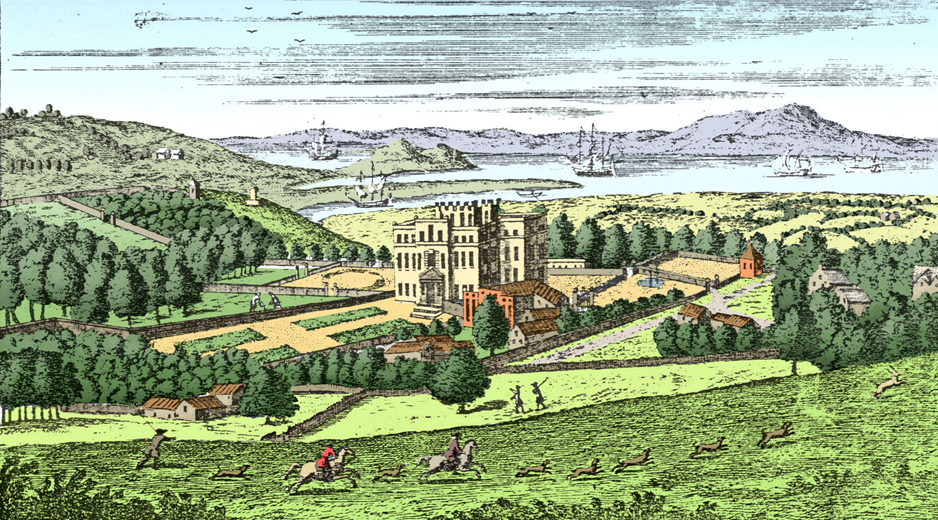
A coulourised early print of Kings Weston at around the time Henry Nicholls would have known it.
Henry was baptised in Henbury church in 1759. His father, aged 36, was already established in the management of the house and estate for the young Ned Southwell. Ned had recently embarked on his Grand Tour of Europe, but on his return seems to have taken an interest in Henry.
Henry took a keen interest in ships he’d regularly have seen arrayed below Kings Weston house, sailing to-and-from Bristol’s docks, and moored in Hung Road waiting for the tide. It was said of him that he “was born of the winds, and cradled in the storm”, and a fascination for the sea no doubt developed from an early age. He reputedly displayed an honest bluntness that earned the respect of Ned Southwell. Recognising the bright nature of the child, and his eagerness to join the navy, Ned arranged schooling for him in Yorkshire, before, in 1774, aged around sixteen, he joined the Royal Navy.
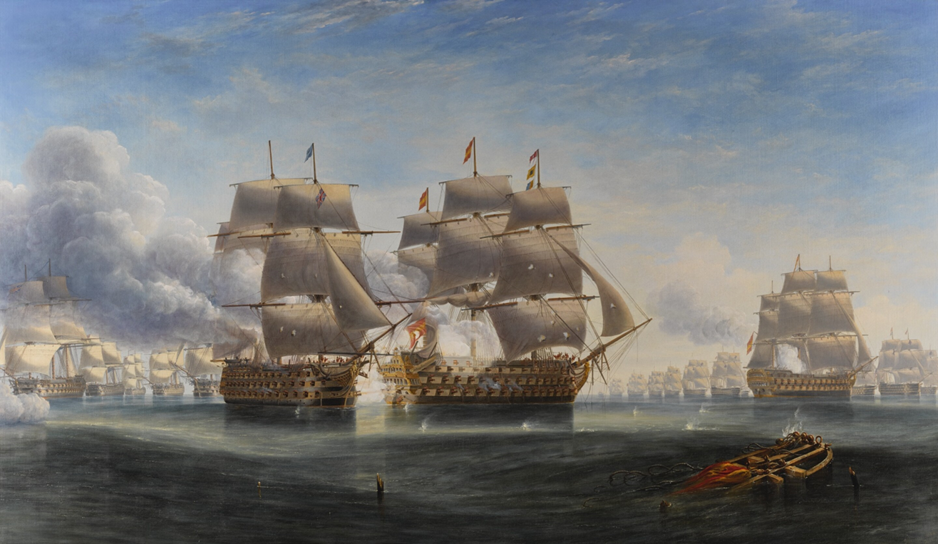
The opening engagement at Trafalgar; Royal Sovereign, seen at a time after Nicholl’s command, raking the stern of the Spanish flagship Santa Ana; John Wilson Carmichael
From his beginnings at Kings Weston, and through the support of Ned Southwell, Henry rose through the ranks of the Royal Navy, first being stationed in Guinea, before involvement in naval skirmishes of the American Wars of Independence. During this period he was promoted to Lieutenant, at the age of just 21. By 1781 he was made Commander of HMS Barracouta, and in 1791 had worked his way up to Flag Captain, commanding HMS Formidable, Flagship of Rear-Admiral Leveson-Gower. His next commission was the flagship Royal Sovereign which, in 1794, he commanded fighting against the French Revolutionary fleet in the Battle of the Glorious First of June, an action in which he performed so honourably he was awarded a gold medal.
He was promoted to Rear-Admiral in 1807, and Vice-Admiral four years later, knighted, and then appointed an Admiral in 1825. Admiral Sir Henry Nicholls, as he then was, retired from the Navy and returned to Bristol, but not Kings Weston itself where few would remember him from his childhood there. Ned Southwell, his biggest supporter, had died young in 1777, and most of the staff had been laid off during the minority of his son, Edward.
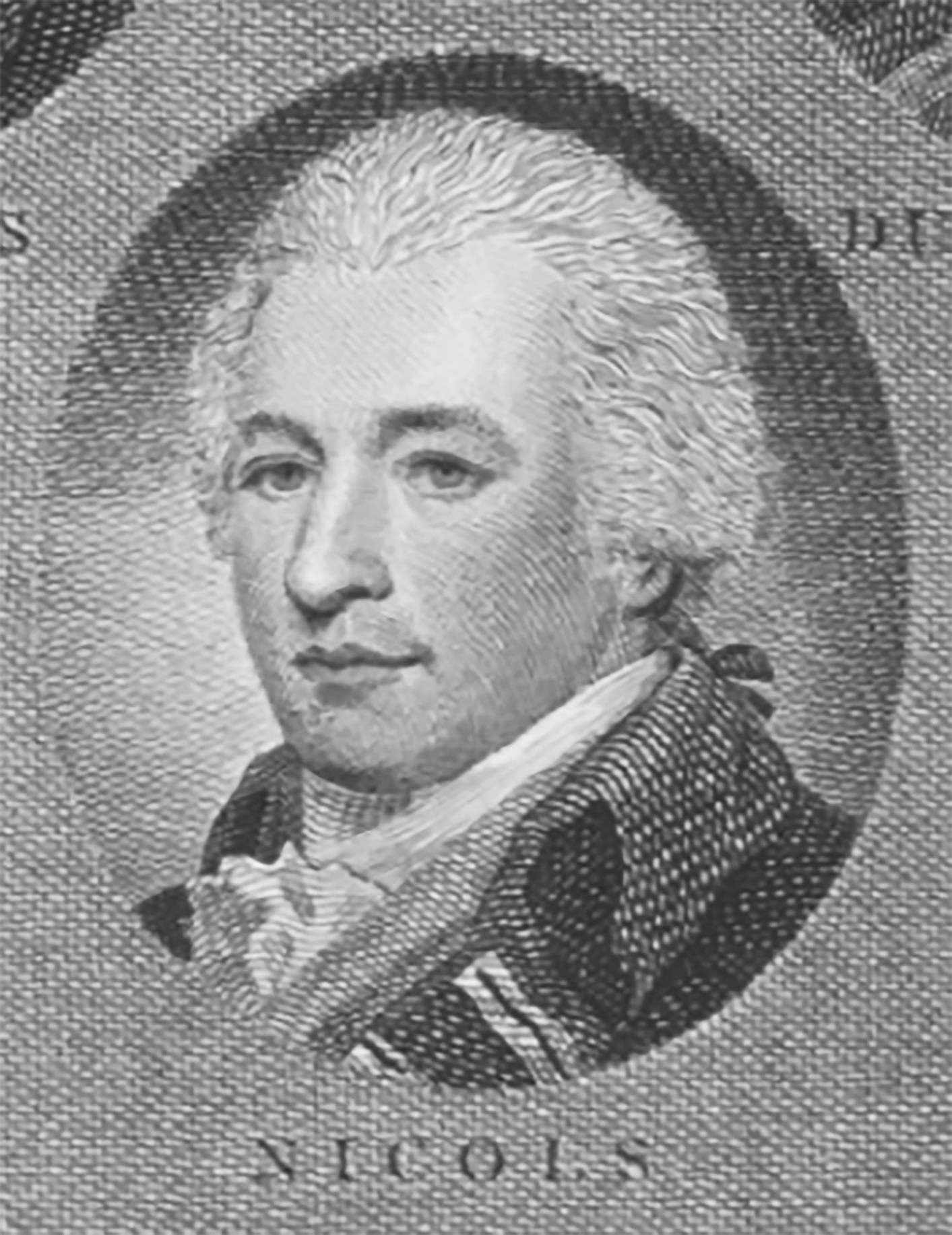
Nicholls pictured in an engraving celebrating the success of the Battle of the Glorious First of June in 1794.
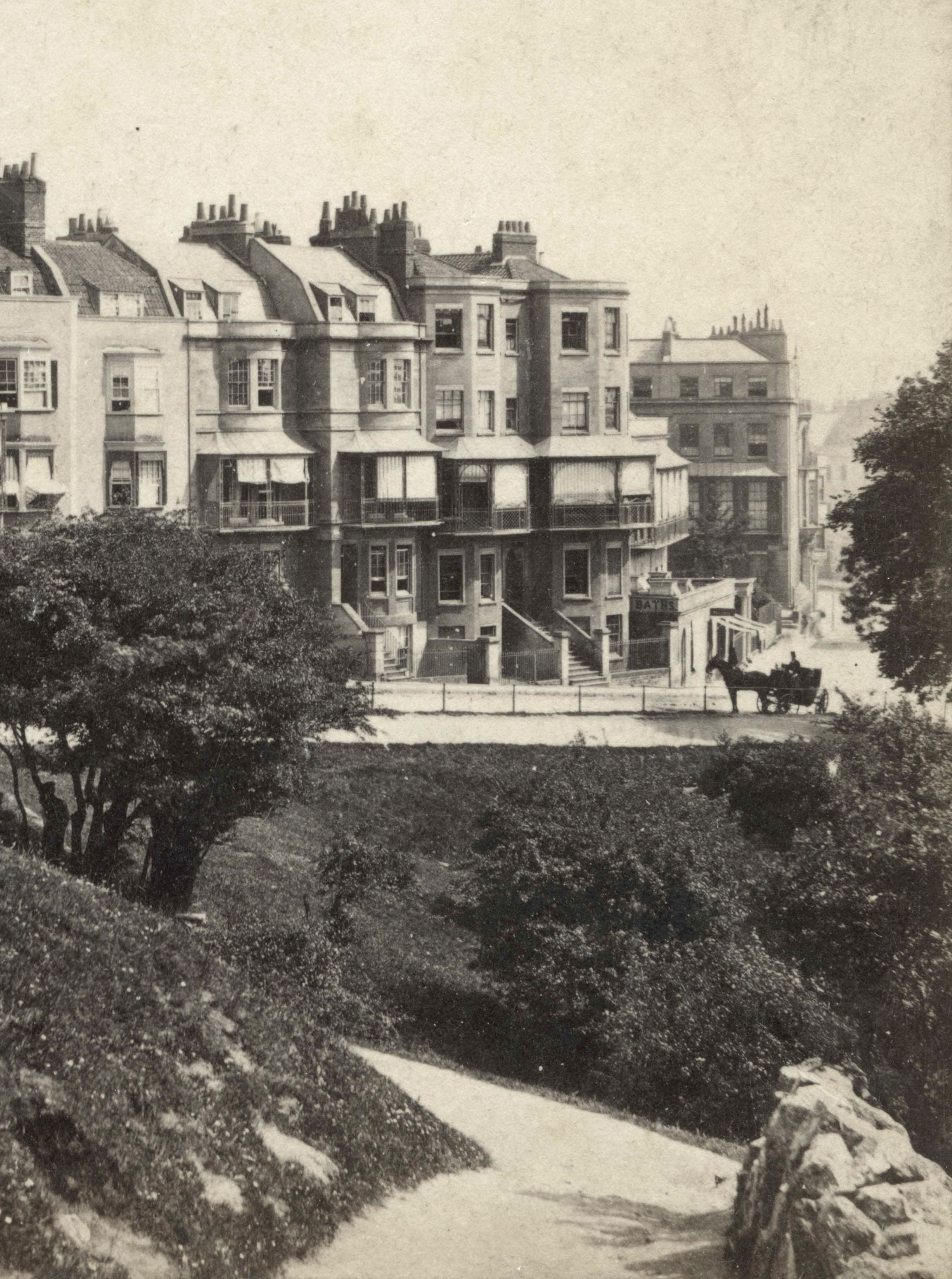
Henry resided at Sion House in Clifton for the remainder of his life. Described in old age as “stoutly-built and above the middle stature. A direct, un-affected man who in later life was regarded benevolently as a rough, kind, seaman, he was an avid snuff-taker”. His 1830 obituary recorded “Sir H. Nicholls, though a strict officer, was still admired and respected, not more for his uniform zeal, perseverance, and ability, than for his excellent disposition, which displayed the kindest heart of a rough seaman in all his dealings with mankind.” Appropriately he was buried in the church where he’d been baptised, back in Henbury.
Strangely, for such a high-ranking Naval officer, with a glowing war record, there is little written about him, and less still on his connections to Kings Weston. Even his final home on Sion Hill lacks a blue plaque. Perhaps this son of Kings Weston deserves to be better know.
Sion House, Sion Row, Clifton, is the tallest of the houses facing the Gorge, with a pair of matching tall polygonal bay windows. Seen here in the 1860s at the top of the Zig-Zag.
Way back in 2013 KWAG made contact with the John Russell, 27th Baron de Clifford, ancestor of the Southwell family. Initially we were most keen to record a number of paintings the family possessed, those which once hung at Kings Weston before the last member of the direct lineage died in 1832, but the family were eager to show us a large collection of documents too. We were delighted to be able to arrange for these to be transferred to Bristol Archives on their behalf, and were privileged to be able to review them before they were added to the city’s collections.
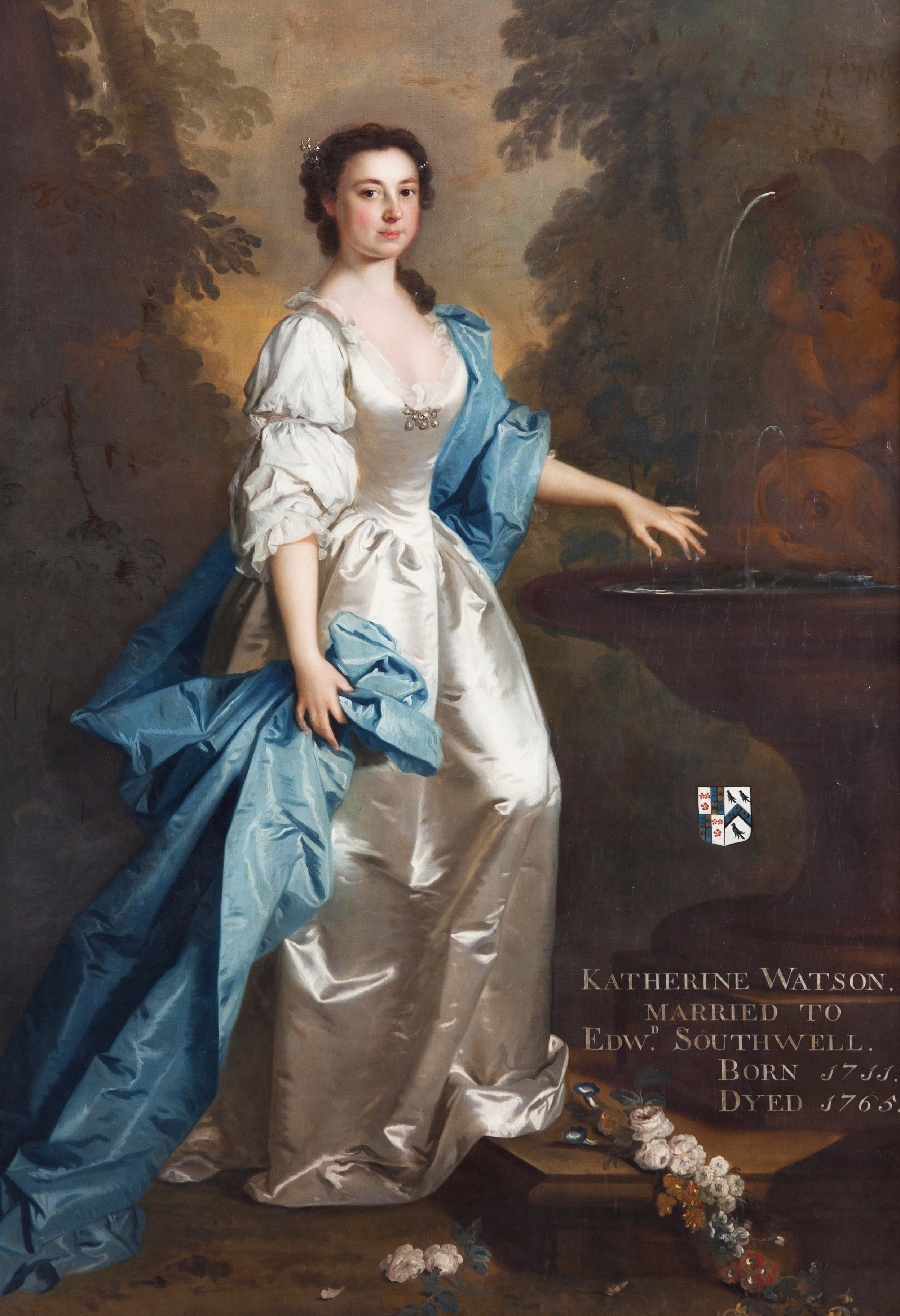
There was a much of interest to Kings Weston, perhaps nothing more so than a fascinating series of letters written from Katherine Southwell to her son, Edward Southwell, whom she affectionately called Ned, the third of the family to carry that name at Kings Weston. We know Katherine today through a glorious portrait of her that still hangs at Kings Weston house. Painted by Allan Ramsay in 1740, it faces her husband across the hall where they were installed there by her son shortly after her death in 1765; indeed the whole of the portrait gallery may have been designed as much to memorialise her as the rest of the family.
Katherine Southwell by Allan Ramsay, 1740. It hangs in the Saloon at Kings Weston opposite that of her husband, Ned’s father.
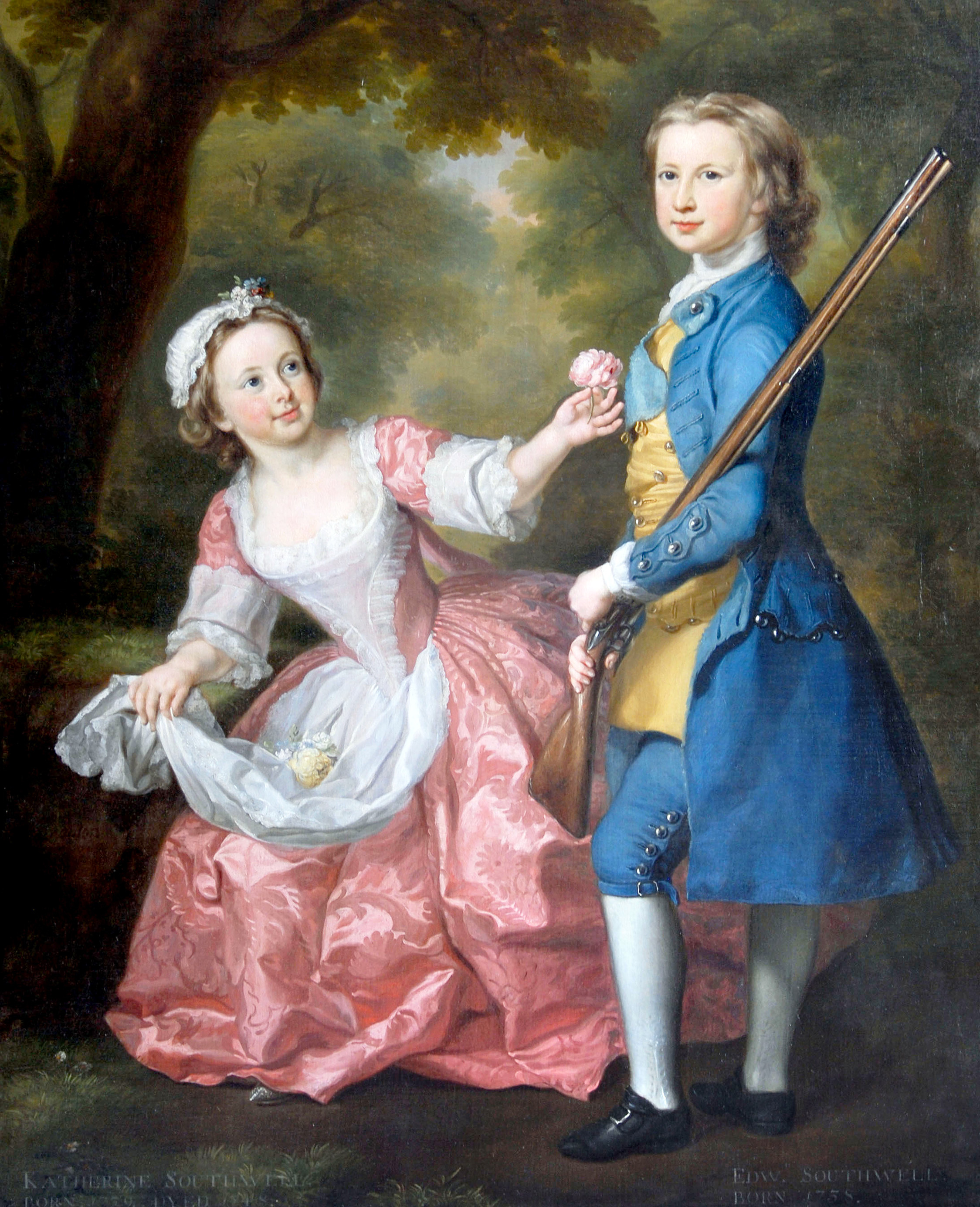
Katherine and Ned’s father, also Edward, appear to have had difficulty in conceiving, the young heir not being born until nine years into their marriage. Another child, a daughter also named Katherine, died but ten years old, and perhaps a second son may never have survived infancy. Edward Senior died in 1755 leaving his wife and son alone. It is perhaps in this context that Katherine’s affections for her surviving son were so great.
The letters between mother and son begin in 1749, but climax after 1758, the year that Ned left for the Grand Tour of Europe, an essential component in the life of any young man of means at the time. Ned, then aged 20, left behind his 48 year old mother with few friends and family members around her. The parting was keenly felt by her, and the ensuing stream of letters that followed his departure exudes that affection and care felt for her son, but also the eagerness for him to improve himself and kindle ambition.
Throughout Ned’s three year tour of Europe his mother sent letters, each one was carefully preserved by Edward on his travels and returned with him to the country, testament that his affection matched that of his mother. The majority survive today, though sadly there are notable gaps, where batches of correspondence appear to have been lost to time. It’s also unfortunate that we don’t have a reciprocal collection of Edward’s writings to make full sense of Katherine’s letters, but this doesn’t dim their colourful and engaging insight into mid-18th Century life. In them she updates her son on the global political situation, intermixed with “tittle-tattle” and gossip, encouraging words, and descriptions of her own exploits. Her search for a suitable new home to act as a Dower house is also a regular feature of her letters. Moreover, the letters are an incredible insight into Kings Weston, the gardens and staff employed there, and the comings and goings of tenants, neighbours, and livestock long-known to them both.
Ned Southwell in the only known portrait of him with his sister Katherine. The painting must date to before 1748, when his sister died. He would have been under 11 years old.
In Ned’s absence, Katherine spent time at Kings Weston, working with the head gardener, Gould, and the estate manager, Nicholls, carrying out her son’s instructions. Sometimes she is at the centre of the action, actively out in all weathers assisting in planting trees, and other times an observer, sending on vivid descriptions of the flourishing parkland. She wrote:
“I got hither to dinner yesterday, and was lucky in having good weather, and took the advantage of a very fine afternoon, to visit your plantations in the quarries, who thrive very well and are very clean, as is the garden; nay even the park is more free from nettles than usual; a prodigious quantity of grass and bullocks and sheep fatting on it; your colt frisking about very gay and for what I know very fine ones; ………I live on the hope of once more enjoying you all together and let the intermediate space run on as it can.” Kingsweston, 27 Sept. 1758.
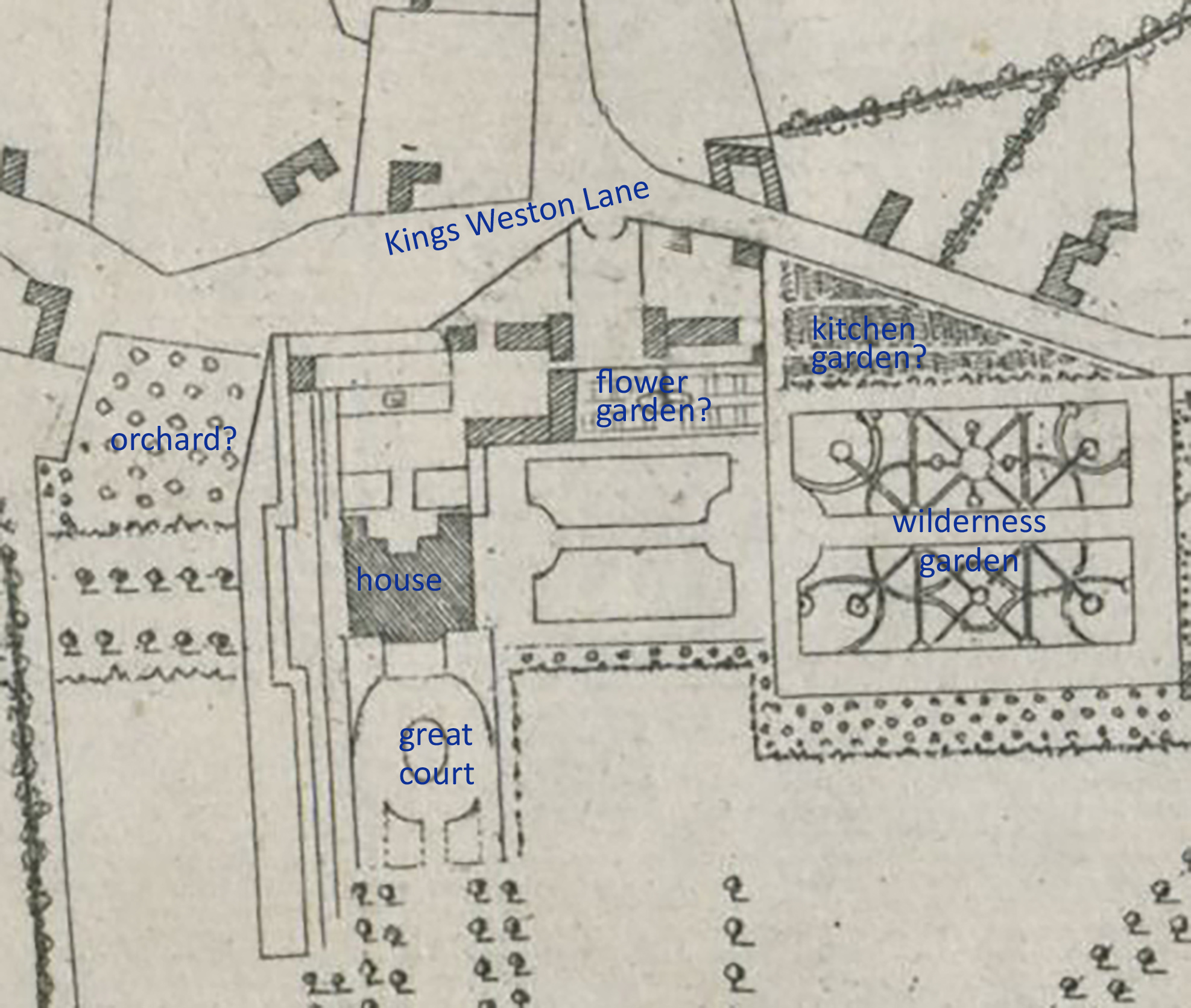
The gardens around Kings Weston house in 1720, before their redesign.
And soon after: “Having no letter of’ yours, my dear Ned to answer, and having had no visitor but Mr, Berrow this can bring you no news but of the mute and vegetable part of the creation. To begin then your serpentine plantation at the bottom of Penpole looks much less like a snake than it used to do, the trees in general are flourishing and, the laurels almost cover the wall; it is extremely clean and has been twice sow’d this year, once with turnips and once with fetches.
The quarries have lost but few trees, but the hares and the lambs have crept under the rails and nibbled some, out. I find they took good care to keep them out as soon as they perceived it for ‘tis very little damage that is done.
The old kitchen garden is transformed into a nursery, but Gould cou’d not entirely part with the sparrowgrass (asparagus) beds, so has planted only between them, but the want’ of room this year will force him to quit his beloved.
There’s a fine parcel of young things of last year’s sowing in the flower garden, viz beach, swamp oak, Weymouth pines, cyprus, holly, laurel and some larch.
Now for my own particular friend the tulip trees that were removed are in health the arbutus are full of fruit and the two small magnolias are alive, but, alas, the great one is dead but what is still a greater misfortune to me, some Dutch sailors stole Jewel (a horse) but the day before I came.” Kingsweston, 1 Oct. 1758.
Kings Weston in about 1763, with some of the plantations below Penpole Point that Katherine mentions, and shortly after the demolition of the walls of the Great Court in front of the house. (Sir John Soane’s Museum)
Throughout his time away, Ned was replanning his estate. Katherine writes frequently about floor plans and elevations of the house being sent out to him in Europe with her letters; evidently there were plans being sent back to her and Nicholls too, and schemes which she intimates were significant in ambition. A plan for firing bricks and setting out new kitchen gardens was already in train in 1758. These plans would finally come to fruition after 1762, with the stables and walled garden complex on modern Napier Miles Road being begun; indeed, brick was made extensive use of in these walls.
“Gould advises you to make bricks for the kitchen garden wall; he says there’s earth fit for it, and ‘twill save a great deal, for they are very dear here; send me word if I shall begin; the earth must be dug six months before ’tis worked” (Kingsweston, 1 Nov. 1758)
And later:
“My dear Ned, I have sent you by Mr. Gaussin, Gould’s plan for the house and garden; l don’t imagine ‘tis quite the design you will follow, but as the ground is regularly measured and marked, I hope ‘twill give you some amusement.”
“…I come now to yours of 30 Dec. I have sent you, Gould’s plan, it is not so extensive as your: scheme, tho’ it does take in some of the road.” (Spring Gardens) 23 Jan. 1759.
“I am in a fright about the bricks; for as that was not Nicholls’s own proposal, I find he does not approve of it, and make great puzzling and difficulties and works, so unintelligibly about it, that I don’t know what he is doing.”
In this letter Katherine implies that the line of a road, probably part of Kingsweston Lane, is included. That may have been the southern end that now faces onto the side of Kings Weston inn cottages, but before then looks from maps to have been aligned further to the west. Katherine eventually settled on a house at Westhorpe, Little Marlow, which she figured would be convenient for her son to drop in on between the family’s town house at Spring gardens and Kings Weston. Most of the letters after 1760 are written from her retirement there.
Westhorpe House, Little Marlow, Buckinghamshire.
From 1759 Katherine leased the place as her Dower house. She agreed to buy the furniture already there, and a boat that she fancied Ned would enjoy using in the park’s lake. After his return to England in 1761, Ned quickly took works on the estate in hand. Unlike his father, who had been created Secretary of State for the Kingdom of Ireland by entail, he had no position in court or government, and sought to rebrand Kings Weston as a political powerhouse. With an ambition for a seat in Parliament, he set about modernising house and grounds as a statement of intent, as many of his peers had also done. His first task was to move the collection of old stables and kitchen gardens from a cramped position next to the house. Employing the architect Robert Mylne, a gentleman whom he’s believed to have met in Rome during the Tour, Ned began work quickly. It is perhaps not a surprise that he turned to his mother to lay the literal and metaphorical foundation of this political ambition.
“You are very ‘obliging in seeming to think what I have done at Kingsweston prospers; alas, ’twas so very little, that to me ‘tis not perceptible; I shou’d very gladly lay the first stone of any building projected by you for I have a great propensity to like your designs.” 3 May, 1762.
She appears to have had concerns over the height to which the garden walls were to be carried for she wrote later the same year:
“I honour your spirit and resolution, that has carried your walls up against all your ministry, but know that from this time forward you’ll be charged with every blight that falls on your trees and must never complain of unripe fruit, or backward pease, without being told you wou’d have the walls so high no sun can come into your garden.” Westhorpe, 3 Sept. 1762
The stables and walled garden begun by Ned immediately on his return from his Grand Tour. the garden walls make extensive use of the brick he was intent on firing from his own resources.
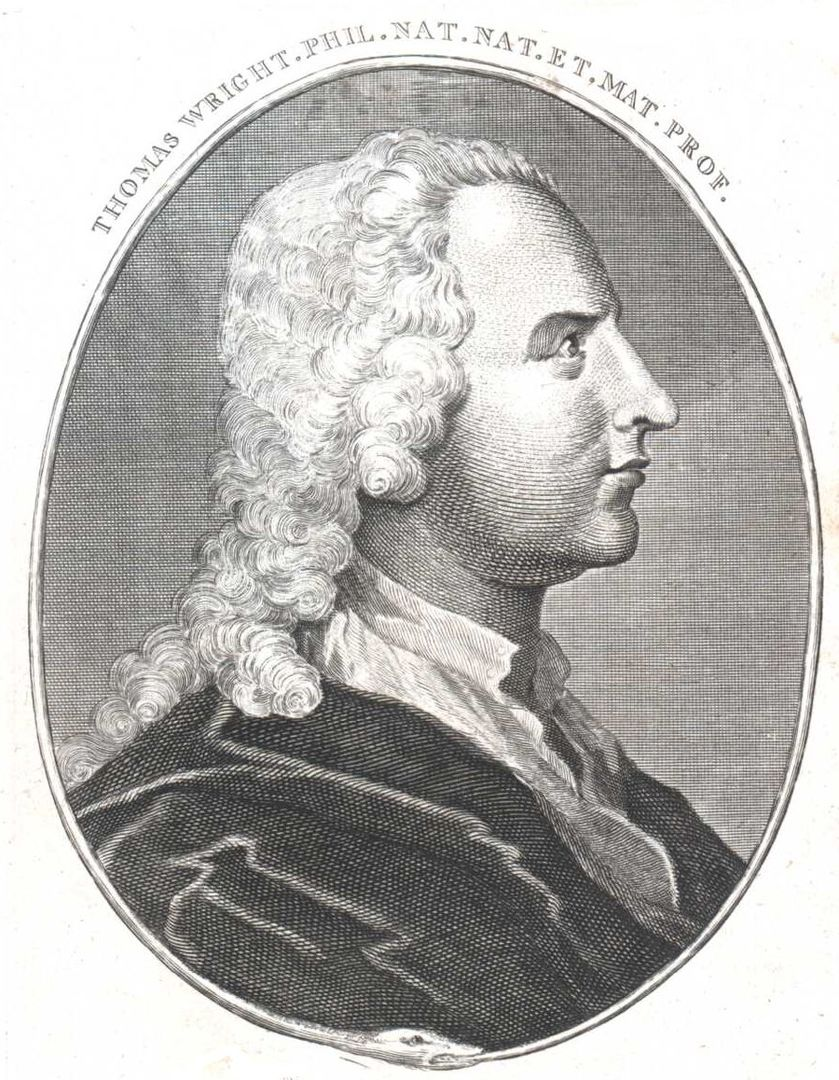
We had long believed that the landscape gardener Thomas Wright, the “Wizard of Durham” had worked at Kings Weston, but it is only through Katherine’s letters that this has been confirmed. Wright had been working nearby at Stoke Park on the other side of Bristol, but also for the Duke of Beaufort at Badminton. That he worked at Kings Weston too explains some of the landscaping introduced during the 1760s and the celebration of the quarries in Penpole Wood as rustic garden features.
“… I am glad you are agreeably detained and that Mr. Wright and you have not quarrelled. He must be a very odd creature for he has refused very advantageous offers from Lord Halifax to go with him to Ireland and prefers liberty tho’ joined to poverty. I don’t blame him for I think I shou’d do the same. Saturday, 11 April. 1761 (Westhorpe?)
“I wish I could see your new designs with Wright but you will tell them me and they will shew better when executed” Tuesday 8 April 1761 (Westhorpe?)
Wright probably advised on the deformalisation of the Kings Weston landscape, the thinning of avenues and grandiose architectural features in favour of a naturalistic pastoral landscape. It may have been his suggestion that resulted in the pulling down of the Great Court in front of the house. An important note from Katherine records the year this was planned:
“You are a lucky man, my dear Ned, to have nothing, to find fault with on your return home. I hope your perturbed spirit is at rest now, my dear Irishman and that you no longer overlook your works after ‘tis dark and before it is light. I shall find great fault when I come if the return wall to the parlour window is not down.” Westhorpe, 22 Aug. 1762
Thomas Wright, 1711-1786 Wizard of Durham, architect, astronomer, mathematician, and landscape gardener.
Katherine writes in an incredibly genuine and engaging manner, making her letters a joy to read. They are sometimes candid and amusing, whilst her campaign to resurrect the de Clifford Baronetcy in favour her son shows her as determined and intellectual. The total collection of around 200 letters is a vast trove of fascinating details on mid-Eighteenth Century life. We are only now transcribing the collection, possibly for future publication. The original letters are available free to view in Bristol Archives: Letters from Mrs Southwell to her son Edward (bristol.gov.uk)
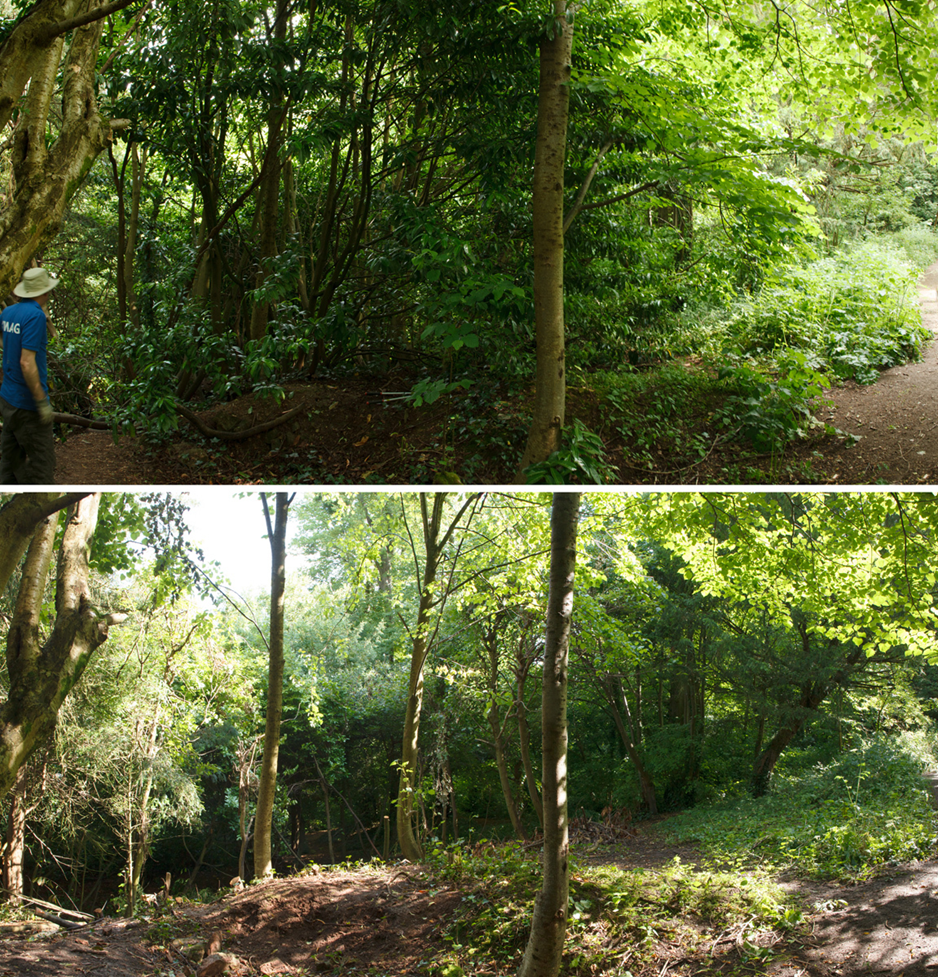
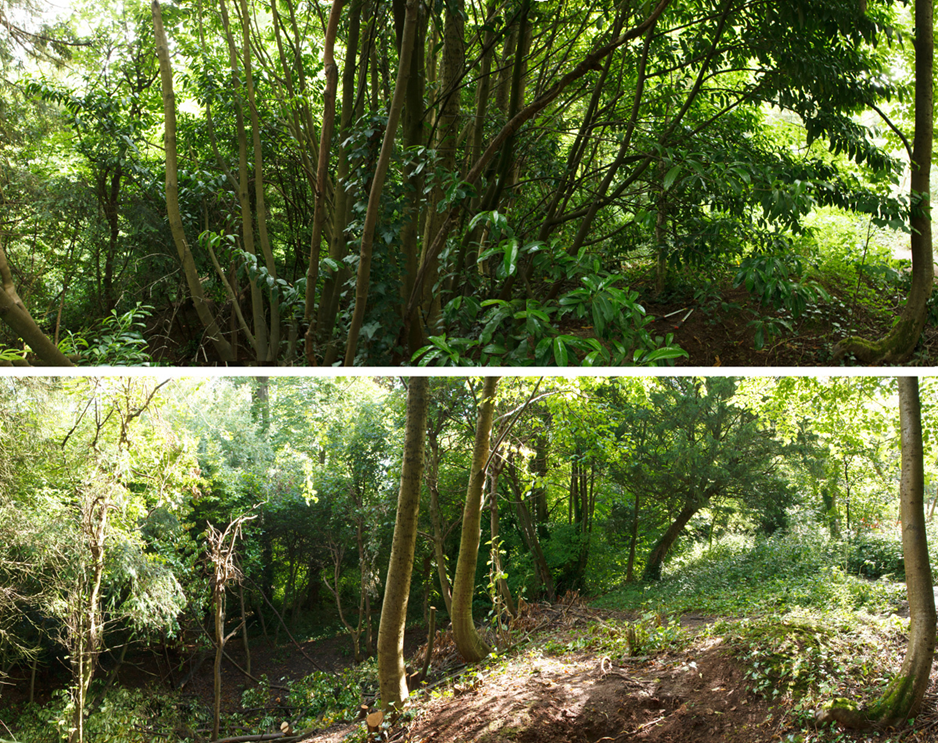
Perhaps it was the forecast of bad weather, or the holidays, but we had a very low turn out in July for the working party. However regrettable, we were still able to make headway on our challenge of clearing cherry laurel from an area close to the historic Scouts chapel in Penpole Wood. We will need to return here again this coming week, to today as much as to complete the job.
The difference made between June and July, with the lime trees of the Scout’s Chapel appearing beyond.
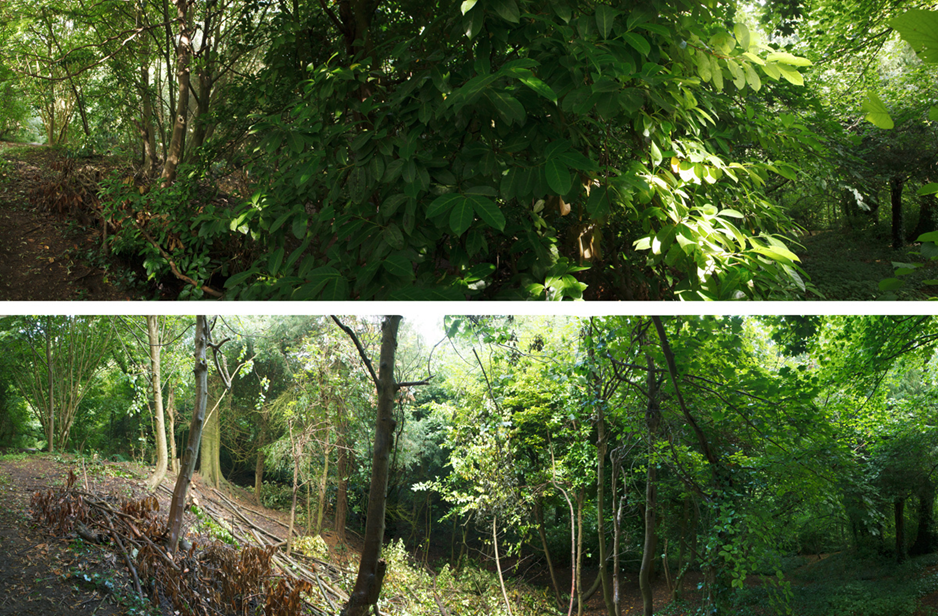
The work over the last couple of months has revealed another post quarry, later turned into part of the landscaped grounds of the house. As well as views through the woods to the tall lime trees around the Scout’s chapel, itself part of the Georgian landscaping, work has opened around a mature beech tree and yews. The last push in August should add another beech tree to this collection of veteran parkland trees and open the woodland floor for colonisation by native species.
Because of the small turnout, and the rain that eventually curtailed efforts in the afternoon, we were unable to property and safely tidy up the area, but we made sure that nothing was blocking any public areas around the quarry. Apologies for the unsightly mess, but we’ll make sure to clean it up this time around!
looking eastwards, along the slope, with the main path through the woods on the right.The view in the opposite direction, in the direction of Penpole Point.
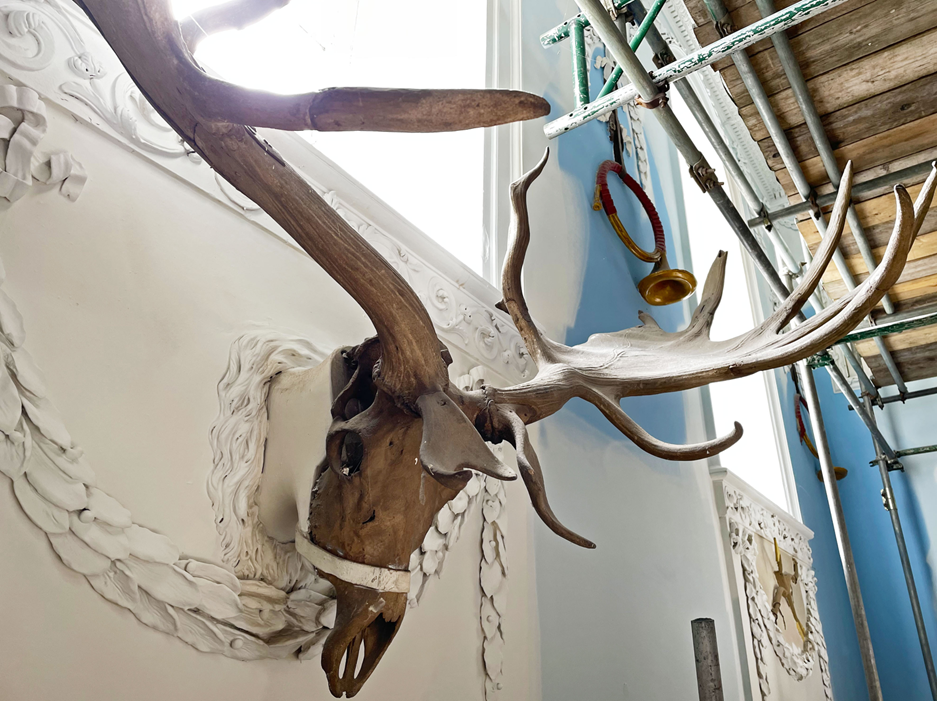
A feature older than the house itself hangs in the Saloon, or portrait gallery of Kings Weston house; it is in fact around 13,000 years old! This incredibly ancient artefact is the fossilised skull and horns of the extinct Great Elk. Today the antlers are integrated into the architectural treatment of the Georgian interior, as they have been since the hall was redesigned in 1769 by the architect Robert Mylne, but they’ve been at Kings Weston longer than that.
The skull and antlers of the Great Elk, or Irish Elk, incorporated into the Georgian interior design of the Saloon with stucco hunting trophies set around it.
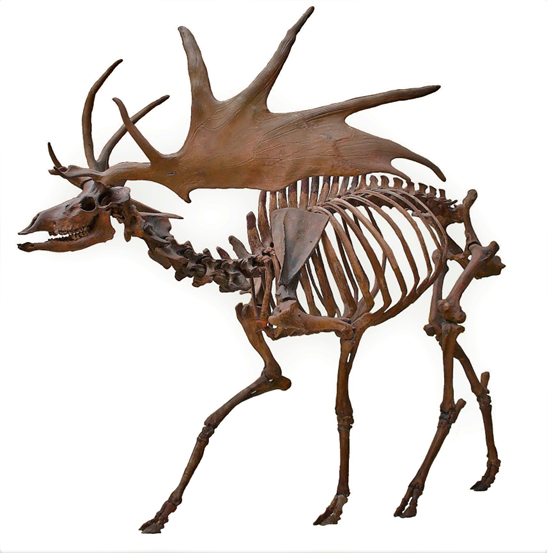
A complete Great Elk skeleton (Wikimedia Commons)
The Southwell family who built the house were from a dignified Irish family in southern Ireland, but their wealth suddenly increased when, in 1703, Edward Southwell married Lady Elizabeth Cromwell. She was a wealthy heiress to a fortune, with an income of £2000 a year – around half a million in today’s money. Most of her family’s wealth came from extensive estates around Downpatrick in northern Ireland; these lands would remain the main source of income for the Southwell family for the duration of their time at Kings Weston. After Elizabeth’s early death in 1708, all her wealth passed on to her husband, Edward, known by family and friends as Neddy.
Neddy was a very learned gentleman. Like his father, he was a member of the Royal Society, the world’s oldest scientific academy. It was, no doubt, his reputation and interest in the sciences that led Mr James Kelly, probably the estate steward for the Downpatrick estate, to write to him in 1725:
“Since I know you to be a gentleman very curious in searching after nature I thought it would not be unacceptable to give you an account of those appearances that we meet with in searching for marle, now in so plentiful a manner found on your estate in this country.
Among the marle, and often at the bottom of it, we find very great elk horns, which we, for want of another name, call elk horns: where they joyn the head they are thick and round; and at that joyning there grows out a branch of about a foot long , that seems to have hung just over the beast’s eyes: it grows round above this for about a foot and some odds, then spreads broad, which it does in branches, long and round, turning with a small bend. The labourers are commonly so busie that they rarely bring them up whole; yet I have one pretty well, of which I send you an icon done as well as I could, but not so nice as I could with. We also have found shanks and other bones of these beasts in the same place.”
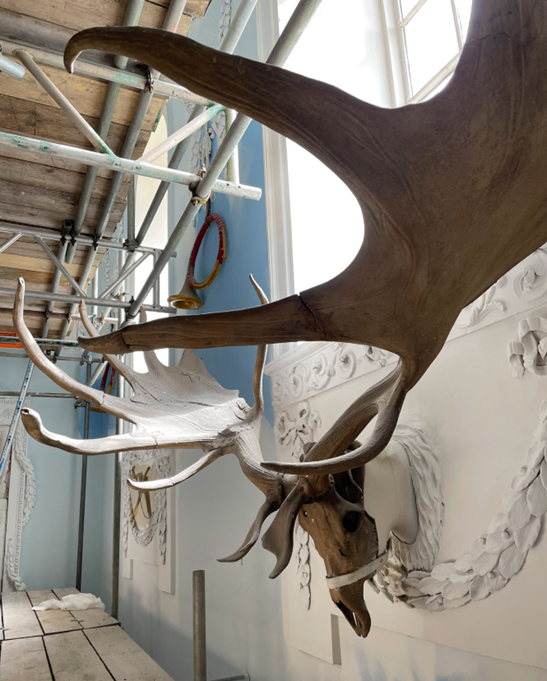
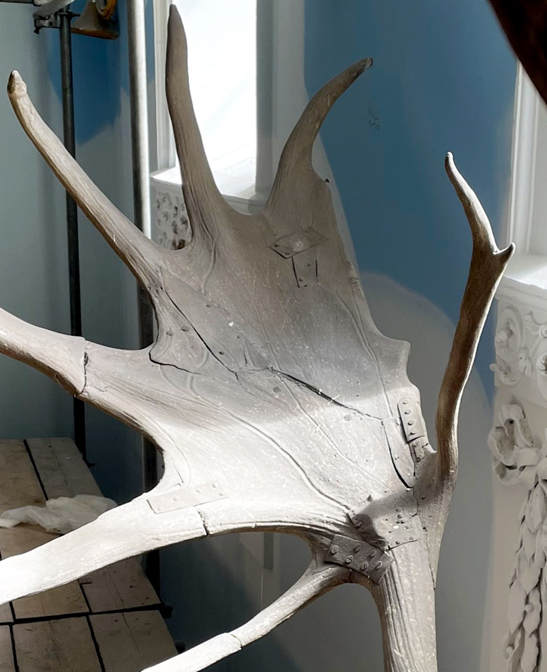
Another view of the skull showing the great scale of the antlers.
Detail showing the riveted repairs and mismatched parts added to complete the specimen
This wasn’t the first account of Giant Elk being discovered in Ireland, the first such being in 1695 when physician Thomas Molyneux made the first scientific descriptions from antlers discovered near Dublin, but the letter was of such interest that I was presented to the Royal Society and published in their transactions in December the same year.
We can’t be certain that the elk skull at Kings Weston is the same that Mr Kelly salvaged from the marl workings, but there’s a strong likelihood that it was sent back to Neddy for his closer study. If it wasn’t the same one, then it would have been another example excavated with greater care, for preservation. A close inspection of the skull where is hangs today reveals it wasn’t brought up whole, with a variety of metal plates of various dates holding it together on the wall. Some of these are likely to be from its original reassembly, with other pieces appearing to have come from other specimens, to make up a complete skull for display.
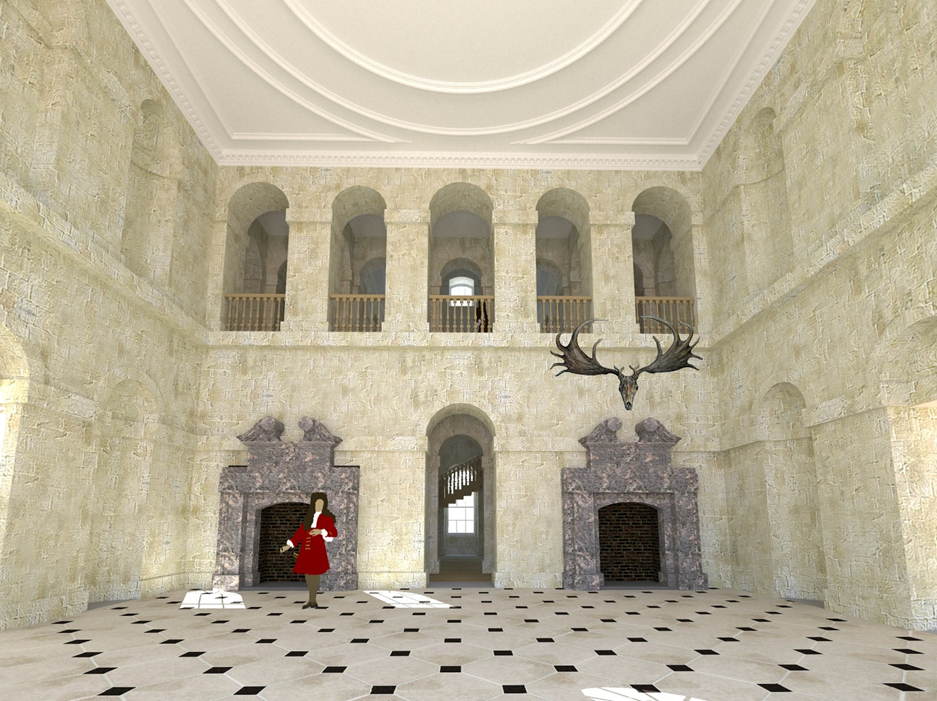
Whenever it arrived at Kings Weston it was immediately a trophy of great interest and was hung prominently in the saloon; this would have been the hall in its original form, as designed by Sir John Vanbrugh, and with stone walls, arcades, and architectural details. At the time there were a pair of fireplaces, one either side of the present later Georgian one. This explains the description of the room immediately before it was refurbished to its present appearance in 1769:
“From the landing place I passed to Kings Weston, the feat of Edward Southwell, Esq; built by Sir John Vanburgh. It is in his heavy stile; the hall the only tolerable room, and that rendered totally useless, by a vast echo. Before one of the chimneys, is a prodigious pair of elk’s horns, dug out of a bog in Ireland” (Arthur Young: A six week tour thru the southern counties of England and Wales)
A reconstruction of the Saloon, later the portrait gallery, in it’s original form, with an impression of how the elk might have been hung before 1769
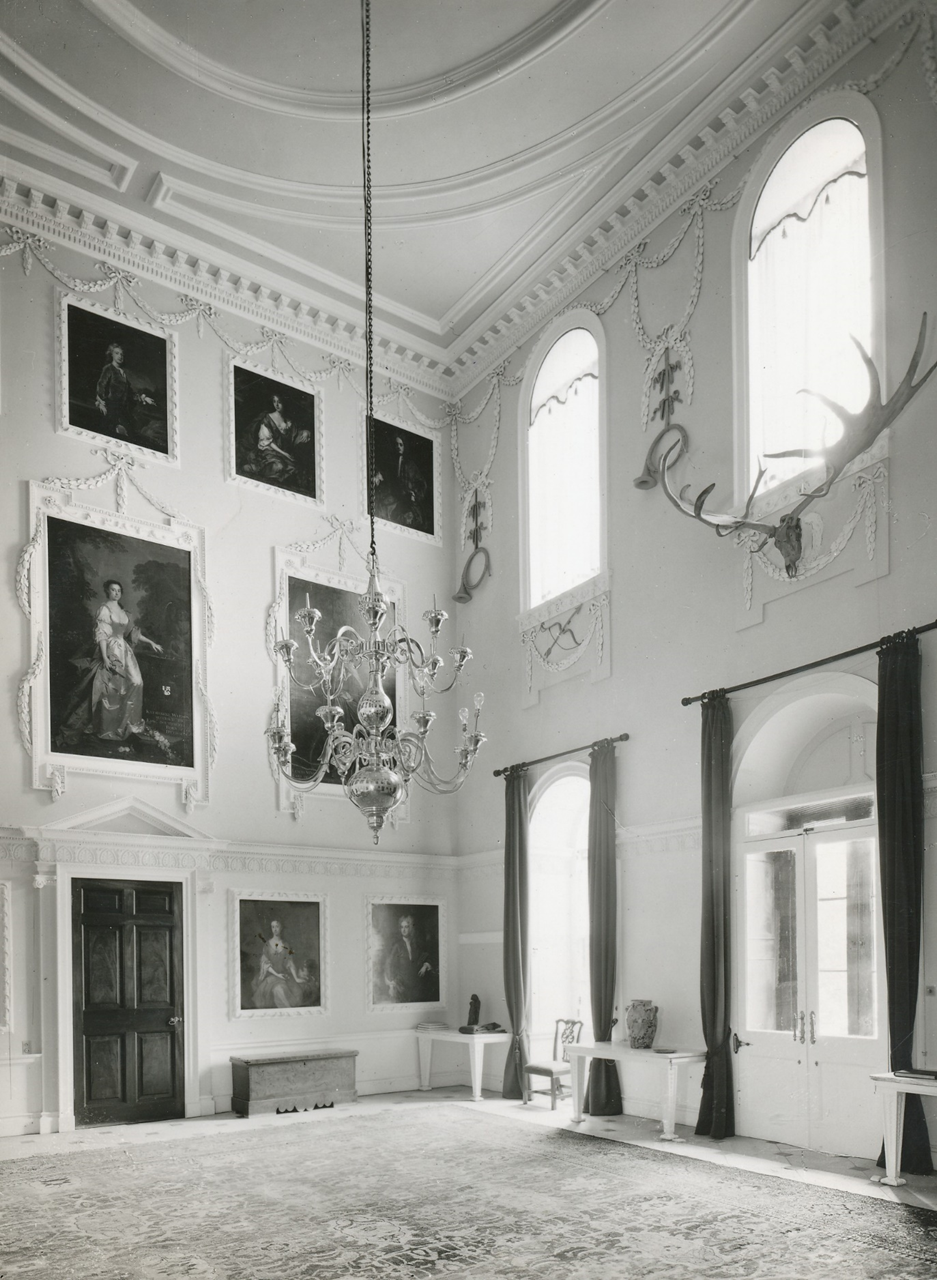
It must have presented quite a lopsided appearance for thirty-so years, a huge set of antlers above just one of the fireplaces in the hall, but this was rectified when the architect Robert Mylne was trusted with the redesign of the room as a grand portrait gallery for the family. He incorporated the skull and antlers into his designs, locating them immediately above the entrance door. To it were added a series of other stucco motifs, four horns hung from plaster swags and bows and arrows amid festoons, all moulded by notable plasterer Thomas Stocking. Rather than stand exhibited as an ancient artefact, the skull became read as part of an ensemble of hunting trophies.
Interior of the portrait gallery in 1927, showing the skull and antlers integrated into the overall interior design, with hunting horns and longbows adding to the hunting theme.
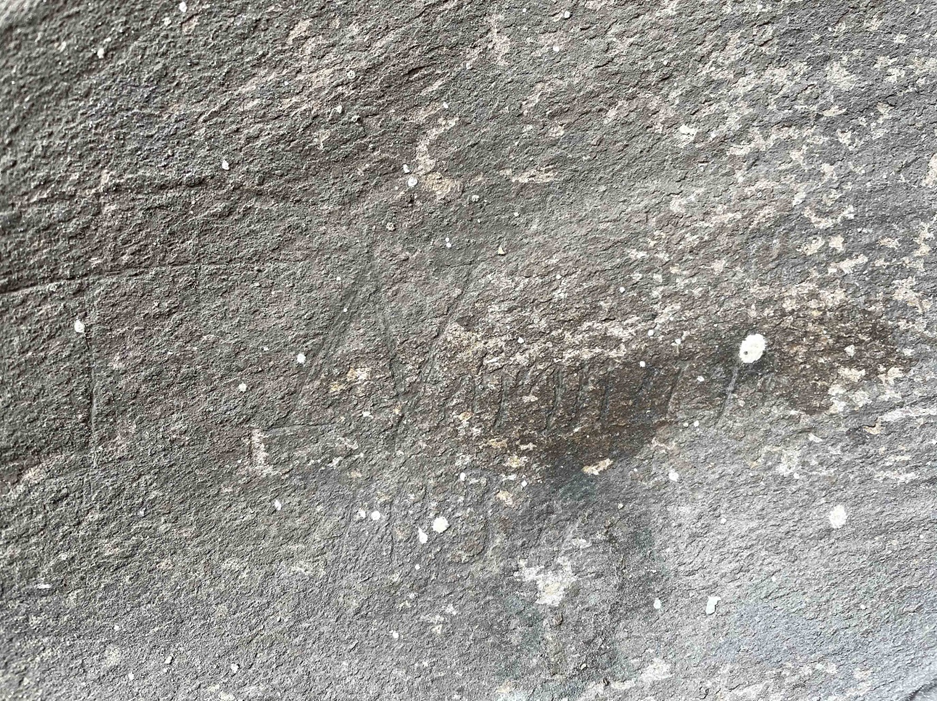
Restoration work in 2021 filled the Saloon with scaffolding, allowing closer inspection of the Great Elk fossil. The metal plates holding it together were clear to see; less clear was a scratched signature and date carved into the upper surface of one of the antlers. The date, we think 1834, coincides with the second great family of Kings Weston, The Miles’s, moving in. Perhaps a decorator hired for the refreshing of the interiors took the opportunity to make a bid for immortality by making their mark. Sadly for them the name is virtually illegible. If you can decipher it, we’d love to know!
Sgraffito name and date. The year looks to be 1834, but who was the carver?
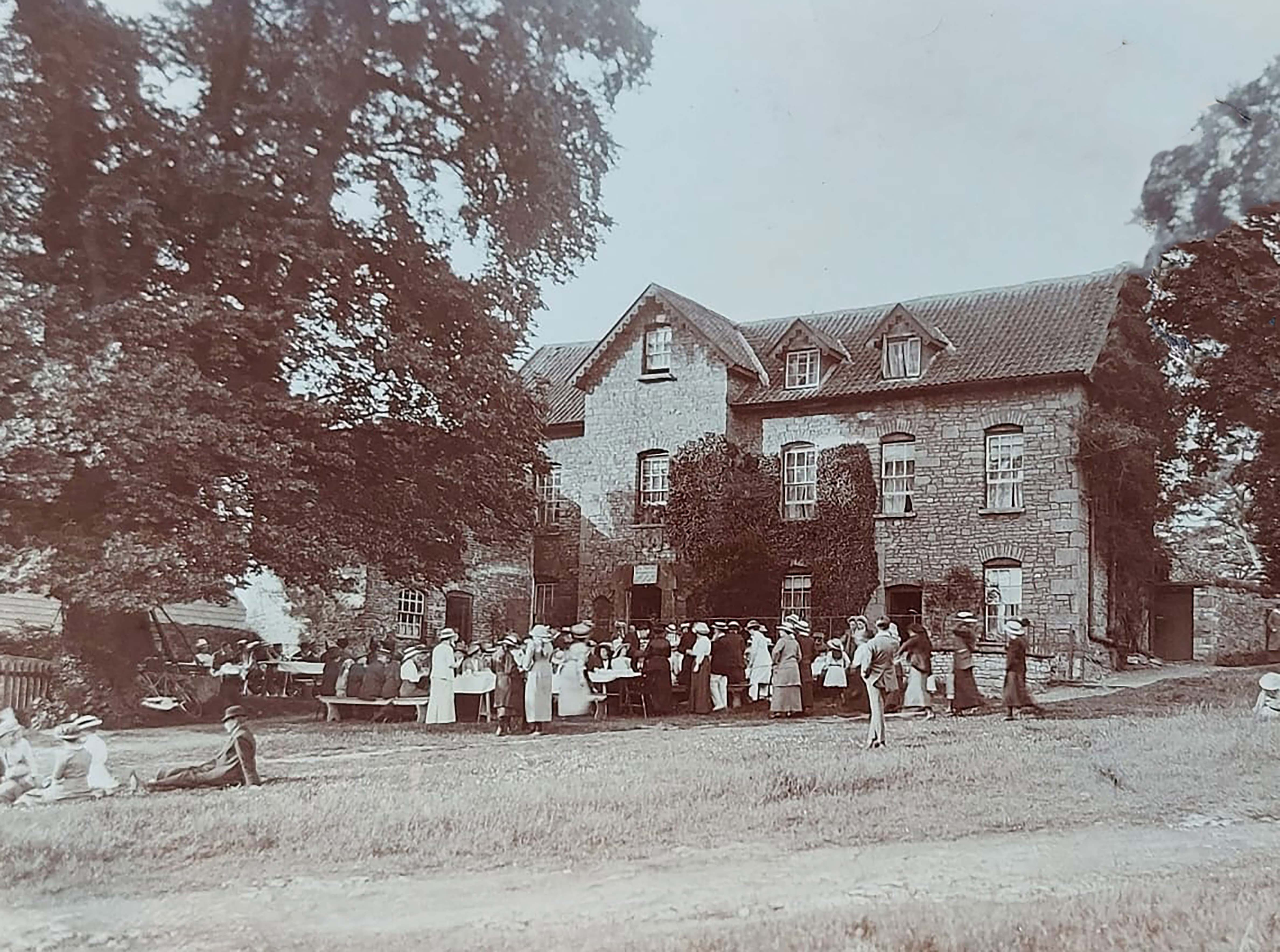
The acquisition of a detailed view of the former Kings Weston Inn is occasion enough to add a little colourful history to the building. The view shows the inn at the turn of the 20th Century with a large party of guests sitting down on long tables for refreshments. The inn had ceased trading as a pub by this point but is known to have offered accommodation for tea parties under a Mrs Withers. This may be one of the many meetings of ladies of the Primrose League, a Conservative organisation, that are known to have taken place at Kings Weston at this time.
Kings Weston Inn in the early 1900s with a large gathering over trestle tables
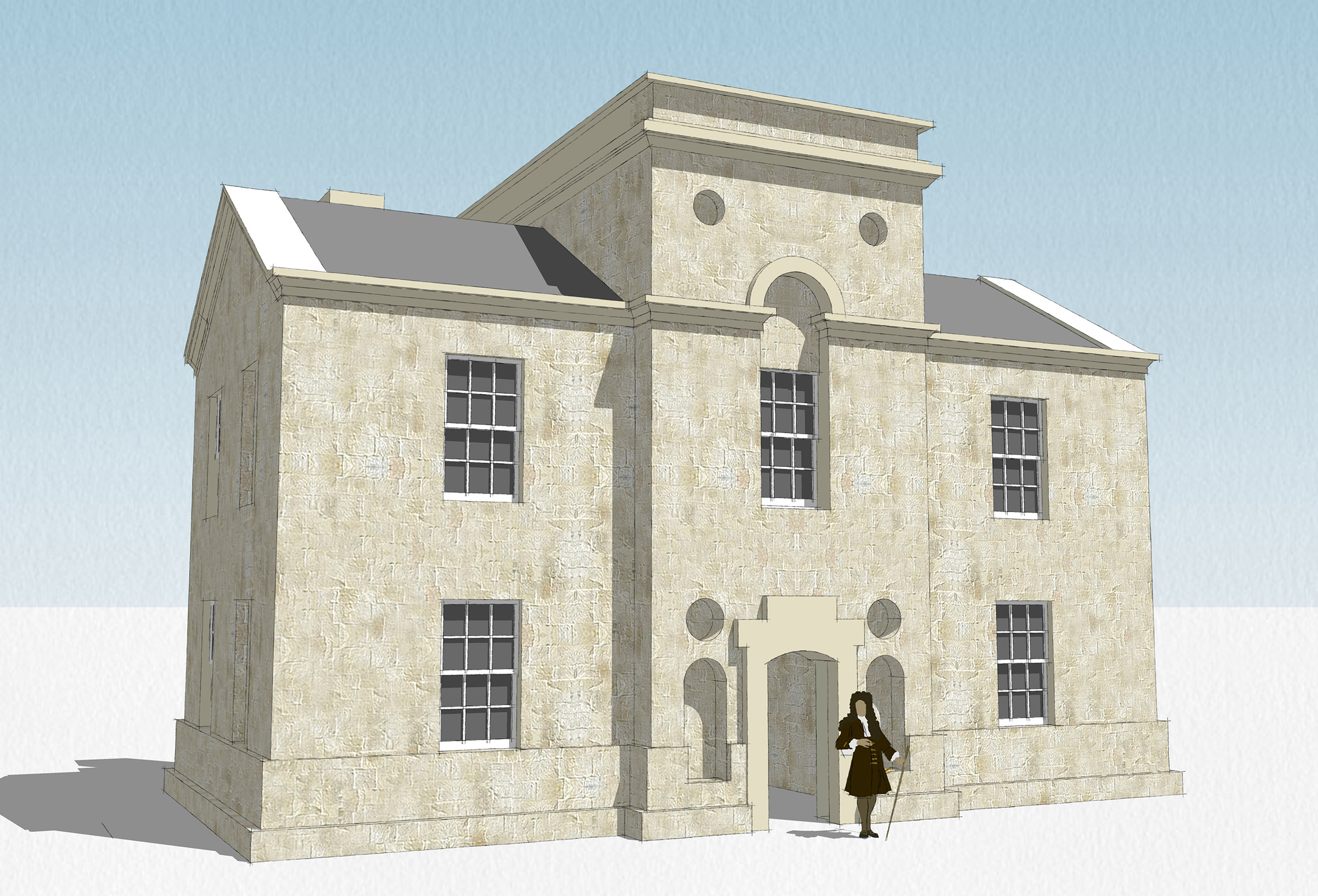
The building itself was probably built shortly after 1718, when a drawing for an inn, then ale house, at Kings Weston was drawn up by the architect Sir John Vanbrugh. The dated drawing was superseded by a later version that is strongly similar to the core of the present building, but we can also attribute this design to the great architect. The building was much smaller than it is today but with features that are still recognisable. A central dog-leg stair ran up the centre of the building with a simple room either side on each floor. The central bay of the building rose above the pitched roof, terminating in a low tower that, we believe, was used as a viewing platform for patrons.
The second plan for Kings Weston ale house, from the Kings Weston Book of Drawings. circa 1718. (Bristol Archives)
The building of inns to serve visitors was not unusual in the Georgian era, but that at Kings Weston is very early, being only a year later than the New Inn at Stowe, Buckinghamshire, built for the same purpose. Using the drawn dimensions has enabled us to create a simple 3D model of the building before later extensions and alterations changed its appearance. The architect’s measurements compare well with that of the core of the existing building.
We know that there were modifications in the mid-Victorian period, but even before then the building must have been found wanting. Parties from Bristol and Bath regularly visited the inn for recreation during the Eighteenth Century and it was part of well-published local tours.
Reconstruction of the original Kings Weston Ale House, before alterations.
In stark contrast to the genteel party in the new image, one intriguing report involving the inn comes to us from a newspaper report from 1774, perhaps one that may, or may not, be fitting for publication in Pride month. The incident followed a private tour of Kings Weston house for a couple of visiting gentlemen, given by one of the male servants there. The report implies that the servant was sexually assaulted at the inn by one of the visitors as the other sought to stop him from escaping. It’s not known who Mr L and Mr B were, they both escaped, though we the scandal broke Mr B fled the country all together, no doubt with his reputation shot, and fearing reprisals. How much truth there is in this report is unclear, but it shows the taboo of homosexuality at the time and the risks that men would sometimes go to:
Reading Mercury & Oxford Gazette Sept 12 1774
Extract of a letter from a Gentleman of Bristol to his friend on London Aug 31
An affair has lately happened here, which has been the general topic of conversation ever since last Wednesday, Mr B—-, Mercer of this city, and Mr L—–, a linen draper, not a hundred miles from the Haymarket, London, went in a chaise together to Kings Weston, to view the house of Edward Southwell Esq – At their departure they offered the servant who showed it a piece of money, which he refusing, they insisted on his drinking a glass with them at the inn they put up at. After they had drank pretty freely, Mr B—- on some pretence left the room; which he had no sooner done. That Mr L—- behaved in such an indecent manner as contrived the man of his brutal intentions; he therefore attempted to quit the room, but was prevented by Mr B—-, who held the door on the other side; finding he could not get out, and being irritated by such an infamous insult, fell upon him and beat him unmercifully.
The noise being heard below, brought several people up, which Mr B finding, thought proper to leave the door and fly to the window from whence he made his escape, leaving Mr L— behind to bear the insults of hostlers, cooks, chambermaids etc who kicked, cuffed, and clawed him, tore his hair, had the dogs set on him, afterwards uncovered him, rolled him in the nettles; finally the maids would have proceeded to castration, had they not been prevented.
Mr Southwell, being acquainted with the affair, ordered two men to guard him that night, with the intent of bringing him to justice the next morning, but he found means to bribe his watch, and got clear off before morning. As for Mr B—- he attended his shop as usual two or three days, till the matter became public, and everybody looking on him equally guilty, he thought fit to decamp, and has not since been seen; it is said that he is gone to France or Italy with an intent never to return.