Tag Archives: painting

‘Adorable magnificent view’: Lost prospects from a once famous hill

Last month we mentioned Kingsweston Hill in passing, and the “Evergreens Wood” marked on old maps. It’s worth reflecting more on the Hill, and its once-famous attractions now lost to us. Common Land until the 1830s, its public status was challenged by the Enclosure Acts which sowed the seeds of its change in character.

The hill was once open downland, grazed by sheep and bare. Compared to the present appearance it was a wild and exposed place. Siting a windmill at its summit reflects the position wide open to the winds reaching up the Severn Estuary.
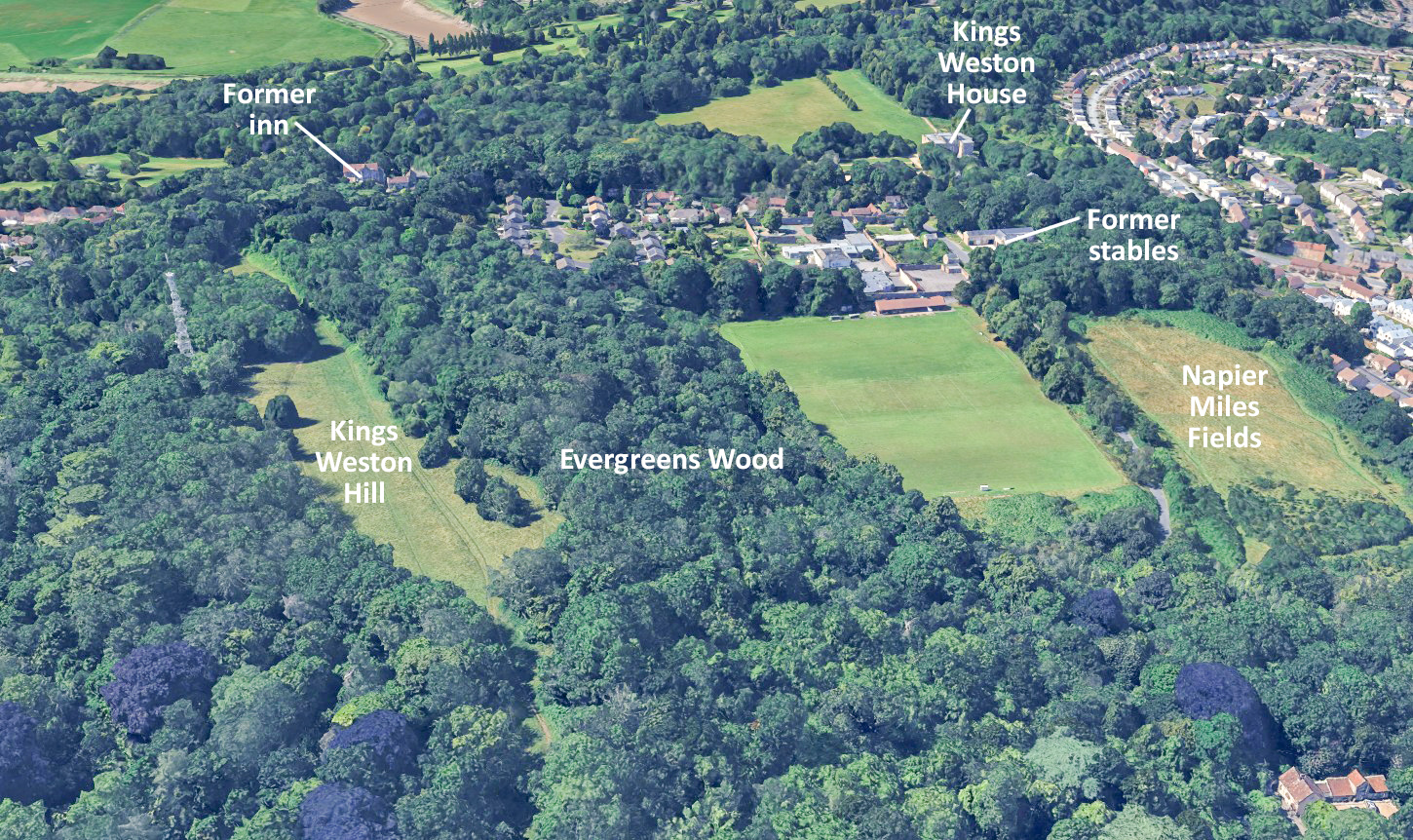
Aerial view looking west along Kingsweston Hill, with some familiar landmarks indicated.

It was probably already a popular resort from the city by the time the Kingsweston Inn (sometimes called the breakfasting house) was built in the 1720s to cater for visitors and “which is much, resorted to on account of its situation”. The open views stretched all around you from the top, right across to Wales in the north, towards Somerset and the Avon Gorge to the South, and stretching as far as Chepstow and down the Bristol channel in the direction of the New World.

The sublime character of the spot, the raw nature of the hill and the beauty of the views, became one of the most famous attractions of Kings Weston in the Eighteenth Century. There are many documented visits and descriptions throughout this period.
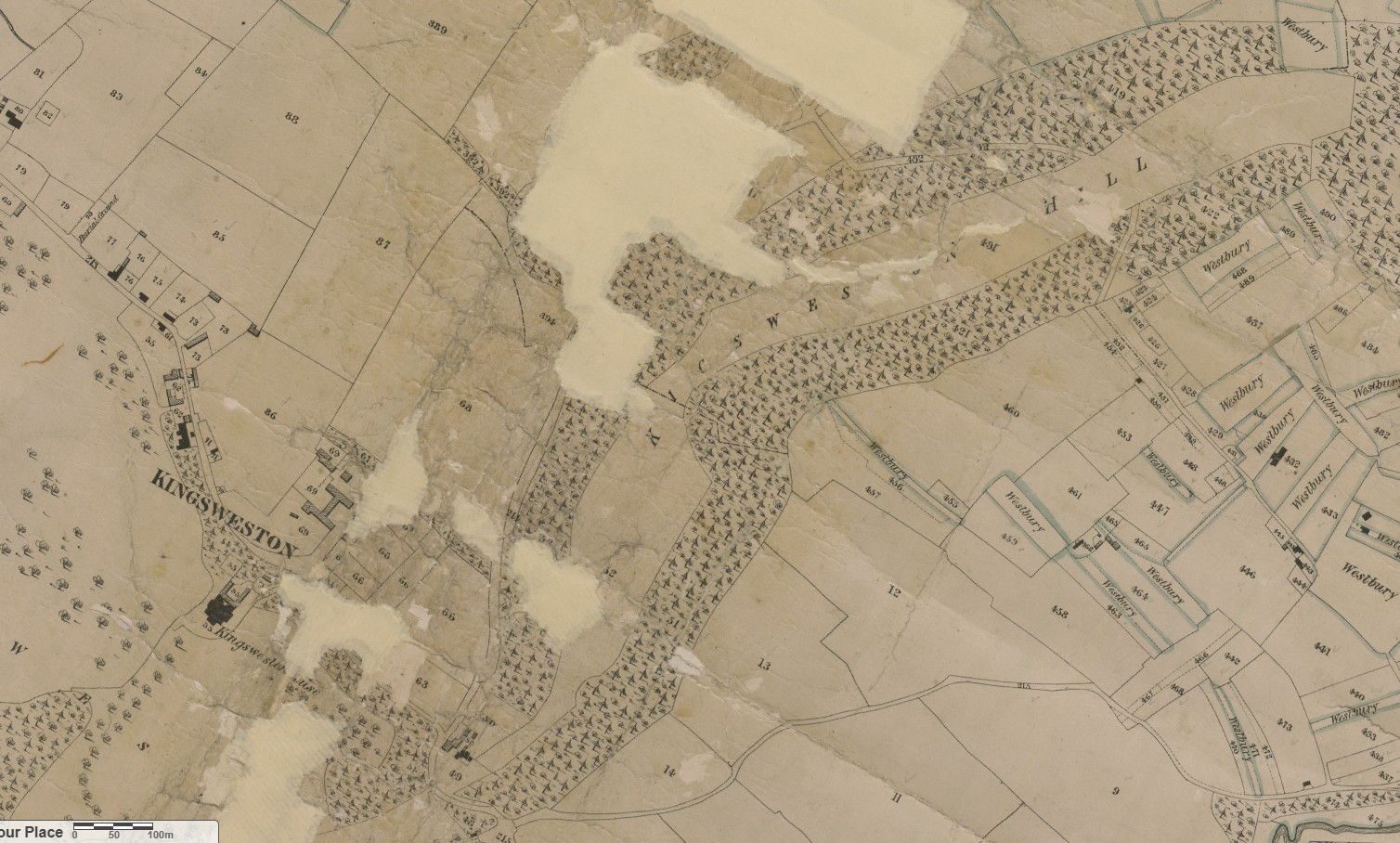
This excerpt from the 1840s tithe map shows north and south slopes of Kingsweston Hill already cloaked in new plantations.

John Wesley, preacher and founder of the Methodist Movement, was a frequent visitor to Kings Weston, writing of it often in diaries and letters. He recounts one such occasion in 1739 when his spreading notoriety for open-air preaching saw himself becoming a local attraction:

“On Holy Thursday, many of us went to Kings-Weston Hill, 4 or 5 miles from Bristol. As we were sitting on the grass, two gentlemen went by, and by way of jest, sent up many persons to us from the neighbouring villages: To whom therefore I took occasion to speak on these words, ‘Thou has ascended up on high’”.
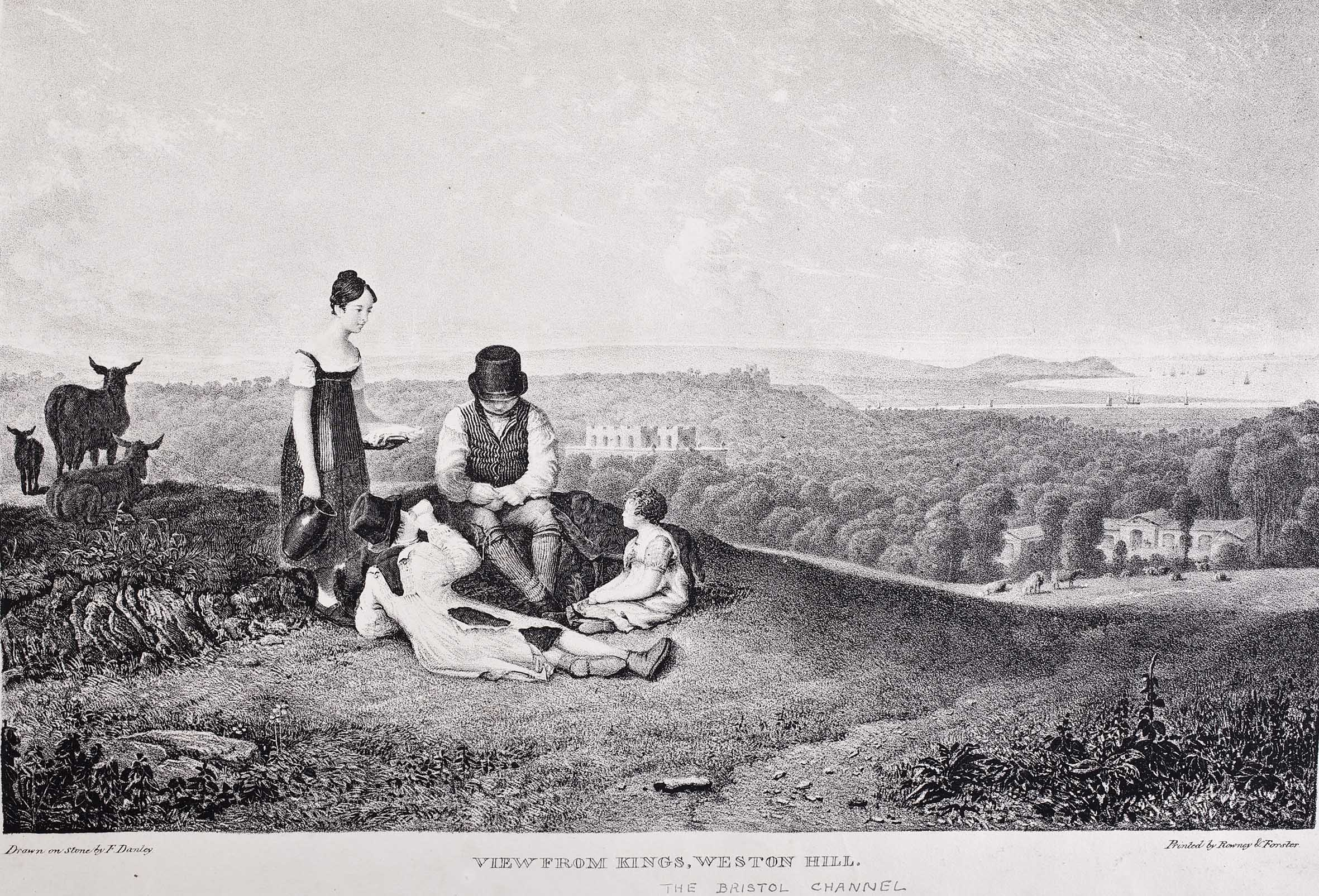
One of a series of popular lithographic prints published by the artist Francis Danby. This one shows the general appeal of the view from Kings Weston Hill and its popularity with patrons.

‘A six week tour thru the southern counties of England and Wales’, a travel guide published in1769 by Arthur Young remarks on the breadth of the views;  

“for a prospect, you must go up the hill, a little beyond where the breakfasting house for the hot-well company is situated; you look down from the hill to the west upon some fine woods, in the midst of which, Mr. Southwell’s house appears. In front is a very fine valley, two miles broad, beautifully intersected with hedges and trees, and bounded by the Severn, which is here ten miles over; you command Kingroad, with a fleet of shipping, generally lying at anchor; and, lastly, the Welsh mountains terminate the whole. Behind there is an extensive view of the country, well scattered with villages: the windings of the Severn are seen 20 miles, and those of the Avon quite to Bristol. The prospect extends into Somersetshire, Gloucestershire, Monmouthshire, Glamorganshire, Brecknockshire, Radnorshire, and even to Pembrokeshire; and, upon the whole, is inferior to nothing”.
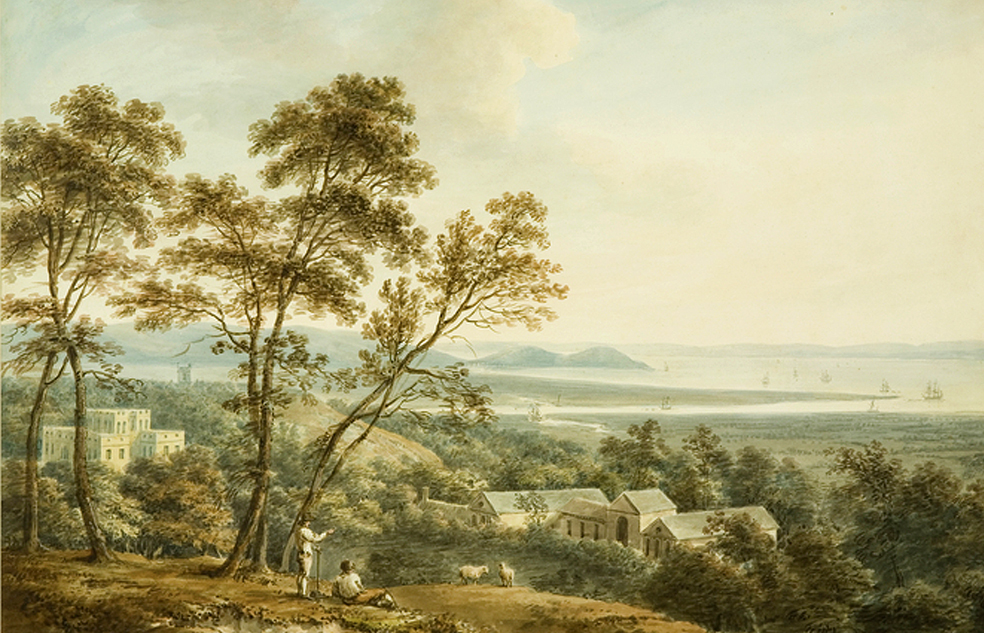
 Samual Jackson’s well-known painting from Kingsweston Hill from the 1790s

In the 1780s, another such book, The Bristol and Hotwell Guide, lauded:

“There is scarcely a spot in the kingdom that affords a more pleasing and extensive  view of land and water than is seen from This hill.”

The same decade saw the publication of a poem named after the hill by a Thomas Hobhouse, further raised the national profile of Kingsweston Hill and its views.

The picturesque prospects led to a brisk trade in paintings and artworks developing around the turn of the 19th Century, with many versions of the view across the Severn recorded by artists of the Bristol School. This was Kingsweston Hill at the height of its notoriety.
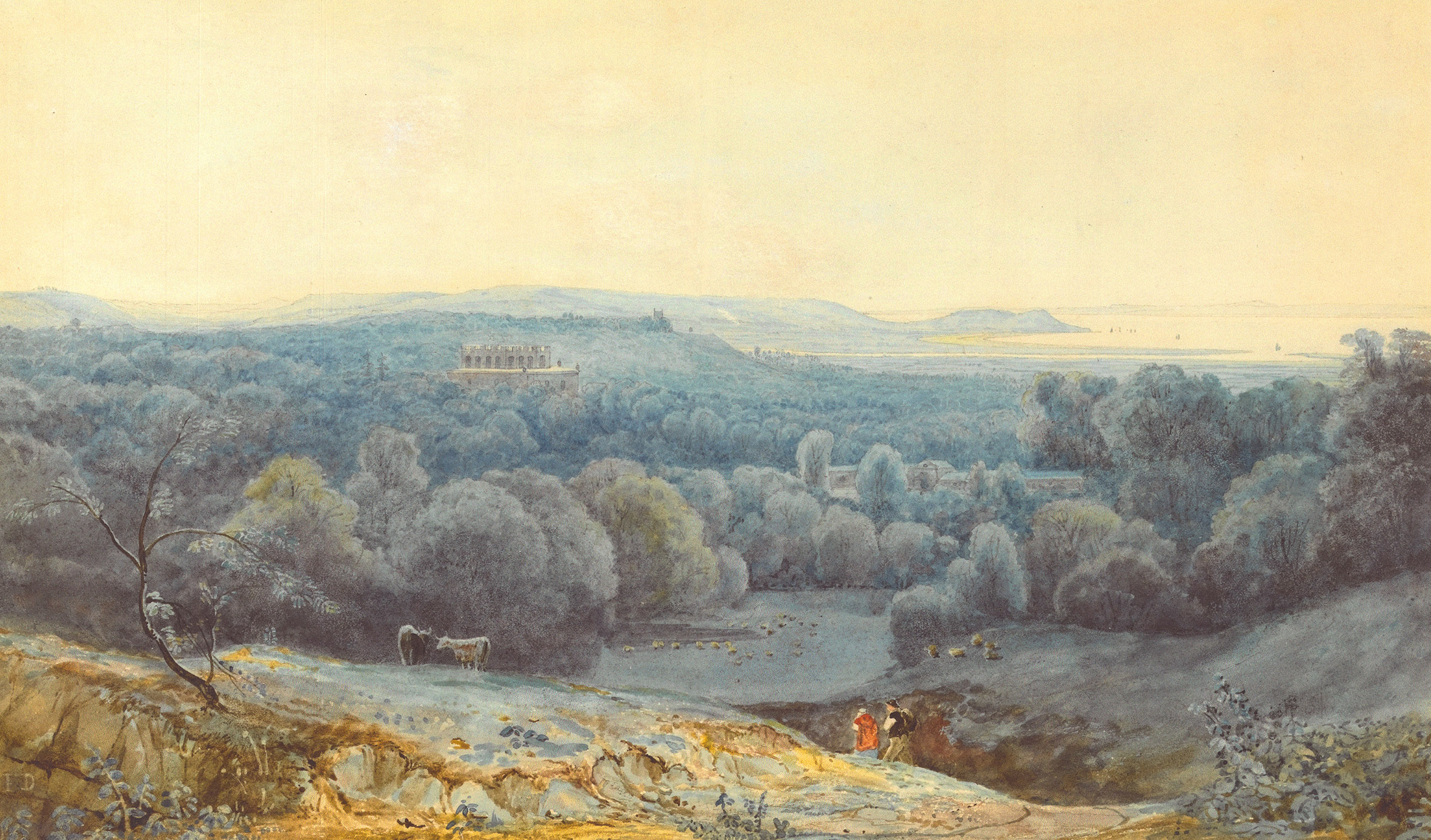
A Francis Danby watercolour of evening light seen from Kingsweston Hill, circa 1815.

Many of these views took advantage of a common spot now engulfed within Evergreens Wood on the north side of the Hill. The location was along the path along the northern edge of the hilltop from where the visitor could enjoy the views westward towards the Bristol Channel with the vast scale of the natural landscape put into perspective by the diminutive (relatively speaking) mansion and buildings of Kings Weston house in the middle distance.
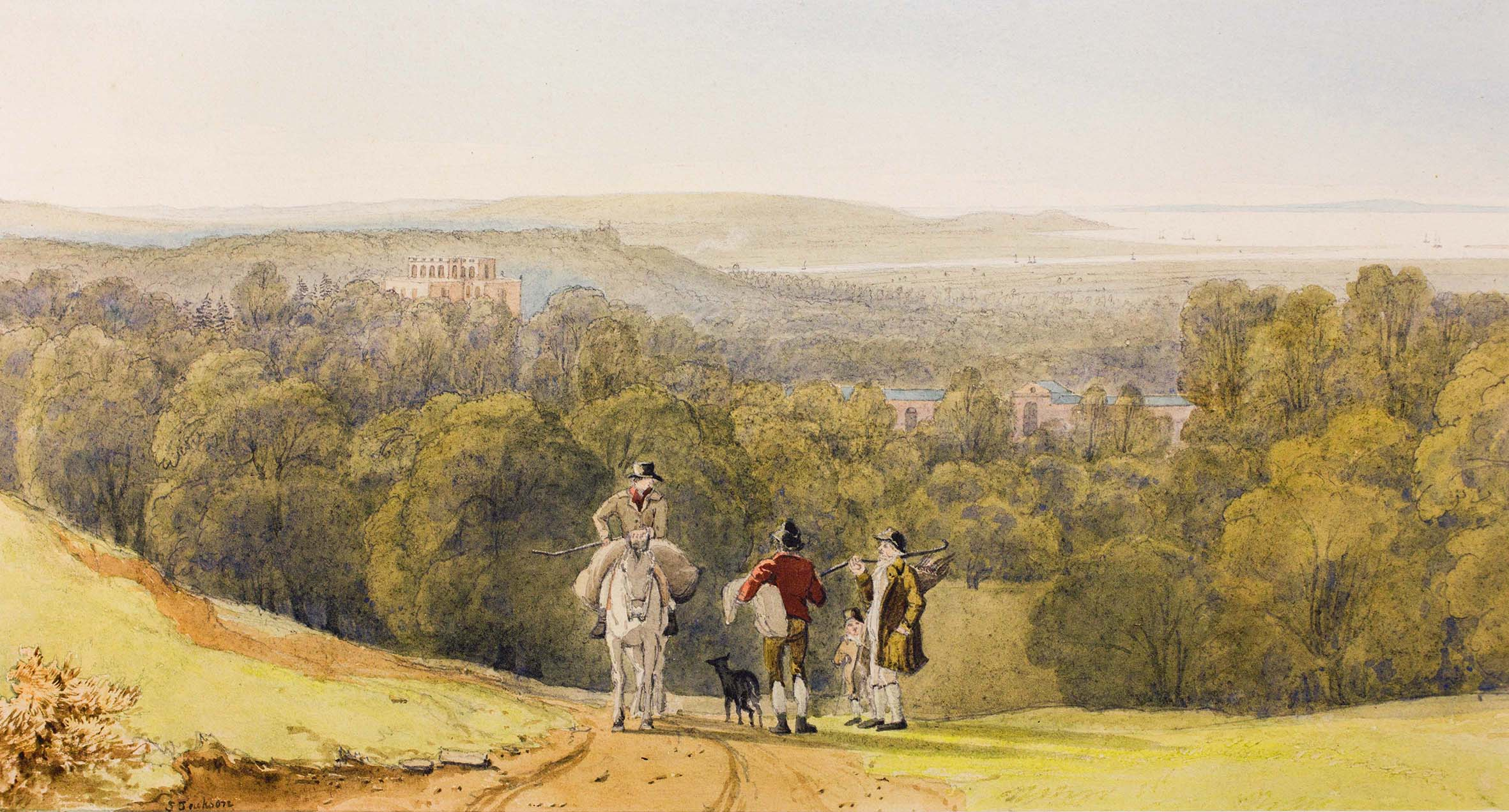
Watercolour looking across Kings Weston and Penpole Point by Samuel Jackson, circa 1820.

Trying to find the site today is confounded by the dense woodlands that have grown-up since. This is in large part to the Enclosure Act of 1812 that saw the whole of the hill ‘privatised’ in the ownership of the Southwell family, then the Lords de Clifford. The Act was not enacted formally until 1822, after which Edward Southwell, 21st Baron de Clifford set about making his mark on it and making it an extension of the Kings Weston landscaped parkland.
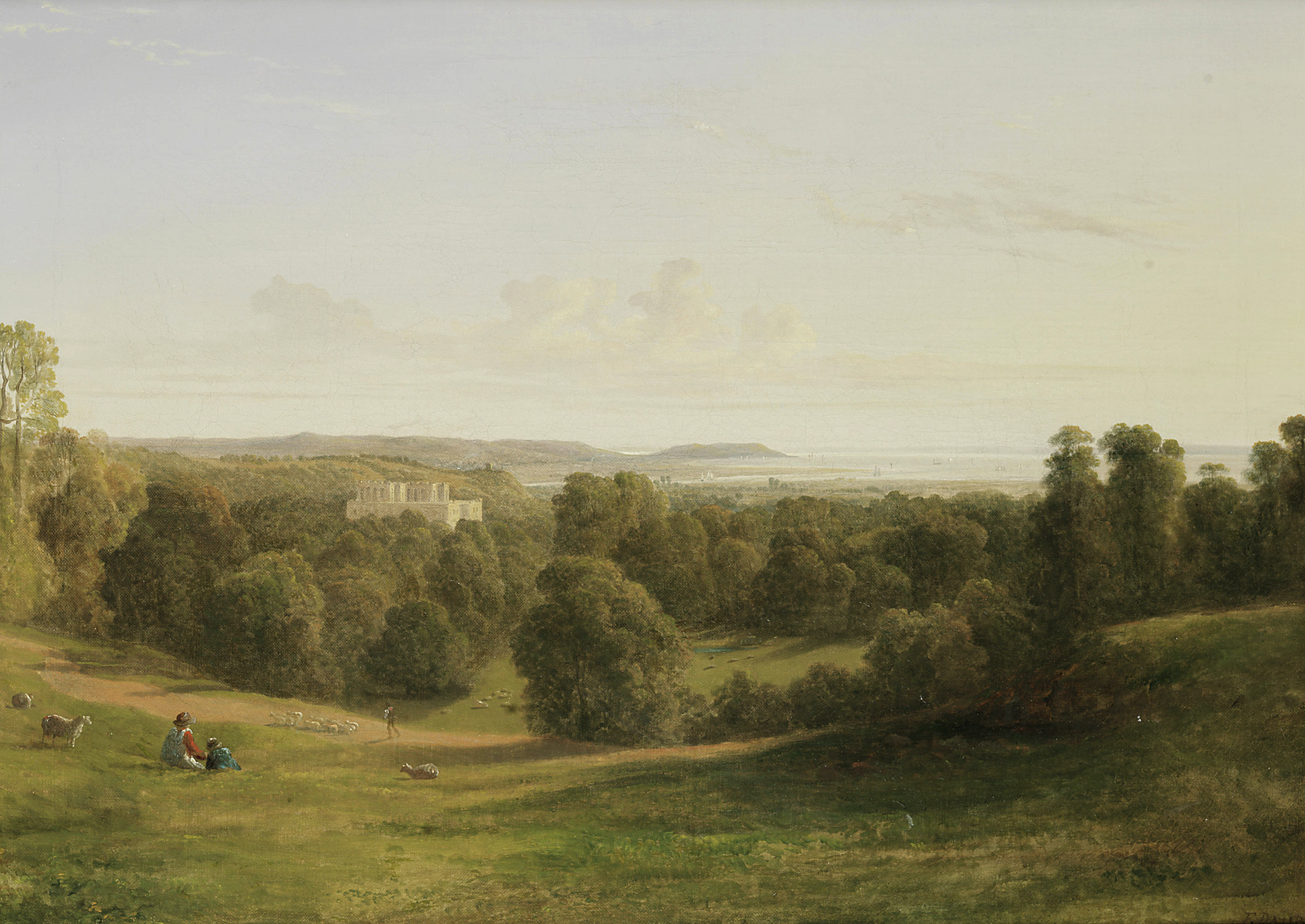
Oil Painting “View over the mouth of the Avon and kings Weston House” by Francis Danby. Circa 1815.

Of Lord de Clifford, it was written

“The great enjoyments of Lord de Clifford when at home was planting shrubs and trees. Many thousands were planted under his directions. I can picture him now as I often saw him, a little insignificant man riding on a very quiet horse followed by John Webb, his favourite groom, to superintend operations.”

One focus for this avid planting spree appears to have been Kingsweston Hill. New carriage rides were constructed encircling the hill, routes that can still be enjoyed,  and these were planted heavily with new trees.

Whether the Lord’s intention was to deliberately obscure the views that attracted so many public visitors to his land isn’t known, but this was certainly the end result. Evergreens Wood was planted along the side of the hill with yews, cherry laurel, conifers, arbutus, and Evergreen Oak that might be better suited to north-facing slopes.
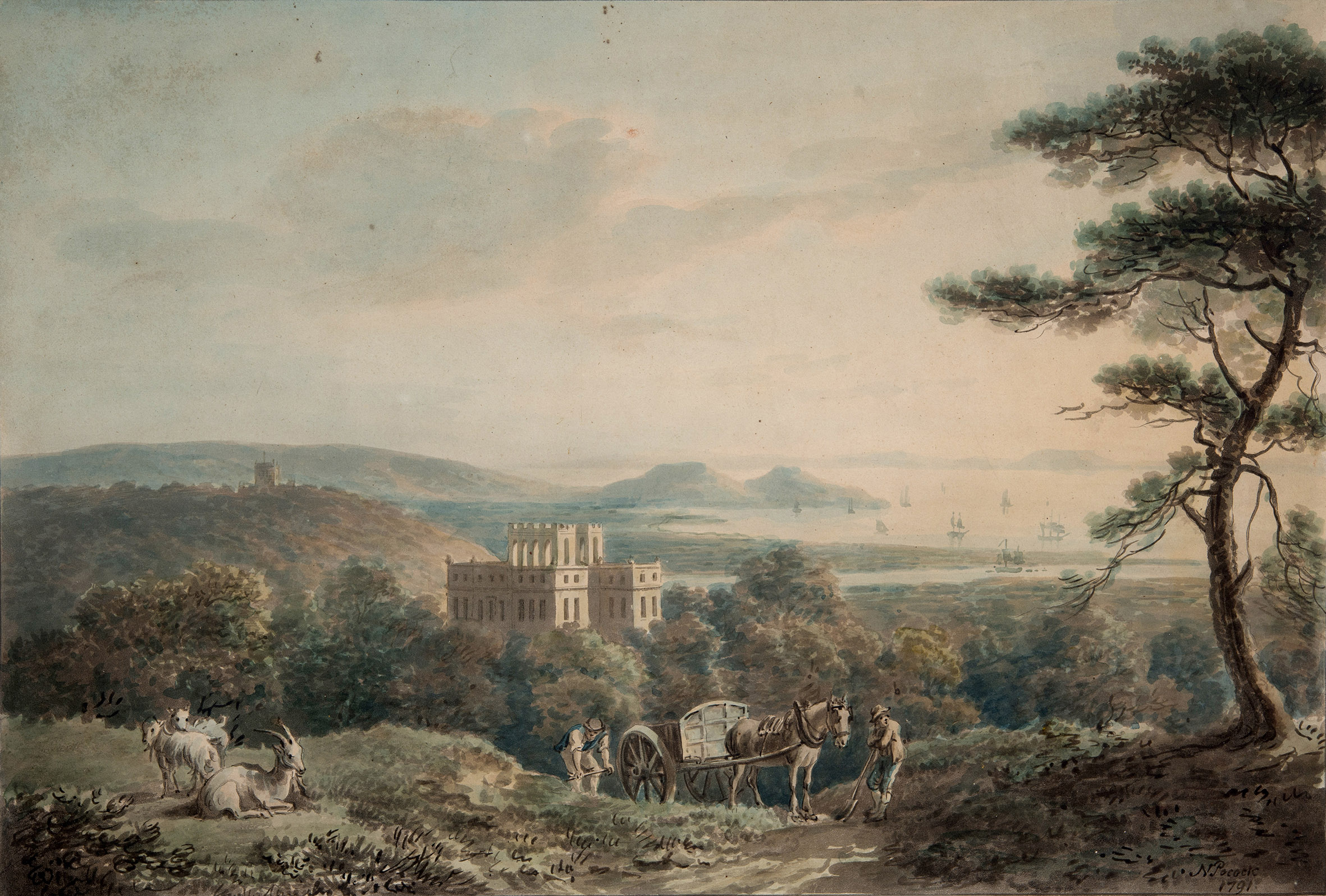
Coloured print by Nicholas Pocock showing the view from kingsweston Hill  1791.

Whilst the view from Penpole Point remained celebrated, the frequency with which the views from Kingsweston Hill are mentioned falls off rapidly after the 1830s, perhaps as rapidly as the new evergreens grew up. With the purchase of the estate by the Miles family in the same decade they sought to prevent all public access to the hill, but the strength of feeling against this from across Bristol saw them relent.
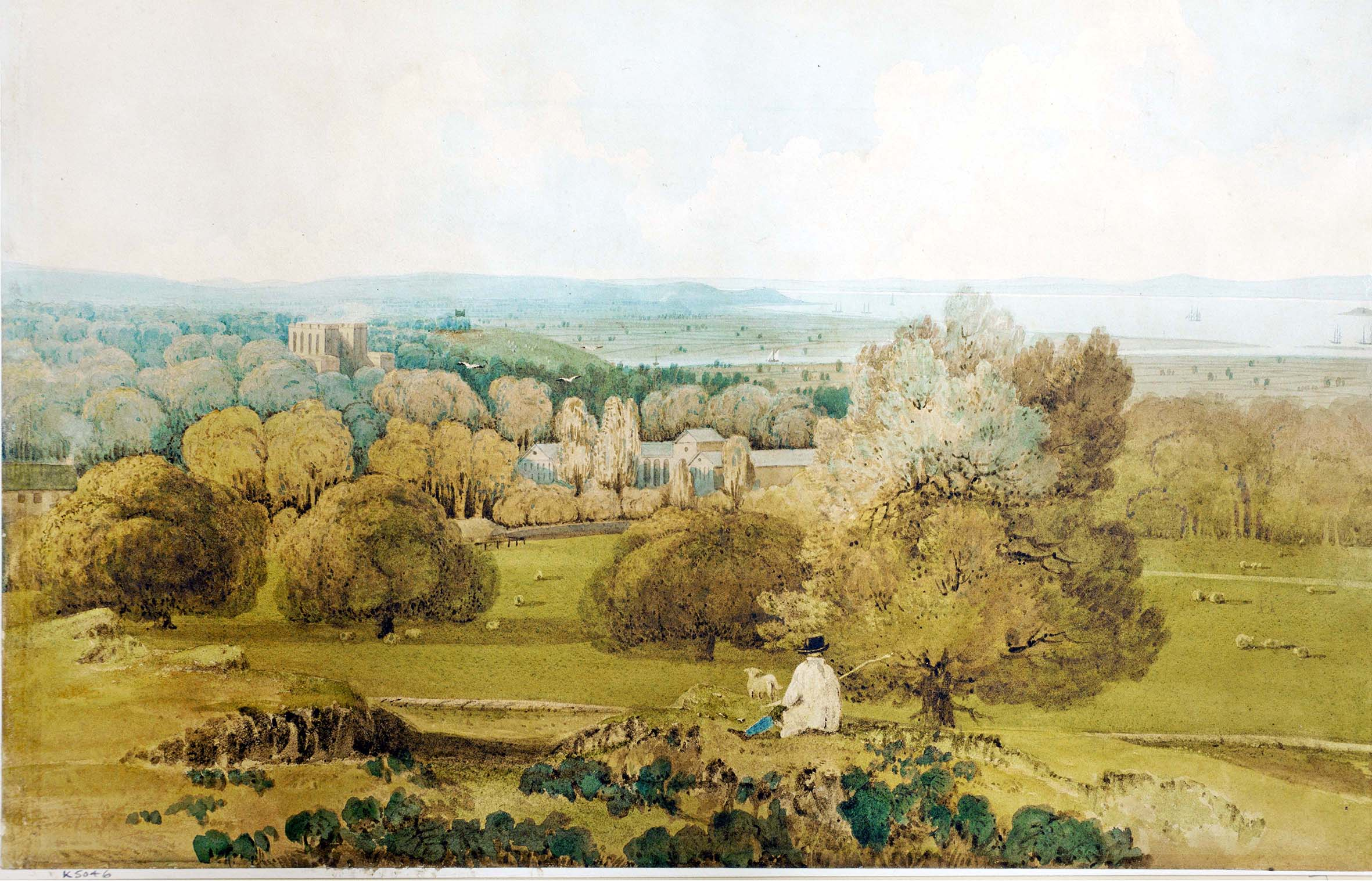
Watercolour by Samuel Jackson, dating from the 1820s

The botanist Charles James Fox Bunbury makes no mention of views from the hill on his visit In September 1870. He wrote:

“Kate and I had a long walk with Miles through his beautiful woods, clothing the ridge of the hill eastward of the house, and joining on the woods of Blaise castle. The luxuriant growth of evergreens is remarkable: above all the arbuti are more numerous and larger and finer than I have seen anywhere else except Killarney.”  
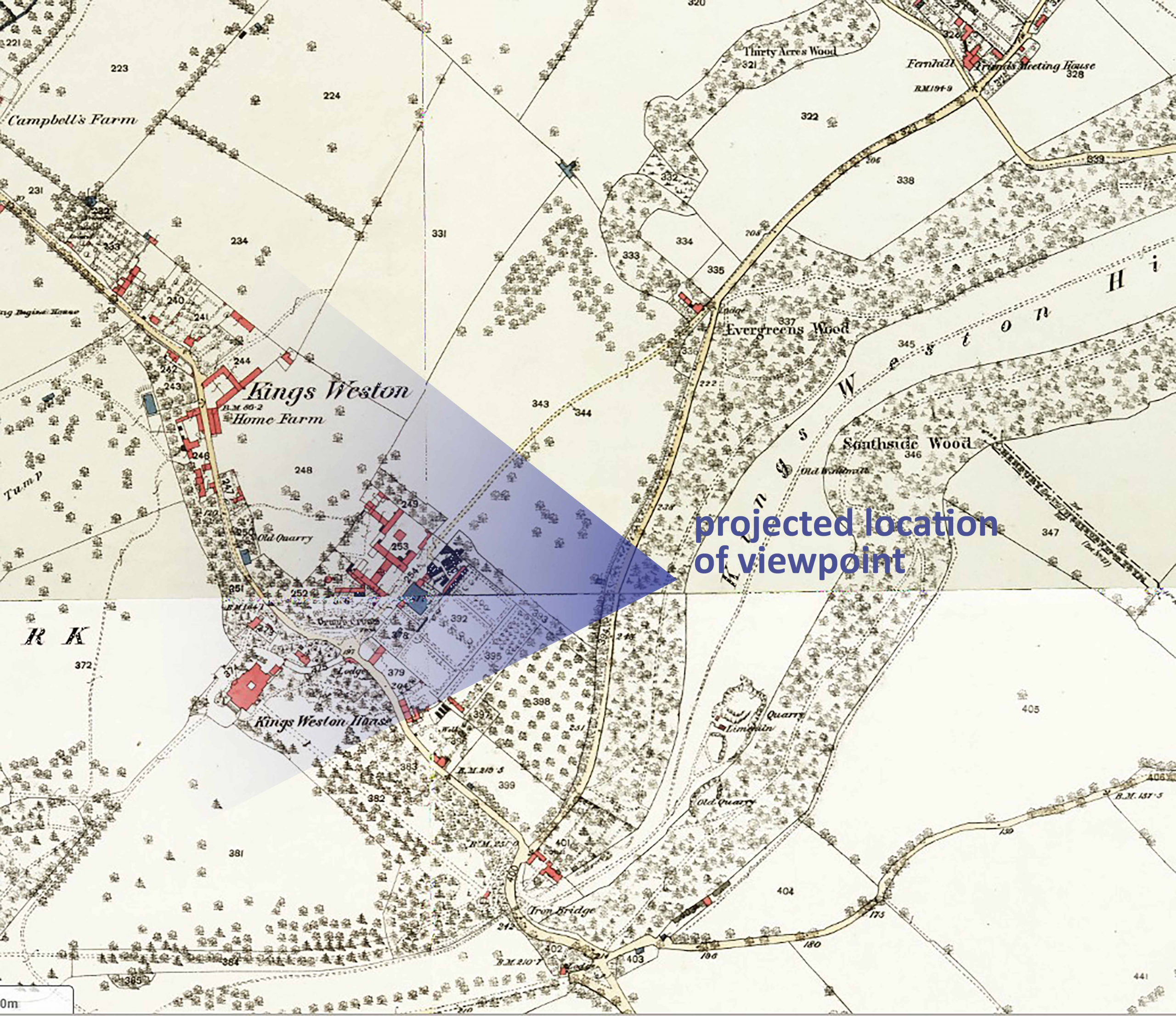
1880s ordnance Survey map showing the projected location from where artists painted.
Views of the Georgian stables are now rare from this angle.

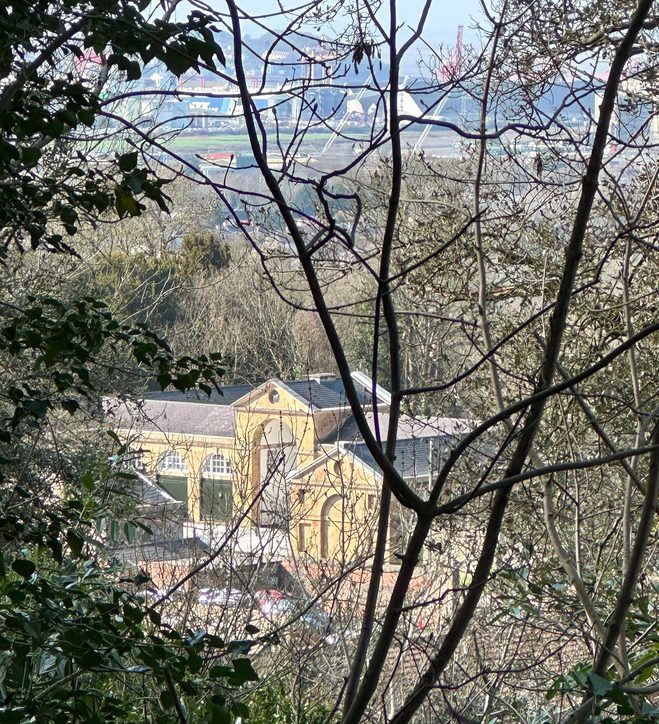
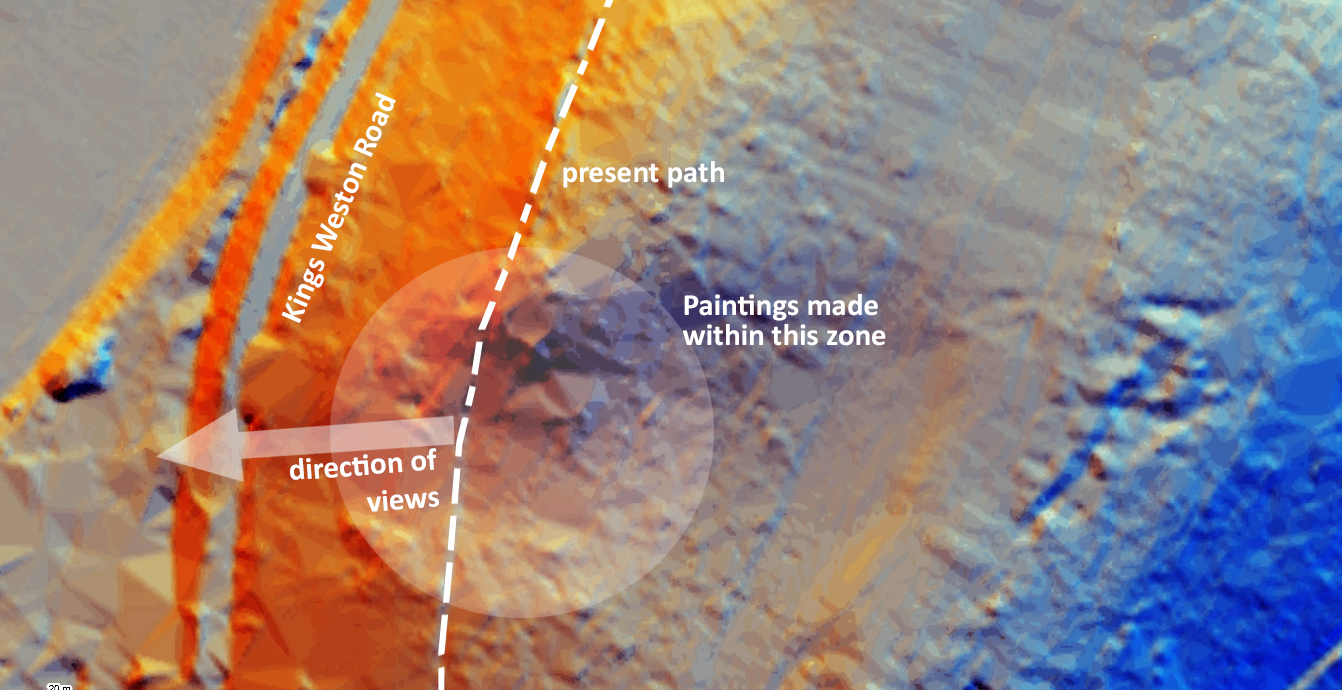
And so, the character of Kingsweston Hill has been permanently changed by these plantations. No longer can views be enjoyed, barely even glimpsed through the dense dark foliage. The exact location once enjoyed by Bristol’s artists remains uncertain, but the clearest impression of where it once was can only be gleaned using Lidar plans. A shallow valley in the side of the ridge now unrecognisable beneath the trees, and associated with it some rougher topography, is likely to represent the celebrated spot. If one looks through the dense canopy of trees that now cloak the slope, you might just glimpse a view out, and again marvel at how high you are suspended above the Severn estuary.  
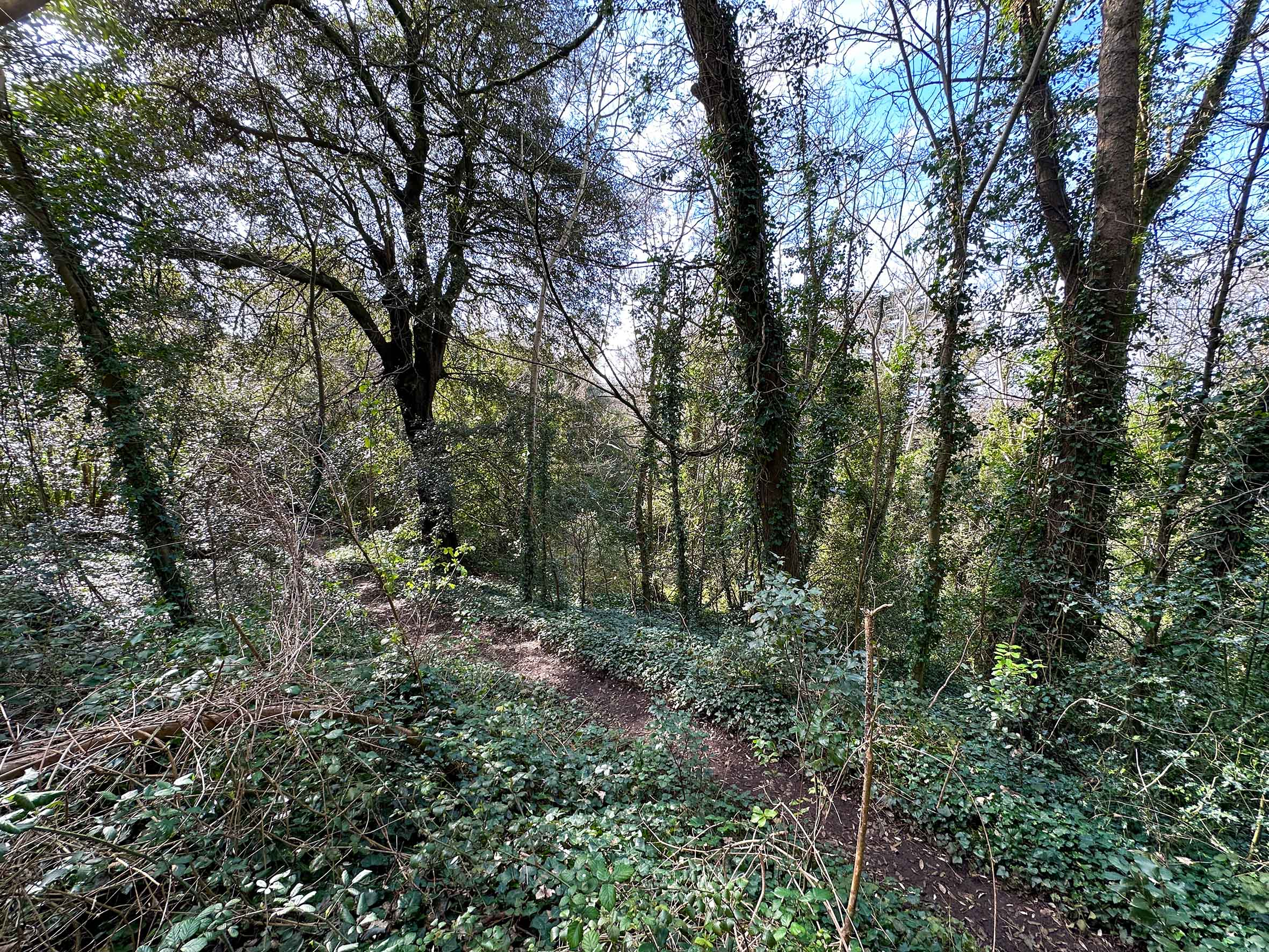
The approximate location where artists once sat to record the Kingsweston landscape from the hill.
Coloured Lidar plans showing the modern topography with the possible location favoured by artists of the Bristol School

“Old Frank” up for auction 

An old master oil painting, once the collections of the Southwell family of Kings Weston house, has recently been advertised for auction. We note, with disappointment, that it has recently been released from the large collection of historic Kings Weston paintings held in trust by the descendants of the Southwell’s, later Barons de Clifford.

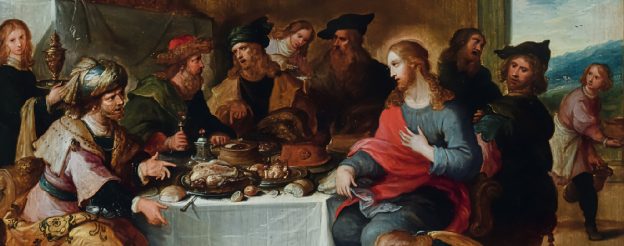
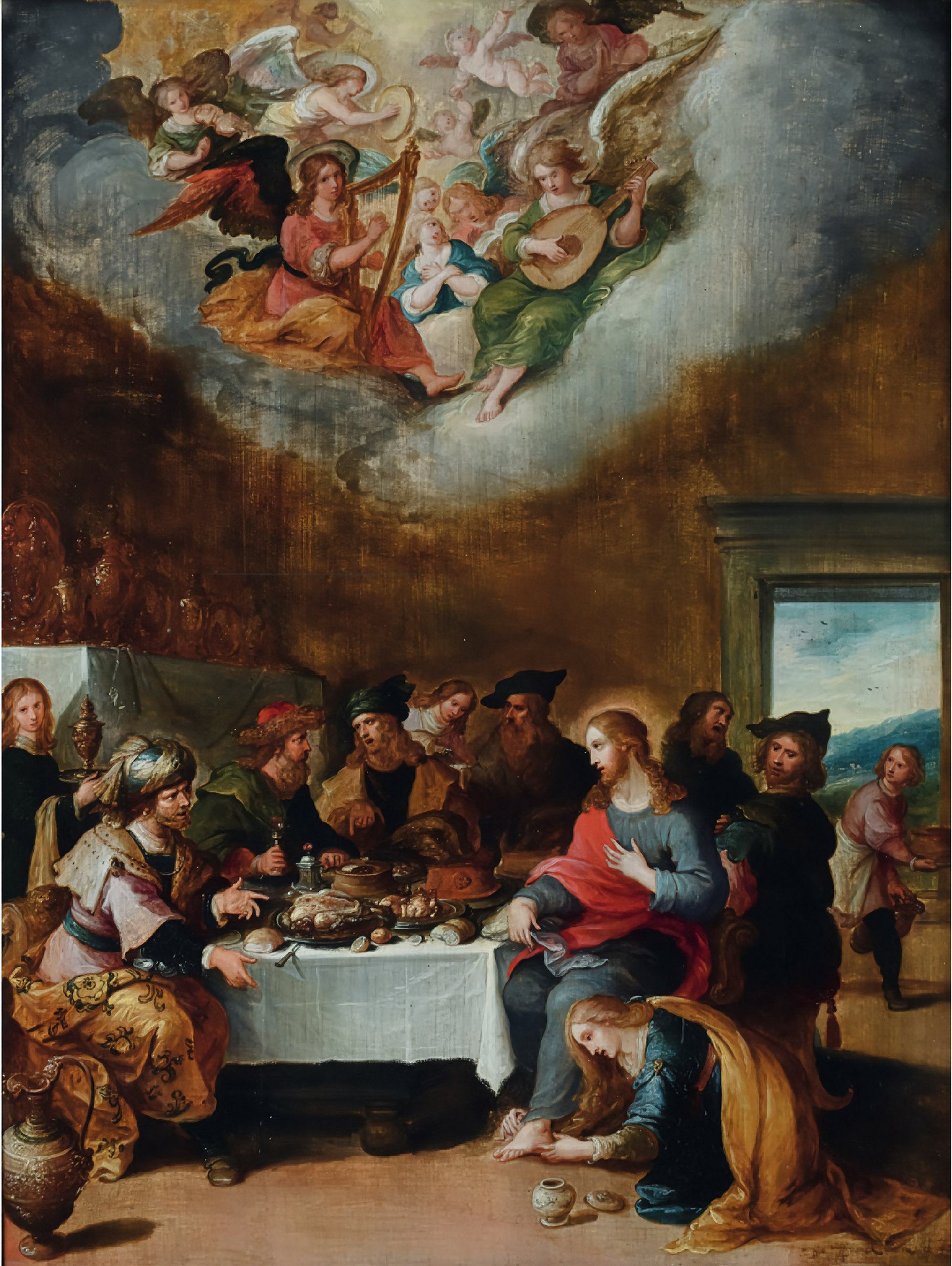
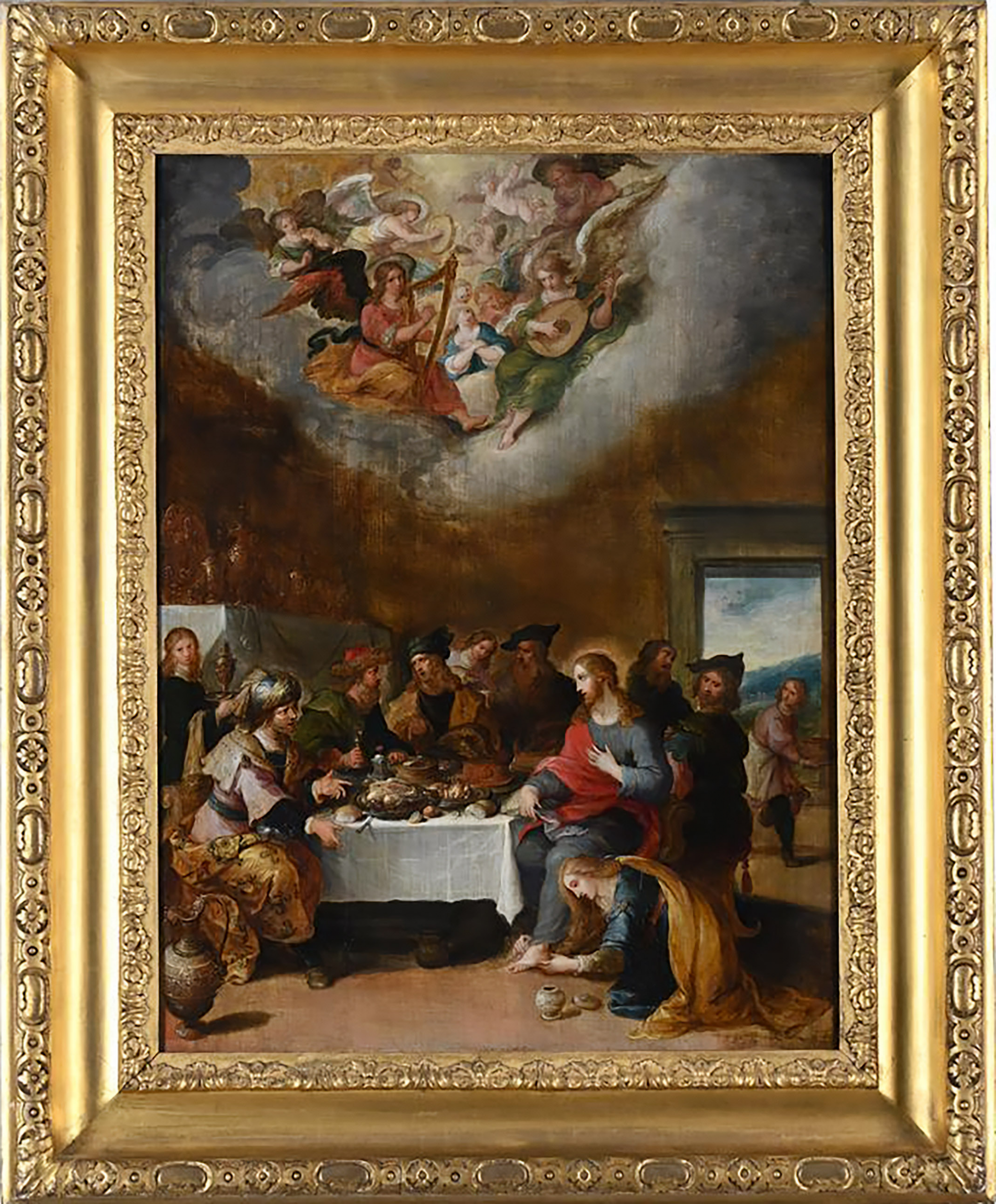
Christ in the House of Simon the Pharisee, one of the Old Master paintings once given pride of place in Lady de Clifford’s private chambers. 
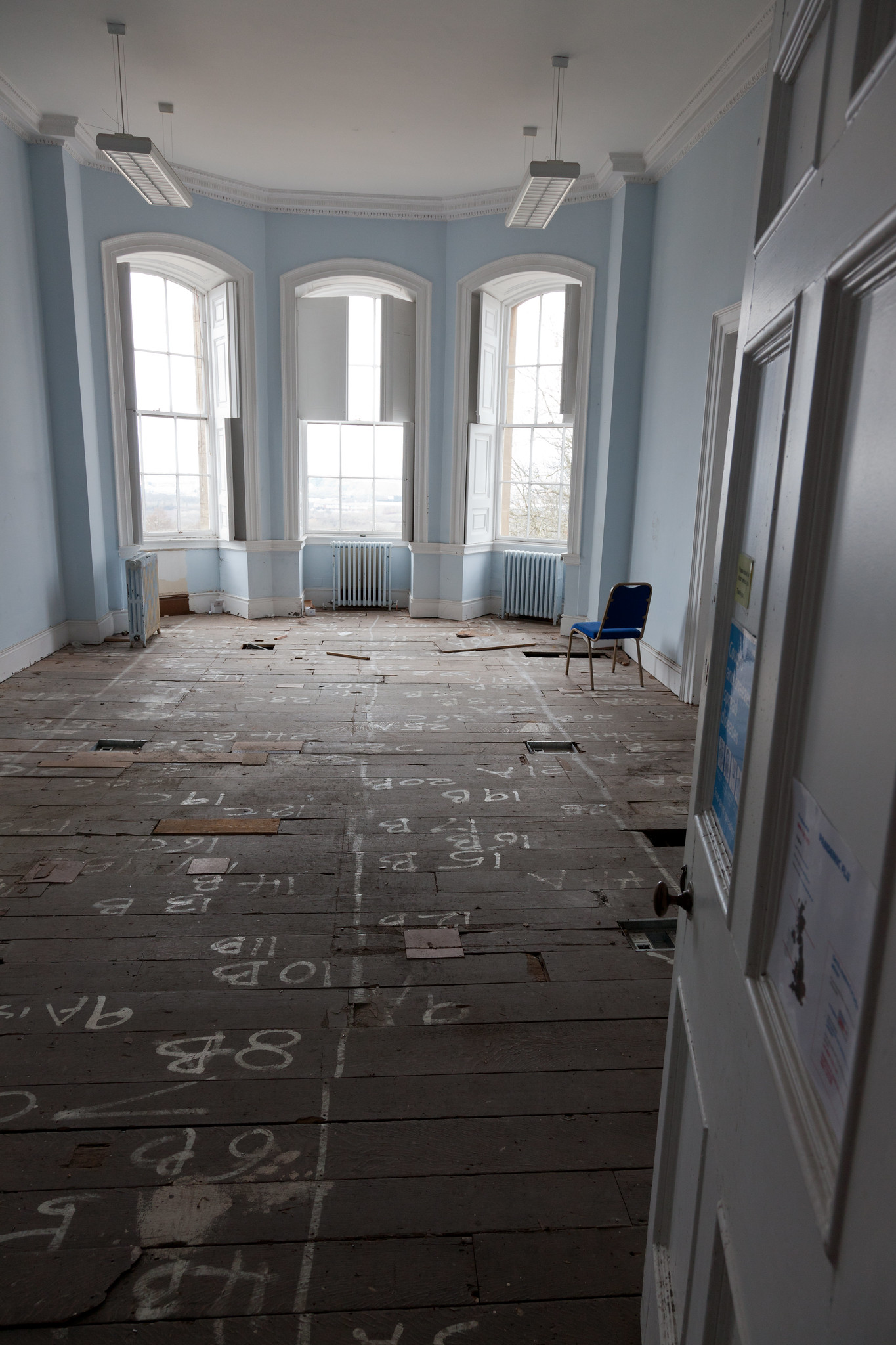
Formerly Lady de Clifford’s Dressing Room, this “long and lofty” space once had “no equal in the Kingdom” and was hung with paintings “the subjects in general are small, but they are of the first excellence”  . Seen during work in 2014.

The painting, Christ in the House of Simon the Pharisee, is first recorded hanging in Lady de Clifford’s dressing room decorated in blue silk damask. This room is now the first floor room with the bay window overlooking the Severn. Here it accompanied some of the best of the family’s collection of paintings, the most intimate, and intended only for view by them or their most special guests. On the surrounding walls were works by Claude Lorrain, Nicolas Poussin, Annibale Carracci, Pietro da Cortona, and four paintings by Canaletto.
 
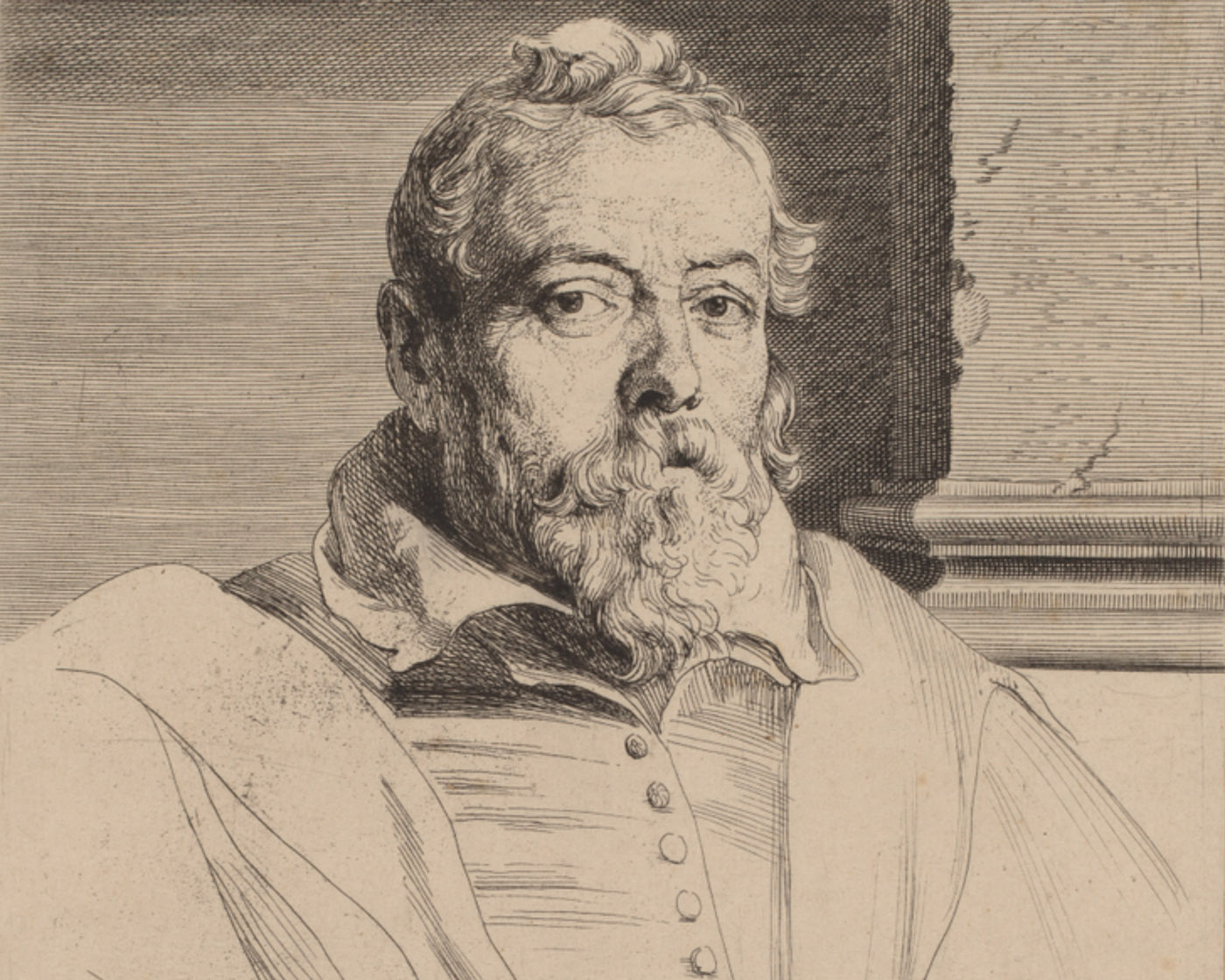
An inventory of the contents of the house in 1777 describes the painting as “The washing of our saviour’s feet” and the artist as “Old Frank”. This attribution has now been revised and is now considered to be by his son,  Frans Francken the younger (1581-1642). The 18th-century attribution to Francken the Elder likely stems from the signature “D.o. ffranck,” where “D.o.” stands for the Flemish de oude, meaning “the Elder.” However, this signature was actually used by Frans Francken the Younger from the late 1620s. Prior to the death of his father in 1616, he had signed his works as “the young Frans Francken.”

Engraving of the artist Frans Francken the Younger ( 1581-1642) by Van Dyke. 

Whilst the auctioneer suggests that it come to Kings Weston courtesy of the second Edward Southwell (1705-1755), it’s more likely to have been during one of Sir Robert Southwell’s journeys across the Low Countries that it was purchased or perhaps his son, Edward’s travels in 1697; it’s not included in an inventory of pictures at Kings Weston from 1695, so perhaps the latter is more probable.

The framed painting shortly to be sold

The painting remained at Kings Weston until the last of the direct line of the Southwell Family, The 21st Baron de Clifford, died in 1832. With no direct heir, he willed that the contents of the house be sold in its entirety. The painting, by this time described as Mary Magdalen washing the feet of Christ and attributed to Old Franks, sold for £10 10 shillings, as much as a painting by the more famous Poussin. As was common, it’s likely that a family member bought back a number of paintings, perhaps one of the nieces who were the ultimate beneficiaries of the sale.
 
We last saw the painting just outside Taunton where the family trust stored much of the collection of paintings. The circumstances and reason for it leaving such an important private collection are unknown, but we’ll endeavour to find out. If anyone were interested in returning it to Kings Weston, it will be sold via Dreweatts auction house on November 4th and the current estimate is £20-30,000! 

The Cromwell Connection    

Thomas Cromwell, Earl of Essex, by Sir Godfrey Kneller, circa 1703. 

A painting with Kings Weston interest recently went through auction. On the face of it, a posthumously painted 1700s portrait of Sir Thomas Cromwell, he of “Wolf Hall” notoriety, might not strike you as having a connection, but delving deeper through the archives its importance becomes clearer.
 
The rather gloomy oil painting was attributed to Sir Godfrey Kneller by the auction house, who included detail of an old label attached to reverse which stated “This picture which hangs here at the request of … Russell daughter of the 24th Baron de Clifford was painted by Sir Godfrey Kneller for a member of the Southwell family from an engraving of Holbein’s”. It had hung in a manor house in Faversham, Kent, though the label clearly identifies it as having formed part of the family collection of the Barons de Clifford, the descendants of the Southwell family of Kings Weston.
 
The last of the direct line of the Southwell family was the 21st Baron de Clifford on whose death the Kings Weston estate was sold along with the majority of its contents. This painting is, in fact, described as having been sold at Auction in 1834 for a derisory £14, but must have been re-purchased by the family. Many paintings that remain in the trusteeship of the descendants found their way back into family hands in this way, including a series of portraits by Kneller.

Kneller’s portrait of Lady Elizabeth as Diana the huntress, hanging today at Kings Weston.  

There survive in Kings Weston house today, several other portraits by Kneller, including the full-length portraits of the first Edward Southwell (he who rebuilt the mansion) and his wife, Lady Elizabeth Cromwell. And it’s through this marriage that the painting arrived at Kings Weston in 1703.
 
Lady Elizabeth was a very wealthy heiress with extensive landholdings in Northern Ireland. Sir Thomas Cromwell, 1st Earl of Essex,  was her great x4 grandfather. Through his rise to great fame and power under Henry VIII, and the considerable wealth and titles bestowed upon him, he was considered as the founder of the Cromwell dynasty. It would have been apt that Lady Elizabeth held her family name in high regard, and it’s notable she retained it after her marriage to Edward Southwell on 29th October 1703. Edward, no doubt, considered it an accolade to have such a great name in English history associated with his.
 
Lady Elizabeth was something of a patron of the arts, or at least to Kneller, with whom she spent huge sums. Her great wealth enabled her to indulge in commissioning works. Earlier in 1703 she’d been in receipt of sixteen paintings from him totalling an extraordinary £415. Fortunately, Kneller’s list of these pictures survives. Four were intended as gifts, two were whole-length portraits of Lady Elizabeth, and several of auspicious ancestors including her father, Vere Essex Cromwell, Earl of Ardglass, and “Ld Essexes picture – whole length” – the picture recently sold.
 

Kneller’s 1701 whole-length of Lady Elizabeth Southwell, still in the ownership of the descendants. 

Lady Elizabeth settled her bill, or most of it, by a £400 bond received by Kneller on 5th June 1703. One of the paintings in this series, one of the full-length portraits of herself, is dated 1701, suggesting that the collection was produced over a several years. The other, “A diana, whole length”, is the portrait of Elizabeth as the goddess of hunting that hangs today in the hall at Kings Weston. Together, these were the two most expensive of her purchases, £50 each, indicating the more direct attention of the artist rather than his workshop. That of Sir Thomas Cromwell was £30, suggesting it was produced with more involvement with artists employed by Kneller in his studio.

Aged 27, marriage came unusually late for the period. Her father had died in 1687 leaving her as an only child and sole heir. Always strong-willed, she appears to have been independent in spirit and unconcerned about making a match unless it was on her terms. It appears likely that the collection of paintings are connected with Lady Elizabeth’s hunt for a husband. By displaying images of herself and her illustrious ancestors she may have been promoting herself as a worthy match for any suitor. However her marriage to Edward Southwell came about, it was more than a one of convenience despite her enormous wealth and the prestige brought to Southwell’s house through the great Cromwell name. On her death in 1708, we know that Edward was bereft and took many years before he sought to fully reengage with society.

Most of the paintings commissioned by Lady Elizabeth can be identified as hanging at Kings Weston throughout the 18th Century. In 1777, we have the portrait of Thomas Cromwell above the fireplace in the eating parlour, todays Canaletto Room. Fittingly, it was matched on the adjacent wall by one of the full-length portraits of its commissioner, Lady Elizabeth.

The Eating Parlour of Kings Weston house, now the Canalletto Room, showing the relative locations of two Kneller paintings known to have hung there. The dashed lines indicate the locations of three oil paintings of ruins, two by “Pasla Panini” and the third possibly another work by Kneller. 

The same inventory that ties these pictures to this room also explains helpfully that Cromwell’s portrait was “copied from Holland”, rather than from Holbein. This goes some way towards explaining why Kneller’s portrait looks so unlike the famous portrait of the sitter by the Tudor artist (itself a copy, the original now being lost): It was a third-hand impression of the original painting, copied and adapted from a small engraving published by Henry Holland in his Herologia Anglica in 1620.
 
Despite its historical interest, the painting is far from the best example of a Kneller. Kings Weston still boasts several examples including a portrait of Edward Southwell. Dated 1710, the pose and format suggest that it was commissioned as a partner to the whole-length of his wife Elizabeth after her death. Today, they still hang together, fittingly either side of a portrait of their son, the second Edward Southwell.

To the left, one of the contemporary copies of Holbein’s lost original portrait of Cromwell, and to the right, Holland’s 1620 engraving from which Kneller took his likeness. 


An image from the past: Shirehampton Park

Another artwork with Kings Weston Interest has come our way recently. The panoramic views across the waters of the Severn to the north were matched by the rolling landscape framing the Avon and its gorge to the south. Both proved popular locations for picturesque paintings throughout the Eighteenth and Nineteenth Centuries. The recently uncovered work shows the view up the Avon from Shirehampton Park, a spot much-favoured by artists. Here, the view across Horseshoe Bend was attractively framed by trees along the parkland edge. Distant views of Cook’s Folly, a tower with romantic associations, added distant intrigue to the scene.

The painting is likely to date from the 1830s, before the twin towers of the Clifton Suspension bridge rose to punctuate the skyline.  Our artist, whoever they might have been, has added a sentimental vignette as foreground interest. A young couple, the gent apparently an artist working on his own version of the same view, have been approached by a gentleman and his dog. It may be that, in his red tunic and walking stick, he is an old soldier begging for money, so adding a poignant human touch in the midst of such natural drama.

An elegant portrait of a Kings Weston lady 

An elegant portrait of a Kings Weston lady 

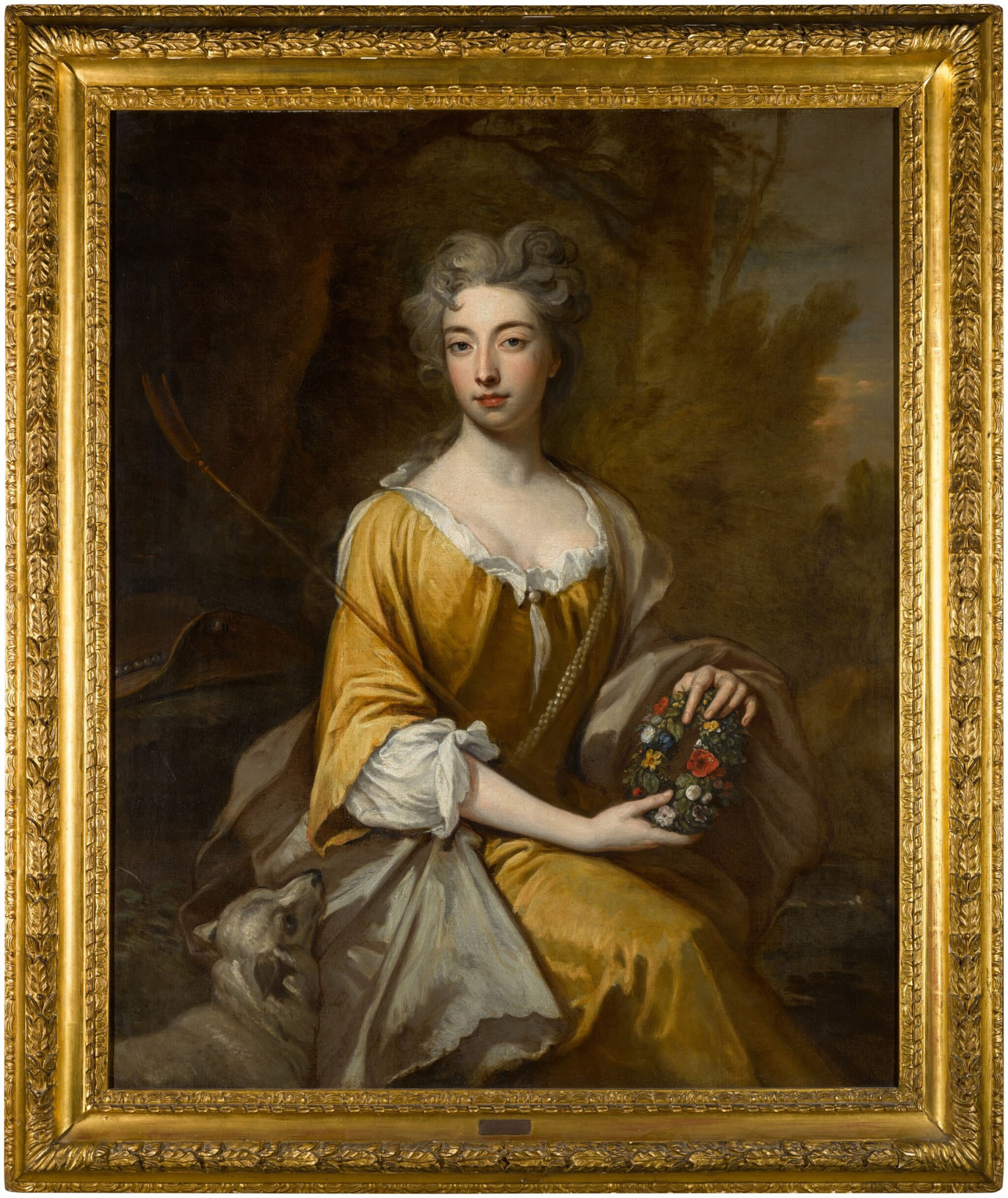
KWAG usually scans archives, libraries, auctions, and private collections in search of new pieces of the Kings Weston history jigsaw, but we recently came across something that had evaded our radar last year. Kings Weston house is already home to a majestic full-length portrait of Lady Elizabeth Cromwell, who married Edward Southwell in 1703. Edward, or Neddy, went on to rebuilt the mansion later that century, but his wife was at least his equal. Around the time of their marriage Lady Elizabeth – Betty to her friends and family – became the muse of Godfrey Kneller, one of the foremost portraitists of his age. Kneller made more paintings of Lady Elizabeth than any other sitter, about ten more-or less.


Reputedly he was obsessed by her and resented her marriage to Southwell, but continued to paint her subsequent to that union. In July 2022 a significant painting we’ve been unaware of went under the hammer at Sotheby’s. It depicted Lady Elizabeth in a fashionable pose, as shepherdess seated in a landscape, holding a floral garland, a lamb by her side. We’ve not yet worked to establish whether it was one of those that hung at Kings Weston, the Southwell’s London house, or elsewhere. With an estimate of £20,000-£18,000 it’s perhaps best we missed the sale!  
 

A Regency Fancy 

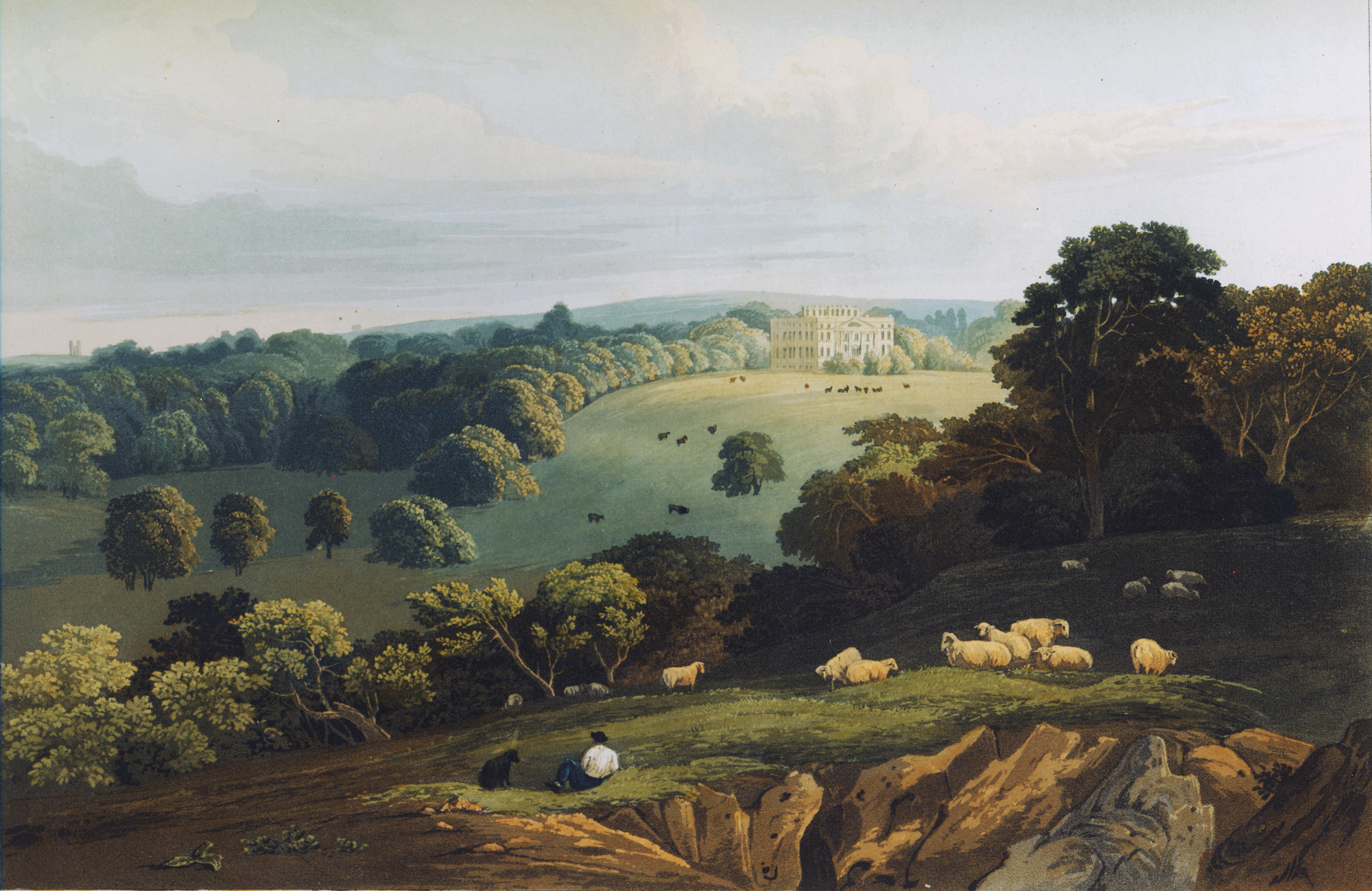
Another painting recently came to auction that’s of Kings Weston interest; it’s a watercolour of the house and park from Penpole Point. It’s a view that’s already familiar to us through one of the most widely published and most attractive prints of the park in the early 19th Century. The artist was the impressively named Anthony Vandyke Copley Fielding (1787-1855) who visited Kings Weston in 1816. It’s not clear whether it was intentionally painted as part of a larger project, but reproduced it found its way into a Series of Picturesque Views of Noblemen’s and Gentlemen’s Seats seven years later.

the original watercolour showing the view of Kings Weston house from Penpole Point. 1816, Anthony Vandyke Copley Fielding (1787-1855). 
One version of the print copied from the original painting. 

A Shirehampton Park Painting

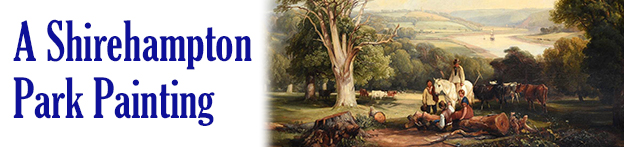
A fantastic painting of the estate has just come to our attention. Kings Weston was once famous for its views, not just northwards across the Severn to Wales, but also to broad panoramas southwards up the Avon and across to Somerset. This newly discovered painting supposedly dates to around 1836, a time of great uncertainty for the house and estate. Edward Southwell, 21st Baron de Clifford (1767-1832), last in his line had died in 1832. His will instructed the sale of house and park, effects and furniture, and all the landed estate, with the proceeds being split between several nieces. His widow was required to give up living at the mansion, but had been well provided for with the splendid town  house in Carlton Terrace in the centre of London.

Above: Henry Willis’s painting showing the view across Shirehampton Park, towards the Avon, circa 1836. 

The following year the house and estate was marketed by estate agents; they described the park as “forming a most desirable situation for the erection of one or more villas.” Looking at the view depicted you can see the attraction to a potential developer who might be tempted to pepper the landscaped grounds with mansions for well-heeled merchants. By good fortune the estate was instead purchased by the incredibly wealth Philip Miles and preserved intact. By 1836, the suggested date for the painting, Miles was settling in having moved here from Leigh Court with his second wife and their children.  

The artist, Henry Willis, has chosen to emphasise the pastoral character of the view from Shirehampton Park, towards the Avon in the distance. A small group of agricultural workers have paused a while to chat as cattle amble through the landscaped ground behind them.  Beyond them a steam tug assists a sailing vessel up the Avon towards the city docks. The  contrasting of verdant trees with the dying elm and felled trunk in the foreground suggest themes of the passage of time and the circle of life.

The valuation and marketing prospectus for the estate from 1834

Willis was an artist associated with the Bristol School of Artists, and was a member of sketching parties with members of that group until his departure for the United States in 1842 until his health forced his return to England.  These artists, part of the Romantic Movement, often celebrated the natural beauty of the Bristol region. The Gorge was a particular favourite location, but paintings around Kings Weston are rarer from this group. It’s interesting to note that in 1829 Lord de Clifford had paid Willis the sum of £8 8s for a painting of Kings Weston, and out paid a further £2 10s on a frame.  There’s a remote possibility that it could have been this painting, but possibly there are others out there for us to discover.

Painted from Penpole – a new discovery  

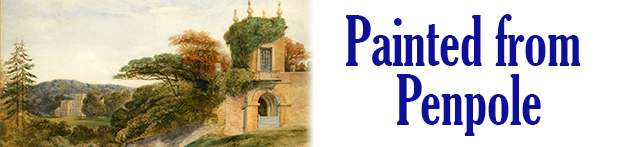
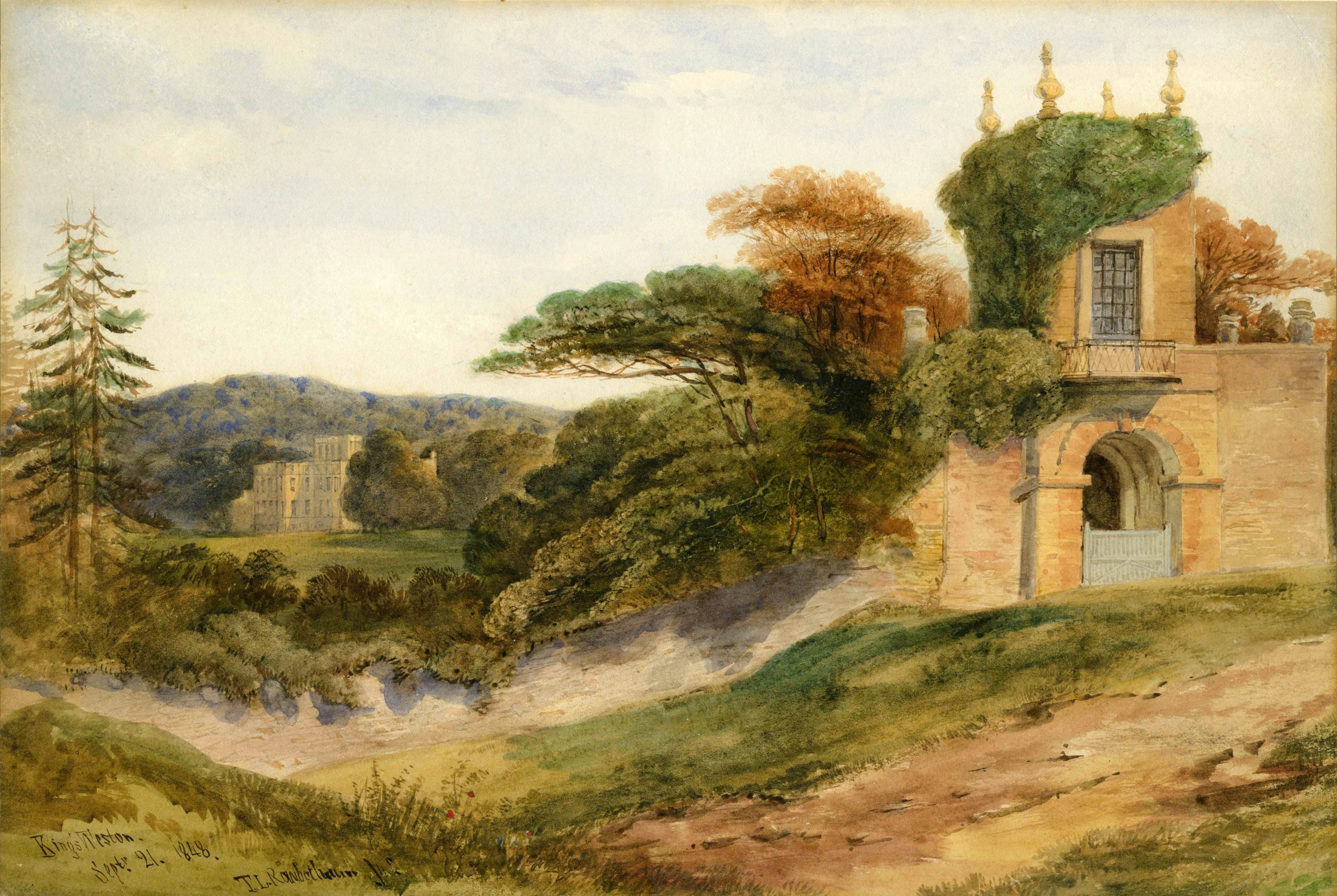
A recent new acquisition is this watercolour painting of Kings Weston house framed by the trees and lodge at Penpole Point. The gates separating the common land on the Point from the private woodland walls is firmly shut and the top of the lodge is almost enveloped in ivy. The sun makes the golden stone of both buildings glow in the early autumn light. This was once a well-known view of the house, being the subject of several other known paintings, but inclusion of the lodge in the view as well is unusual. The view to the house must have been obscured by trees not long after this painting was created as we have no later image from this perspective.

It’s an important find for a couple of reasons; first it was painted by a well-known local artist, Thomas Leeson Rowbotham (1782–1853), whose paintings form a major component of the city museum’s Braikenridge collection. Most of these date to the 1820s and were commissioned to record historic buildings and monuments in the city, though the Kings Weston painting falls outside of that collection. It’s also significant for its very precise date – September 21st 1848 – just a year short of 175 years, almost to the week. It’s a late work by Rowbotham, then aged 66, the artist surviving just five years longer after its completion.  

Kings Weston house and Penpole Lodge from the point, Thomas Leeson Rowbotham, 21st September 1848. 

Recently acquired painting of Shirehampton Park.

The golf course on Shirehampton Park often puts off potential visitors, but it remains an integral part of the historic landscape. This oil painting, “In Shirehampton Park”, recently surfaced showing the pastoral scene in the Edwardian Era. The Golf course began in 1904 and extended to eighteen holes in 1907. This painting shows the scene before the setting out of the course in the eastern side of the park, and illustrates the rolling pastures dotted with parkland trees which sadly have not survived later landscaping schemes.

The artist. CW Goodridge, was apparently an amateur, but anyone with further details of him or his work would be very welcome.

“In Shirehampton Park”, CW Goodridge, early Twentieth Century  

Memorials of Philip Miles

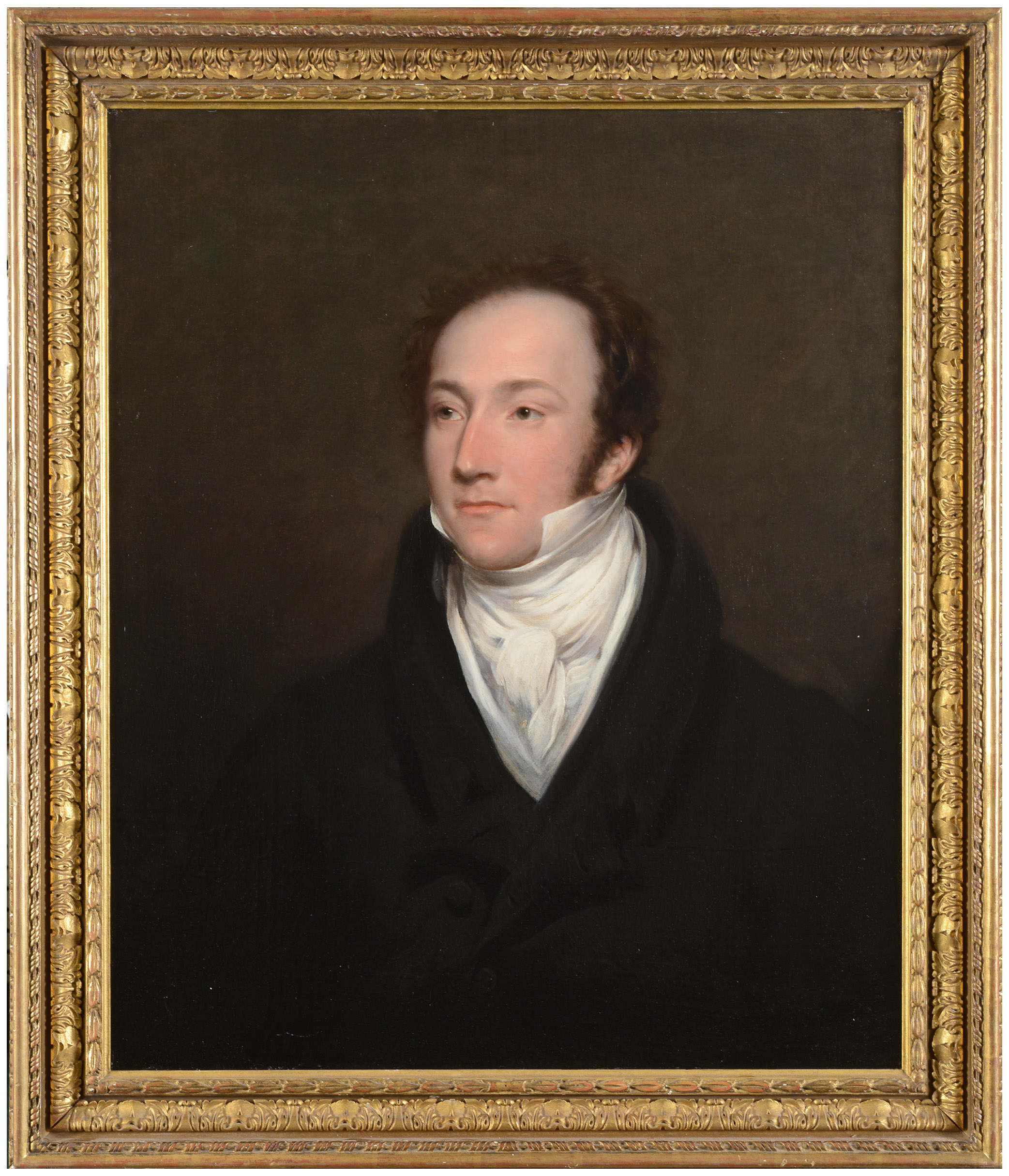
If you are looking for something interesting to liven up your walls and you have a penchant for Bristol then a recent auction lot might take your fancy. A portrait is shortly to be sold by Lawrences in Crewkerne, Somerset that has a strong connection with Kings Weston. The sitter is Philip Miles, who bought the estate in 1833 for the princely sum of £206,000; an extraordinary sum for the time. It will perhaps come as little surprise that Miles was Bristol’s wealthiest person and, when he died, the city’s first recorded millionaire.

Philip John Miles by Sir Thomas Lawrence, currently up for auction on the 19th Jan

When he bought Kings Weston he already owned the palatial Leigh Court on the other side of the Avon in Somerset, and had filled it full of famous Old Master paintings. For his own portrait he commissioned Sir Thomas Lawrence, the most famous portraitist of his time; this may not have just been purely for the prestige, but Lawrence was a Bristol-born artist who had made good in the capital.


The Miles’s founded their fortune as merchants, bankers, and ship owners, and owning plantations in the colonies. As might be expected for the period his business interests were heavily dependent on slavery right up to 1833, the year he bought kings Weston, and the Slavery Abolition Act.  He was also MP for Bristol between 1835 and 1837.

Philip Miles’s memorial in Abbots Leigh church, by E H Baily 

The painting up for sale is likely to have been painted before Miles moved to Kings Weston, and it is not documented as having hung in the house, but it is an important record of a man who played an important role in the history of the city and the estate.

After Philip Miles’s death his family went to the foremost sculptor of the age to have his memorial carved. Again, perhaps not be coincidence, the artist, Edward Hodges Baily, was Bristol-born. It is known that the family were keen benefactors of the Bristol Arts scene and it is likely that their patronage of Bristol artists was intentional. The monument stands today, pale and magnificent, on the north wall of the tower of Abbots Leigh church; a pair of pensive figures stare up towards a draped classical urn bathed in carved stone rays of heavenly light.    

The portrait of Philip Miles sells at Lawrence’s auction rooms on the 19th of January with an estimate of £4000-£6000. For further information, or perhaps even to make a bid, go here.