Tag Archives: Kings Weston

Edwardian Sketch comes to light

Many people local to the Kings Weston estate will be aware of the death two years ago of local Historian Ralph Hack. Ralph had amassed a large collection of research and original material about the whole area including Kings Weston and we’ve been keen to track-down his archives since then. 

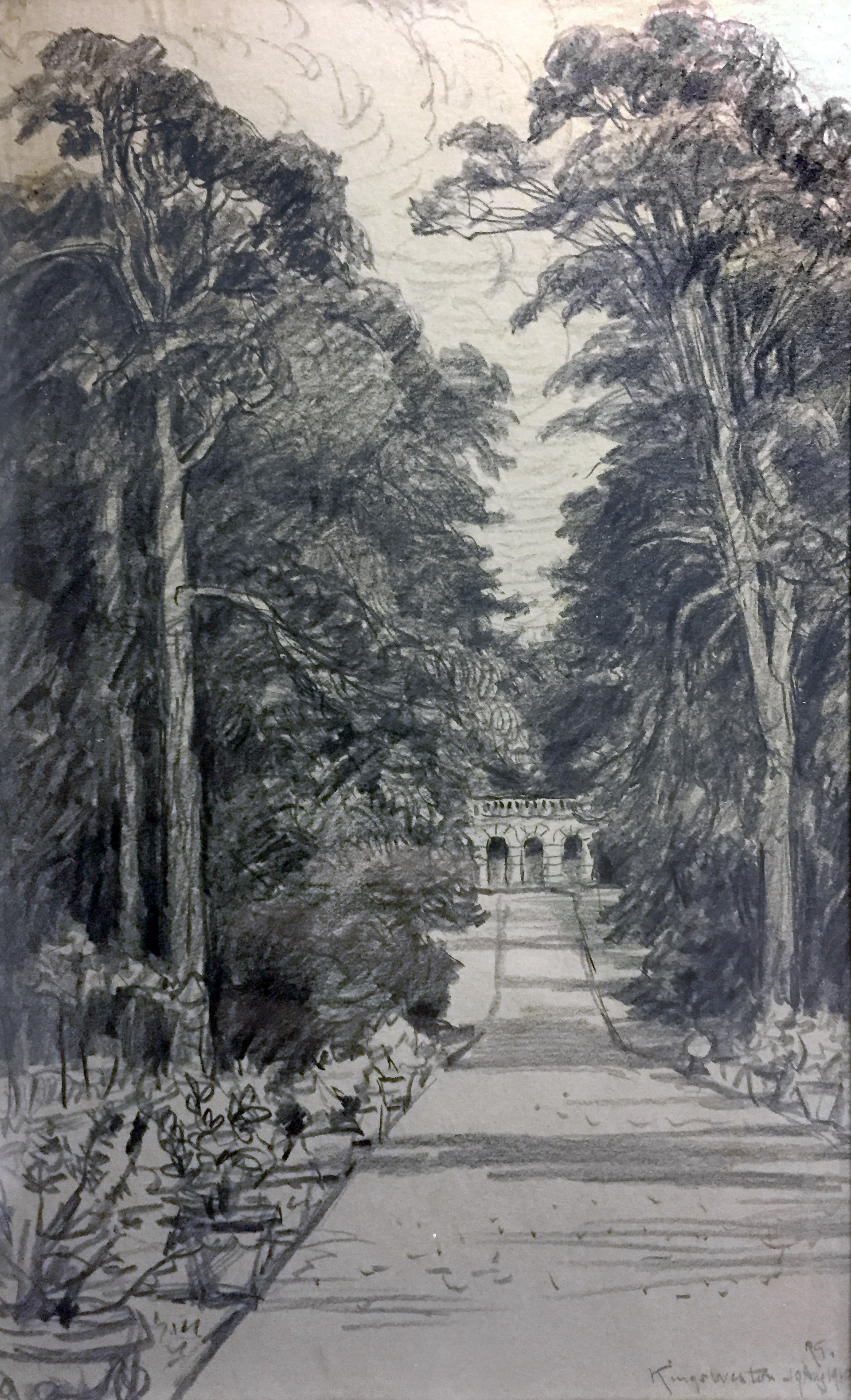
View towards the Echo, Robert Goff, 1910

Recently portions of his collection came to light at Bristol Auction Rooms, and we were keen to try and identify anything that might relate to the house and its history. Amongst the lots was a pencil drawing that particularly stood out. Catalogued only as a view  at Kings Weston, dated 1910, and signed “RG” it is a well executed sketch of the view looking towards the Echo from the house. We were in a fortunate position to recognise the sketch, and the monogram, as being the work of the artist and etcher Robert Goff. 

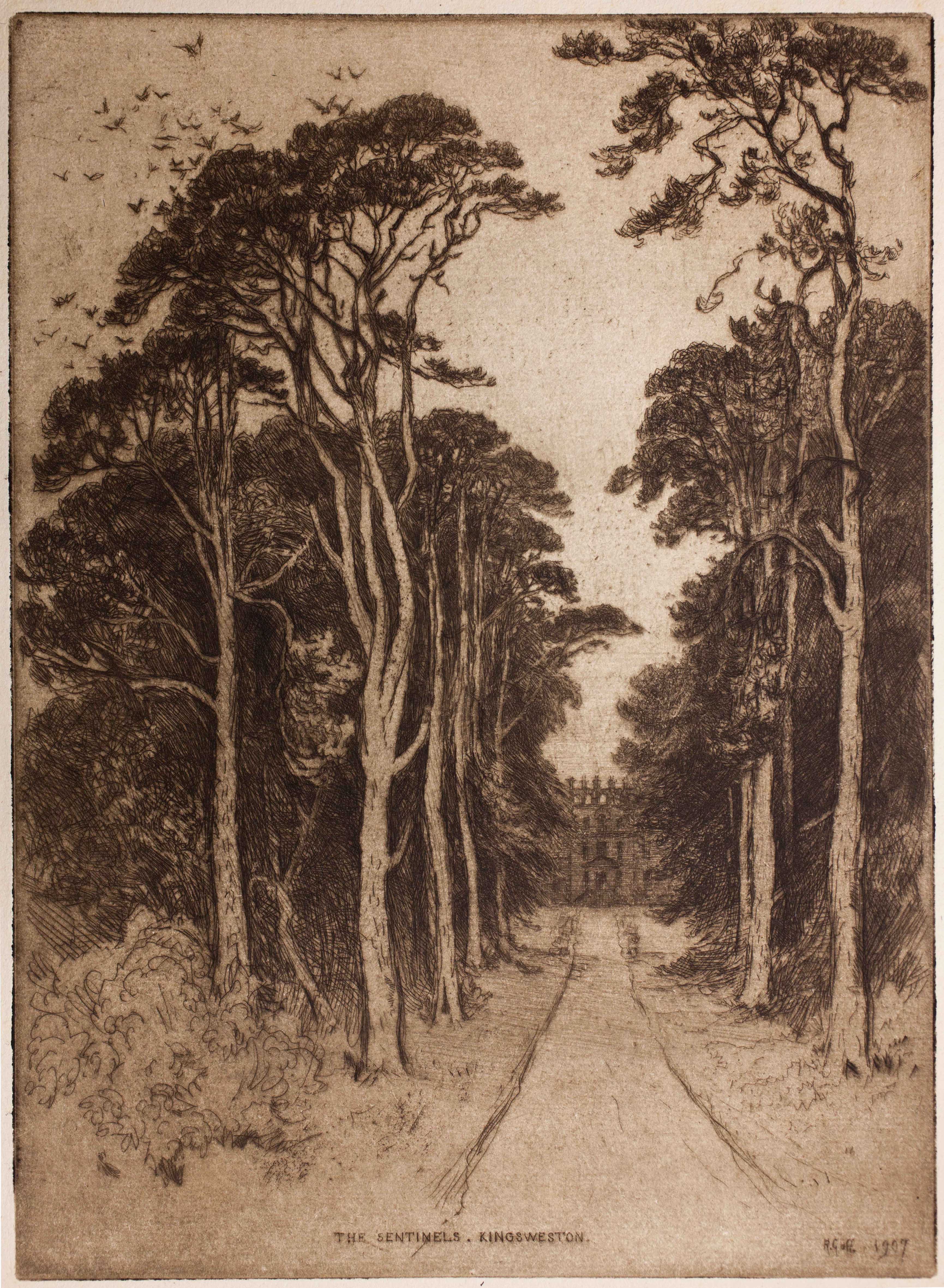
Goff was the brother-in-law of Philip Napier Miles, the last private owner of Kings Weston house, and he evidently spent some time there sketching and developing compositions for his etchings. Whilst we don’t know if the drawing ever developed further it’s a fascinating companion to an image we’ve hosted here before: the opposing, engraved, view looking down towards Kings Weston House in 1907.  It’s unlikely we’ll ever know if the two images were ever intended to be seen together, but, rest assured, we’ll be keeping our eyes out for an engraved version in the future!

“The Sentinels” Kings Weston. Etching by Robert Goff, 1907. 

School Memories

We’re aware than many of our followers have fond memories of their time at Kings Weston house when it operated as a school between, 1949 and 1960. 
We’ve just collected a new photo for our archive showing a school group on the steps of the house in May 1952. All we know is that this was class IX, but does anyone recognise themselves, friends or relatives in this photo? 

A Delve into the Museum Stores

A recent visit to the back rooms of Bristol Museum and Art gallery has uncovered some interesting new finds. The museum holds an extensive collection of material on Kings Weston including paintings, prints, drawings, and artefacts. This particular visit was focussed on uncovering, and recording, some of the less well known images of the historic estate.
samuel-jackson-kingsweston-hill-copy
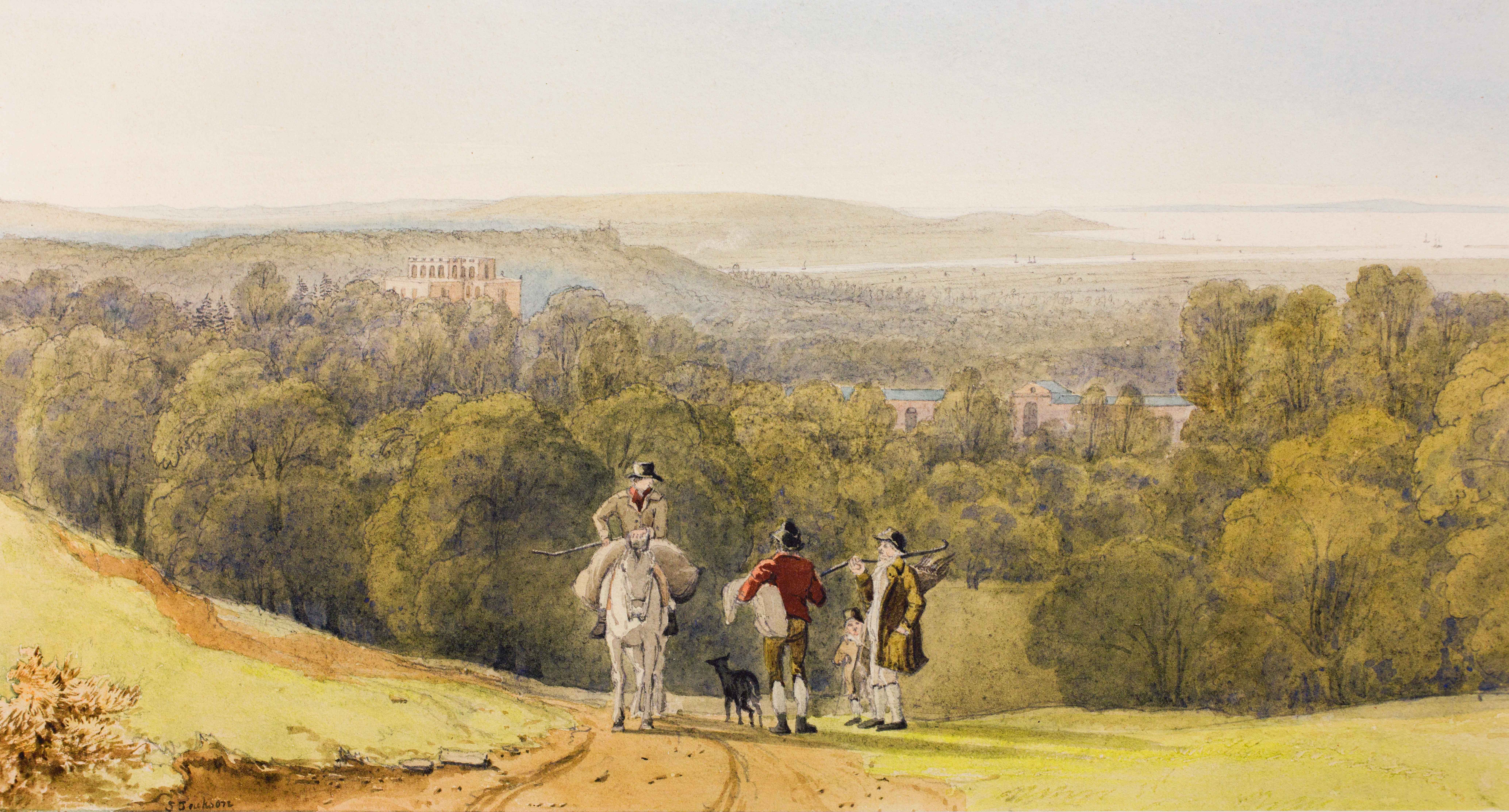
Above: The view from Kingsweston Hill, a watercolour from the late C18th by Samuel Jackson (BMAG K181). Below-right: Sunset from Kingsweston Hill, circa 1790,Nicholas Pocock (BMAG Mb1996)
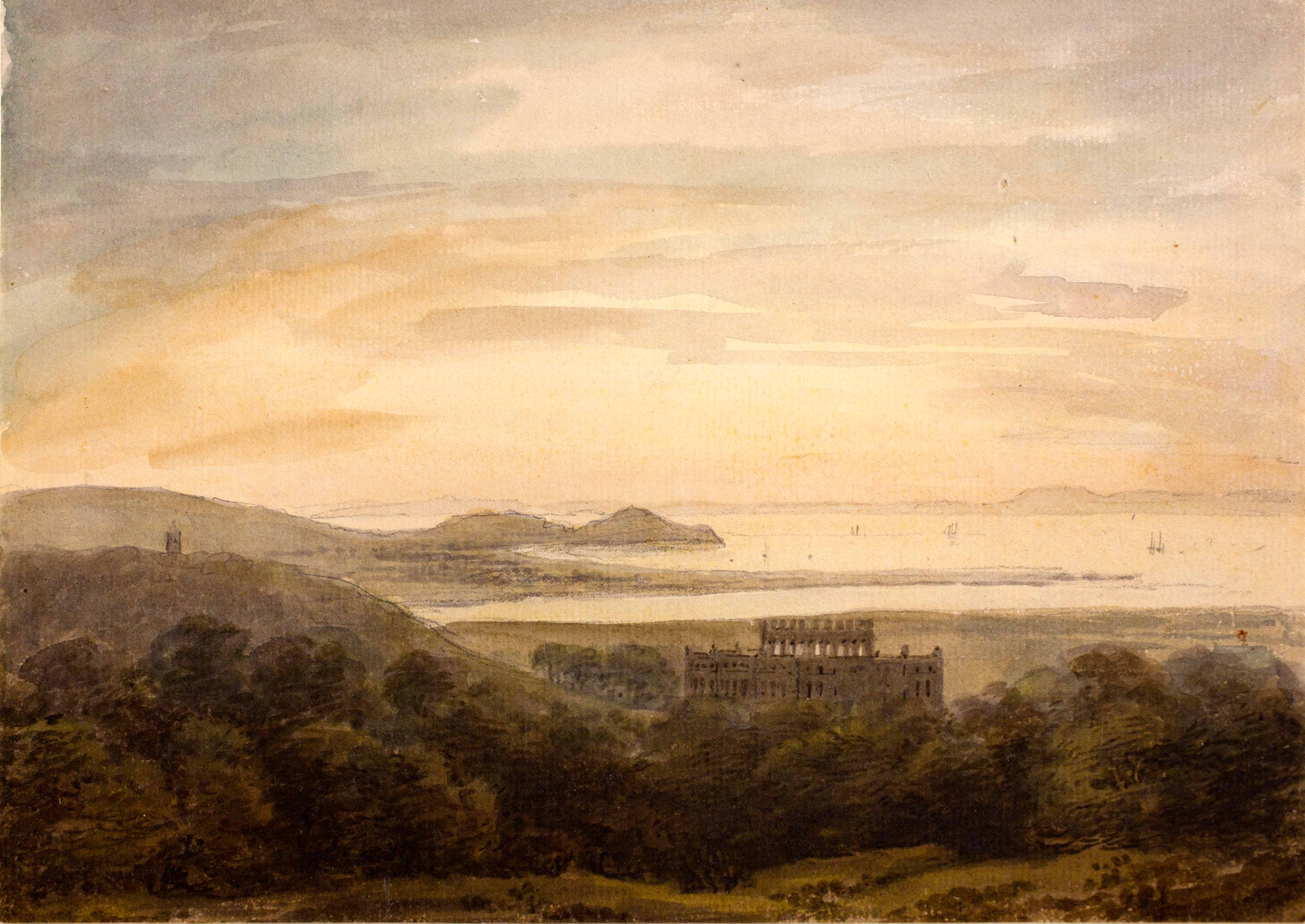
pococke-sunsetThere are a number of memorable paintings in the collection, just a small number of which we share here. Most are from the estate at the height of its fame in the late Eighteenth century, with many by notable artists of the “Bristol School” such as Francis Danby, Samuel Jackson, and Nicholas Pocock.
Of special interest was a large portfolio of art etchings by the eminent artist Robert Charles Goff (1837-1922). Most of the dozens of etchings are little to do with Bristol, but are significant for their connection with the last members of the Miles family. The collection was gifted to the museum in 1936 by  Mrs Sybil Napier Miles, the wife of Philip Napier Miles the last private owner of the estate, and her sisters. Goff was their brother-in law, having married Sybil’s sister, Clarissa, in 1899.

Below: The Sentinels, Kings Weston, Robert Goff, 1907(BMAG Mb2555)
goff-1907-sentinels
The Goff’s and the Miles’s were close and Robert and Clarissa were frequent visitors to both Kings Weston, and Napier Miles’s villa at Alassio in Italy. On Robert’s death in 1922 Clarissa came to live permanently with her sister and brother-in-law at Kings Weston, and presumably brought the artist’s portfolio of work with her.

Sadly for Sybil, both her husband and sister died in 1935 within weeks of each other, leaving her with a huge estate and the contents of the house to manage alone. Evidently she sought to ensure that Goff’s artworks were kept together as a single archive and, in memory of her sister, donated then to Bristol Museum and Art Gallery the following year. In this way the provenance of the works can be directly connected back to the artist’s ownership.

Amongst Goff’s works in Bristol museum are two etchings of Kings Weston. One, of 1907 we have discovered before and our Tree Trail guide sports a low resolution version of it, and the other completely new to us. This second view is taken from the Shirehampton Park side of the estate, where the parkland drops steeply down to Horseshoe Bend of the River Avon. It is a particularly pleasing composition with the once-famous pine trees framing glimpsed views back upstream to the Avon Gorge. This scene has sadly succumbed to the ravages of time and the Portway Road now passes through this very area.

In due course copies of all the artworks recorded will be uploaded to KWAG’s website to accompany the galleries of historic views.

Below: The Avon below Kings Weston, Robert Goff, drypoint etching. (BMAG Mb2552)
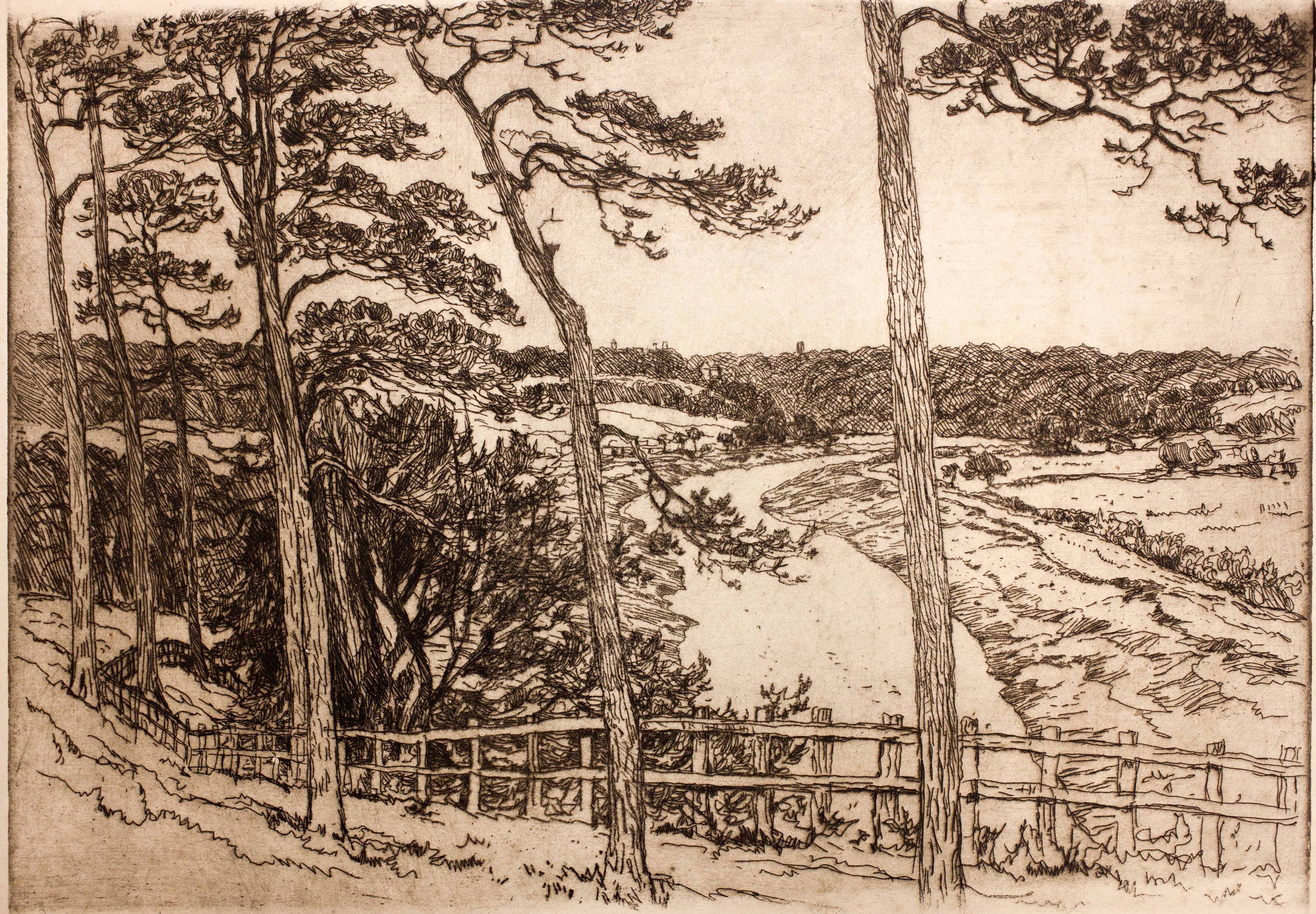
goff-shirehampton-park

New light on WWI Kings Weston auxiliary hospital. 

We’re very grateful for the following short report compiled by Ann Cunningham. Ann contacted us a short time ago and has helped add a new insight into the WWI years: 

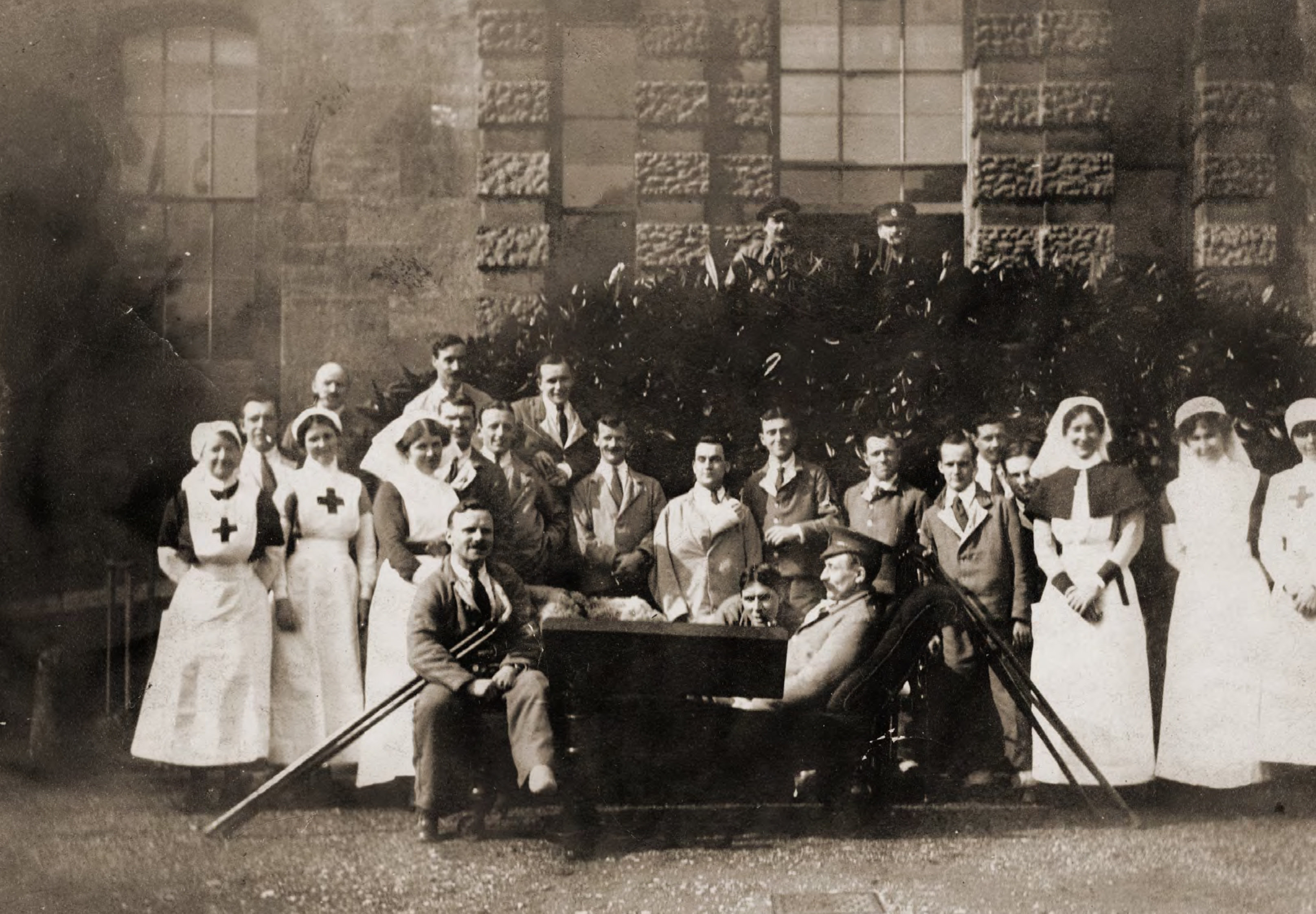
In 1914 Kings Weston House became an auxiliary hospital for wounded soldiers in WW1. From 1914 to 1919 there were many nurses and workers who came here to help and support the injured. After doing some research, I have found the following nurses that worked at the house. There are 7 in total.

Miss Hilda Prance

From May 2nd 1915 until June 1918, Hilda was here for approx 18 months.

Miss Mabel C N Moore

From May 2nd 1915 until June 1919

Miss Frances Geraldine Moore

From May 2 1915 to January 1917

Miss Ethel M. J Moore

From May 3rd 1915 to January 1917

Miss Alice Maud Muriel Borase

From Nov 1st to 18th 1916

Miss Joan Badock

Worked for one year in 1916

Miss Ethel Maud Adams

March 1918 to March 1919. Ethel was a Ward sister and also a night duty nurse.

Ethel was born in 1879 in Long Stock, Hampshire, England. Her parents were James and Susan Adams. She has the following brothers and sisters. Sarah, Annie Elizabeth, John George, and Herbert Evans.

Soldiers and nurses pose on the garden steps of Kings Weston House.


Ethel has been documented as being a Pioneer Nurse. In 1887 the first register for professional nurses was founded. It was the first in the world. It was called  the Royal British Nurses’ Association (RBNA). Its aim was to provide a snapshot of the nurses training and qualifications.

Ethel has been documented as registering in 1915, at this time it was voluntary, but by 1919 it was compulsory and finally in this year the Nurses Registration Act became law.

Further information can be found about Ethel and other pioneer nurses at http://www.kingscollections.org

Anyone that is interested in learning more about the Red Cross, what they did, or simply wanting to search for other nurses can visit: www.redcross.org.uk/About-us/Who-we-are/History-and-origin/First-World-War. Information has also been sourced from http://www.ancestry.co.uk

KWAG’s first World War exhibition boards can be viewed here

A view from an angle last enjoyed a generation ago; The garden front of Kings Weston over the recently relaid lawn after the ruins of QEH were recently removed.


Kings Weston Iron Bridge history

It is almost a year since the historic Iron Bridge  across Kings Weston Road was hit by a lorry and damaged an severed an important footpath. At last we have some good news to report: Bristol City Council highways team have now started commissioning survey work of the Grade II Listed structure in advance of physical work being undertaken to reopen it.

A structural survey is just one element of the package of information needed to ensure the most sensitive approach is taken in making repairs; A Listed building assessment and heritage report is also being undertaken by the city’s conservation team to ensure that the significance of the structure is understood, and to inform best practice in dismantling and reinstating damaged elements.

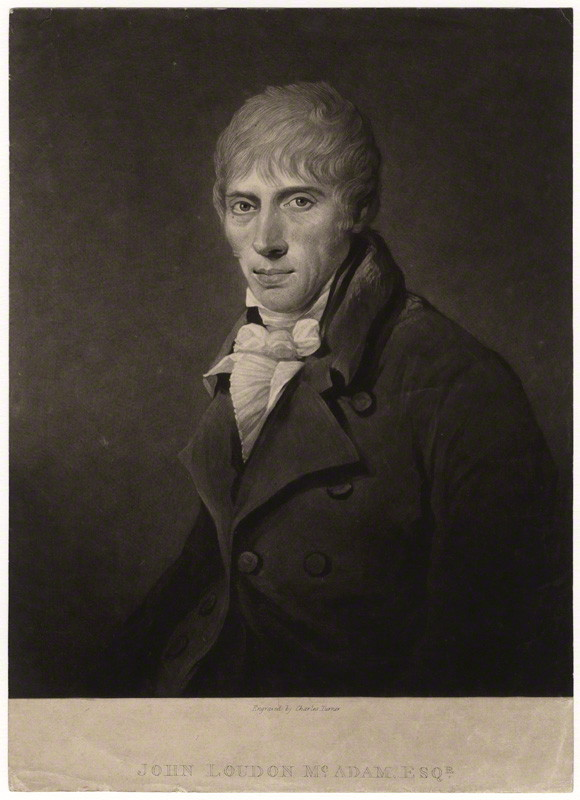
John Loudon McAdam (1756-1836)

The bridge was designed by the eminent highways engineer John Louden McAdam who, at the time, was the engineer tasked with improving the turnpike roads around Bristol. In 1819 the lane, a parish road between Kings Weston and Henbury, was turned into a turnpike road and work commenced to improve standards to justify the tolls levied on such routes.

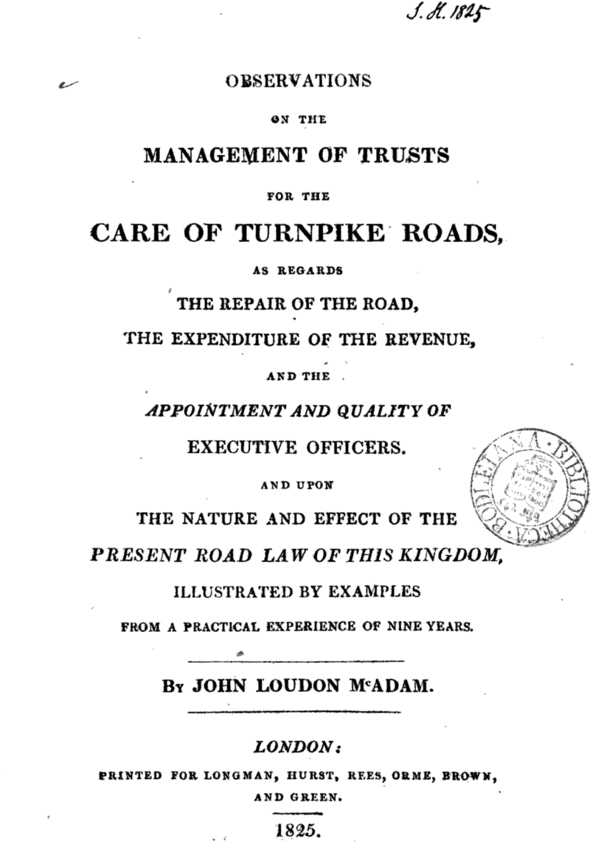
It wasn’t until 1821 that McAdam noted in his observations that labourers had begun lowering the hill and building walls at Kingsweston Hill. This would have formed the deep cutting through which the current road passes. In the following year he notes the formation of a new footpath in association with the same works which is likely to have been the track approaching the old inn from the Sea Mills direction. It’s probable that the iron bridge was installed at the same time, as the completion of these ambitious works. 

Title page of McAdam’s 1825 Observations


The bridge was constructed of more than 130 individual components of both cast and wrought iron. More technically advanced than most similar structures of the period it used a closed-mould casting technique which allowed the incorporation of strengthening flanges to the structure. New work has been undertaken by KWAG, in cooperation with the Council’s conservation team, that sheds light on the construction and fabrication of the bridge. Following a study of the structure a 3D model has been created which will now be used to inform the best approach to restoration. As you can see, for such a small structure, it’s surprisingly complex! 

The city’s highways officers are currently considering options to raise the bridge to remove the possibility of it being hit again in the future. There is also the potential that the whole of the bridge will need to be dismantled and removed before re-installation. As the project develops we hope to be able to report on progress, but physical work is unlikely to begin before spring 2017. 

exploded diagram undertaken by KWAG showing the construction of the Iron Bridge

Laurel clearance concerns

Please be reassured…

KWAG appreciates that there is some concern locally about the felling of laurel in Penpole Wood. We do understand that the degree of change can be challenging, but we’d like to assure everyone that the work KWAG are doing is necessary for the future protection of the Ancient Woodland.

Over the last few months KWAG volunteers have been undertaking two projects directed by the Forestry Commission; Natural Spacing and the removal of Laurel. Natural Spacing is good practice to thin-out poor quality saplings to allow the best ones, and most importantly the existing mature trees, to thrive with less competition. It promotes growth and reduces the risk of disease.

Cherry Laurel is an invasive foreign plant, and has serious implications for the health of natural woodland; it suffocates all other competing native species by preventing light from reaching the forest floor. It also decays slowly leaving a cocktail of toxins in the soil that retard the growth of other trees and ground cover.

It’s also on the Dogs Trust list of poisonous plants for dogs.

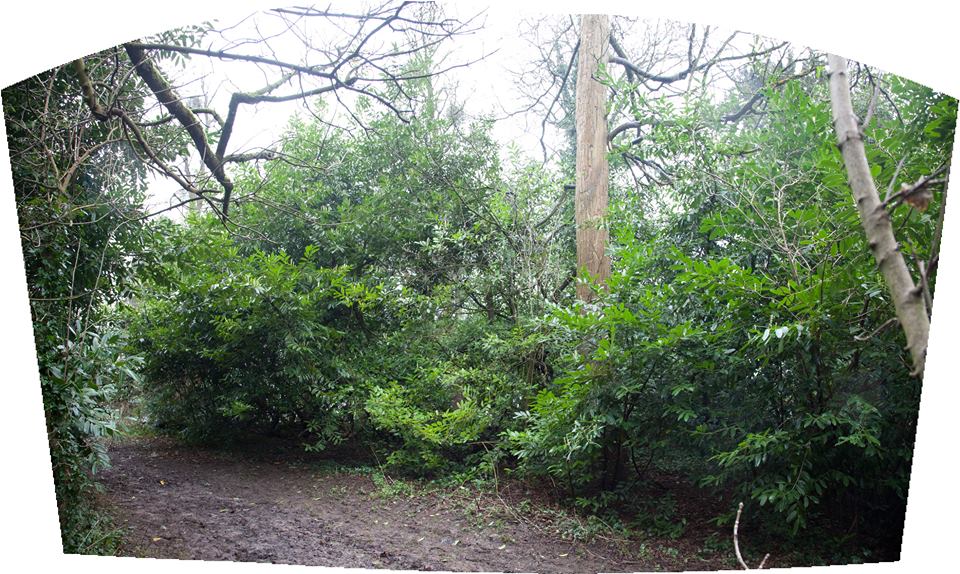
Laurels recently felled

Laurels recently felled

Although laurel’s been present at Kings Weston for centuries, introduced as an ornamental shrub, it’s now run wild, threatening the nature, fabric, and diversity of the Ancient Woodland; as such it needs to be removed.

Although it will look bare for a short time, especially now in winter, the removal of the laurel will allow the forest floor to regenerate naturally with native trees and undergrowth; That it looks so bare right now is largely because the laurel has already suffocated everything at ground level.

The process will ensure the survival of the Ancient Woodland for future generations, ultimately increasing the diversity of woodland habitat and species.

The majority of the feedback we’ve had has been resoundingly positive, but we appreciate the loss of familiar thickets will upset some people. Please be assured that KWAG are working to a brief defined by the Forestry Commission, and supported by Bristol City Council, and that the work is designed to save Penpole Wood from permanent decay, not to damage it.

You can read more about Bristol’s Biodiversity Action Plan for woodlands, and the benefits of re-opening the forest floor to native growth here:
https://www.bristol.gov.uk/…/369f1561-116b-40d0-8cf9-50eaa6…

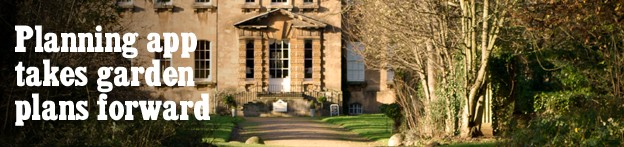
Planning application takes gardens project forward

We know that the inevitable loss of the lime trees on the ancient avenue has come as a great shock and sadness on many people in the park, and so many people have spoken to us about it. We are looking to prioritise how we can replace the lost trees as soon as possible, but this won’t be at least until the next planting season next winter. This will give us plenty of time to secure the funding we’ll need to support this.

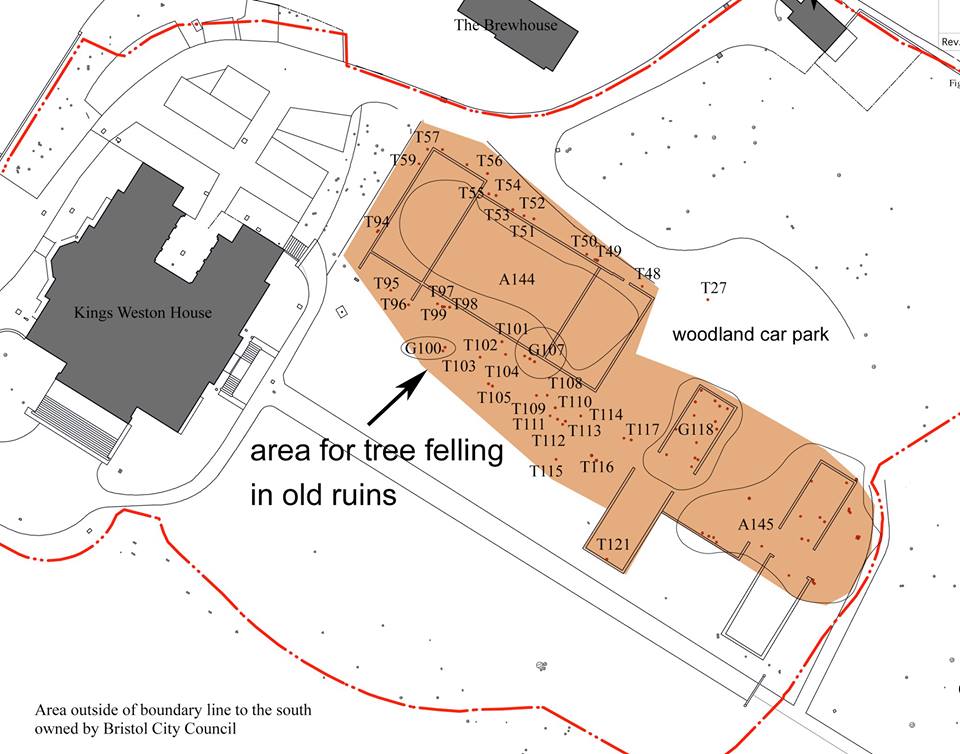
However, there are many other trees in the park that we are less sorry to lose, and a recent application to fell trees within the Conservation Area has been submitted for planning. The application from Kings Weston house marks the next stage in the restoration of the grounds. Norman Routledge, the owner of the house and the area of grounds immediately around it, is keen to repair and enhance the grounds and one priority that everyone has agreed on is improving the current woodland car park.

10168182_1029465873786538_8766583060941615027_n

Undersized for use by both the house and park visitors it’s led to vehicles damaging the park and paths. The new proposals will see the establishment of a better designed, and more appropriate car park that will tackle the problematic issue of some of the brick ruins around the house. As a first stage a planning application has come forward for the felling of many of the poor-quality sycamore and ash that currently engulf the ruins and are obstructing views of the Echo. These trees have grown up entirely unmanaged only since the 1950s and the area is identified in the City’s Conservation Management Plan for this work.

A full copy of the application can be found on the City’s Planning website (search for ref: 16/00359/VC)
http://planningonline.bristol.gov.uk/online-appl…/search.do…
It’s accompanied by a professional tree survey that’s reassured us that there are no trees of good quality of high habitat value being proposed for felling. We are hoping that the council will apply policy to ensure that trees felled will be replaced with higher quality specimens in the next phase of the proposals, and as such we are minded to support this proposal.

If you have any thoughts please comment on the planning application.

A mystery solved

Carriage memories confirmed

We’ve had many people coming up to us recalling old horse-drawn carriages stored at Kings Weston shortly after the Second World War. It’s been a bit of a puzzle as to what they were, and what happened to them, but this week the story came into sharp focus. A new on-line interface for the collections of Bristol Museum and Art Gallery Provided the answer.

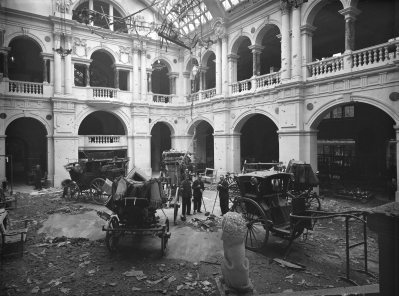
While searching for Kings Weston related items an entry appeared for one of a collection of carriages in the City’s ownership. This was an early Nineteenth Century carriage used by the Duke of Beaufort of Badminton. During the war it had been on display in the rear atrium of the museum when, in 1941, a bomb detonated on the roof, completely destroying a biplane hung from the ceiling, and badly damaging the carriages. They  were speedily removed to Kings Weston estate buildings for safe storage for the remainder of the war, where they must have stayed into the early 1950s when people recall seeing them. They reputedly received more damage from damp through the leaky roofs of the stables than they did in the initial blast! 

WWII in the Home Park

A series of fascinating discoveries have come to light in recent weeks

Surprisingly it’s the more recent history of Kings Weston that we have less historical evidence for than earlier periods. A lack of original material is a particular problem when researching the Second World War at Kings Weston when necessary secrecy meant that fewer records were kept. We know that it played and extremely active role during the war with two army camps; one on the Shirehampton Park Golf Course and one on Penpole Lane. These were “Camp Seamills” A and B respectively and mainly housed regiments of Black US Army soldiers that formed the Port Companies used to unload war supplies and arms arriving in Avonmouth.

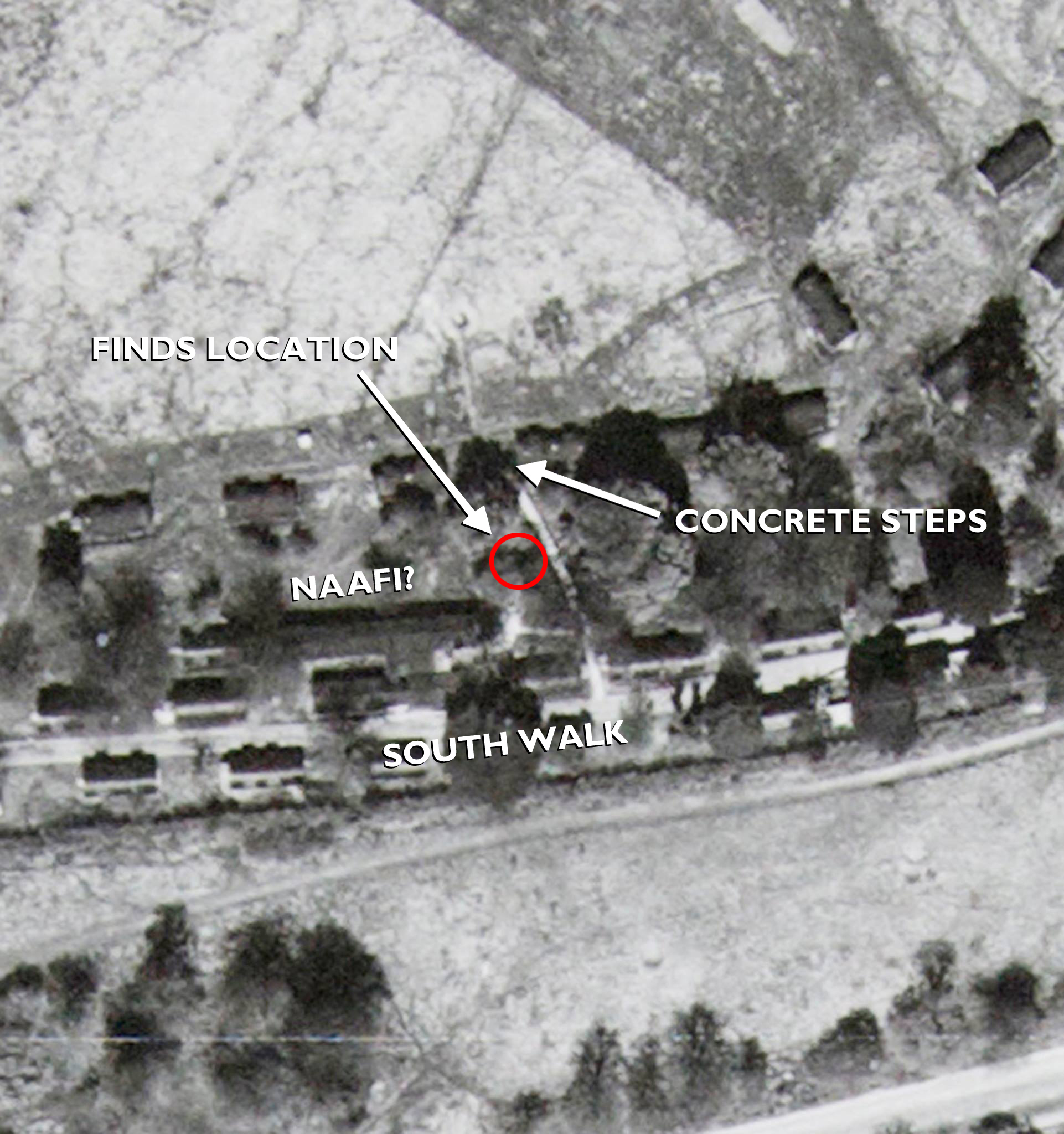
We’re less clear about how Kings Weston house and the surrounding area of the Home Park operated during the War. From contemporary aerial photos, and from the remaining concrete bases, we know that there were several dozen barrack huts built along the South Walk and as far as the Echo, but we’ve yet to establish who they were used by.

Our recent work clearing the area below the South Walk has uncovered a lot of the ruins of the former army camp, but last month we uncovered some interesting artefacts from the area. Close to where the newly-revealed concrete steps descend towards the house there is a very large concrete slab base from a building much larger than the other barrack blocks. It was close-by that we found a rubbish dump with a lot of contemporary finds amongst a lot of tipped ash. You can see where we found it using this link to the Know Your Place website.

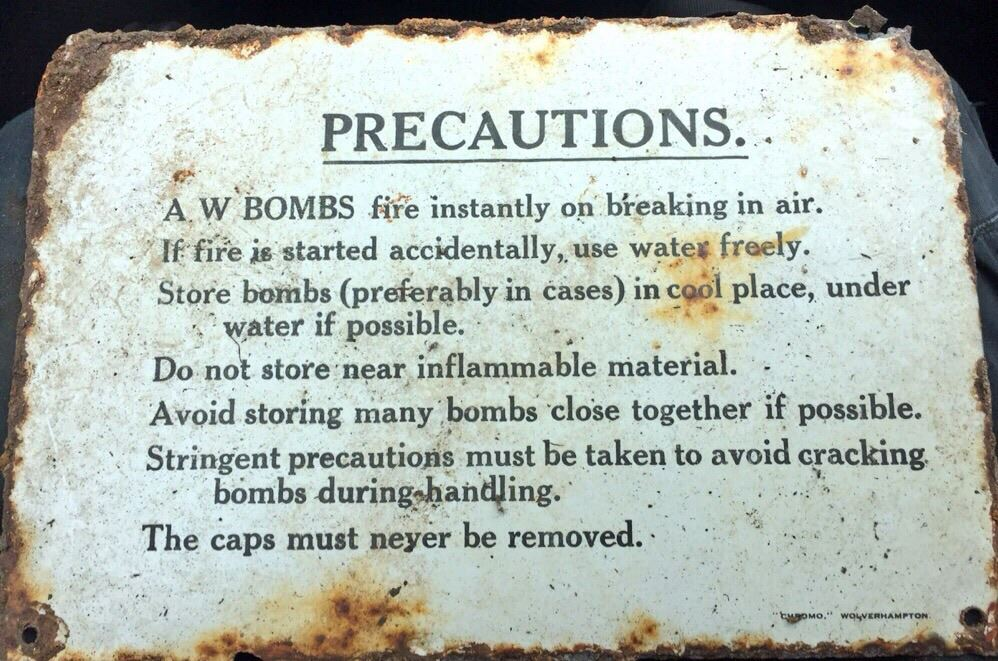
Most interesting was probably this well-preserved enamel sign. Further research has shown that this came from the inside lid of a wooden crate used to store “A W Bombs”. These ‘bombs’ – actually incendiary grenades – were produced in large numbers from 1940 onwards and were issued to the Home Guard in the event of German invasion – a real threat at that point in the war. Fortunately we didn’t find any of the glass flasks that contained the white phosphorous that would still have been dangerous today!

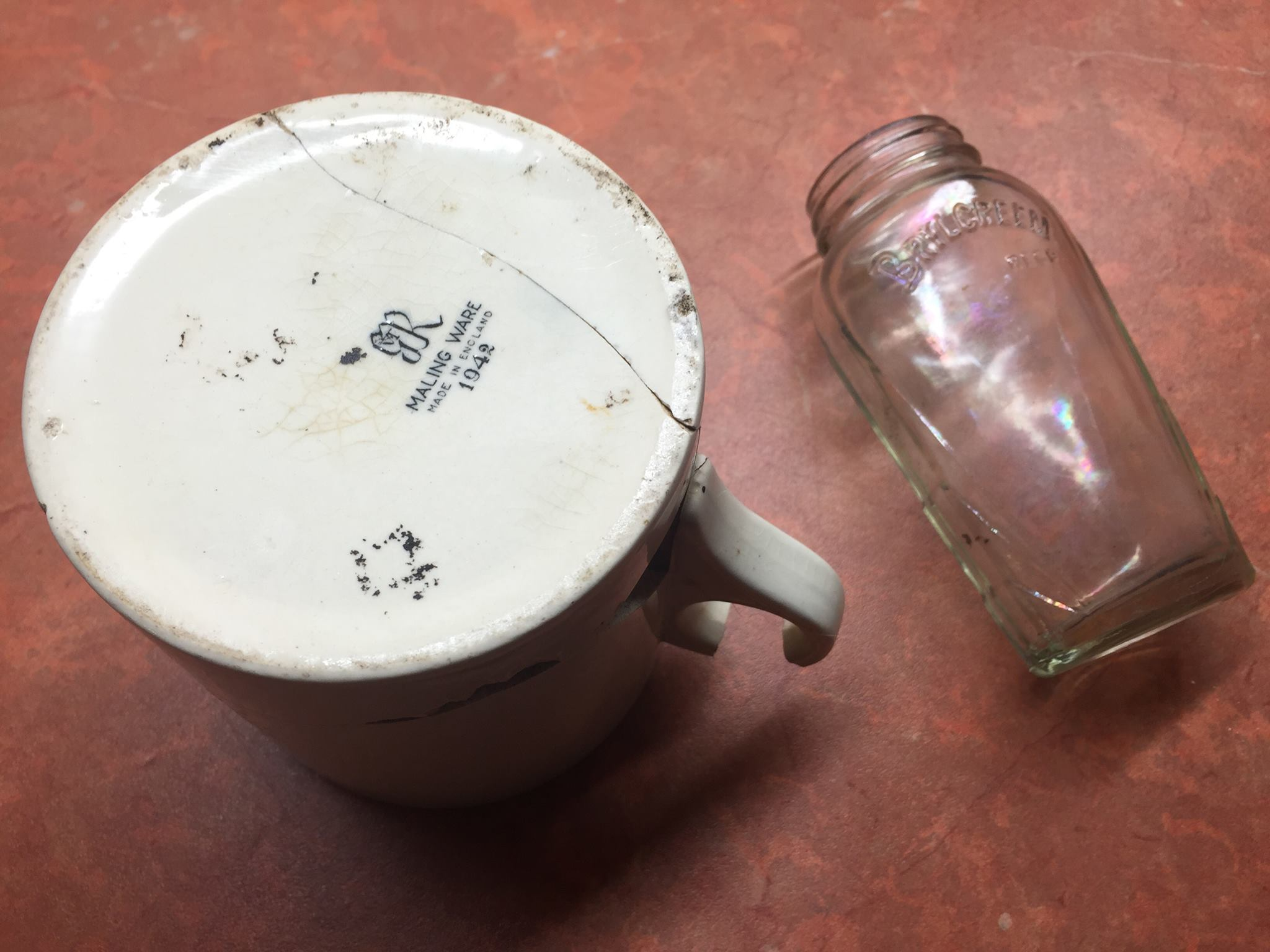
Also uncovered were the shards of a very large mug with the printed date 1942 on the base – could this have been from a nearby N.A.A.F.I canteen? Amongst other artefacts was a 1940s Brylcreem bottle; an evocative reminder that men lived and slept in the huts scattered about the estate.

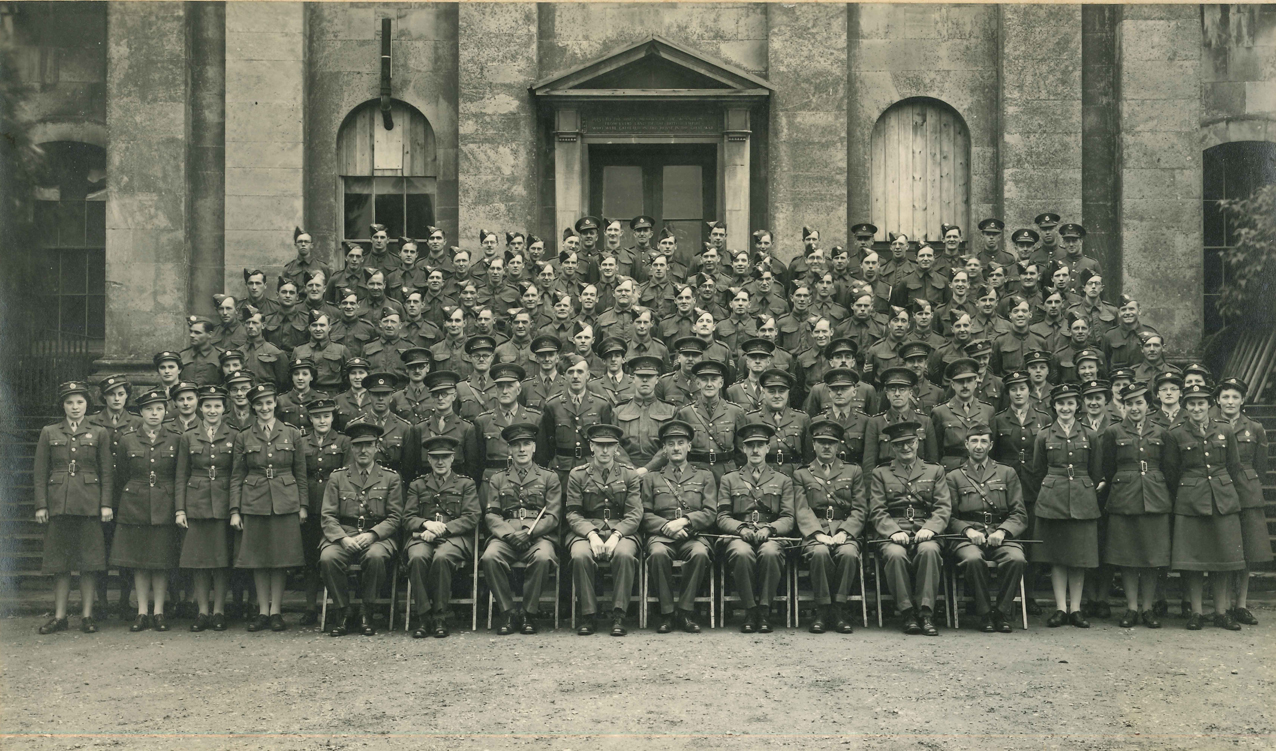
This month seems to have had a WWII theme running through it as we also acquired two period photographs that we are hoping people might be able to help with. The setting for both is clearly on the front steps of Kings Weston House. The front windows have been boarded over as protection against bomb damage for the paintings still in place in the Saloon beyond it. In front are posed British servicemen and women from a wide variety of regiments. One photo shows just the officers, and the other, shown below, shows a wider group of staff. The only clue we have to the event, or organisation represented here is the pencil note on the back of the photographs “Capt’ Myles”.

We’d be really interested to know more about this photo and if you can add anything please let us know. Can you find out who Myles was, what does this group of people represent, or do you even recognise anyone? Please let us know if  you can  help us. A much larger version of the photos can be found on our website here.

New acquisitions – can you help?

New additions to the park’s history

We’re always on the lookout for new historic material relating to the Kings Weston estate. If you have anything you can share with us, photos, memories or artefacts, we’d love to hear from you

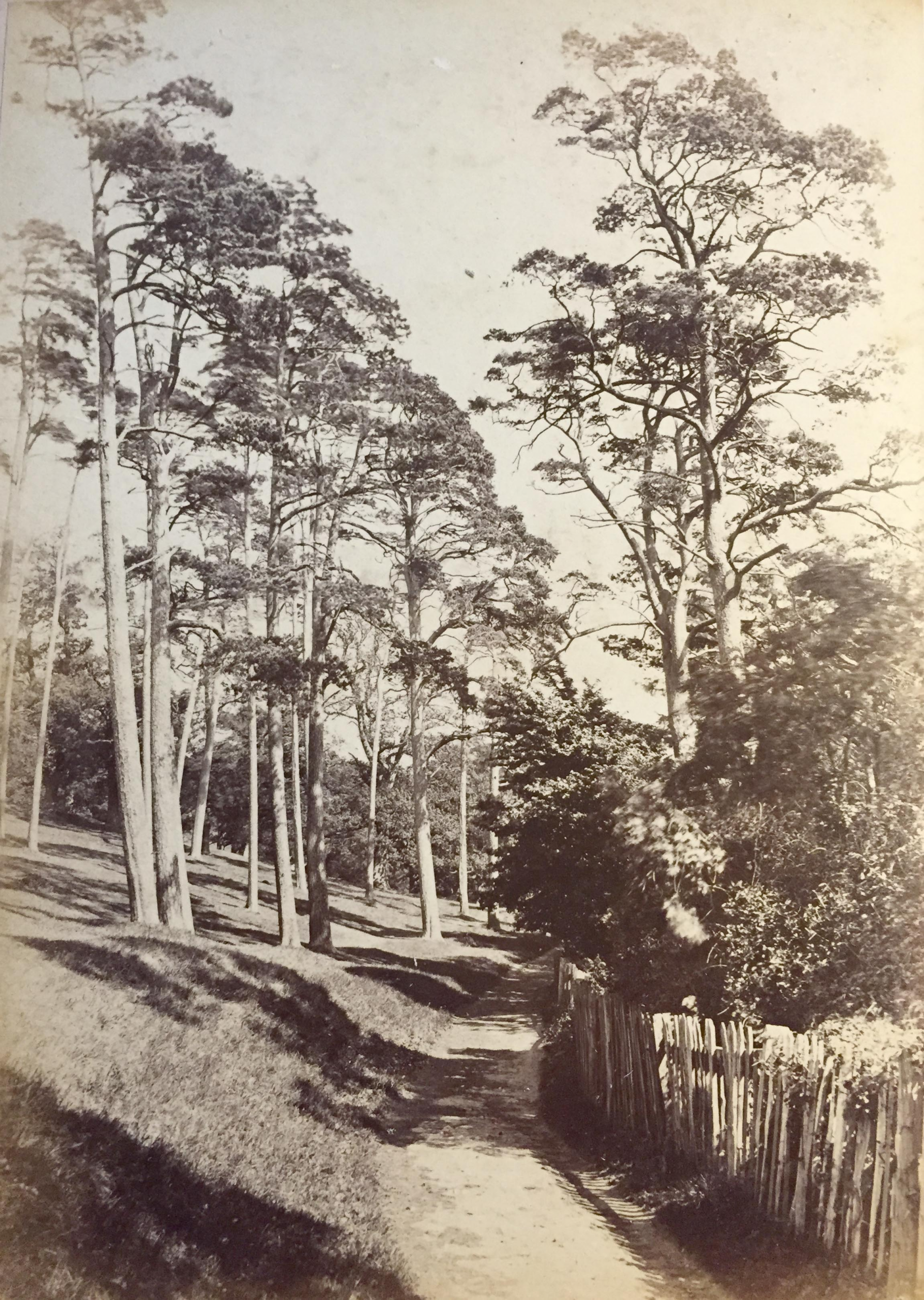
This month several items have come to our attention. Above you’ll see an idyllic photograph of Shirehampton Park looking in the direction of Sea Mills in about 1880. The grove of pines was a popular spot for artists at this time, but the trees were probably planted much earlier, by Sir Robert Southwell in the late Seventeenth Century. They are a constant feature of Shirehampton Park through the 1720 and 1772 estate surveys and successive owners must have replenished and maintained the small plantation. This picturesque view shows the wooden fence that was erected to protect the public from the recently opened railway line that had been threaded through the park, along the banks of the Avon, in 1875.

Sadly this viewpoint and most of the pines were lost in in the 1920s when the Portway cut through this exact location.

We hope that someone out there can help with another discovery. We’ve acquired the scout badge illustrated here, but we are having difficulty in tracking down its history. Emblazoned with a crown (possibly symbolic of the “King” in Kings Weston?),  a pole, and the words ‘Penpole District’ we believe it relates to the Bristol District Scout camp that was based in Penpole Woods between 1937 and 1947. During this time Penpole Lodge became the gateway into the camp site and was used by the older Ranger Scouts as their HQ. 

A second image here shows the detail of a wartime photo posed in front of the gates of the now-ruined lodge and shows the plaques the Scouts attached to them. Is this the same logo as the badge we’ve acquired, was there a later Penpole District Scout Group, or is there no connection with the estate at all? We hope that someone out there might know and we hope that any former Scouts that remember their time at the Penpole camp might be able to help us.