Category Archives: Uncategorized

Memorials of Philip Miles

If you are looking for something interesting to liven up your walls and you have a penchant for Bristol then a recent auction lot might take your fancy. A portrait is shortly to be sold by Lawrences in Crewkerne, Somerset that has a strong connection with Kings Weston. The sitter is Philip Miles, who bought the estate in 1833 for the princely sum of £206,000; an extraordinary sum for the time. It will perhaps come as little surprise that Miles was Bristol’s wealthiest person and, when he died, the city’s first recorded millionaire.

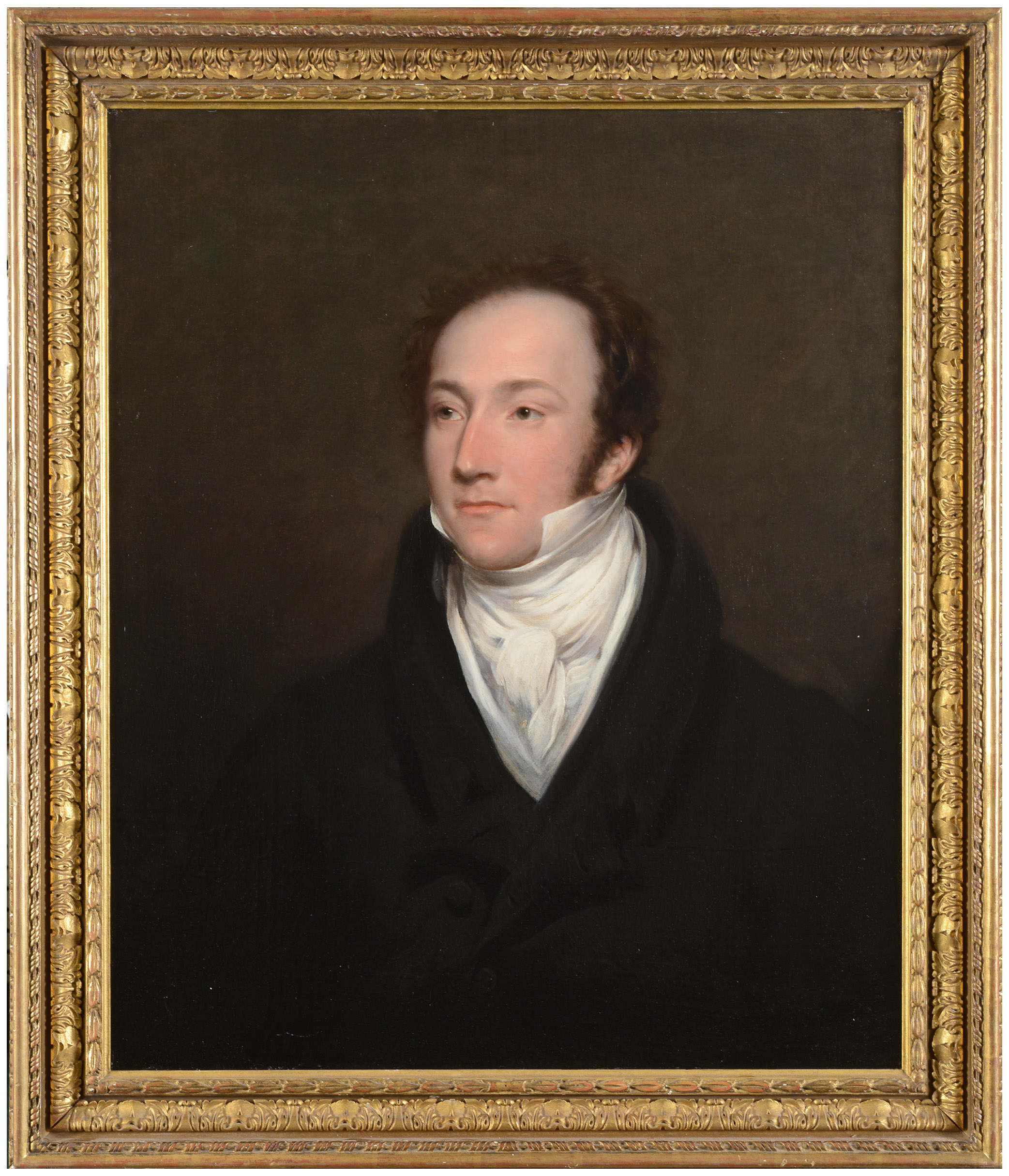
Philip John Miles by Sir Thomas Lawrence, currently up for auction on the 19th Jan

When he bought Kings Weston he already owned the palatial Leigh Court on the other side of the Avon in Somerset, and had filled it full of famous Old Master paintings. For his own portrait he commissioned Sir Thomas Lawrence, the most famous portraitist of his time; this may not have just been purely for the prestige, but Lawrence was a Bristol-born artist who had made good in the capital.


The Miles’s founded their fortune as merchants, bankers, and ship owners, and owning plantations in the colonies. As might be expected for the period his business interests were heavily dependent on slavery right up to 1833, the year he bought kings Weston, and the Slavery Abolition Act.  He was also MP for Bristol between 1835 and 1837.

Philip Miles’s memorial in Abbots Leigh church, by E H Baily 

The painting up for sale is likely to have been painted before Miles moved to Kings Weston, and it is not documented as having hung in the house, but it is an important record of a man who played an important role in the history of the city and the estate.

After Philip Miles’s death his family went to the foremost sculptor of the age to have his memorial carved. Again, perhaps not be coincidence, the artist, Edward Hodges Baily, was Bristol-born. It is known that the family were keen benefactors of the Bristol Arts scene and it is likely that their patronage of Bristol artists was intentional. The monument stands today, pale and magnificent, on the north wall of the tower of Abbots Leigh church; a pair of pensive figures stare up towards a draped classical urn bathed in carved stone rays of heavenly light.    

The portrait of Philip Miles sells at Lawrence’s auction rooms on the 19th of January with an estimate of £4000-£6000. For further information, or perhaps even to make a bid, go here.

Urgent Iron Bridge Action!

Important news about the Iron Bridge!

KWAG fully supports a morning event this Sunday to bring about new attention for the plight of the Grade II Listed Iron Bridge on the estate.Frustrated locals in north Bristol are marking 800 days since a vital – and historic – footbridge was closed to pedestrians by Bristol City Council, with a public rally showing how much the bridge is loved.


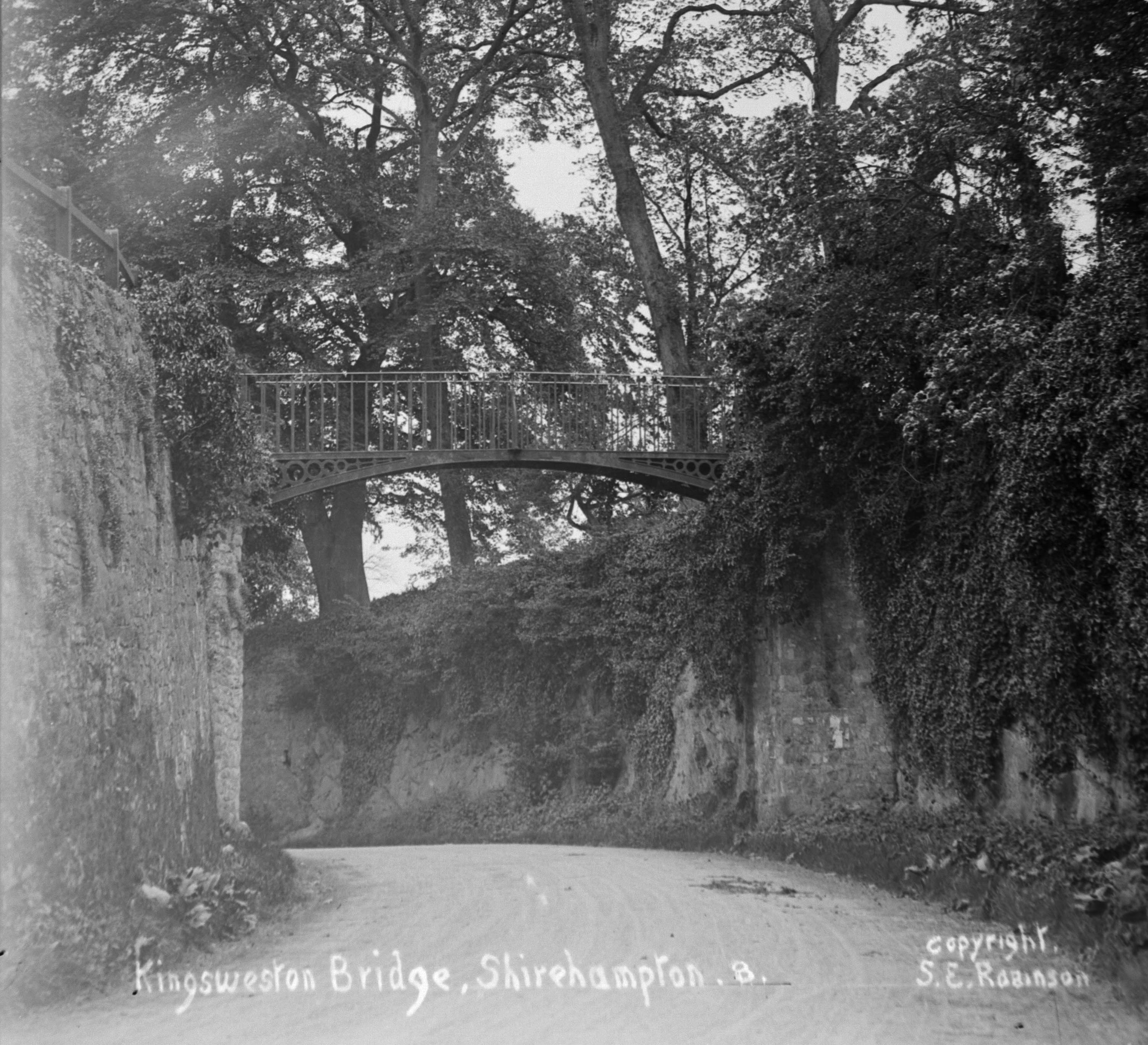
Kingsweston iron bridge is a Grade II listed cast iron structure, built circa 1820 by legendary roads engineer John Loudon McAdam (who gave his name to tarmac). It forms the only safe pedestrian link between the Blaise and Kings Weston estates in north Bristol. It was used daily by hundreds of dog walkers, families, schoolchildren and ramblers until it was struck by a high-sided lorry on 4 November 2015. The bridge was swiftly scaffolded by Bristol City Council and closed to pedestrians – and has now remained this way for over 2 years and 2 months. This week marks 800 days since the bridge was last open to foot traffic.

The Facebook group Save the iron bridge – Kingsweston has over 400 members, but campaigners are growing frustrated with the Council’s slow pace and poor communication with locals. The closure affects thousands of residents of Sea Mills, Shirehampton, Combe Dingle and Lawrence Weston, as well as many visitors from the wider Bristol area.

We are urging anyone who uses or cares about the future of the bridge to join them this Sunday 14th Jan, 10-11am and attach their messages of support to the bridge. Messages will be pinned to the scaffolding around the bridge and then put on display locally. “Although Bristol Council has said it’s committed to repairing the bridge, so far we have only had words and no action,” say event organisers Ella Davies and Dan Linstead. “We appreciate budgets are tight, but we need the Council to act now rather than later.

With the footbridge closed, locals are forced to cross the notoriously busy Kingsweston road, with traffic coming fast and unexpectedly in both directions. It is only a matter of time before someone is seriously injured or worse.”

Group members and local councillors will meet at the bridge this Sunday 14th January at 10am (press photocall at 11am) to raise awareness ahead of a full council meeting on
Monday.

For more information and to join the Facebook group, visitgreenironbridge.com. contact organisers Ella Davies (ella.davies@yahoo.co.uk, 07707 125227)
or Dan Linstead (danlinstead@yahoo.co.uk, 07866 551632)

Kings Weston on the verge

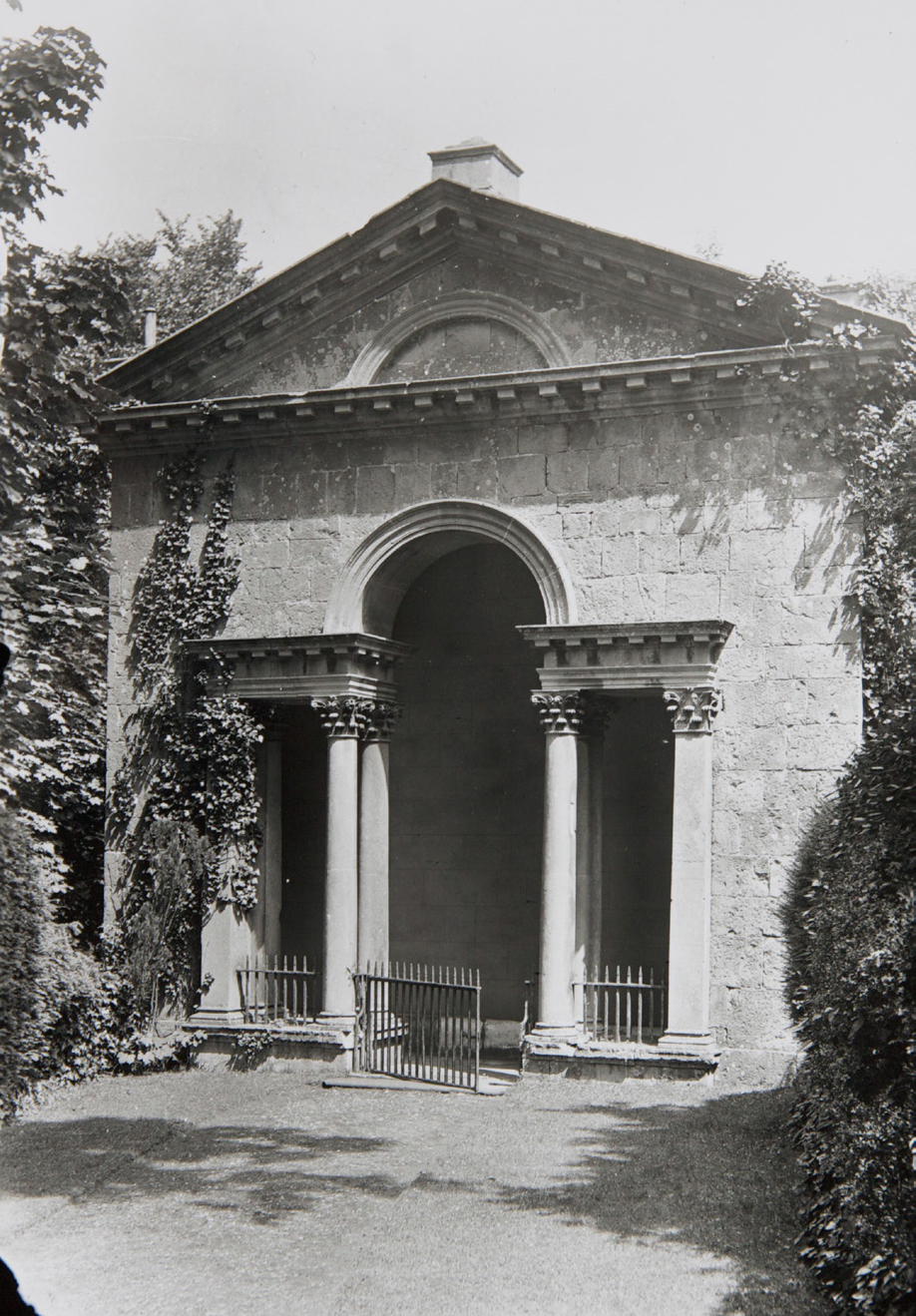
The Loggia, designed in 1718 by Sir John Vanbrugh. Seen here in 1927 (Country Life)

The area recently worked on by KWAG volunteers, just below the coffee shop terrace, Is an odd corner of the Kings Weston estate. Hard up against Kings Weston Lane in its gulley to the east it has always been an abrupt edge to the Landscaped grounds.

Before the present house was built the slopes descending towards Lawrence Weston here were laid out as formal kitchen gardens, though would have been sorely exposed to the brisk winds off the Severn. The top of the slope offered spectacular panoramas across the estuary and, in 1705, a banqueting house was built on a terrace overlooking the kitchen gardens. When Sir John Vanbrugh came to rebuild the house for Edward Southwell his plans extended to major landscape interventions. The small banqueting house received a new façade in 1718, one that looked back into the park and along a vast new terraced promenade; this building forms the core of the current Loggia.   

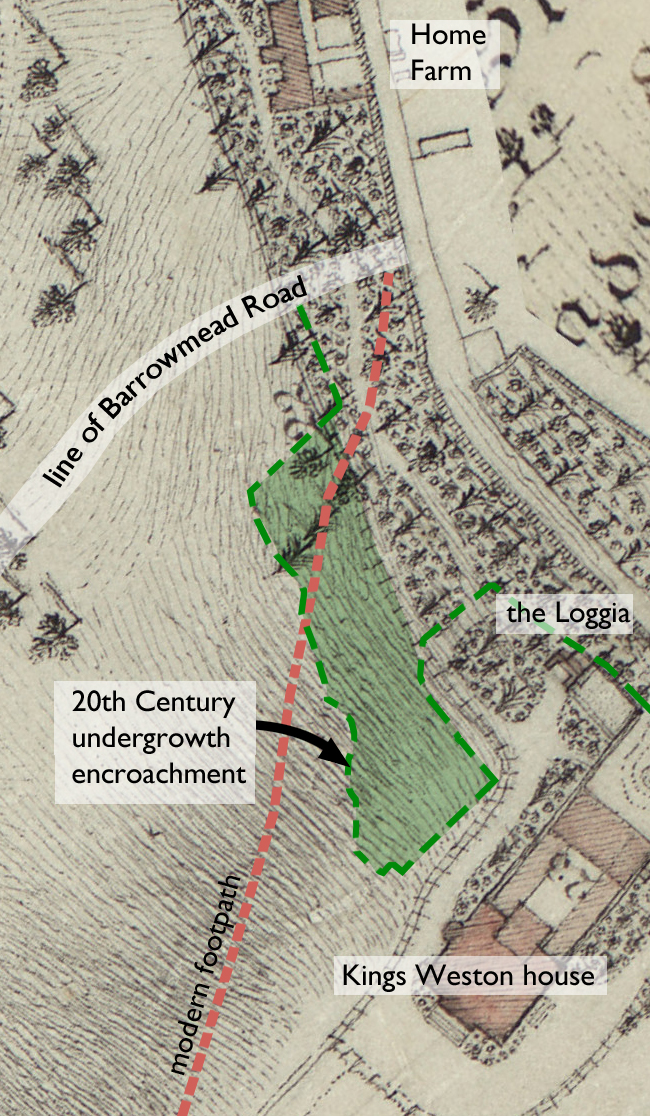
As garden fashions changed the whole of the area below the banqueting house and Loggia were deformalised and the topography took on a form much the same as today’s. By 1772, when the area was surveyed by Isaac Taylor, only the Loggia remained, and the terraces and formal gardens swept away. In their place the open parkland swept unbroken to an area described as “verge plantations”. On his plan Taylor identified a railed fence separating the newly planted area from the recently created rolling meadowland below the house; the remains of this Georgian fence can still be found in the area recently cleared.

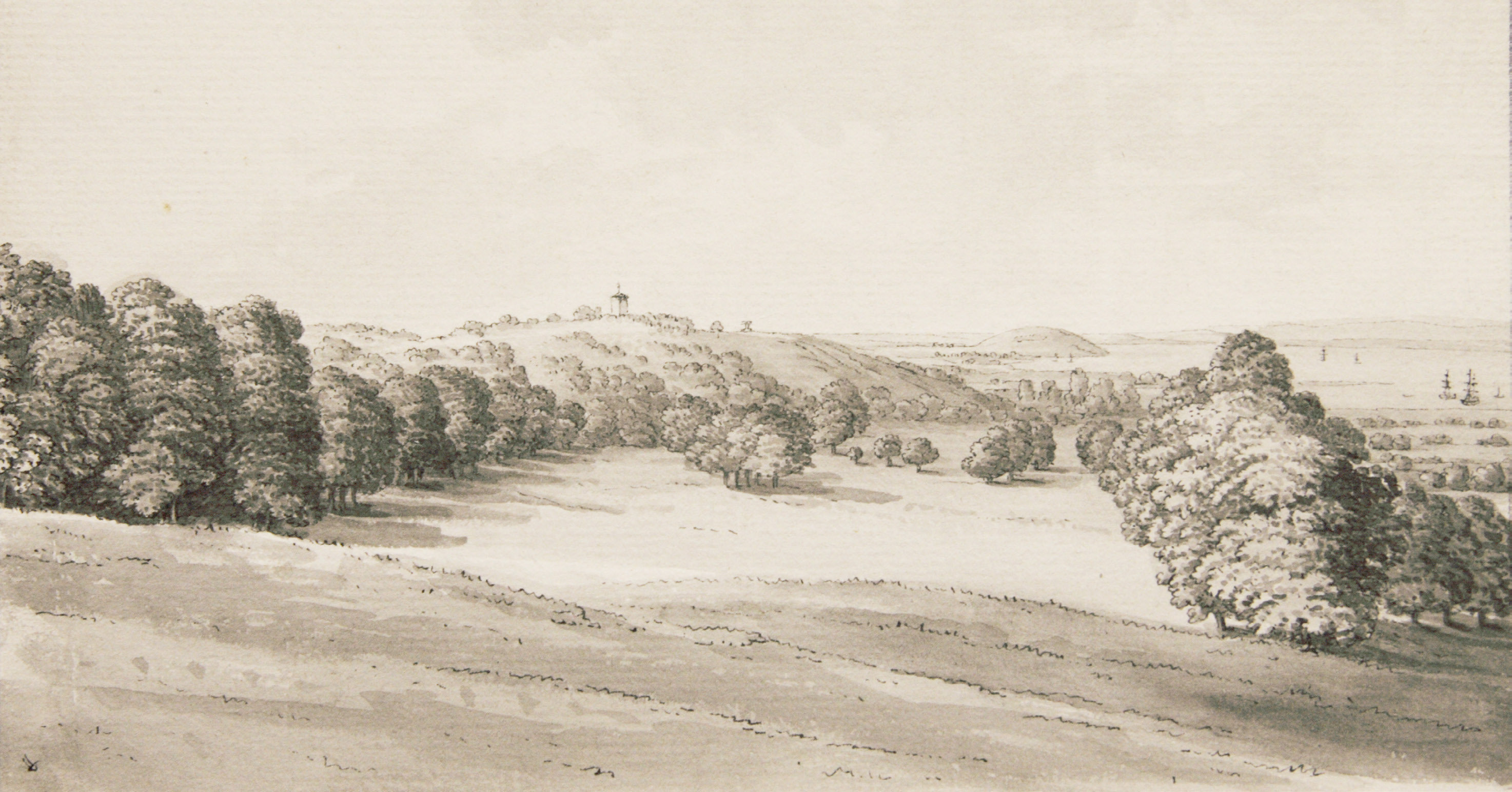
The view from the loggia across the meadow land. Hieronymus Grimm, 1788 (Bristol Museum and Art Gallery) 
 Taylor’s 1772 estate plan with later alterations annotated

Within the plantation new trees and shrubs were laid out as part of a pleasure walk that connected the house and Loggia with the Home Farm and Menagerie below. This planting would have been intentionally picturesque in style and some of the holly, yew, and Portuguese laurel from this era are still growing there, though the path has long become lost. Maps show there to have been many evergreens incorporated within a design intended to frame the open meadow and focus the eye on Kings Weston house commanding the ridge above it.  

As time went on the trees and shrubs grew up and the view of the Loggia from the park was sadly obscured. The pleasure walk and planting continued to be maintained until the 1930s, but since then there has been little attention spared on them. Since WWII and the cessation of regular livestock grazing, this has resulted in the gradual encroachment of self-seeded trees beyond the historic fence line and the loss of the tamed edge of the meadow. Today trees cover almost twice the area of the original verge plantation and have further obscured the house and Loggia from within certain areas of the park. It is hoped that KWAG’s work, and forthcoming work as part of the National grid contributions, will help enhance the setting of Both Grade I Listed buildings and the park as a whole.    

National Award Recognition for Kings Weston

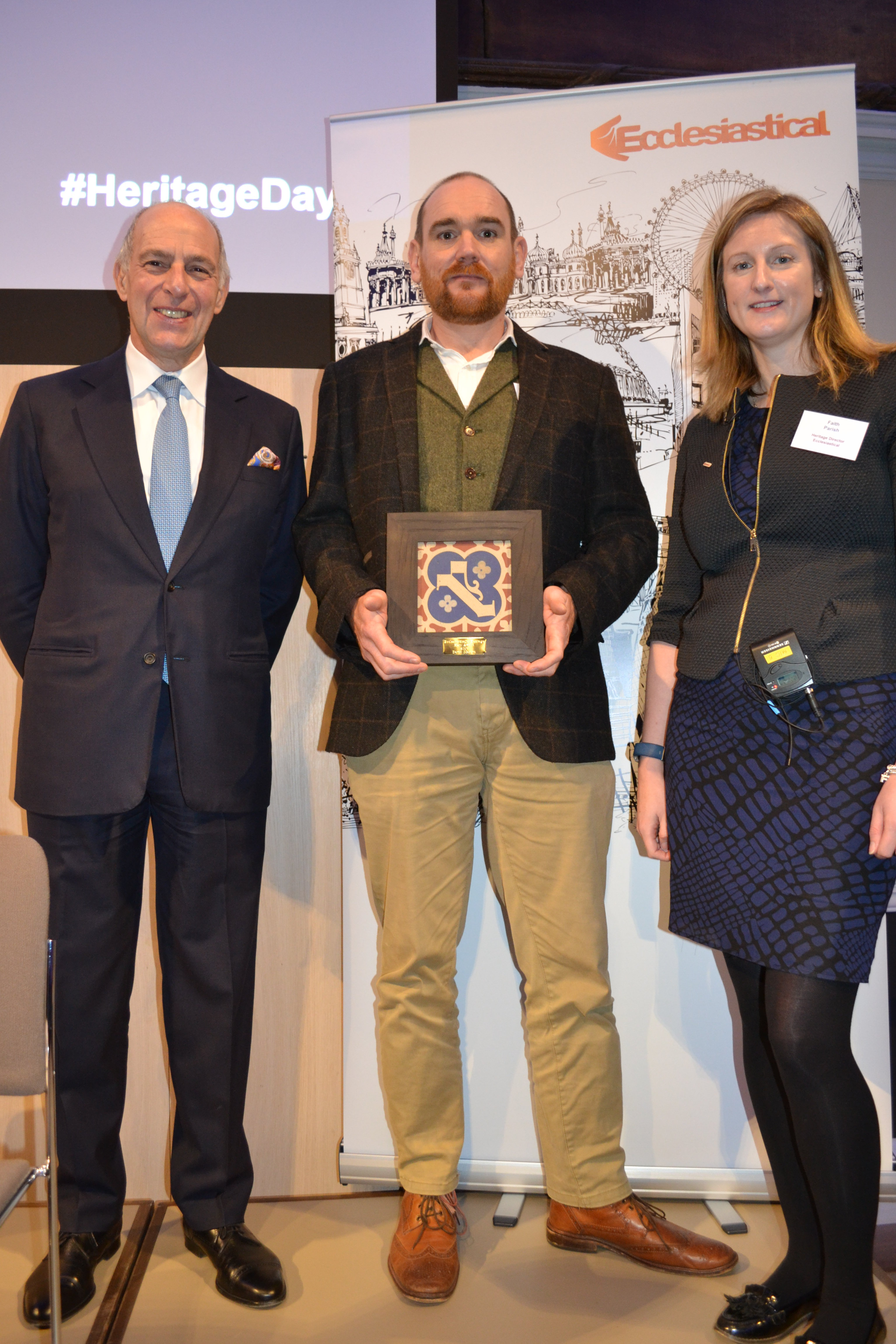
KWAG’s Chair, David Martyn, collects the Award from Lloyd Grossman

Kings Weston has again received some national notoriety. Last week KWAG’s co-founder and chairman was invited to London to receive a Heritage Hero award for his voluntary work on the estate. The award was presented as part of the Heritage Alliance’s Heritage Day at RSA House. The Heritage Alliance is England’s biggest coalition of heritage organisations, representing groups as diverse as the National Trust and the Historic Houses Association, to more specialist conservation bodies. The Alliance said “England’s heritage sector simply couldn’t function without the hard work and dedication of its volunteers. The Heritage Heroes Award, supported by Ecclesiastical Insurance, is the Heritage Alliance’s celebration of the amazing achievements of volunteers.”
 
The Alliance’s chairman, Lloyd Grossman, said ‘every day, thousands of people around the country give up their time for free on projects like King’s Weston without public recognition.  The heritage sector is dependent on volunteers to save and cherish heritage that would otherwise be lost. David Martyn has worked incredibly hard and achieved stunning results. I hope his success will inspire others to give up their time and get involved with local heritage projects’.
 
As part of his acceptance speech Mr Martyn recognised the efforts of all KWAG’s volunteers in supporting the estate, whether through working party events, helping behind the scenes, or even those members who support the group from afar. It is heartening to know that in just six years KWAG’s efforts promoting and conserving the estate are being noticed at a national level.

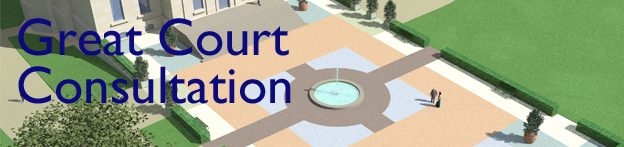
Great Court Consultation

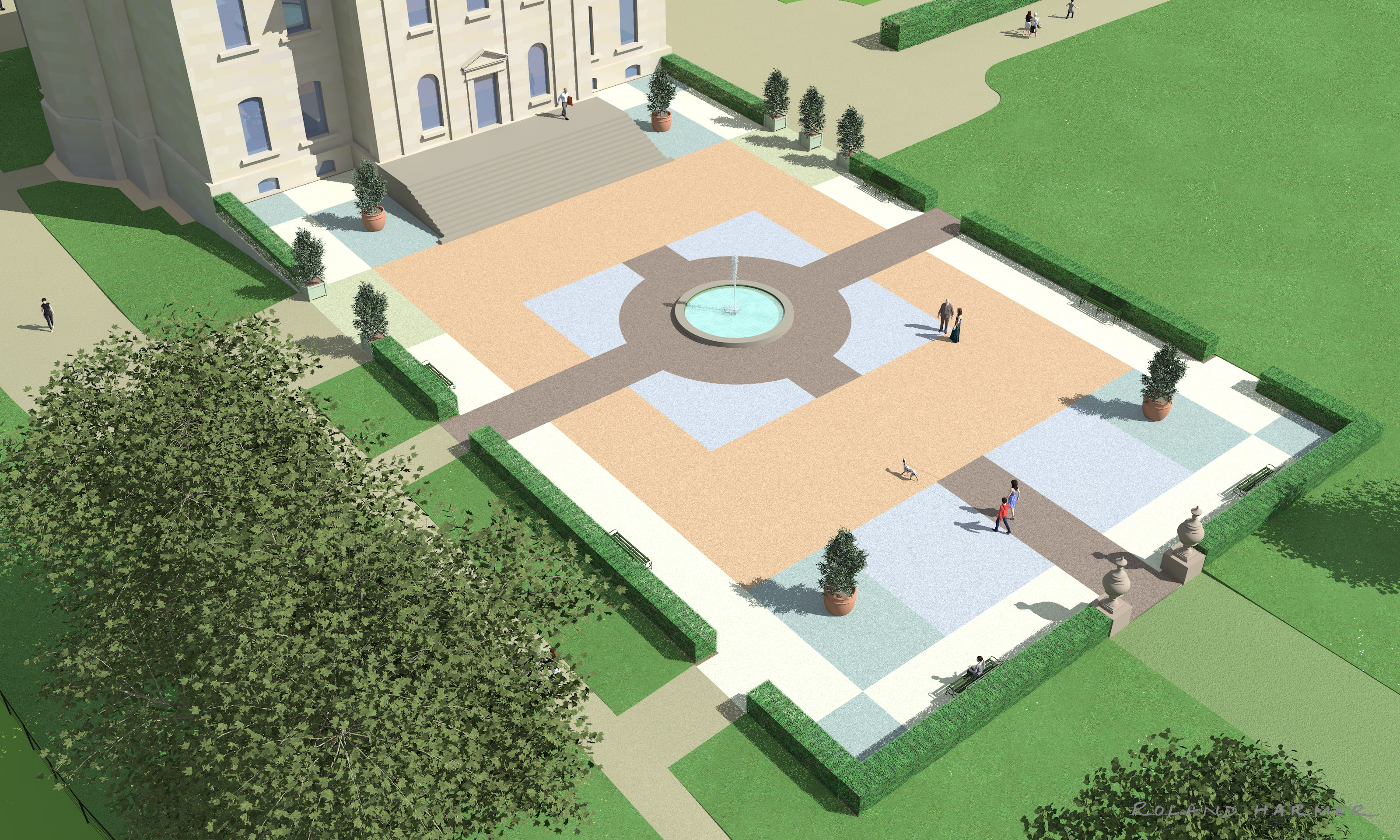
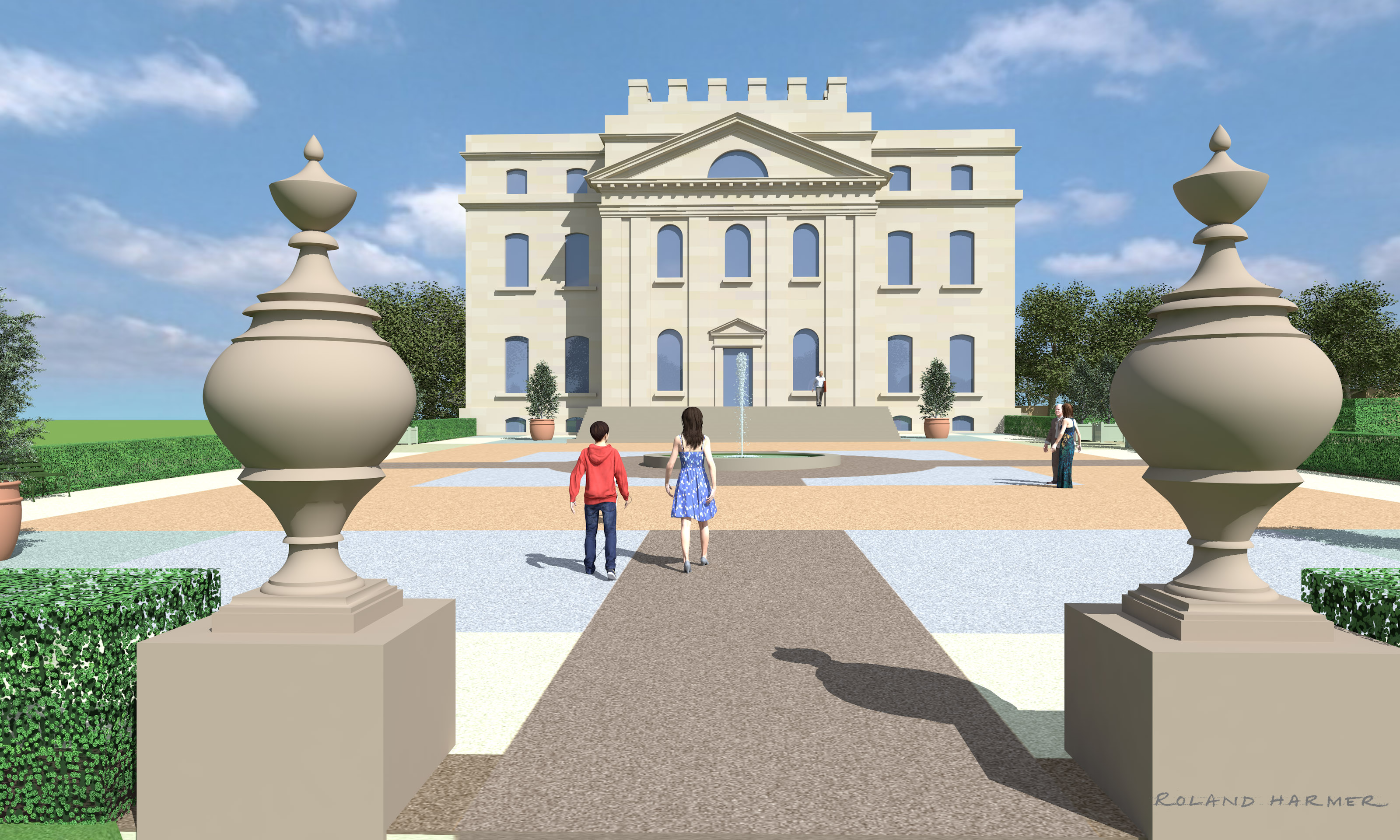
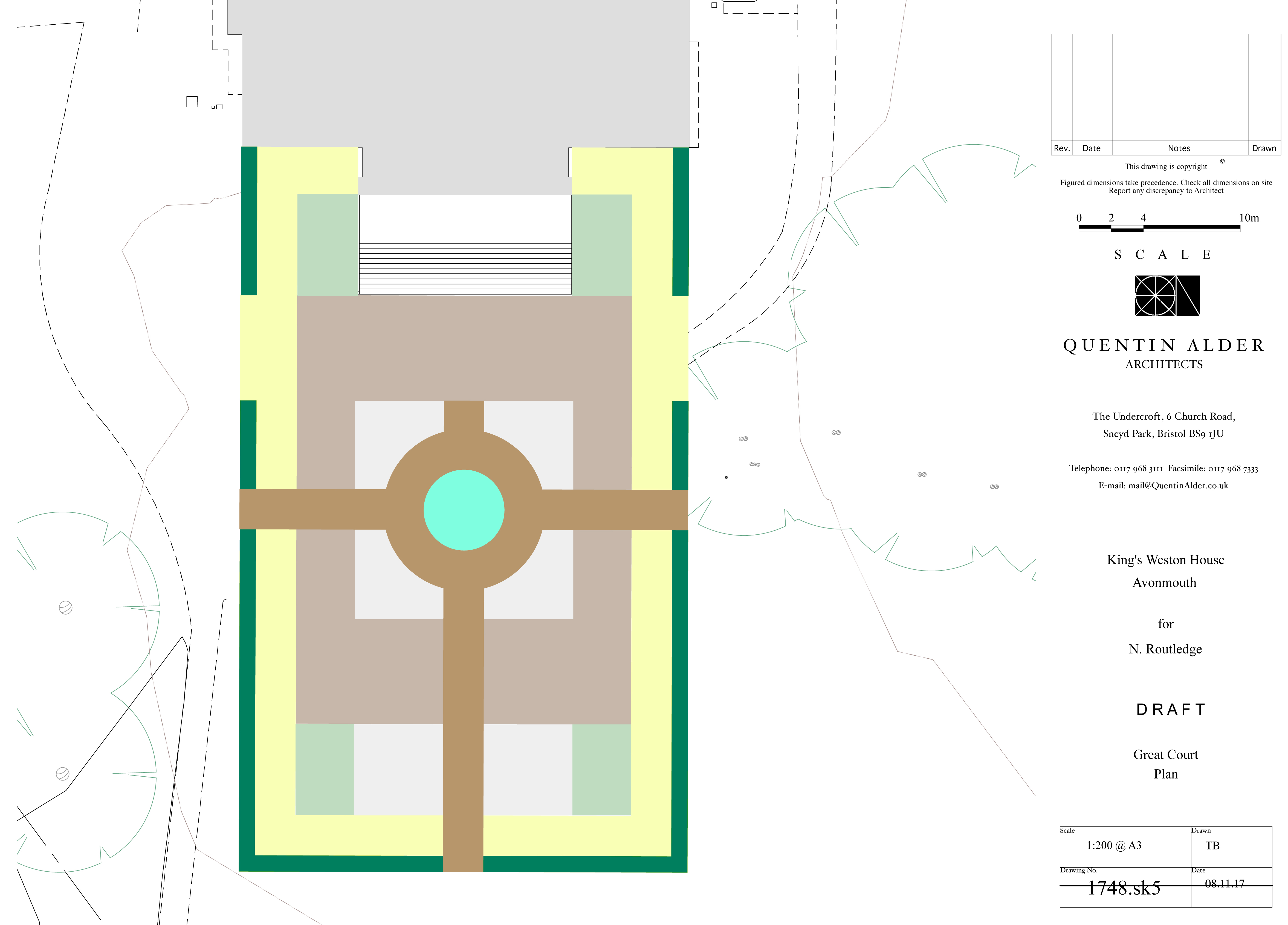
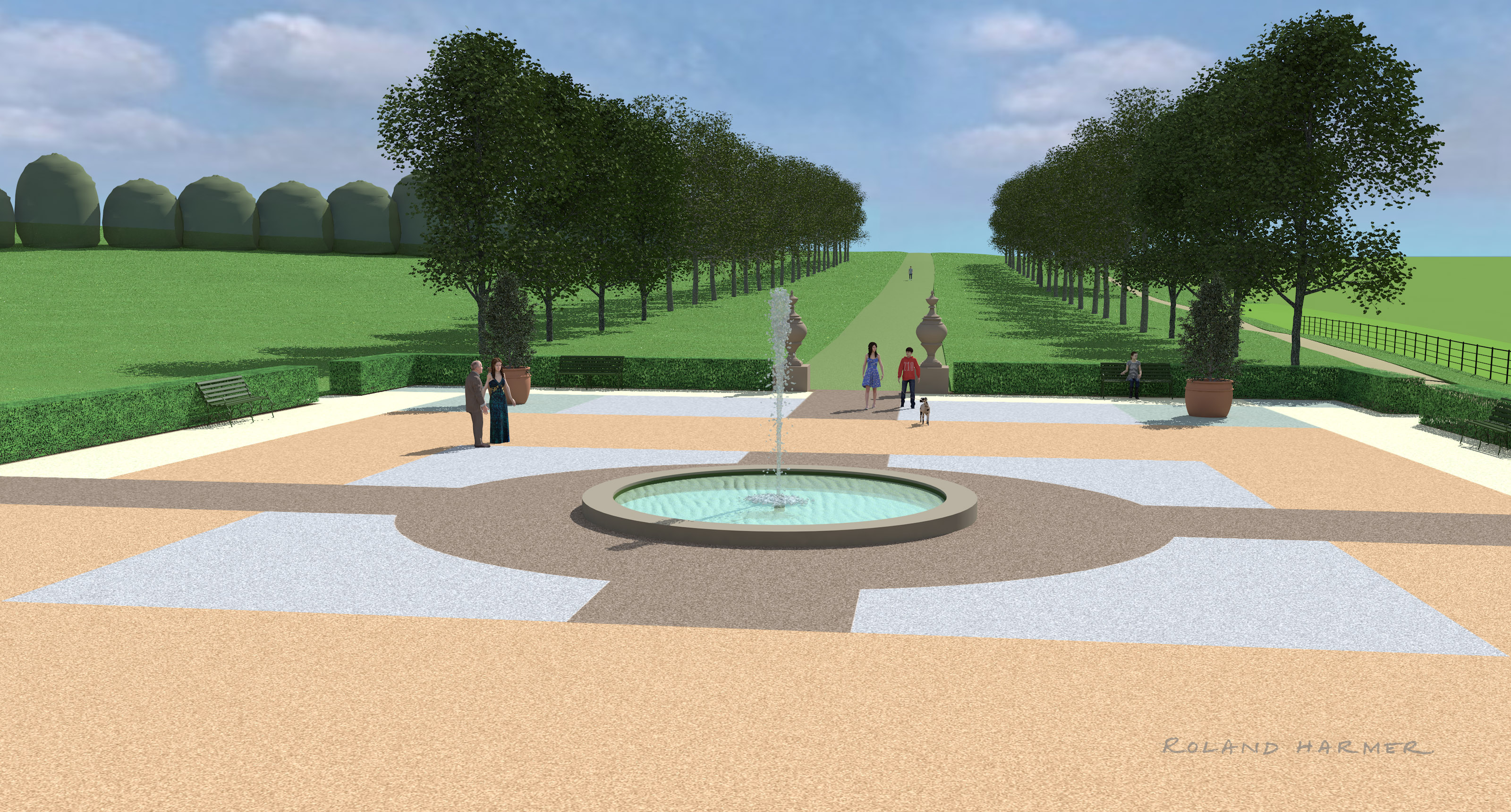
The last planting beds on the garden front of Kings Weston have recently been completed by Norman Routledge and his team at the house. Focus is now turning to the main front of the house facing the Home Park. Plans are being drawn up by the house to look at creating a new formal forecourt in front of the main steps.

The new formal area is intended to reflect the original Great Court that once lay in a similar area. Although smaller in size it is intended that the design will use the same classical proportions.

Work on designs is likely to continue over winter and a Planning and Listed building application will follow. The illustrations here are to help everyone get an idea of the character of the proposals and get feedback on them to help Norman and his architect, Quentin Alder, develop designs that respond to people’s thoughts.

If you have any suggestions, ideas, or concerns please forward them to us so we can coordinate a response to Norman. Unless you ask otherwise we will keep any feedback anonymous. Please email us at kwactiongroup@gmail.com, call 07811 666671, or post your comments to us as soon as possible, or before 1st January 2018.

More historic entries on Know Your Place

Bristol City Council’s Know Your Place website goes from strength to strength with regular new entries of historic information and images provided by volunteer contributors and public collections. Amongst the recent submissions KWAG has included on the map-based site are some Twentieth Century images including the one below of Home Farm in 1936. As published in last month’s newsletter the Home Farm building, once the agricultural heart of the estate, is today for sale. This image comes from an earlier sale catalogue issued by the executors of the estate of Philip Napier Miles when the estate was split up and sold at auction.  

Whilst the building remains recognisable the attractive garden setting and outhouse in the foreground were swept away after the Second World War when Lawrence Weston Estate was laid out and the building converted for use as a new health centre. Since then is has been a Bernardo’s home, and, most recently, a nursery. Although the building is now Listed Grade II there is little left inside that hints at its historic nature; much was refurbished and modernised and the fifties though the roof timbers remain preserved in the attic spaces.

You can access Know Your Place using this link, though please have patience as the page loads as there is now a huge amount of information available on it that needs to load. It may take as long as a minute.     

Above: Home Farm on Kings Weston Lane seen in 1936

New theories on Kings Weston’s Roman Landscape

Many in Shirehampton will know about the lamentable destruction of the former National School in the village centre a few years ago, well some interesting things have arisen since the loss that might start to outweigh the loss of the historic building. Last year Avon Archaeology undertook an excavation on the site and made some exceptional finds; the first significant Roman material found in Shirehampton beneath the Victorian foundations.

One of two bronze alloy broaches from the 1st or 2nd Century AD

Some of the pottery dating mainly from the 3rd to 4th Centuries.

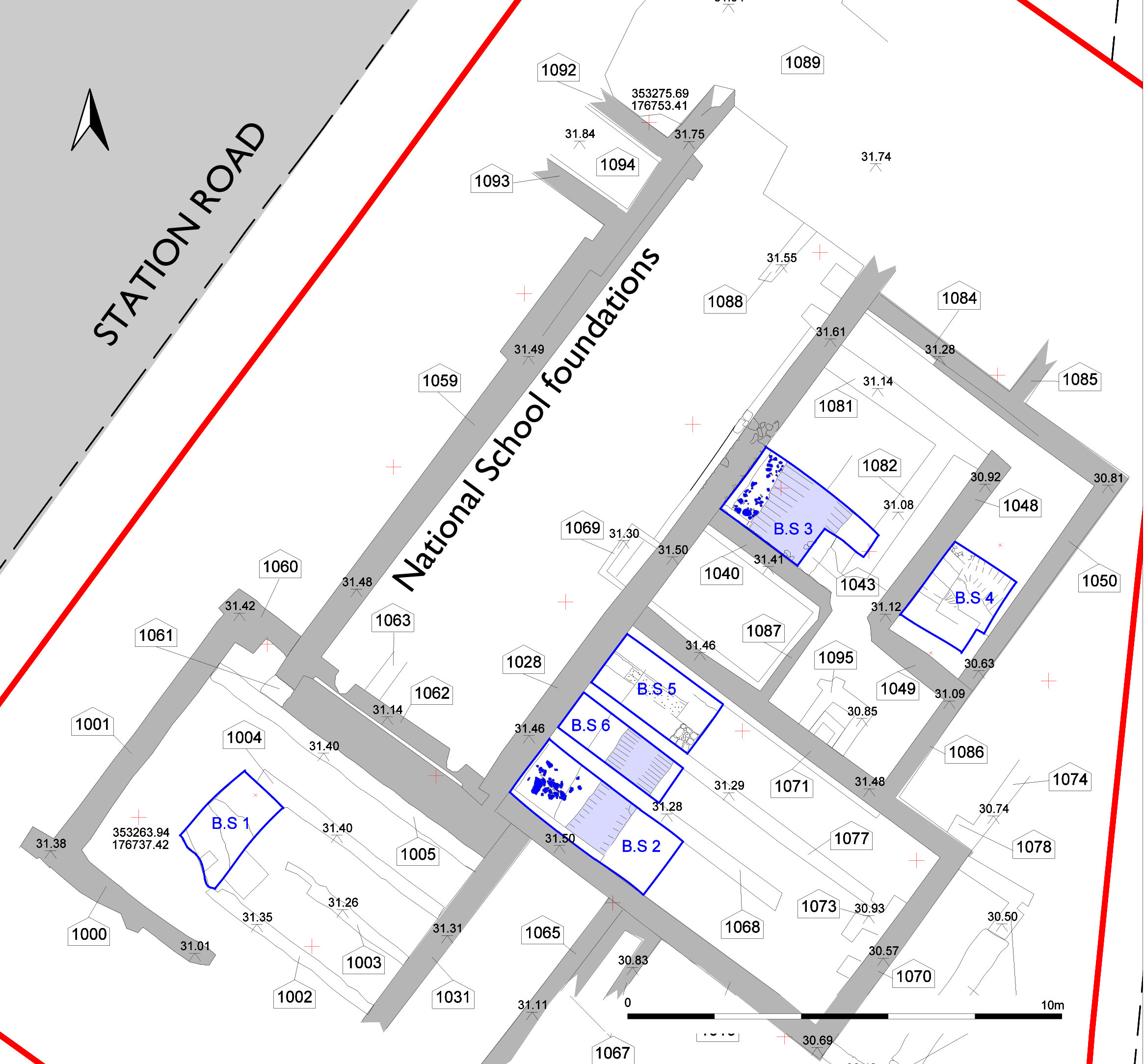
As well as some fascinating individual finds including two fibulae brooch and a good quantity of pottery The dig identified a strong linear ditch feature into which much of the material had been deposited. This ditch, and an associated stone scatter along one side, support a new assessment of the Roman impact on the Kings Weston estate.

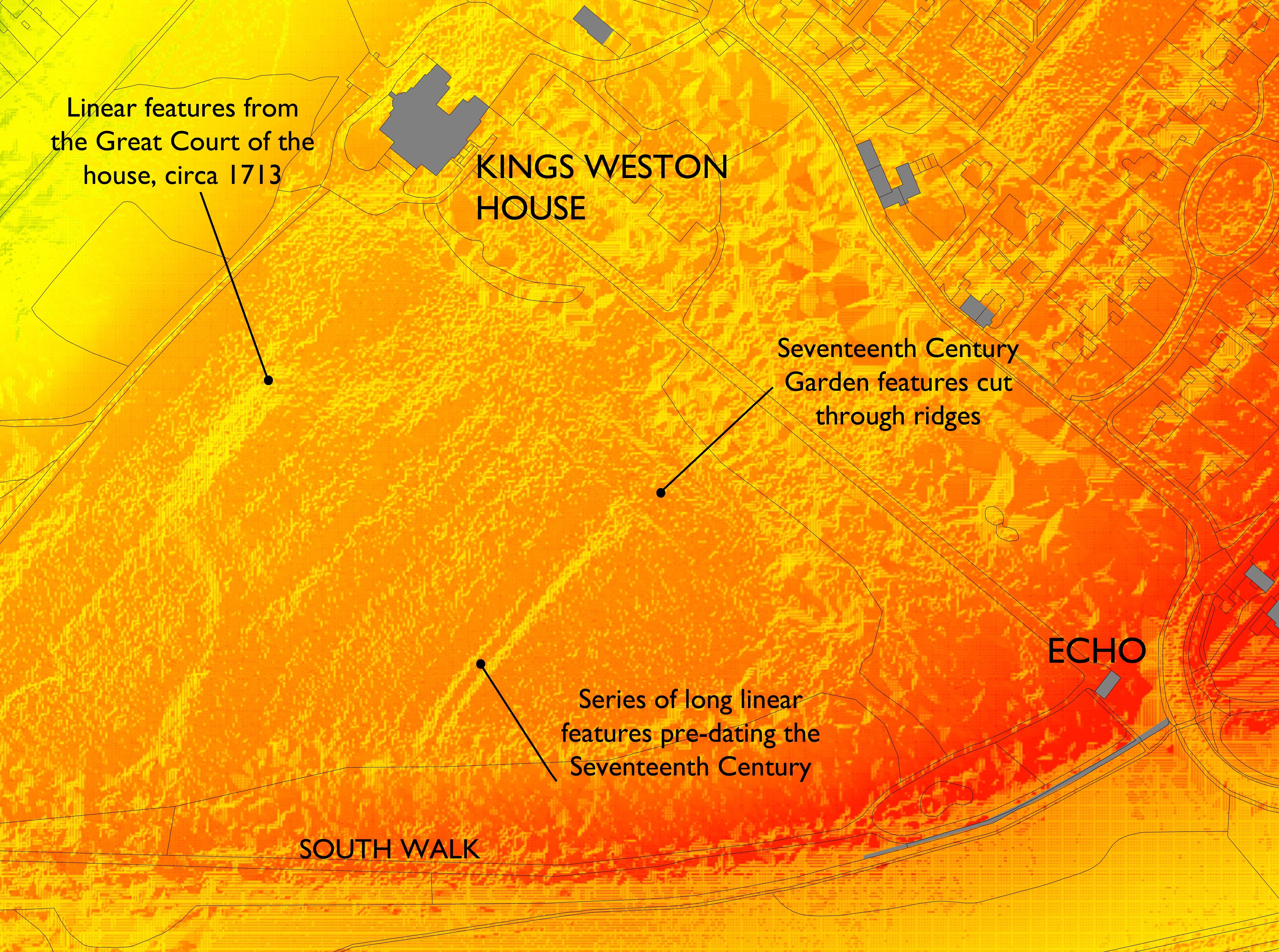
Linear ridges and shallow impressions crossing north-east – south-west across the meadowland of the Home Park have long puzzled us and our archaeological geophys surveys have not yet reached the most visually prominent areas to asses them. In association with our existing knowledge there is more exciting potential in these features.

Roman linear feature and site plan (Avon Archaeology)

To the south of Kings Weston was the town of Abona, on the Avon at modern Sea Mills. Roman Roads can be tracked southwards and across Durdham Downs heading for Bath, and a major connection to Gloucester is known. It is significant that the known course of this road passes to the north side of the Kings Weston Ridge, continuing a line from Cribbs Causeway through Henbury. However, if that line is projected onwards it is not to Sea Mills that it heads, but directly through the Kings Weston Parkland to the old ferry across the Avon to Pill and the Somerset side of the Avon.

The recent finds in Shirehampton now give greater weight to the route of the road passing across the Home Park, Down Park Hill, then heading towards the banks of the Avon at Lamplighter’s along the modern course of Station Road; From there significant settlements at Gatcombe, Charterhouse on Mendip, and Ilchester would have been directly connected with Gloucester.

LIDAR data showing the landscape features around Kings Weston house in high relief.

A review of the archaeological record for the road from Bath towards Abonae also suggests that that road too bypassed the settlement proper and headed across the river Trym in a characteristically straight line, and crossed Kings Weston Hill at the Old Inn, and by way of a zig-zag known to have existed before the 1730s.

What this means for Kings Weston is significant. The conjectural new alignments give great potential for undisturbed Roman material being located within the flat land around the Home Park, and close to a major junction in Roman Roads. The nature of that junction, the foundation of the medieval manor at Kings Weston, and the efforts made by the Southwell families and those before them to divert the road outside their park might now be explored within this new hypothesis.

CLICK TO ENLARGE. Conjectural alignment of Roman Roads around Kings Weston with other sites.

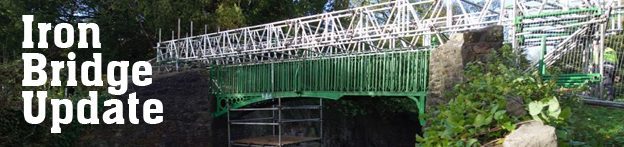
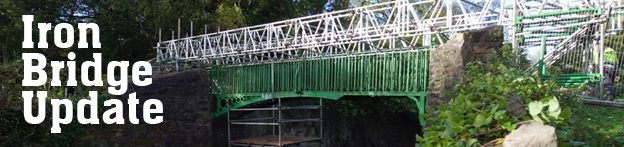
Iron Bridge Update, August 2017

Some long-awaited progress to report from Bristol City Council regarding their repairs on the Regency iron bridge over Kings Weston Lane. This is the full text of the highway teams report:

Kingsweston Lane Footbridge was impacted by a HGV on the 4th November 2015, where substantial structural damage was suffered to the underside of this lightweight footbridge cast iron structure. There is already low headroom warning signage in place on approaches to this footbridge. The footbridge was immediately inspected on the same date and was subsequently closed to pedestrians on health and safety grounds.

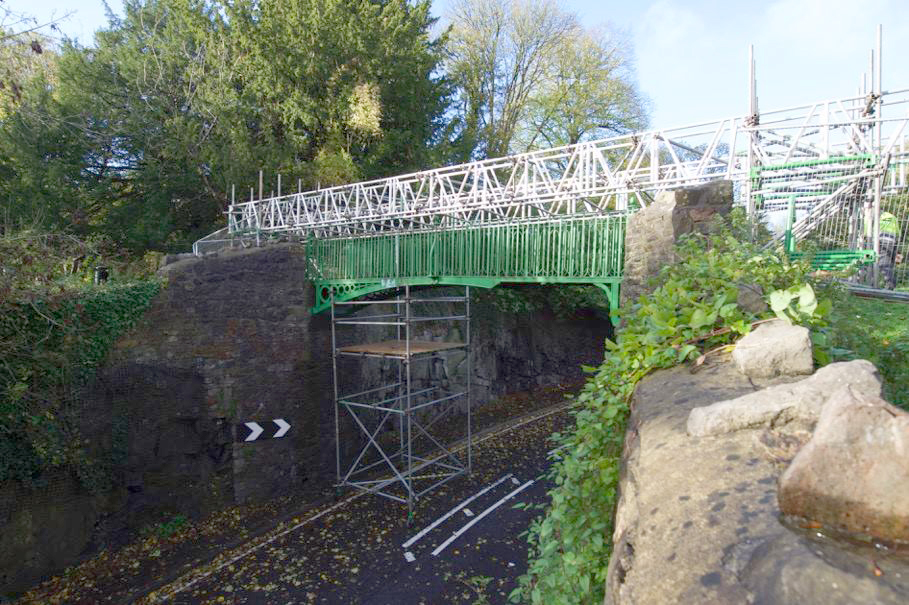
As a consequence of the damage incurred the Council installed a temporary scaffolding bridge support arrangement above this footbridge to prevent the bridge itself from collapsing onto Kingsweston Road below. This support scaffolding was installed using an emergency road closure on the 5th and 6th of November 2015. The bridge remains closed to pedestrians. A signed alternative pedestrian route via Kingsweston Lane (including a temporary pedestrian crossing), is in now place. The road remains open to traffic. The alternative pedestrian route is inspected on a monthly basis

The Council is committed to reconstructing this listed historical footbridge and to reinstall this vital pedestrian link. However due to the listed status of the bridge and the paucity of existing information, further detailed investigation will be required to be undertaken before BCC are in a position to commence works on site. Subject obtaining the appropriate Capital Investment availability, this is provisionally programmed to be commenced on site early in the New Financial year, April 2018.

By potentially raising the headroom height of the footbridge it is hoped the mitigate the future potential for HGV bridge strikes, However this would change the appearance and would create pedestrian ramping on the approaches to the footbridge which may not be accepted by (HE) or BCC Planners. This will be investigated further by BCC and a decision made on the appropriate design accordingly.

The footbridge itself is constructed from numerous jointed cast iron elements and is also grade 2 listed, constructed circa 1800. The footbridge has received significant structural damage with the east side of the bridge sustaining major damage and loss to two arch beams which transfer the structural loadings of the bridge to the walled abutments on either side. These are the key structural members that hold the bridge in place and give it the required strength. To date we have luckily been able to find the old wooden moulds for these arch beams and have been able to source an suitable boundary and have had a replacement arch beam already recast and this is now in safe BCC storage awaiting to be installed.

We intend to use our Professional Frameworks Consultants (CH2M) to undertake the preliminary investigations, site surveys, Listed consent submission, detailed design/assessment, and Contract preparation and Tendering out to Market. The likely cost of this this commission brief would be in the region of £30,000.00 to include and cover the following phases:

Preliminary Design and Investigation Programme For Kingsweston Lane Footbridge

Phase 1: Preliminary Date: October 2017 
Undertake a full topographical survey of the bridge itself and the surrounding area of the bridge (15m either side). This will be done under a full road closure, organised by BCC. As this is a Conservation area we will need to consider the flora and fauna within the surrounding area , including bats and badgers etc.

Phase 2: Preliminary Date: November 2017
Inspect Bridge and determine the original method of original construction and connection. This will determine how the bridge is to be dismantled taken down, stored and then resembled. Undertake structural investigation and assessment as to the possibility of raising the bridge by about 400mm and look at the feasibility of this and the overall impact this would have in terms of access across the footbridge ect.

Phase 3: Preliminary Date: December 2017 
Liaise with David Martyn (BCC Historic Environment/Conservation Officer) on Listed requirements from Historic England (HE) for the dismantling, storage and re erection of the bridge. Consult with HE & Planning with regard to consents required to raise the footbridge if this is considered to be feasible.

Phase 4: Preliminary Date: January 2018
Submit required Listed Consent to HE and BCC Planning BCC and await outcome and further instruction.
Phase 5: Preliminary Dates: February to March 2018
Detailed Design, Contract and drawing Preparation, Tendering out to Market, Assessment of returns and award of Contract.

 

Help us solve a seating shortage

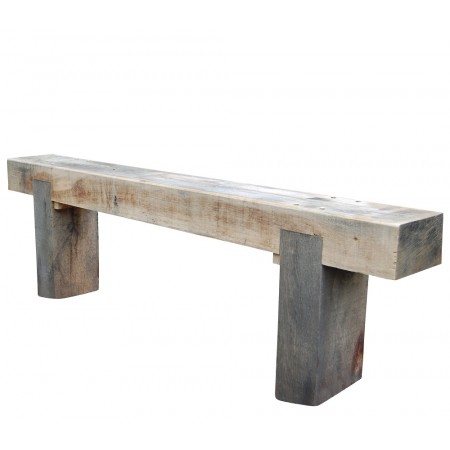
A regular complaint is that there are so few benches around the estate to rest or enjoy the parkland. We’d like to remedy that and hope that you will be able to help us. With the agreement of the Council we’ve identified a series of locations around the estate where they could be installed, and we are asking for sponsorship for simple oak benches.

Our intention is that people can select a location and sponsor a bench as a, gift, memorial, or simply as a generous gesture. KWAG volunteers will procure heavy duty oak benches and install them on your behalf. If you would like a small brass plaque on your bench these can be supplied at extra cost.

This map will show you the agreed bench locations. https://drive.google.com/open?id=1uBosa4CK0btlH_JFb_bB3jvTVZ0&usp=sharing We regret that locations can only be offered on a first-come first-served basis.

The solid oak benches are available to sponsor for £190 or £230 with a personalised memorial plaque. Payment can be made via Paypal and the location, and any further details included in the “Add special instructions” box, or get in touch with us by email at kwactiongroup@gmail.com or call 07811 666671 to reserve a location and find out alternative methods of payment.
KWAG has already committed to providing two benches and we hope to install these soon. You will also notice that one location has already been reserved. This spot, overlooking the Home Park and the house, will be the location of an artwork as part of the Forgotten Landscape project, and will be designed by Debborah Aguirre Jones. The bench will be a unique design incorporating elements of just three locations across the whole Lower Severn Vale project area. Each bench will then have a texture or pattern burnt into the wood

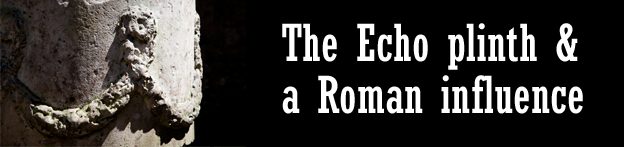
The Echo Plinth and a Roman Influence

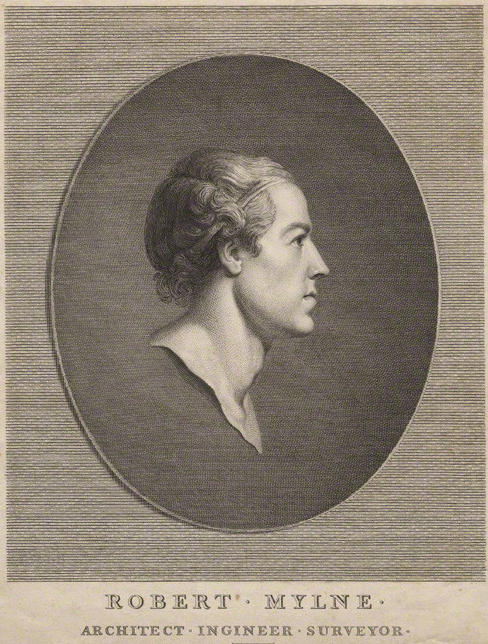
Robert Mylne is a significant, but less well known, figure of Eighteenth Century architecture. Long overshadowed by his contemporary and fellow Scotsman, Robert Adam, he was no less skilled as a designer. He studied extensively in Rome under the architect Giovanni Battista Piranesi, and when he returned to England in 1759 he quickly entered, and won, a competition for a new bridge at Blackfriars, London, one of the most prestigious and high profile projects of the age.

Robert Mylne by Vincenzio Vangelisti, after Richard Brompton, line engraving, 1783 (1783)

A recent research visit to the collections of the Royal Institute of British Architects at the V&A has brought new depth to our understanding of what the two men achieved at Kings Weston. Although Mylne’s diaries have been published before there have been many significant omissions.

We now know that Mylne first arrived at Kings Weston, at Southwell’s invite, On April 30th 1763. He stayed for eleven days, during which time he no doubt he discussed his client’s ambitions at length, and made initial surveys and proposals for the house and grounds. He returned to London with Southwell and began work.

First amongst Mylne’s works were the walled garden and stables. The following year he moved onto the house itself and the interiors; The Eating parlour, Drawing Room, the building of the bay window overlooking the Severn, and the Saloon (picture gallery) and other interiors were all tackled over the following five years.

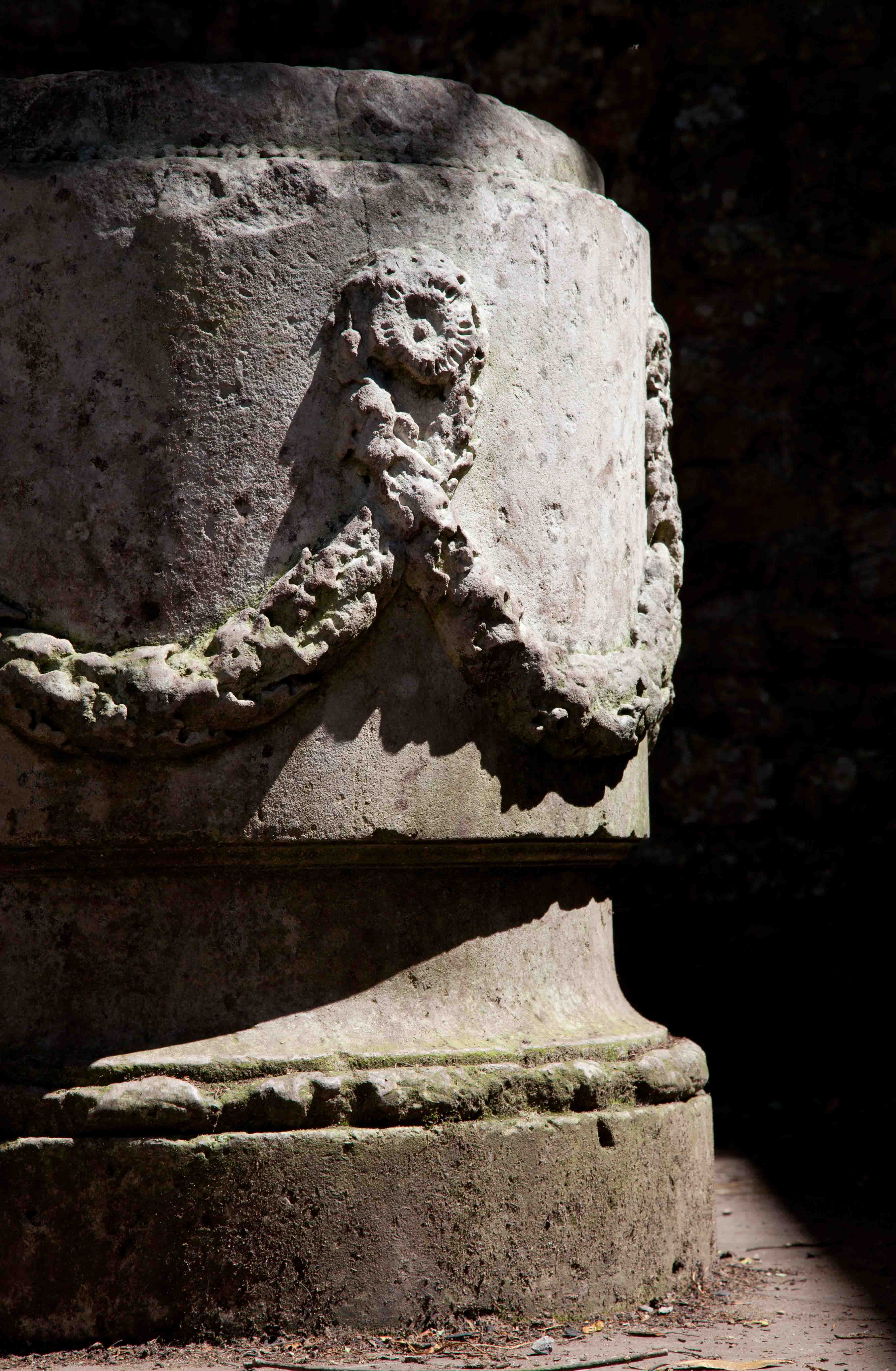
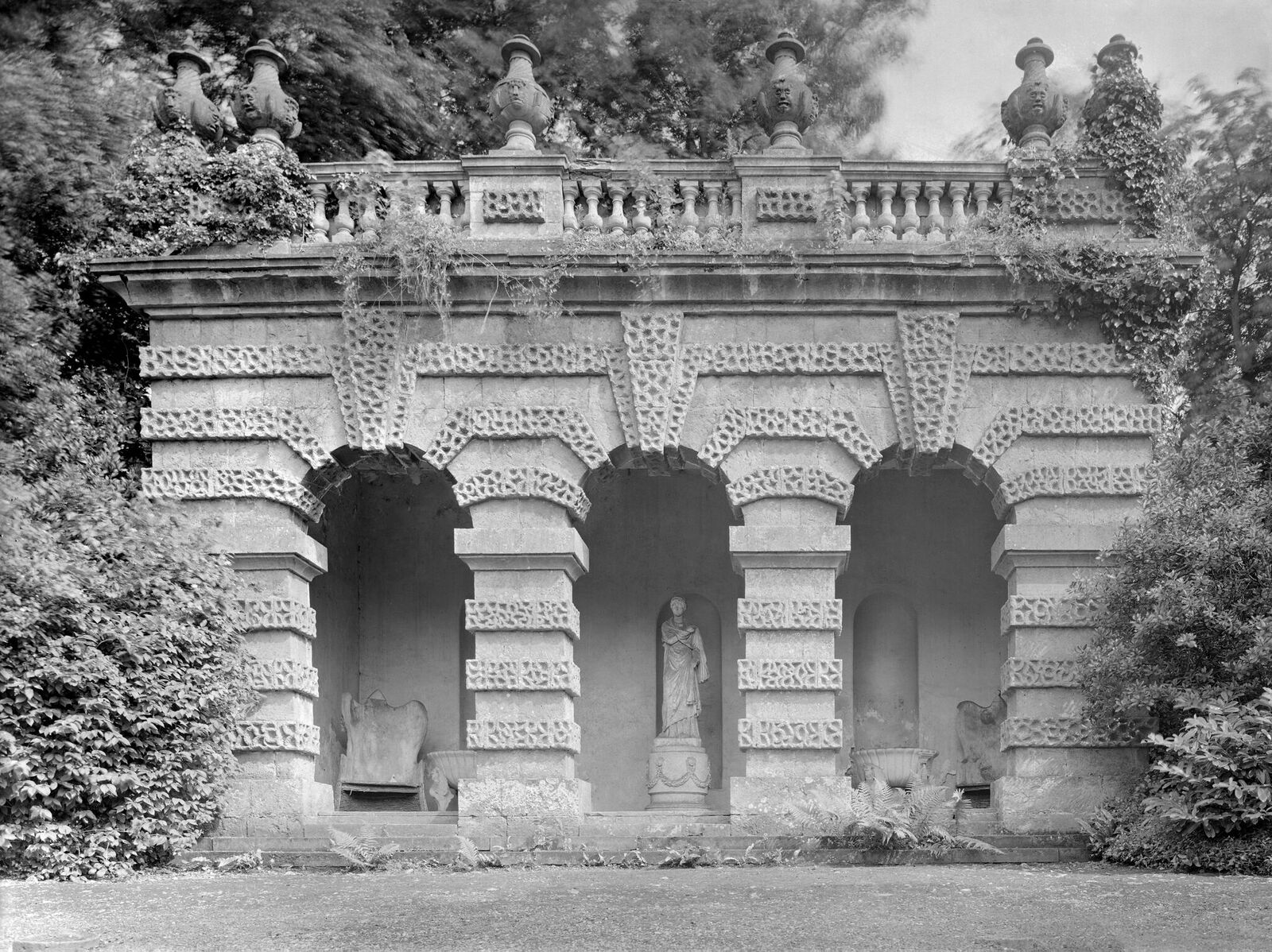
Amongst the inexplicably overlooked diary entries is one that now confirms the stone pedestal in the Echo as Mylne’s work. On March 20th 1766 he wrote “Made out a drawing for a pedestal to a statue for Mr Southwell and ditto at large. To be charged by the workman’s bill.” The following day, no doubt with the instruction of his client Mylne ordered the pedestal to be executed.

The statue is believed to have been collected by Southwell on his Continental tour, but Mylne’s pedestal is a work of art in its own right. Carved from a single piece of Portland Stone the design illustrates the architect’s knowledge of the latest understanding of classical architecture. The round cylinder-shaped pedestal takes the form of an ancient Greek altars. Carved in high relief on the simple drum are swags of leaves draped from simple rosettes; oak leaves are associated with the highest gods in the Greek pantheon, but also have a more general sacred symbolism.

Our recent trip has also identified regular payments made by Southwell for Mylne’s work. During the most active periods Southwell was paying £100 per annum to his architect. Between 1764 and 1770 payments in excess of £450 were transferred to Mylne, a figure excluding the cost of many other individual drawings considered extra to their original agreement. These substantial sums perhaps reflect the skill of the architect, and responsibility of his position; the annual wage of Southwell’s senior footman was just £16 16s a year.

The Echo in 1927 (Country Life)

The Echo in 1927 (Country Life)