
Tag Archives: Kings Weston

The last Squire’s silverware

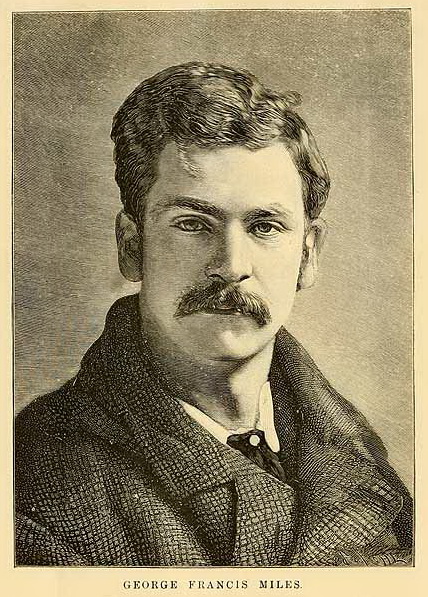
Recently we were approached by someone in Spain, who had recently acquired a fragment of Kings Weston’s history. Fermin Fernandez Izquierdo had chanced upon a solid silver cigarette case engraved on one side with the first few bars of “West Country Overture” and on the reverse with the initials P.N.M and a date. Those familiar with the history of Kings Weston will recognise the initials as those of Philip Napier Miles, the last squire of Kings Weston house, who died without an heir in 1935. Miles was a well-known and accomplished amateur composer, and a little delving in the University of Bristol archives establishes the piece of music as one of his works, most likely the Lyric overture in G minor: ‘From the West Country’, finished 16th March 1898. Ironically the piece wasn’t completed in the West Country, but from Miles’ Italian villa in Alassio!

Napier Miles West Country Overture engraved on one side of the cigarette case.
Philip Napier Miles’ initials and the date of his marriage

The date inscribed on the case, 1.2.99, records the marriage of Philip Napier Miles to Sybil Marguerite Gonne, fifth daughter of Baron de Hochepied Larpent, which took place in London. The solid silver case was most likely a wedding gift, perhaps a personal one to the groom from his new wife; perhaps the wedding was the West Country overture, an introduction to a new relationship that would take the couple back to Kings Weston.     

Thank you to Fermin for sharing his find with us.

Sybil Miles painted by her brother-in-law, artist George Percy Jacomb-Hood, and a photo of Philip Napier Miles at around the time of their wedding

Penpole Point: A place for the people

Strictly speaking Penpole Point shouldn’t form part of the historic Kings Weston landscaped parkland; it has always been common land, separated from the private grounds by a stout estate wall, guarded by lodges. The land was of no agricultural use, exposed, and only offered sparse common grazing land, so perhaps little wonder that it was largely valueless and left for people and livestock to roam freely. Add to this the spectacular views once enjoyed looking across the Avon and Severn estuary and the rocky outcrop proved to be a popular destination for visitors and locals alike.
 

Buttercup-dotted meadow surrounds Penpole Compass Dial, the same spot we’ve just cleared. This postcard dates to the late 1930s. 


The focus of the Point itself was, and still is, the stone dial with its circular bench. Often misunderstood as an ornamental sundial it is in fact a 17th Century marker, set up by the Merchant Venturers, and used as a landmark by seafarers to calculate the safe passage into the mouth of the Avon. The bench was originally a wooden platform to access the upper surface of the dial and the carved compass on its top surface, likely used to take crude bearings for the location of ships moored in the channel. Whatever it’s intended use it provided a convenient bench for visitors to sit and take in the vast panorama below.

With greater appreciation of the picturesque and sublime that developed in the Georgian era the Point, with its rocky edges, and exposed situation appealed to the senses; at once beautiful, but simultaneously perilous and vulnerable to nature’s elemental forces. Notable artists came here to try and capture that experience, and whose paintings now appear in the collections of museums and galleries internationally.     

View of the River Severn near Kings Weston, Benjamin Barker, 1809. The rocks on Penpole Point in the foreground mirror the ominous clouds beyond. Penpole Lodge and in the far distance the Dial appear as fragile human interventions in a landscape of wild, sublime, grandeur.   Yale Center for British Art, Paul Mellon Collection 

Our perception of the Point is today largely marred by the trees that have grown up, particularly on the west side, that rob the visitor of views of the ground on that side, and of an appreciation of the height and nature of the sudden drop. Hidden too are the exposed rocky outcrops and projecting slabs that once added to the rugged character; you can still find these in exposed spots beneath the Point, where the suffocating ivy relents and the thrusting geological beds create sheltered alcoves.
 
The wood that’s grown along this western edge has grown up since regular grazing ended on the common land; we don’t know when, but probably around the 1930s, perhaps after WWII. Views from the point are still remembered from as recently as the 1980s, but since then the onslaught of self-seeded ash and sycamore has cloaked the slope. For the intrepid explored  it’s still worth trekking through the woodland, passing through the hummocks of former quarries and below “The Rocks”.

An early 20th Century postcard view of The Rocks, looking back along Penpole Point, the dial and Penpole Lodge appearing on the left. Already trees and shrubs have begun to colonise the open grassland. 


The area was as popular recreation space as the Point itself, offering the visitor a rugged playground of exposed rocks and little dells. It was popular for picnickers seeking for a more convivial, sheltered spot than the open ground above the Point. It was also the location chosen for a series of famous local events; the open air church services. These were begun in 1910 by the local Vicar, Rev Powell, a provocative figure who was seldom far from controversy. The Rocks most likely provided a physical reminder of the hill of Calvary, fundamental to the Easter story. A makeshift pulpit was set up against Penpole Lane and the assembled crowd could gather in a natural amphitheatre of the rocks opposite to listen to the sermon and sing.

In the Rev Powell’s own words, written in 1914:        
“In the year 1910, 1911, 1911, and 1912 we held open air services in those beautiful surroundings. On Easter Monday of both this year and of last year, although no longer vicar of the parish, I repeated these services. The singing by a special choir, ably led by Mr Milton of Clifton, has always been a helpful feature. The natural formation of this valley-like spot lent itself to the sound of many voices” 

The Easter Service at Penpole Point in 1913, conducted by Rev Powell. He can be seen in the pulpit on the left on Penpole Lane, with crowds seated on the steep edges of the ridge. Penpole Lodge rises up above the tree line on the right. 
The same location as the 1913 Easter Service. Some features remain just recognisable, but today the area has been reclaimed by  woodland. 
Bristol Rock Cress growing still in the Avon Gorge. From Wildwings and Wanderings blo

Sadly the regular events ended in bitterness after a new vicar came to Shirehampton in 1912, and the Rev Powell’s continuation of “rival” services at Penpole caused friction. Powell to put his own side of the story in his book “Recent persecution in the church of England”.

It was this more rugged side of Penpole Point that offered rare habitat to Bristol Rockcress, a variety of wildflower found only in the Avon Gorge and, once here too. The crevices between rocks offered protection for the tiny plants. Like the drama of the place these too have succumbed to the growth of the trees and onslaught of ivy, overshadowing this once-unique habitat.

A group of labourers stop for lunch sat on the Penpole ridge in the 1900s, each with their own flagon. 

Southwell’s Architectural Odyssey

Edward Southwell, circa 1705. Downpatrick Museum

Anyone committing to build themselves a house no doubt puts a good deal of thought and research into the design beforehand, and it was no different for Edward Southwell when he was planning his new home at Kings Weston. Although he had appointed the Queen’s architect, Comptroller of the Royal Works, Sir John Vanbrugh to design the building Southwell would have been keen to make sure the designs, and the cost of the project, suited his needs. In appointing Vanbrugh he had already committed himself to the most modern and innovative architecture of the day. It is difficult now to picture quite how revolutionary the architecture was. For comparison, most of the grand houses around Bristol were still largely Tudor structures. At the time, nationally there were relatively few houses that adopted the newly fashionable Classical style we might now associate with grand stately homes. The revolution in style had only really taken hold in the decades after the Restoration of Charles II to the throne in 1660, and took time to establish after the privations of the Civil War and Commonwealth era. If Southwell was to get inspiration for his new house he had a shallow pool from which to drink.

Sir John Vanbrugh. Painting in the National Portrait Gallery.

Seemingly with little plan for what to replace it with Southwell began demolition of his old family home in Spring 1711. By December the same year his sister, Helena le Grand, lamented to family friend John Perceval 

“we expect my brother in town the end of the week after filling his belly with the ruins of Kingsweston for I can call it no otherwise.” 

Still, in March the following year, Southwell himself confessed to Perceval “Kings Weston house is almost down though I don’t know what to build in the room” – an extraordinary lack of foresight! In the same letter he notes that he is making his gardens there “very fine” though the pressing priority of the house designs continued to elude him.
 
On April 25th Southwell set off from his London house, Spring Gardens, for ten days at Kings Weston, with an intention to set out the new foundations for the house. Rather than hurry to the building site an itinerary had been devised that would take in many of the most modern house architecture between the Capital and Bristol. Southwell’s own travel journals record the visits made on the four day trip and each short entry is accompanied by very basic notes on the incidence of garden features, architecture and stables. This was a study trip to get inspiration, and perhaps some housebuilding advice. 

Beginning on the 25th April
Duke Schomberg’s – Uxbridge (Hillingdon House)
Sr Roger Hill’s – Denham Place, Buckinghamshire
Sr Richard Temple – Stowe, Buckinghamshire
Mr Boyle’s – Middleton Stoney, Oxfordshire
D. of Shrewsbury – Heythrop Park, Oxfordshire
Cornbury Park, Oxfordshire  
Dodington, (Gloucestershire)

This map shows all the stops on the route.

Today many of these buildings are fairly obscure, if not forgotten. Some have been entirely rebuilt or altered, but at the time they represented a good selection of the modern architectural or landscaping works, utilising the most current styles, construction techniques, and building technology.

Painting of Denham Place, its gardens, and estate buildings, circa 1700. Yale Centre for British Art. cropped to image
The grand staircase at Denham Place, circa 1701

Hillingdon House is not supposed to have been commenced until 1717, so what Southwell saw there is unknown. Denham Place had been completed in 1701 and was surrounded by fine formal garden compartments, including a long ornamental canal, that set the house in the centre of a lavish pleasure ground. The ornamental garden buildings, gates,  and statues added opulence to the house itself, which was built of brick. Well-mannered with good proportions it was in a fairly staid style, perhaps even out of date for its time. Inside, a grand central staircase was one of the finest features along with other finely fitted out rooms; perhaps these were inspiration for what Kings Weston could offer.

Stowe house and gardens are now internationally known, and Vanbrugh later worked to embellish its gardens with ornamental buildings, but Southwell will have seen an earlier, less extravagant, house. Built in 1676 it was similar to Denham in its general plan and style with ‘H’ plan and hipped roofs. Both these houses had balustrade rooftop terraces and architecturally prominent chimneys. Architecturally they were fairly derivative, following almost standardised patterns after Burlington house, London, a building, amongst other fashionable examples, that set the mould for house design at the start to the Restoration era. 

Stowe House in about 1715, before it was redeveloped  on a colossal scale. 

Middleton Stoney was built around 1710. Unfortunately it was completely rebuilt in the 1750s and no earlier depiction has been located to know what he saw there. 
 
Heythrop Park was the most architecturally ambitious building visited. Begun in 1706 it was nearing completion when Southwell visited. Not only would it have given him an insight into the modern Baroque style, but he could have sought direct advice from builders and other people involved with the construction. Applied columns in the Corinthian style and ‘Giant Order’, robust window keystones, and an emphasis on the main entrance with its portico have some parallels with what happened at Kings Weston. The unique interiors of this house were lost in a fire in the 1830s.

South east front of Heythrop Park, Oxfordshire, by Thomas Archer, 1706- circa 1718.

Cornbury, though much earlier, shared similar features to Heythrop, but is more restrained in its exuberance. Here, on the south east wing, the Portico is engaged with the façade, with bold projections at the cornice. Imagining the frontage without the two end bays, and a silhouette enriched by a rooftop arcade, this building has stronger parallels with Kings Weston than Heythrop. The south-east wing was designed in 1666 by Hugh May, and architect who Vanbrugh admired for the work he’d done at Windsor Castle. The interiors here have been heavily altered, but there was once a double height hall here whose over-scaled fireplace with a Vanbrughn boldness survives. 

South east wing of Heythrop house, Oxfordshire, by Hugh May, 1666. 

Most curiously the diversion to Heythrop diverted right around Blenheim Palace, Vanbrugh’s most famous work, that was then in the process of construction. Considering Southwell had hired him as architect an inspection of the works might be expected it to have been an essential highlight. It’s assumed therefore that Southwell had visited at least once before and was already familiar with the project. How Heythrop, or for that matter any of the buildings on the itinerary, were selected can only be speculated upon.  

Like Middleton Stoney, Dodington Park was entirely rebuilt in the late 18th century, and little can be ascertained on why it was included on the itinerary. Dyrham Park nearby,  finished in around 1711, would already have been very familiar to Southwell, who was close to the Blathwayt family and would marry into it in 1716.  
 
Further research is required to know whether Vanbrugh accompanied his patron on this journey. Was he there directing Southwell to features he thought fitting for Kings Weston, or did he have some influence on the selection of properties to visit? Was Vanbrugh present when Kings Weston was set out and begun?   
 
You might expect that by the time Southwell reached Kings Weston, on the 29th April, and after so much inspiration, he might have at last decided on a new design. Indeed he writes that already “upwards of 60 men preparing stones and digging the foundation of the new house”; but still, in the closing days of May he wrote “I am full of a great anxiety and trouble as to mine (house improvements) which arises from the uncertainty of setting out right, and to this hour my model, I cannot say, is fixed; though it may be and will be by the next week.” Clearly April’s ambition to set out the new building had failed, the study trip perhaps even adding confusion to the process.    

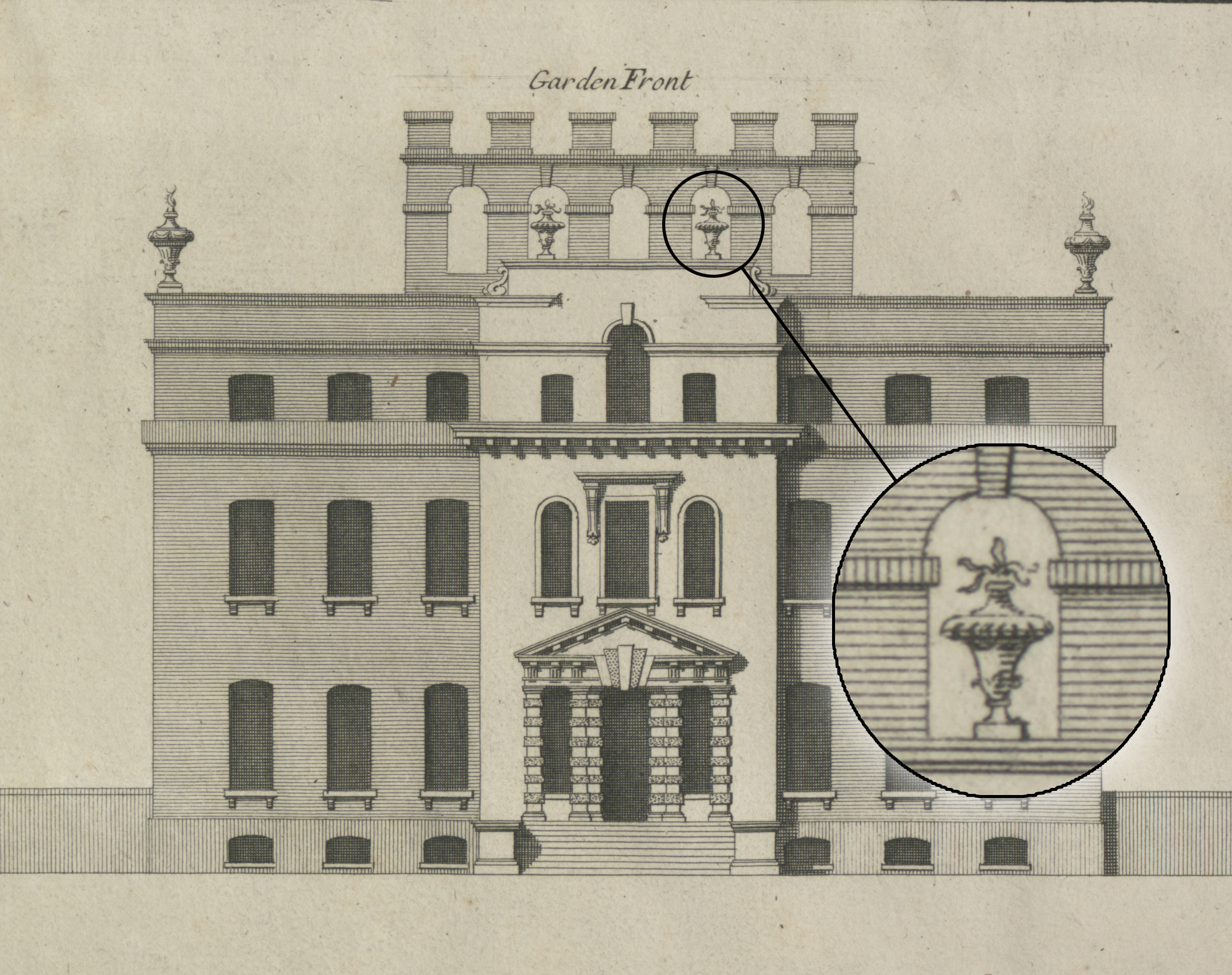
 Architectural drawing of the main front of Kings Weston House, from the office of Sir John Vanbrugh. (Victoria & Albert Museum) 

 This indecision appears to be Southwell’s own, and Vanbrugh is not mentioned at all. The architect must have been working closely with his client on proposals, so whether his designs were rejected and revised, or whether the fault was his, and he’d been slow in furnishing his client with drawings is not known. There are no significant variations in the general design of the new mansion in existing drawings. Eventually plans for the house were agreed, and on 16th of June work on Vanbrugh’s designs for Kings Weston house was begun. In the context of most of the grand houses of its day, particularly in the Bristol Region, it was still a pretty revolutionary piece of architecture. Where Vanbrugh deviates from the rigours of classical architecture with the main front, and experiments with robust modelling of the other three fronts, Kings Weston is particularly unique.  

The stones of Kings Weston house

One of the most distinctive aspects of Kings Weston house is the unique honey coloured stone from which it’s built. Looking closely at the blockwork you’ll notice a world of variation in its colour and composition, but also the way the original masons finished each stone. This short report hopes to focus attention on this overlooked architectural aspect.

The whole of the Kings Weston ridge is peppered with former quarries. Some are obvious, like the one fenced off below the TV transmitter, or to the north of Penpole Point; these are from the 19th and 20th Centuries and their scale is a giveaway. Others are more ancient, possibly as early as the Roman era when the nearby villa and town were built. Having been planted out with trees and landscaped in the Georgian ere these are less visible. The extent of the quarrying is most obvious using Lidar data, that shows the land without the distractions of trees and buildings.

Map with Lidar date, showing excavations of old quarries and their era.

Dig anywhere along the south side of the park and you’ll soon hit greyish limestone, like that in the Avon Gorge. Once quarried it’s best used in rubble walls. But the stone Kings Weston’s built of is the more distinctive Penpole Stone. As its name suggests, Penpole Stone is found exclusively along the north side of Penpole Wood. It’s a hard and resistant ochre coloured stone with pink and red marbling, a mixture of compressed grit, clay, and glittering quartz occlusions, called Dolomitic Conglomerate. At over 200 million years old it’s certainly the most ancient thing you’ll find on the estate!

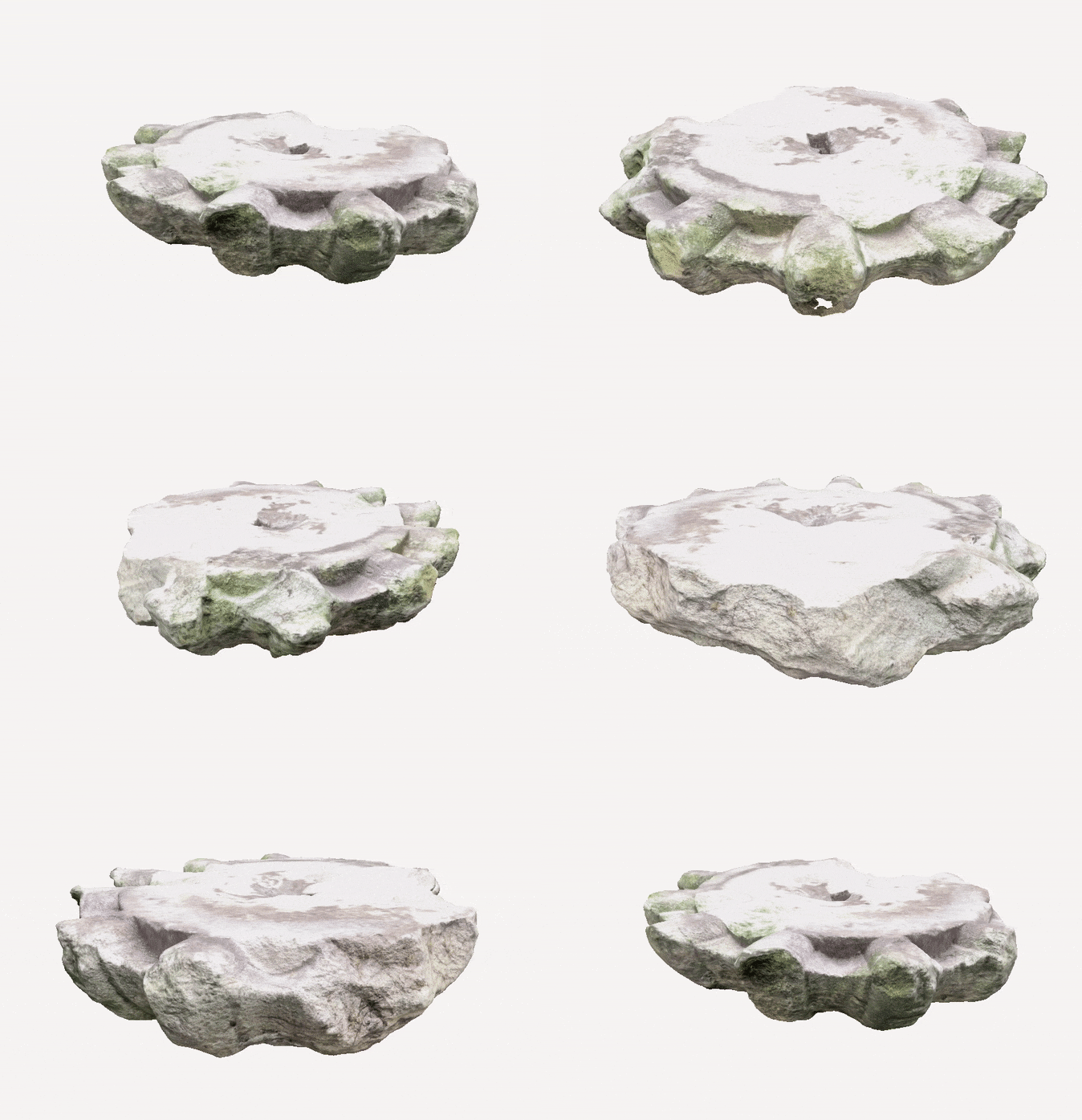
Detailed high resolution scan of Penpole Stone, sowing the huge variety of colour and material.

When the builders of the house were looking for materials they needn’t have looked far for a strong and durable material. The proximity of the Penpole source to the house must also have been a bonus. Other mansions in the 18th Century had to pay large sums to source and transport suitable stone, particularly if they sought the harmonious smooth ashlar finish then desirable for classical buildings. Others, for example Stoke Park, accepted cheaper rubble stone, but rendered and painted it to cover up its aesthetic shortfalls. Kings Weston benefitted not just from good stone nearby, but also one that gave its house such an attractive colour.

The site of the quarry was defined by the most appropriate stone for the job. At Penpole that location remains as an obvious woodland landmark, a long deep cut into the side of the wood that follows the line of the ridge. It was later planted as a rustic garden to reincorporate it into the landscaped parkland.

The former quarry in Penpole Wood, looking westwards, towards Penpole Point. It was later landscaped as a rustic woodland garden in the 1760s.

Whether the stone was the suggestion of Kings Weston’s owner, Edward Southwell, or advised by the masons he employed it would have needed to be approved of by the architect, Sir John Vanbrugh, as fit for his work. In a 1716 letter to the Duchess of Marlborough Vanbrugh names a “Mr Townsend (who did Mr Southwells’ masonry)” as the man responsible. This was probably George Townsend, master mason of Bristol, and capable architect in his own right.

In April 1712 Southwell arrived at the building site being prepared for his new house and noted “Upwards of 60 men preparing stones and digging the foundation of the new house”. One can imagine the activity at the Penpole Quarry in this work, the cutting of the stone from the quarry face, its shaping, and transportation the short distance along the ridge to where it was needed. The quantity of stone required for the construction is indicated, in part, by the scale of the excavation, though it should be noted that much of the irregular nature of the material would have been inappropriate for fine cutting, used as infill, or discarded.

This 17th Century engraving of a quarry could almost have been intended to depict that at Penpole. Quarrymen split and roughly shape stone blocks for lifting onto the waiting wagon.

If you look at the outer walls of the house today you can see how large some of the blocks were. Some are colossal and must weigh more than a ton each. Particularly large are the single stacked blocks needed to give each of the front columns a regular appearance all the way up, and the vast shelving window cills Vanbrugh must have enjoyed drawing an exaggerated effect from. Each of these were cut and finished by hand; with such a hard stone it must have been particularly laborious.

Some of the stone blocks in the portico columns are massive.

If you look closer again you’ll spot something else; each stone is treated individually with regular ridged patterning, and a narrow grooved border in the same finish. Preparing a stone requires several stages. A roughhewn block needs to be dressed several times to get a perfectly smooth block, using different tools for each successive dressing. Here at Kings Weston the blocks have not been given the perfect smooth finish, and instead a clawed bolster, a type of wide headed chisel with teeth, used to give an intentionally grooved texture. Rather than being evidence of cutting corners the finish is deliberate and controlled, the surface of each individual block carefully articulated. This was perhaps to give a veneer of antiquity to the finished monument, or exaggerate the massiveness of the architecture so its character contributed to the “Castle air” that Vanbrugh desired of his buildings.

The subtle but clear chiseled patterns are visible on blocks around the front door of the house.

By September 1713 Southwell the house was so advanced that Southwell wrote that “by the end of next month I may have discharged my regiment of outside people”. However, masons work continued until 1716 Later the same stone went into building other buildings around the estate. In line with their status large blocks went into the ornamental garden buildings like the Echo and Penpole Lodge, whilst and the looser rubble went into other estate buildings like Kingsweston Inn and the cottages on Kings Weston Lane.

The facades of the house will reveal that Penpole stone, whilst predominating, was not the only material used architecturally. Being hard and unyielding it was not suitable for the finer ornamental work. The column capitals, pediment and cornices, urns and other intricate details were executed in softer, finer-grained, buff limestone, possibly from Dundry, south of Bristol. The difference in stone colour and texture is obvious once you notice it. Rather than being a poor match the subtle difference appears to have been used architecturally to emphasise the most civilising classical elements of the Enlightenment design, a deliberate contrast to the background rustic aesthetic.

 The difference between Penpole Stone and the paler limestone used for detailed work is clearly apparent on the main portico front 

The use of specific stone finishes for aesthetic effect is seen again in the “Back Front”, at the rear of the house. This is intentionally the  most ruggedly handled of the four great facades. Here, with its massive forms, turreted corner towers, arched windows, and oversized keystones, Vanbrugh’s castle keep medievalism is at its most developed. To add to the effect the use of stone changes. The massive single blocks of the other facades makes way for smaller blocks, with greater variety in size, and with irregular courses. Abandoned too is the regularity and order of the neatly tooled stonework; Instead the blocks are deliberately rough faced. The Penpole Wood quarry would produce plenty of other large blocks for later buildings on the estate, so the effect here is intentional, rather than the result of a dwindling supply of good stone.

The deliberately formidable Back Front of Kings Weston house exhibits the deliberate use of rough texturing and stone coursing.

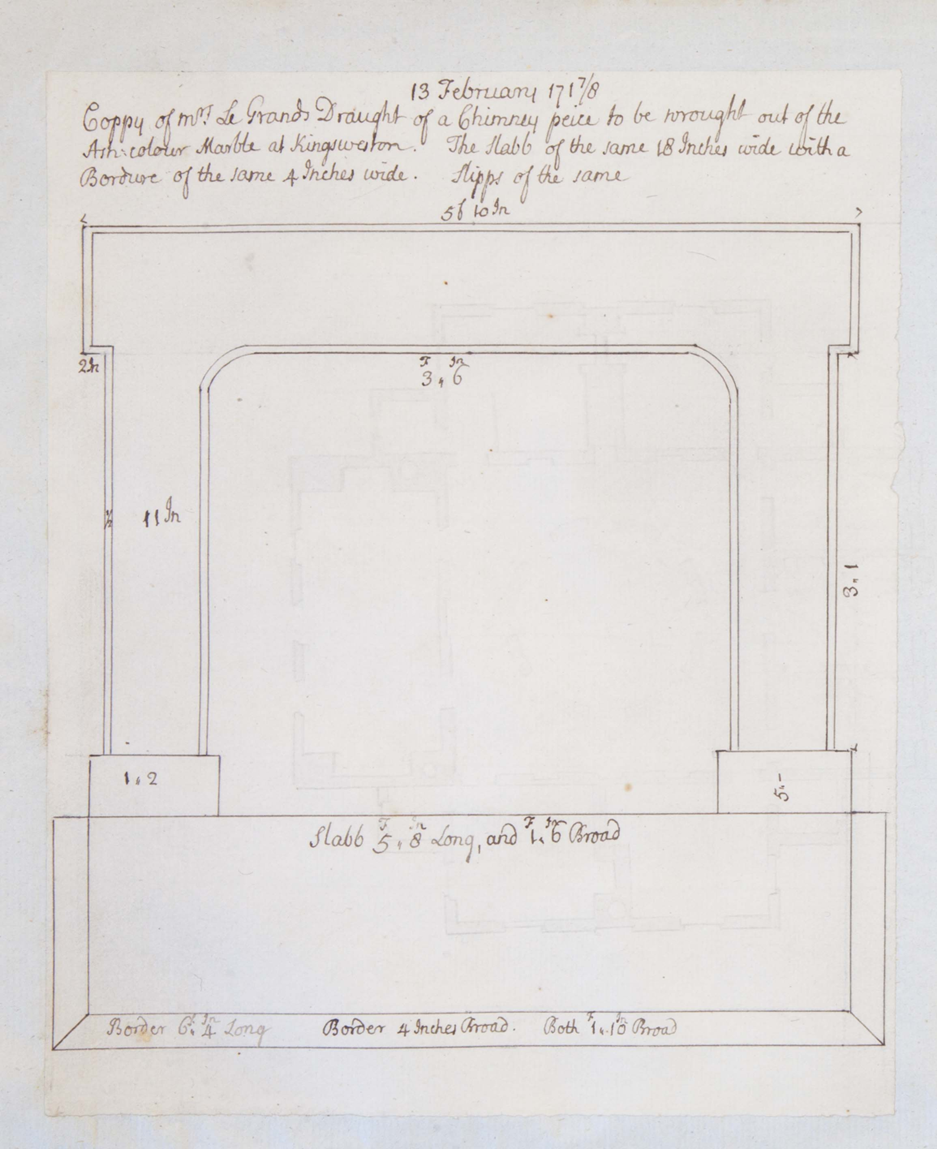
Other stone was also required to serve particular purposes. Marble was imported from Ireland for fireplaces designed to impress. Hardwearing pennant stone was brought in for steps and flagstones. This was sailed across the Severn from the Forest of Dean with surprising ease, prompting Vanbrugh to write, in a letter to the Duchess of Marlborough, who was then scrutinising her architect’s work at Blenheim Palace:

”I writ to him (Southwell) and his steward both to get an exact amount of the charge of his steps, both stone carriage and work; and the account they send me is this. The steps he has are not from Ross, where my Lord Dukes came from, but out of the Forrest from whence the carriage is so easy  to Mr Southwells’ that he says they must needs cost much more to Gloucester from Ross”

Kings Weston had, by this time, become a showcase of the sort of work Vanbrugh was keen for his clients to inspect. The economy with which it had been achieved and the architectural effect would both have been features he was eager to promote. From some of Vanbrugh’s letters the Duchess had clearly been impressed when she’d visited.

A mason employs a bolster to smooth the face of a stone block in the 1700s engraving.

“I am very glad that your Grace is pleased with Mr Southwell’s House; it being the sort of building I endeavour to bring people to who are disposed to ask my advice: Tis certain his work has been cheap and a great deal of it tolerably well”

Though, not all the mason’s work met Vanbrugh’s standards, and he pointed out to the Duchess: 

“The steps in Mr Southwell’s garden are of the same stone that is us’d at Blenheim, but it cannot be had anything so cheap” “they must be better wrought and set both than Mr Southwell’s are; some of his steps being abominable.”

Perhaps we should not be surprised that these steps were replaced when the house was remodelled a generation later!

The farms of Kings Weston

Professor Richard Coates of the University of the West of England has been a regular contributor to academic research on the Kings Weston Estate. Recently he has completed work on a paper detailing the fascinating history of the many farms that lay within the wider ownership of the families who held Kings Weston House. The majority have their foundations in the land improvements undertaken by Sir Robert Southwell and his heirs though some may have their origins in earlier times. Sir Robert was President of the Royal Society and in the 1690s he employed another of its fellows, and close friend, Robert Hooke to design a new sea wall to protect his farmlands from inundation from the Severn. After this work was completed the Southwell family could start developing the floodplain with confidence and throughout the Eighteenth Century new farms were developed for leasing onwards. 

Sea Mills Farm now on Bowerleaze, but dated 1710
Campbell Farm on Kings Weston Lane. 

Whilst the majority of the farmland owned by the Southwell’s stood to the north of Kings Weston house the estate boundary encompassed lands on the south side of the Kings Weston Ridge, stretching as far as Sneyd Park. The area now covered by Sea Mills also incorporated several farms and other buildings that contributed to the annual income of the estate. 

Professor Coates research identifies eighteen farms within these two areas, split by the Kingsweston ridge on which the mansion sits. Many of the buildings of these farms remain today, hidden amongst more recent housing estates. Lost fragments lie scattered in industrial estates, and other have vanished entirely, known today only through historic maps or road names.  Perhaps the most interesting collection of farms are those  that were given family names of the Southwell Family. The best preserved of these is Campbell Farm just to the north of Long Cross on Kings Weston Land. Here there is a good collection of former farm buildings that date from the Eighteenth Century and have since been converted to residential use. This farm would have formed part of the extended village of Kings Weston before it was swallowed up by the post-war Lawrence Weston housing estate.   

Katherine Watson, wife of Edward Southwell II, after whose family many of the farms were named. 

Other farms in this collection are Cromwell Farm, named after Lady Elizabeth Cromwell who married Sir Robert’s son, Edward, Rockingham Farm, named after the noble family title of Edward Southwell II’s wife Katherine, Watson Farm taking the same lady’s surname, and of course Katherine Farm itself at the far northern extremity of the Eighteenth Century estate. The last fragment of this farm is a stone barn still standing on the edge of the modern sewerage works, but the grandiose farmhouse has sadly long gone. 

If you would like to read the full paper Proffessor Coates has kindly allowed us to host it on KWAG’s website and can be viewed and downloaded here: http://www.kwag.org.uk/wp-content/uploads/2018/06/KWFindependent.pdf

Kings Weston
Katherine Farm in the 1950s from Know Your Place
The Georgian barn; the last fragment of Katherine Farm on Lawrence Weston Road.

The yew trees talk to us

the recently revealed line of yews looking up the slope towards the main path 

We’ve made a habit recently of clearing undergrowth and revealing some majestic trees in the woodland, but it’s easy to forget that this wilderness was once all part of a designed landscape; Our April  Working Party uncovered more trees that help tell that story. Just to the north side of the main path through the woods we discovered a line of three mature yew trees, clearly planted in an intentional line, and with the stumps of a fourth and fifth tree nearby and to the same spacing.

the boundary of the woods shown in 1772

Yew are something of a tell-tale species at Kings Weston; whilst their scattering may at first seem random through the woodland many relate to historic planning schemes and features. When compared with historic plans and illustrations the significance of the yews becomes more clear. The three yews we rediscovered last month run along a former boundary between the more open parkland to the east, and the long-established woodland to the west. Originally a wall formed this boundary, with a set of gates straddling the main path, but, by the 1770s this had be de-formalised and  instead an iron park fence replaced it. An estate plan from this date clearly shows the planting of trees on the outer edge of it and the yews are certainly the same ones described in plan.

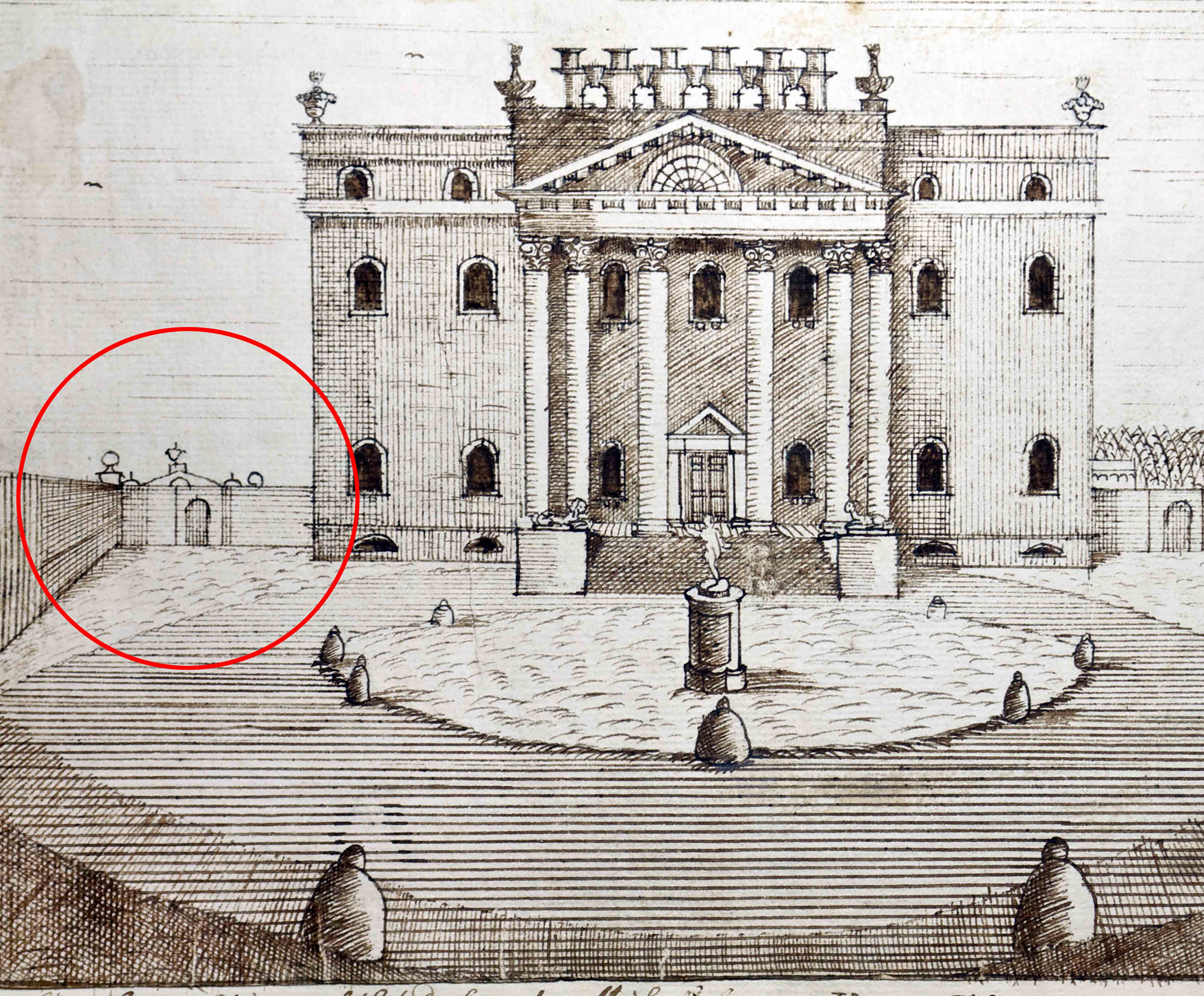
the walled boundary and gates into Penpole Wood in 1710

This is not the only instance of yews indicating lost historic features. Further along the path through the woods to Penpole Point you will encounter many more, frequently grouped around certain points. A careful comparison between these locations and an earlier estate plan of 1720 suggest that these are the remains of woodland saloons where viewing corridors were cut through the trees northwards towards the Severn and Wales beyond. Whether these yews were planted as a deliberate grove, or whether they are the vestiges of a more formal hedged circle can’t be established, but their planted locations are not coincidental.

Penpole Wood in 1720 showing the main path and circular saloons with viewing alleys cut through the trees. 

Our next Working Party will reveal another designed feature in which yews feature prominently: an avenue of mixed yews and oaks leading from the ruins of Penpole Lodge to the Jubilee Clearing. This strip of land is a curiosity. In 1772 the park boundary appears to run just above the main path through the woods, so this elongated sliver of land between that path, the current boundary wall, and running as far east as to incorporate the clearing, is outside the woodland. By 1840 the park boundary had been pushed out to its current extent and the line of yews planted. The planting defining the clearing (along with more cherry laurel) appears to have been laid out at the same time. This may all have been the work of the last of the Southwell family to live at Kings Weston , the 21st Baron de Clifford. He was known to be a keen planter and the dates, between 1777 and 1832, and the enclosure Acts would fit this incursion onto the common land.

So next time you are walking through Penpole Wood keep an eye open, and next time you spot a yew ask yourself what it might be telling you about the lost historic landscape and the people who created it.

Historic letter by Sir John Vanbrugh returns to Bristol

Archivist Mark Small of Bristol Archives holds the newly delivered letter

We’ve had confirmation this month that the missing Sir John Vanbrugh letter has arrived at Bristol Archives! We remain hugely grateful to everyone who donated to our short campaign to bring the document back from the USA, and to the Friends of Bristol Museums, Art Galleries, and Archives for their partnership in securing it. The letter has now been accessioned and is available for anyone to study, though is not yet included on the public catalogue.

Architect Sir John Vanbrugh’s signature from the letter. 

The Southwell’s and the Slave Economy: Report 

The 17th of last month saw Kings Weston house host a talk, and discussion, on the slavery connections of the estate. Dr Madge Dresser, of the University of the West of England and KWAG’s chairman David Martyn tried to put the complex relationships between the Southwell family of Kings Weston and their associations with the Atlantic Trade and slavery into context. Dr Dresser began the evening by explaining the many ways in which historic estates such as Kings Weston could be said to have slavery connections. She outlined the Atlantic trade of the Seventeenth and Eighteenth Centuries and how almost every aspect of it had some relationship with slavery and the direct “triangular trade” connecting Europe, Africa, and the colonies of east-coast America.

The Oak Room was packed for the talk. 
East Florida in the Eighteenth Century, where the Southwells had plantations. 

Mr Martyn sought to tease out the members of the Southwell family and their relationships with the Atlantic Trade. Whether family members were administering government departments, promoting political causes, or involved in plantations it became clear that there were many blurred edges in how their actions could be interpreted. The most direct unequivocal involvement was Edward Southwell III’s grant from the Crown of 20,000 acres of land in East Florida to settle, and the development of that land with plantations worked by black slaves.

The debate following the two presentations mainly revolved around the extent to which Kings Weston could be considered an estate that had benefited from money derived from slavery or the Atlantic Trade. Although the East Florida plantations had collapsed in massive debt, there were members of the Southwell Family who were complicit in enabling the trade to continue. It was difficult to identify any direct financial benefit from the trade that could be linked to the house and estate, but it was largely unanimous that the connections needed to be acknowledged and accepted. The evening was rounded off with continued discussions over drinks at the bar.

Sophia Southwell, wife of Edward Southwell III, 20th Lord de Clifford, and her children by Daniel Gardner. Painted circa.1775, a time at which the family were speculating in plantations in East Florida, but amounting considerable losses. 

Historic Vanbrugh Letter saved for the nation!

There has been some incredible generosity from KWAG members over the last couple of weeks in their support of our campaign to repatriate a letter written by Sir John Vanbrugh regarding the construction of Kings Weston House. We are delighted to announce that we’ve met our fundraising target of £500 to bring the letter back to Bristol in partnership with the Friends of Bristol Museum and Art Gallery. Our contribution will now be added to the £900 the Friends have granted towards the purchase, and the letter added to the collections of the Bristol Archives at B-Bond in Bristol. Once it arrives, and is appropriately conserved, the letter will be available to study by anyone, and we hope that an exhibition celebrating its acquisition might be a good way of thanking the donors.

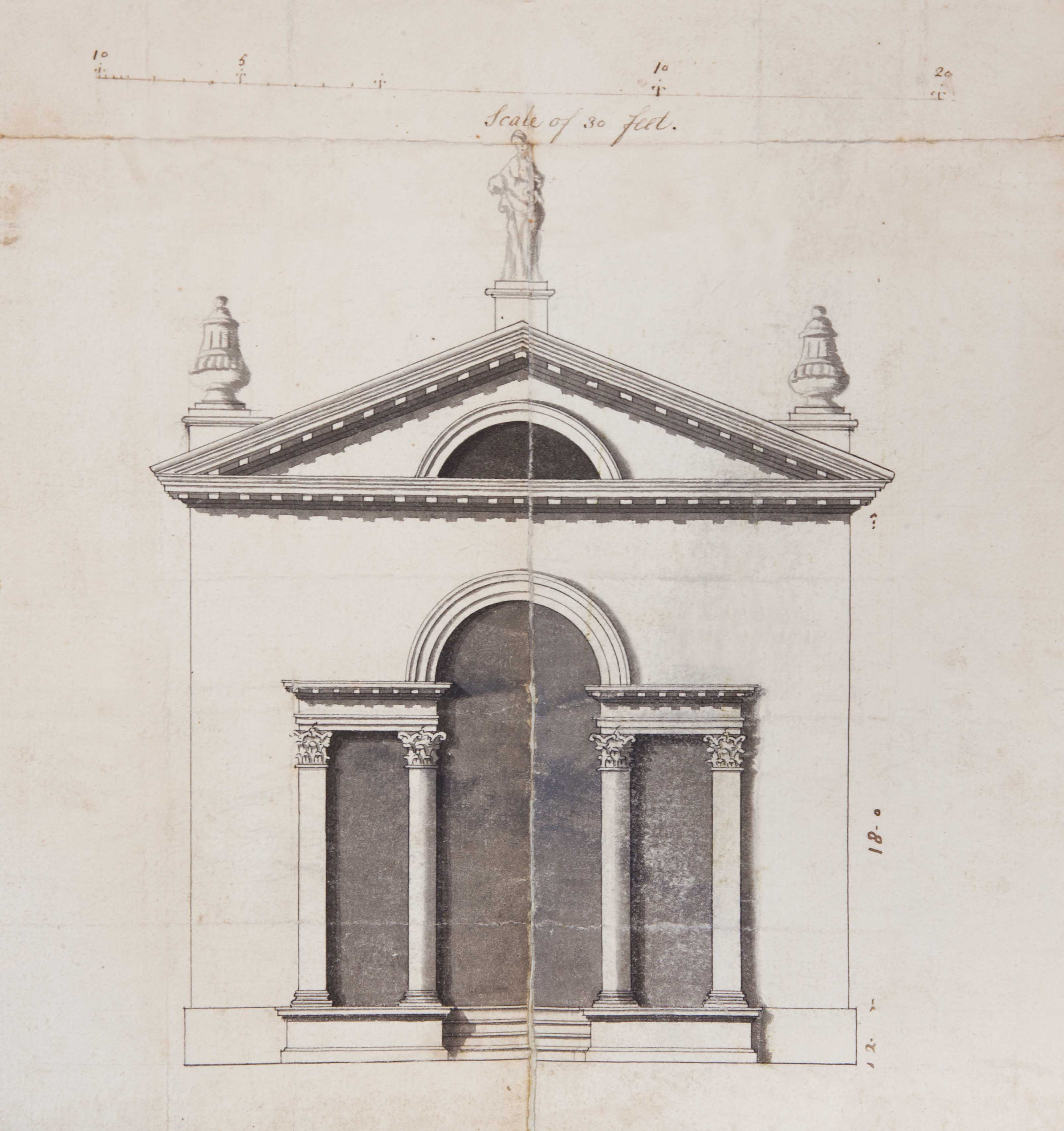
Reconstruction of the Saloon as originally designed. 

The letter now in the process of acquisition dates from December 1713, a time when Edward Southwell was able to walk around the rough floors of the house. From a letter the same September, also in the Archive, we know that it had taken just fifteen months to build the walls of the house up to roof level and have begun leading the roof. In the December letter Vanbrugh discusses Edward Southwell’s hopes to cut costs by leaving out the stone vaults of the basement level which, apparently, were only constructed after the shell of the house was already complete. We also discover that the original plan was to have a stone floor in the great stair hall. Whilst the change to a timber floor appears to have been undertaken against Vanbrugh’s advice Southwell’s idea to extend the stair itself into the cellar was, fortunately, abandoned in favour of the “Little Stair” that was still in construction.

Vanbrugh also discusses the plans to build his intended Kitchen wing at the rear of the building; this structure was built, but later demolished and replaced a few decades later. The letter confirms Vanbrugh’s authorship of the Great Terrace and, from what he writes, he is clearly pleased with Southwell’s decision to execute his designs for it.
Whether Vanbrugh ever returned to Kings Weston in the Spring of 1714 as he promised is not known, but certainly he was keen to make a “trial with boards” to make sure the distinctive chimneys made the effect he intended.

We’re grateful to Mark Small from Bristol Archives for transcribing the whole letter and presenting it along with images of the original. It can be viewed as a PDF here.

Vanbrugh’s original design for the kitchen wing, attached to the north corner of the main house 


The Home Guard at Penpole Lodge

Another foray into the Bristol Archives has uncovered a new photo. The image shows the Home Guard in an official photograph, lined up at Penpole Point close to the end of the Second World War in 1944. These men were part of “C” Company of the 14th Battalion of the Home Guard.

The Home Guard at Penpole Point in 1944. Part of the Ethel Thomas Collection at Bristol Archives. 
The ruinous condition of Penpole Lodge in about 1950

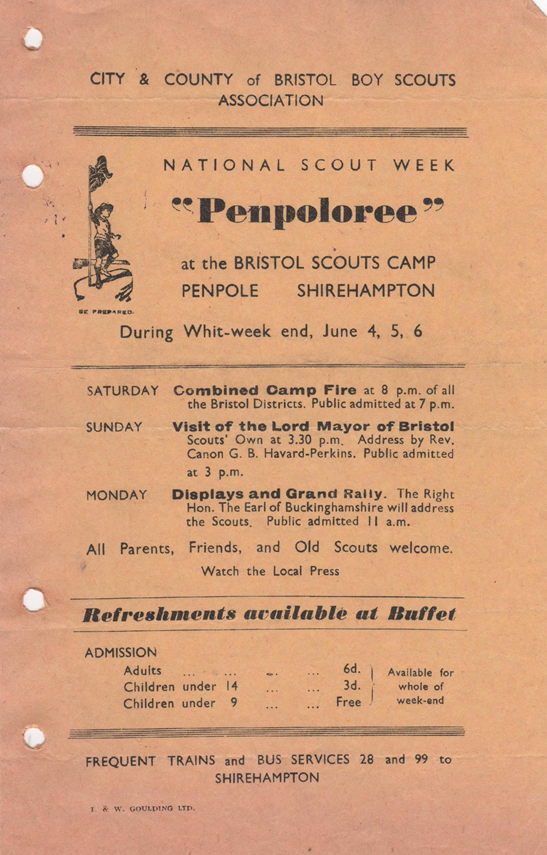
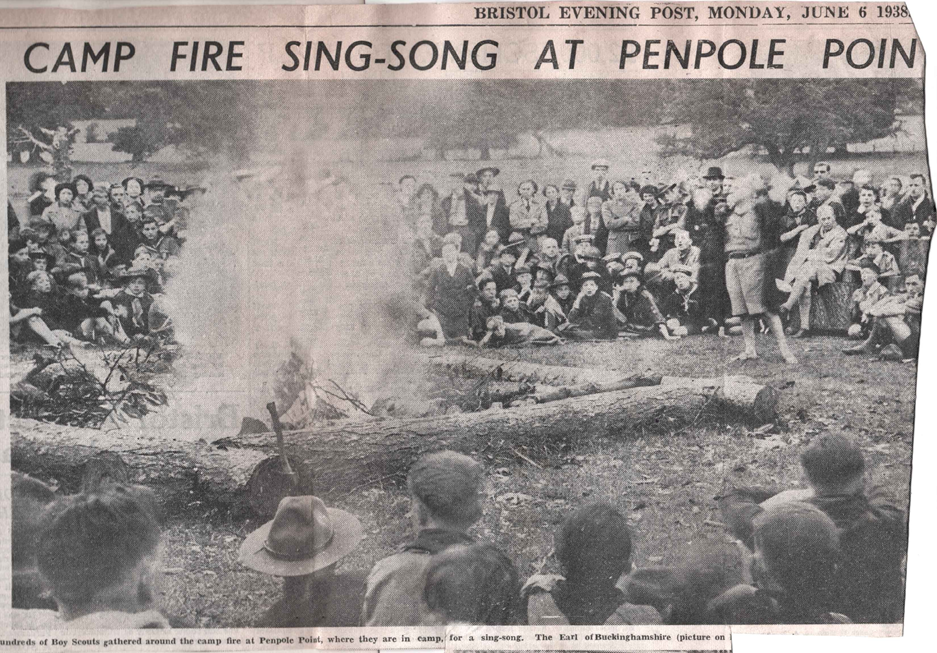
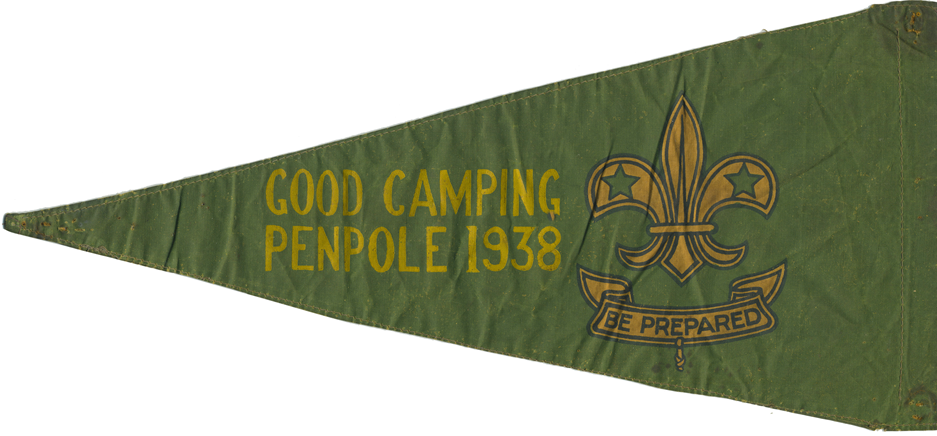
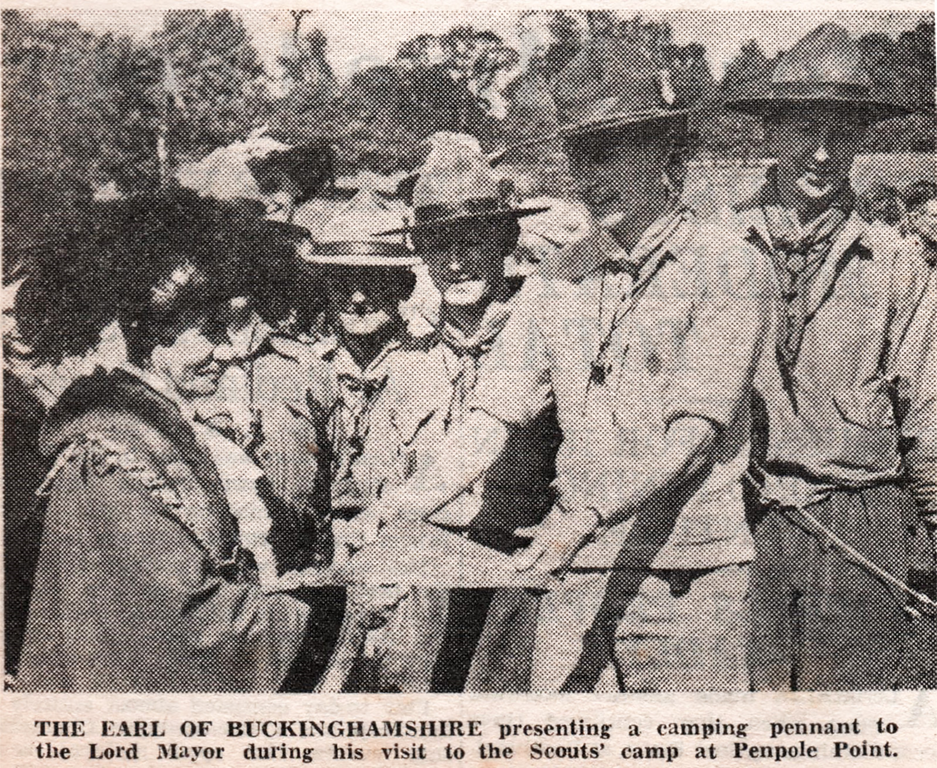
During the war the Home guard used Penpole Woods and the Home Park at Kings Weston, at that time the District Scout Camp, for training purposes. In 1940 they even requisitioned the tower of Penpole Lodge. The Scouts, who still owned the building observed “some concern the activities of the home guard when they took over the tower” and their site warden recalls in his diary of the time that “In the autumn of this year  the Home Guard, or the LDV’s as they were then called, took over the tower as an observation post. They stayed until the Spring. Poor old tower – it bears its scars from friend and foe now. Still we won’t say too much about that; but it’s another job to be attended to after the war.” The journal now also forms part of the Bristol Archives collection.  
It is not clear exactly what damage the Home Guard might have inflicted on the tower, but this, and further vandalism by “Local toughs” in the years following the war, led to the building being ruinous by the 1950s.  

The Home Guard trained in the woodland and camouflage skills were practiced amongst the trees and undergrowth. The warden’s journal for the war years includes some humorous sketches of their activities!  

Humorous sketches abound in MR W Webber’s journal of the Scout’s district campsite (Bristol Archives ref: 45305/1)