Tag Archives: Kings Weston

Dark revelations about Kings Weston and Slavery

Documents reveal new information on New World plantations

Kings Weston has always had some low-key historic connections with the slave trade. Edwards Southwell II was MP for Bristol between 1739 and 1754, during which time he  promoted the interests of Bristol’s Africa, Carolina and West India merchants. After the Southwells’ the Miles family had founded their immense fortune in shipping and plantations in the West Indies, but the infamous slave trade had been banned decades before their purchase of Kings Weston in 1835.

However, new information has come to light about actual plantations and slave ownership by Edward Southwell III in the colony of East Florida. Recently catalogued documents in Bristol Record Office tell the story of how Edward Southwell III entered into partnership with his father-in-law Samuel Campbell, and the latter’s brother in law Closworthy Upton, later Baron Templetown, to petition the King to be granted land in East Florida. The territory had entered into British hands in 1763 following the Seven Years’ War and land was progressively allocated by the crown for colonisation.
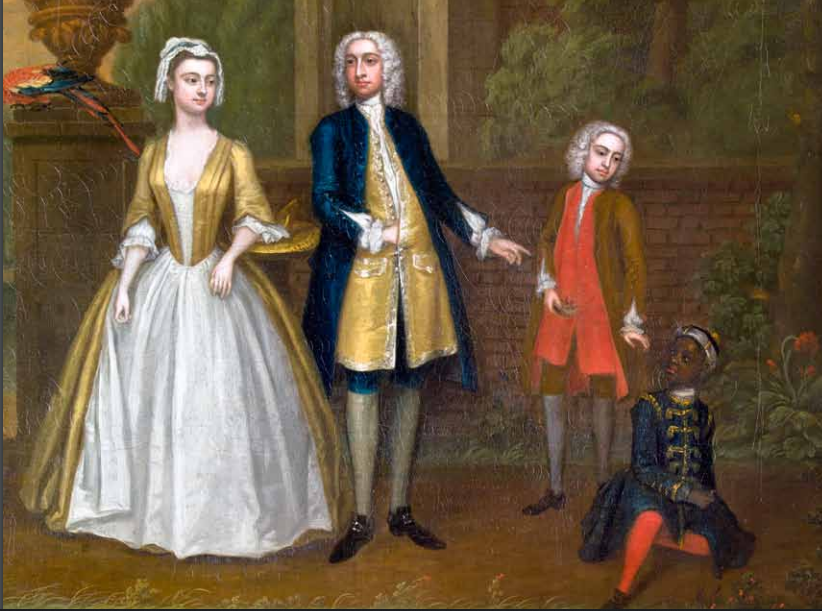
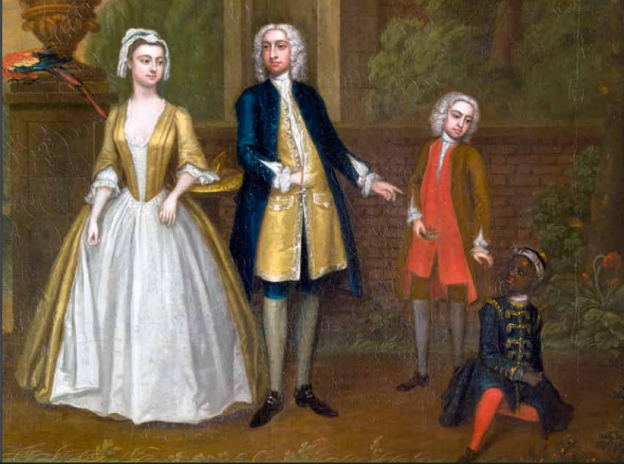
Edward Southwell (II) and his wife Catherine, with their son Edward (III) and a black servant

In 1766 the Crown granted the same amount of land to each of the three petitioners stating “In order to make a settlement thereupon” the King does “cause 20,000 acres of land to be surveyed in one continuous tract in such part of the province as the said Edward Southwell or his attorney shall choose not surveyed or granted to others” and “that the grantee do settle the land with protestant white inhabitants within three years”. The grant further demands that if any of the lands are suitable for hemp or flax production then this use should be given precedence.

With 60,000 acres between them the partnership sought suitable and experienced hands to develop them on their behalf. The services of William MakDougale [sic] were secured and he was dispatched with other eager planters and agents to set-out the claim. Land was secured on the east bank of Lake George, but MakDougale was concerned that the £2000 contributed by each partner would not be sufficient for the venture. In this respect he was entirely correct. The Southwell account books for the following years show a constant flow of large sums of money out to Florida for little return.

Southwell’s land on the east bank of Lake George – still unspoilt today.

There was an enormous amount of fraud and corruption perpetrated by unscrupulous agents and planters in the colony, at the expense of their absentee landlords in England and Scotland. This, combined with the swampy land, poor resources, and occassional attacks by the Spanish, meant that Edward Southwell’s venture was probably doomed from the beginning. To make matters worse their planter, MakDougale, died in 1774 and the 60,00 acres were charged to another planter, James Penman to administer. Little appears to have been produced by the plantations, small quantities of timber and barrels of tar being the only exports, and after the death of Edward Southwell III in 1777 his executors were forced to come to terms with the scale of the losses he’d incurred.

In 1779 the plantation collapsed completely. Writing to Southwell’s executors Penman describes how he abandoned his own plantations, initially to find safer territory to settle following the outbreak of “the Spanish War, and then retreating to the main town St Augustine. He promised to take good care of the partnership’s 20 ‘Negro’ slaves who he took in with his own, but later sold at very poor prices, keeping the money for the expenses he’d incurred.

The venture had led to Edward Southwell becoming heavily indebted, and it is no surprise that the several English and Irish estates he owned, including Kings Weston, all had to be mortgaged for over £30,000 to help support the disastrous endeavour. 

New archive acquisition: Wood Lodge drawing adds to the records

A new image has just been acquired of one of the Kings Weston Estate’s 23 individual Listed Buildings. Seen above, this is a pencil drawing of Wood Lodge dates to 1956 and was sketched by  local artist, and Bristol Savage, George Holloway. This view looks towards the Grade II Listed building from the east and shows a number of features that have since been lost including the blocked windows and the stone drip-mouldings above others.

The lodge owes much of its ornamental appearance to Philip Skinner Miles during the Victorian era. It was in the 1860s that Miles undertook the refurbishment of a number of the estate’s buildings, including Wood Lodge, and added rustic wood work, decorative barge-boards and a clay pantile roof; Kingsweston Inn Sea Mills Farm, and Henbury Lodge also received similar alterations at this time. However, Wood Lodge has a much earlier origin.

The lodge has always had an important role on the estate; guarding the private parkland to the east from the publicly accessible common land on Penpole Point in the west. It is first depicted on an estate plan of 1772 and is seen in the smaller accompanying image here, by Samuel Hieronymus Grimm, in 1788 (Copyright of the British Library). This earlier view shows the front of the building as it would have appeared from the west. What is obvious is that the present building has very different proportions when viewed from the side, and appears to have shrunk from its original width. The projecting bay on the Penpole Lane side is likely to be the same one as seen today.

From the general appearance of the building, and some of the features shown in these two illustrations, it is possible to attribute this lodge to the architect, garden designer, and mathematician Thomas Wright. We know that Wright was working on designs with Edward Southwell III of Kings Weston House from 1761 and there are strong stylistic similarities between Wood Lodge and some of his other work on the Badminton Estate, Gloucestershire and Tollymore Park in Ireland. At what time the building was so drastically altered it’s not known, and although the thatch has a far more picturesque effect, its present tiled roof must be far easier to maintain! 

New acquisition

A historic document has just come our way related to Kings Weston. It is a contract between Edward Southwell II of Kings Weston, his Court acquaintance James Vernon, and John Lambert, a builder of Lambeth to complete a building at Spring Gardens In London. Spring Gardens was the London home of the Southwell Family and they sought to develop the land they leased from the Crown from the 1730s onwards. This document from 1754 is an interesting insight into Edward Southwell’s development of the site around his Spring Garden Mansion.

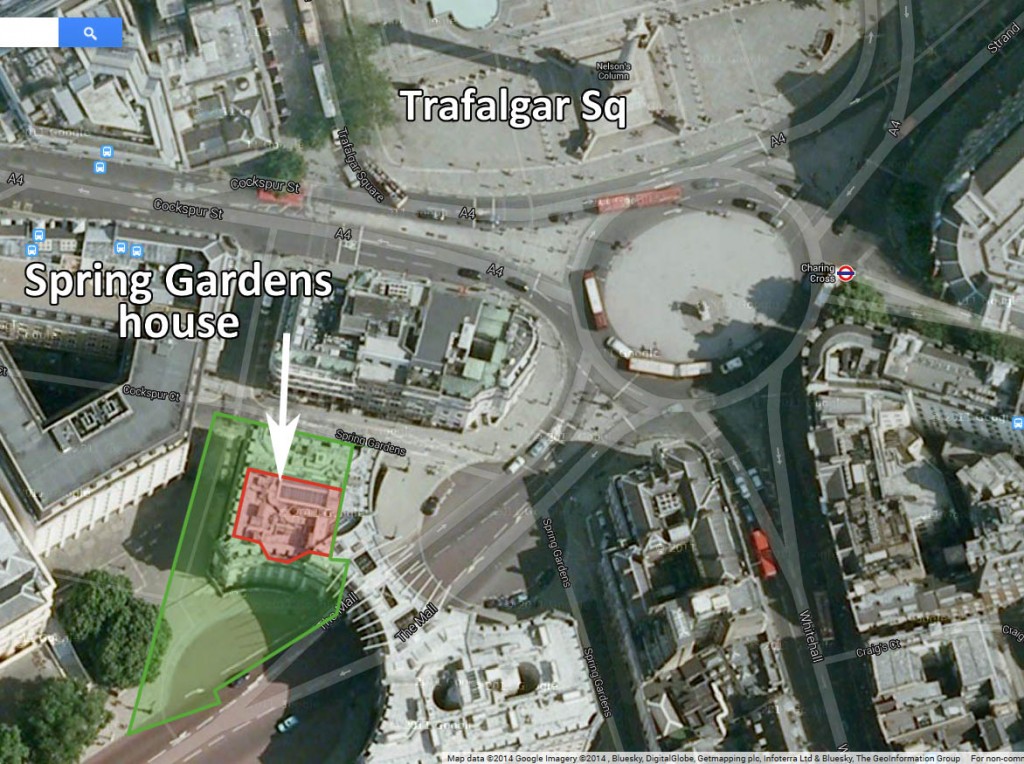
Spring Gardens was located on the south side of Trafalgar Square, where The Mall now joins it. It disappeared under the construction of Admiralty Arch at the start of the Twentieth Century, but you can see where it was on this map. The area shown here was the house and garden of the Southwell’s in 1777 after they had leased much of their surrounding property for development.

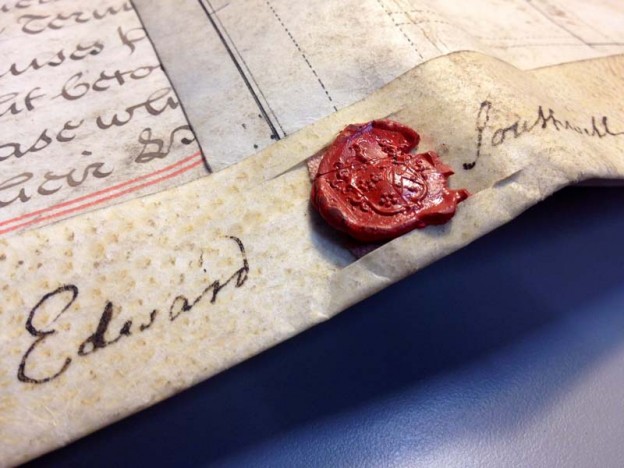
The document is particularly interesting for its three wax seals, all bearing the arms of Edward Southwell II surmounted with the armorial goat. Edward’s signature bestrides the best of these seals.

spring gardens

Bristol BioBlitz launches Bristol99 this weekend at Kings Weston. Get ready for a 30 hour wildlife extravaganza!

3 DAYS TO GO UNTIL THE BRISTOL BIOBLITZ AT KINGS WESTON – HURRAH!  This year, it marks a particularly special occasion – the launch event of Bristol99, a pilot project to celebrate the 10th anniversary of Bristol Festival of Nature.  For 6 weeks, starting with the Bristol BioBlitz, Bristol Natural History Consortium will be working with partners to deliver a huge variety of FREE activities (currently, about 40 and counting!) on some of Bristol’s best wildlife sites – the 99 Sites of Nature Conservation Interest.  From the 30 hour wildlife recording extravaganza that is the main Bristol BioBlitz, to a gentle cycle ride along the Malago Valley looking at wildflowers, an evening bat walk, or a glimpse into the world of the water vole, there truly is something to tickle everyone’s taste buds.

Bristol99 concludes it’s journey around Bristol at Bristol Harbourside, for the big finale – Bristol Festival of Nature, on the weekend of 15th/16th June.  Bringing together over 150 organisations for an exciting and interactive programme, it is the UK’s largest FREE natural history event and a truly great day out, whether or not you are a wildlife aficionado!

So why not make Bristol BioBlitz the start of a summer exploring the wildlife hot spots of our wonderful city? Come along to a few of the Bristol99 events in the weeks to follow, and then join us at the Festival of Nature!  I can’t think of a better, or cheaper way to have fun in the (hopefully) sun!

By Lucy Gaze