Category Archives: Uncategorized

Continuing work in the gardens

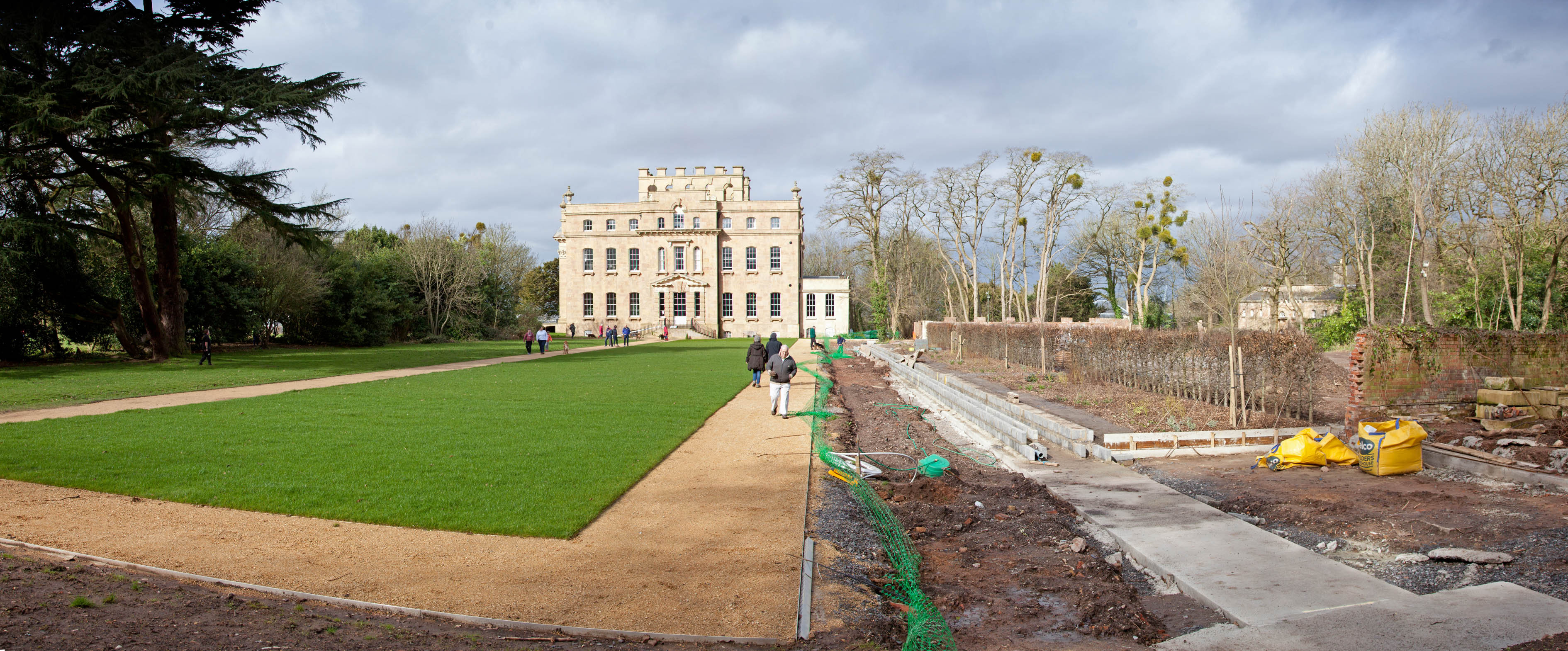
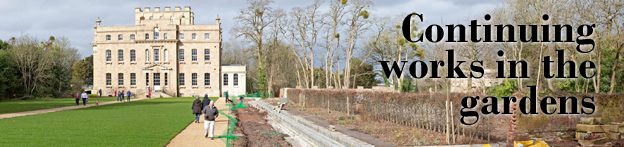
Norman Routledge of Kings Weston house has been continuing work on the gardens throughout the winter. The new plans and landscape design received planning consent in January and since then the area of the old building site ruins on the south-east side of the mansion has been transformed. The scheme includes a re-laid lawn, new planting, trees, and a long water rill running down through the site along an old workman’s trench.

View across the new lawn and garden works towards Kings Weston house

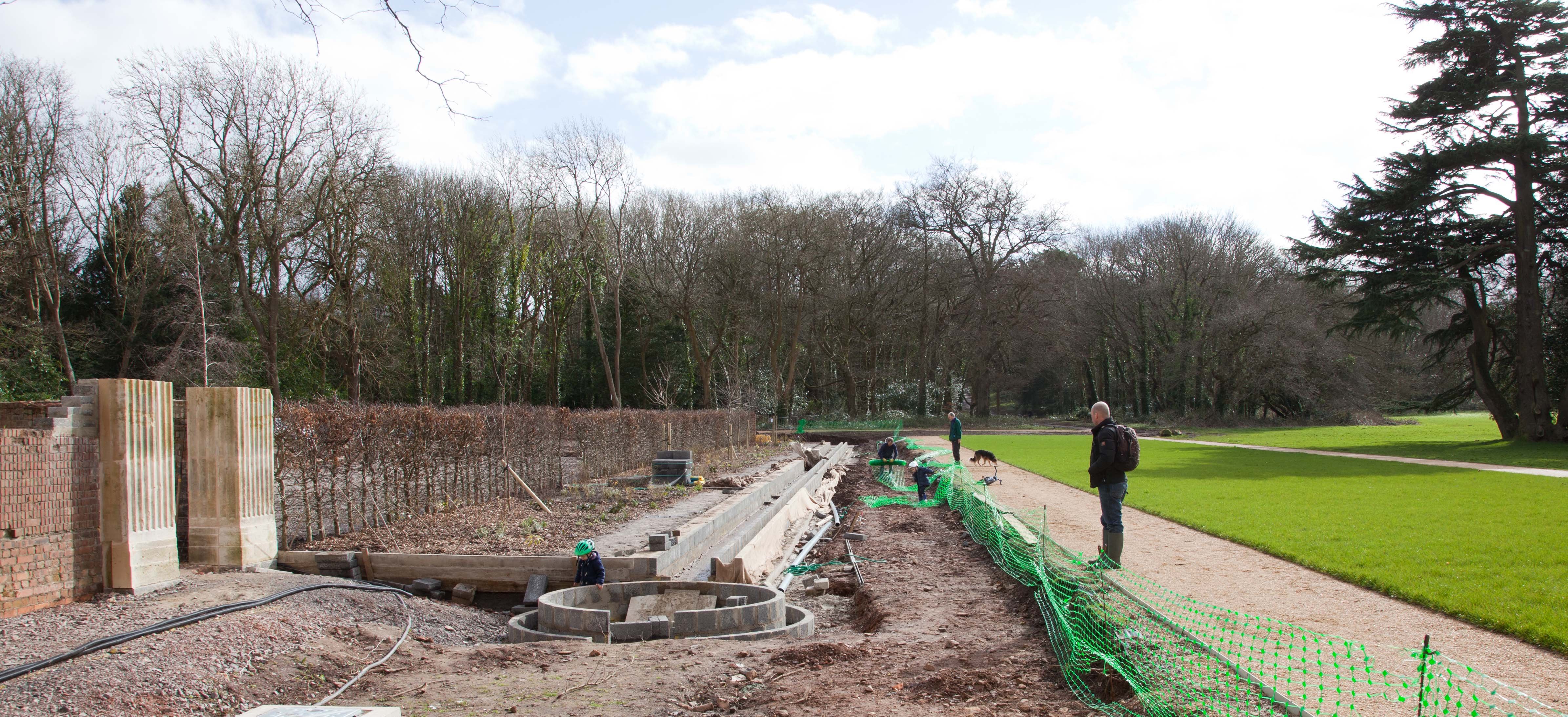
These images show the site as it now looks including the concrete foundations of the new water feature and the recently planted beech hedge and shrubbery that will separate the gardens from the existing car park.  Some of the stone elements recovered from the ruins that once stood here have been reincorporated into a retained section of the old walls and turned into a secret garden for private use.

Plans have been amended from since we last circulated them; the proposed second drive exiting onto Kings Weston Lane from the woodland car park has been omitted following consultation.

More planting  along the south side of the water feature, alongside the new gravel path, will soon enhance the scene. Although the gardens are still incomplete it’s easy to see the handsome effect they will have when finished, returning some of the lost formality to the setting of this Grade I Listed building. Norman would like to pass on his thanks to some of KWAG’s volunteers who let a hand last month in getting the new trees and shrubs into the ground.

Looking towards the Echo with the secret garden to the left and the new water feature in development in the centre.

Edwardian Sketch comes to light

Many people local to the Kings Weston estate will be aware of the death two years ago of local Historian Ralph Hack. Ralph had amassed a large collection of research and original material about the whole area including Kings Weston and we’ve been keen to track-down his archives since then. 

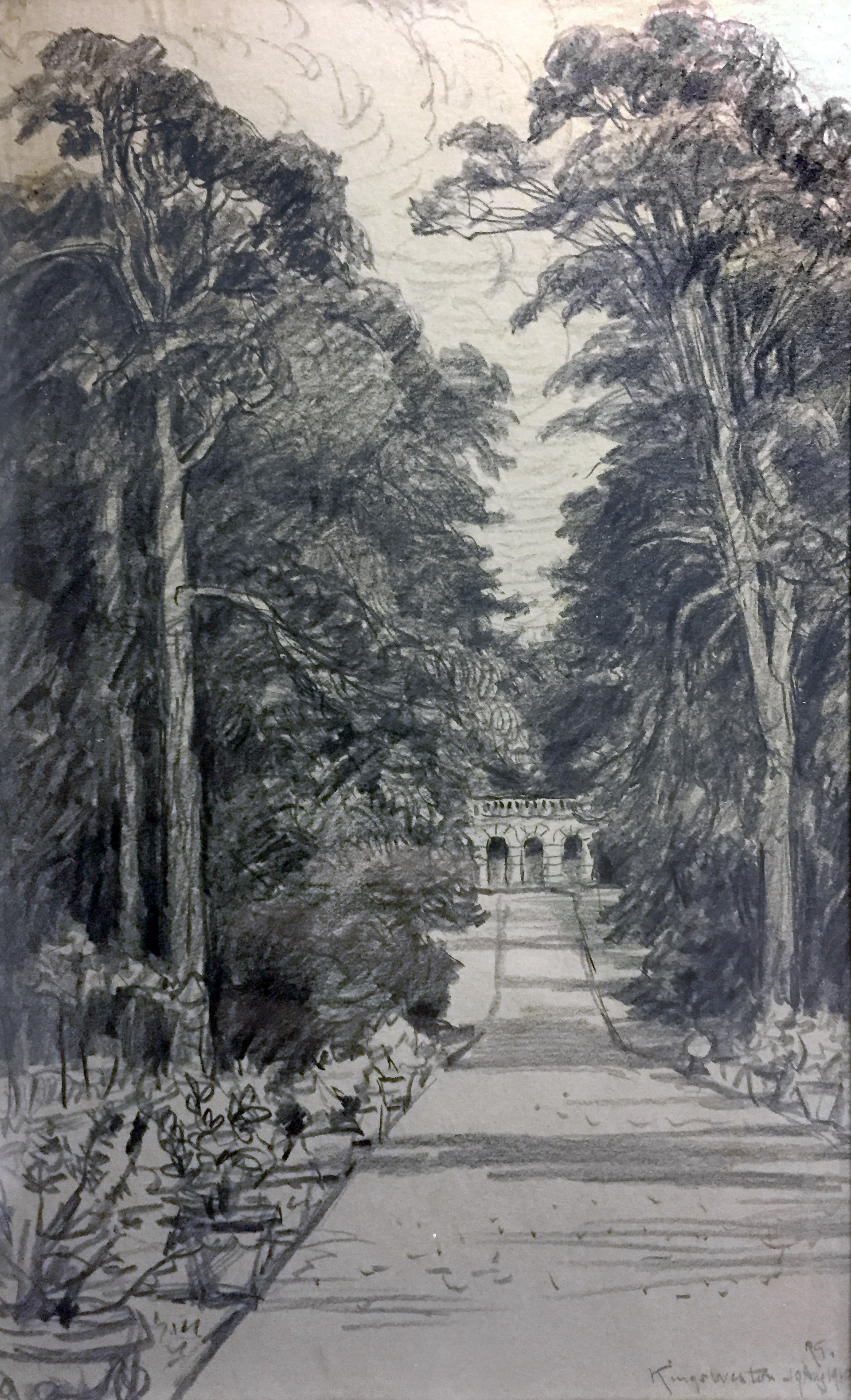
View towards the Echo, Robert Goff, 1910

Recently portions of his collection came to light at Bristol Auction Rooms, and we were keen to try and identify anything that might relate to the house and its history. Amongst the lots was a pencil drawing that particularly stood out. Catalogued only as a view  at Kings Weston, dated 1910, and signed “RG” it is a well executed sketch of the view looking towards the Echo from the house. We were in a fortunate position to recognise the sketch, and the monogram, as being the work of the artist and etcher Robert Goff. 

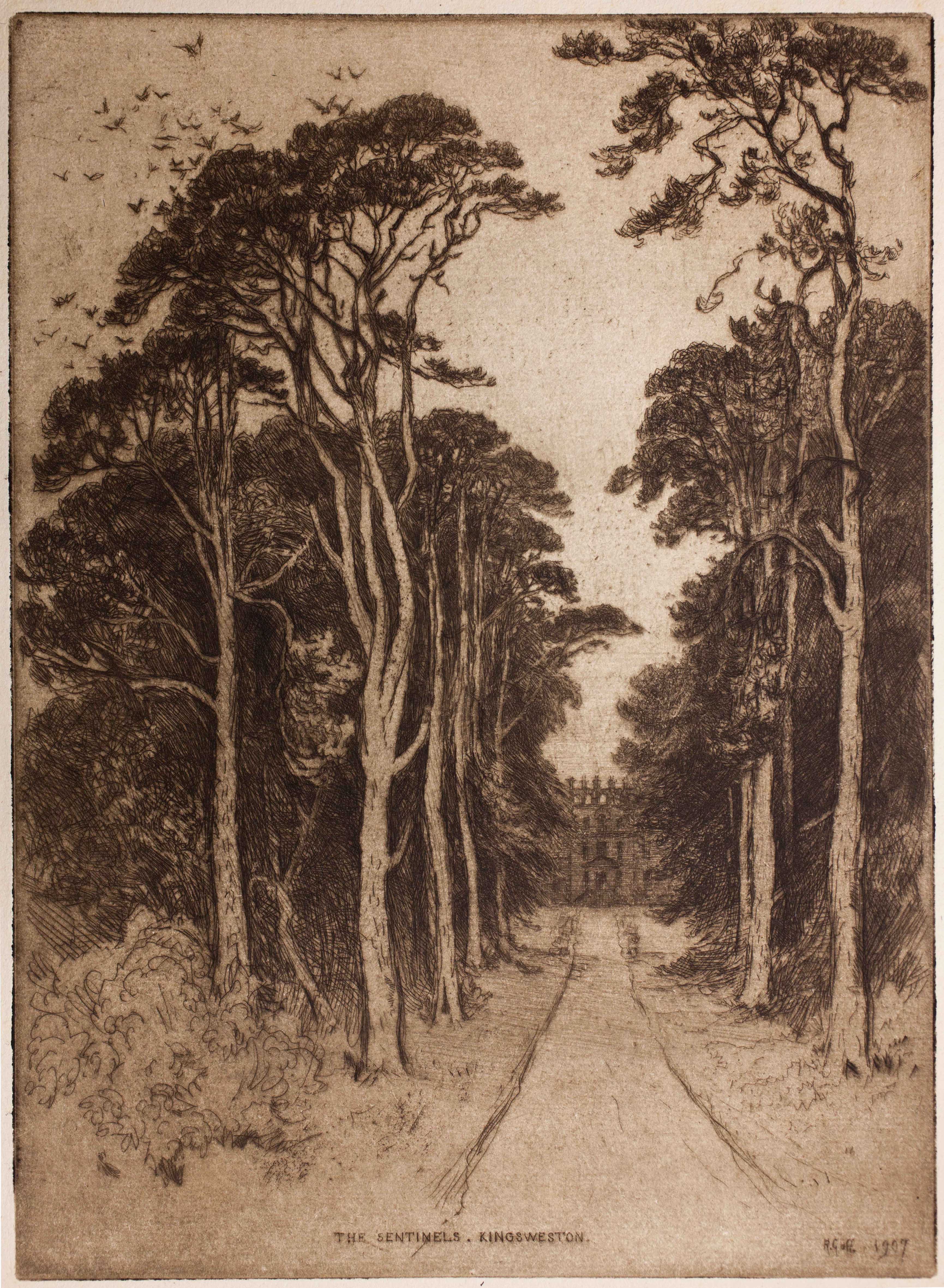
Goff was the brother-in-law of Philip Napier Miles, the last private owner of Kings Weston house, and he evidently spent some time there sketching and developing compositions for his etchings. Whilst we don’t know if the drawing ever developed further it’s a fascinating companion to an image we’ve hosted here before: the opposing, engraved, view looking down towards Kings Weston House in 1907.  It’s unlikely we’ll ever know if the two images were ever intended to be seen together, but, rest assured, we’ll be keeping our eyes out for an engraved version in the future!

“The Sentinels” Kings Weston. Etching by Robert Goff, 1907. 

The Circle completed

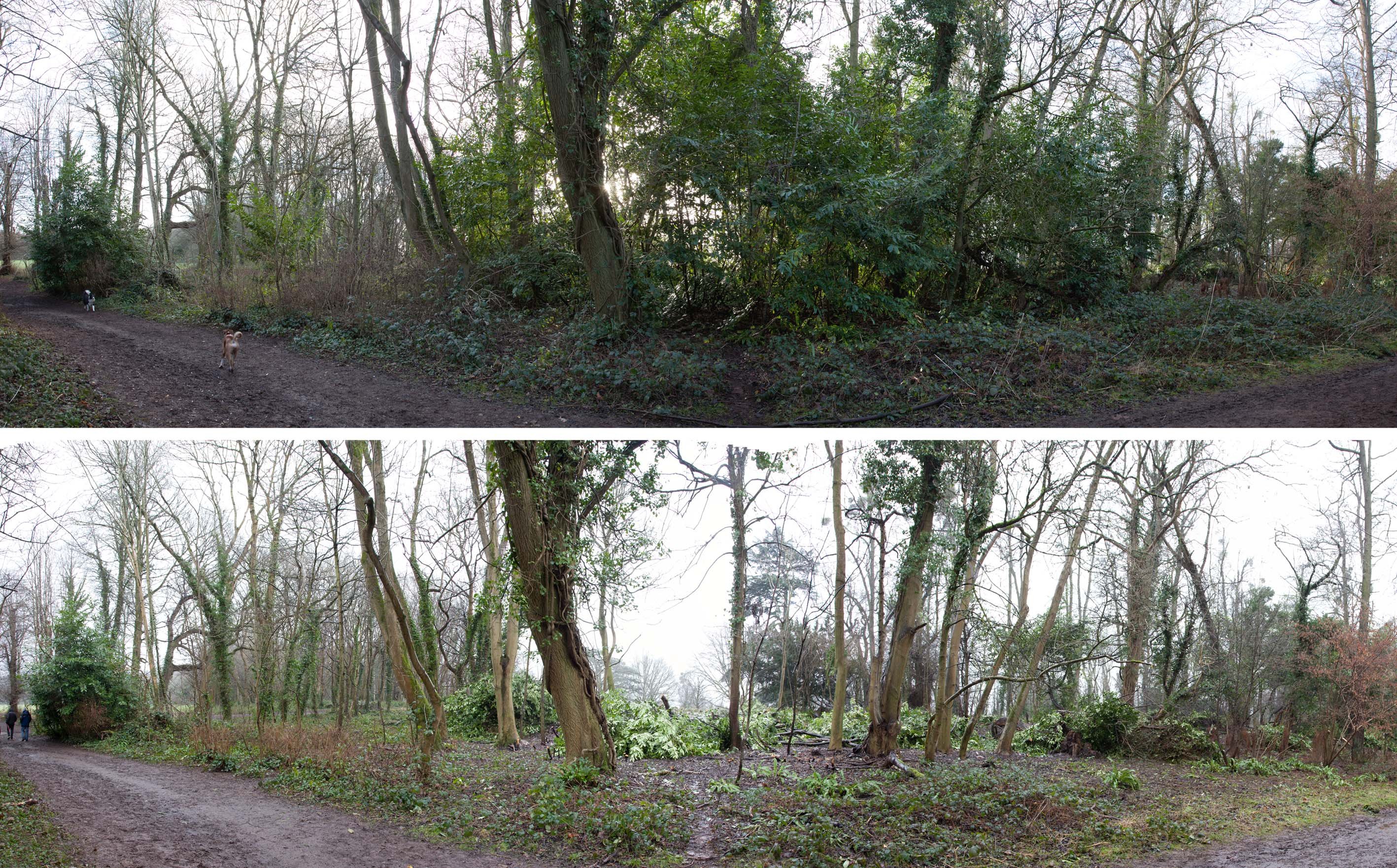
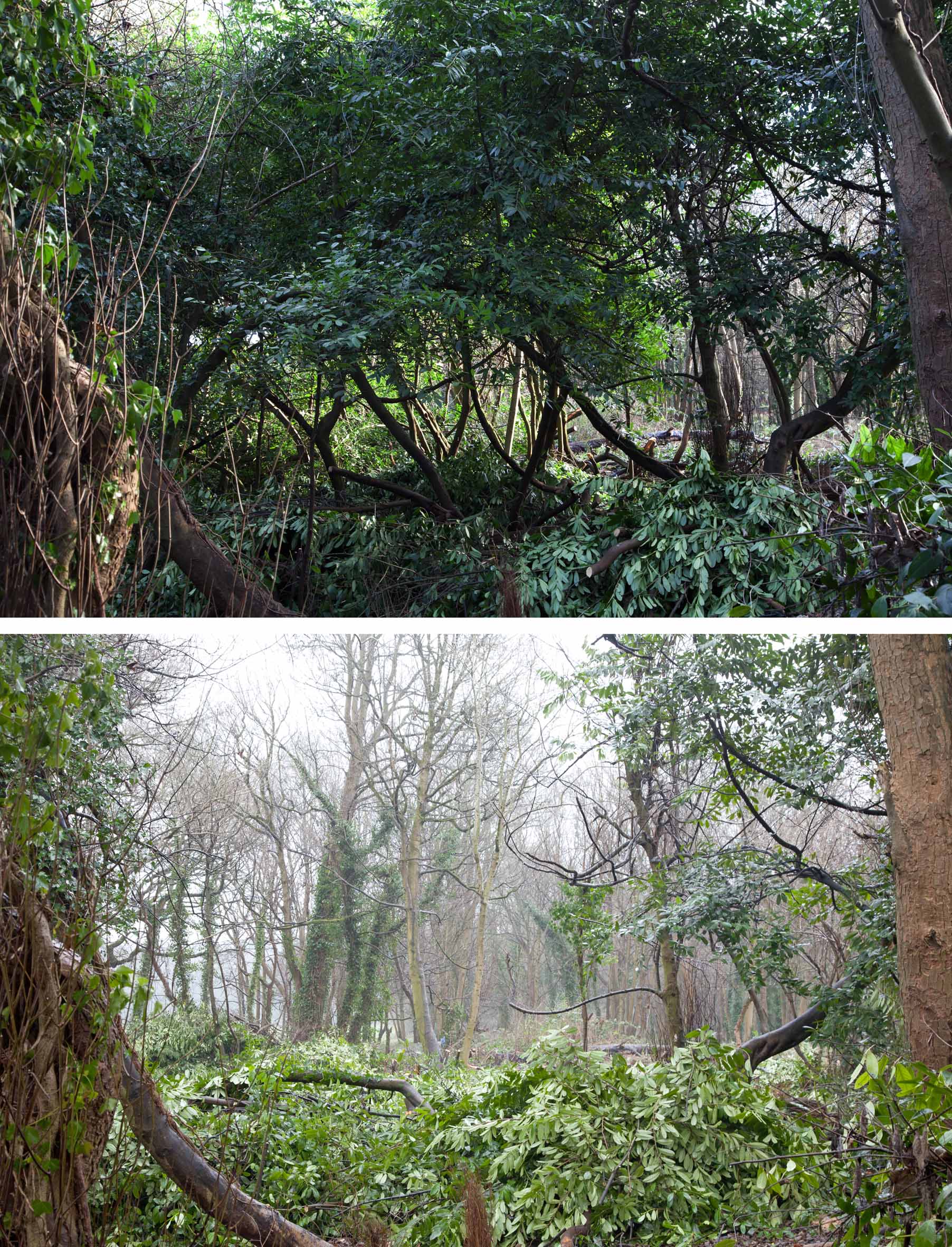
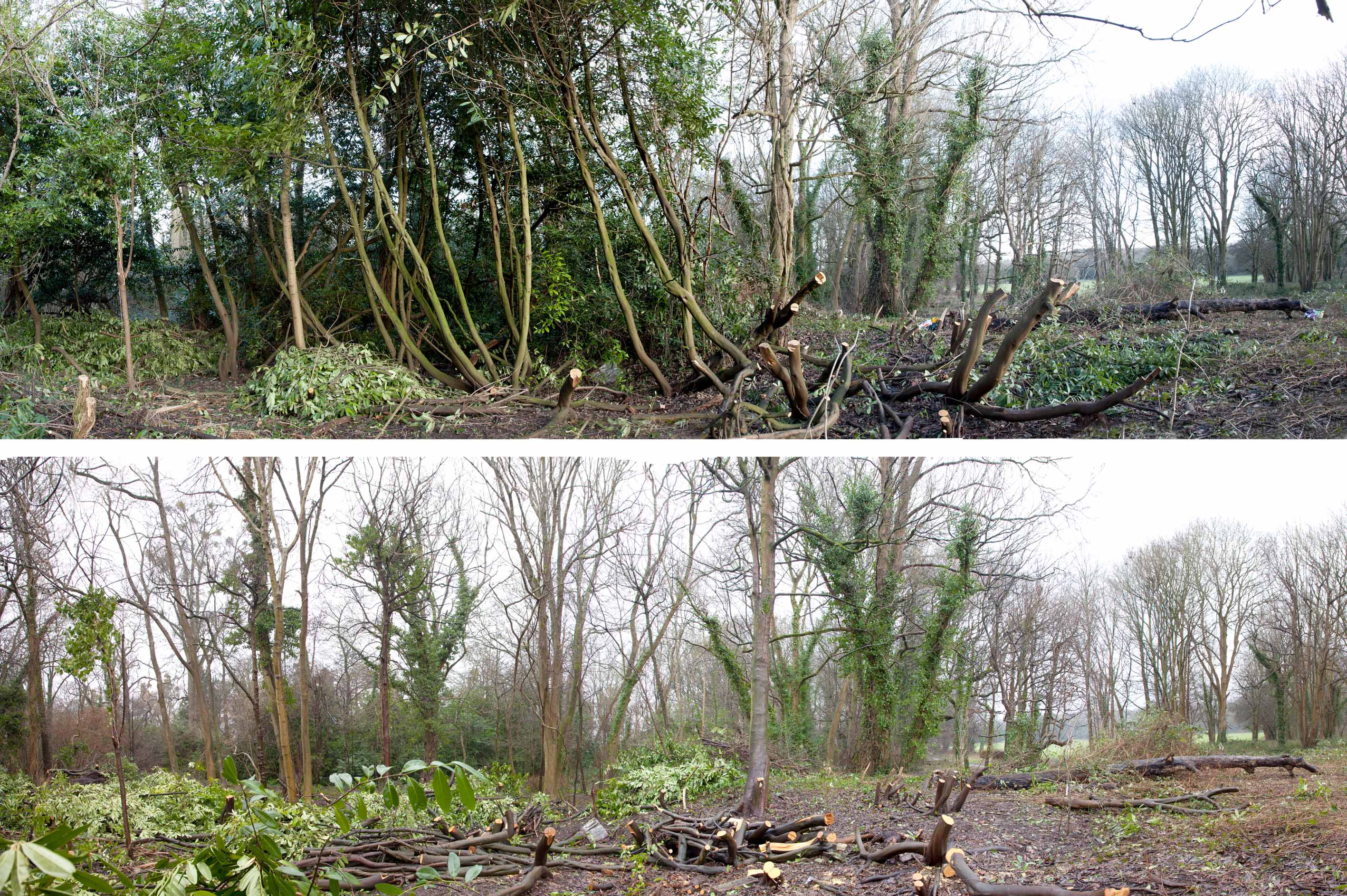
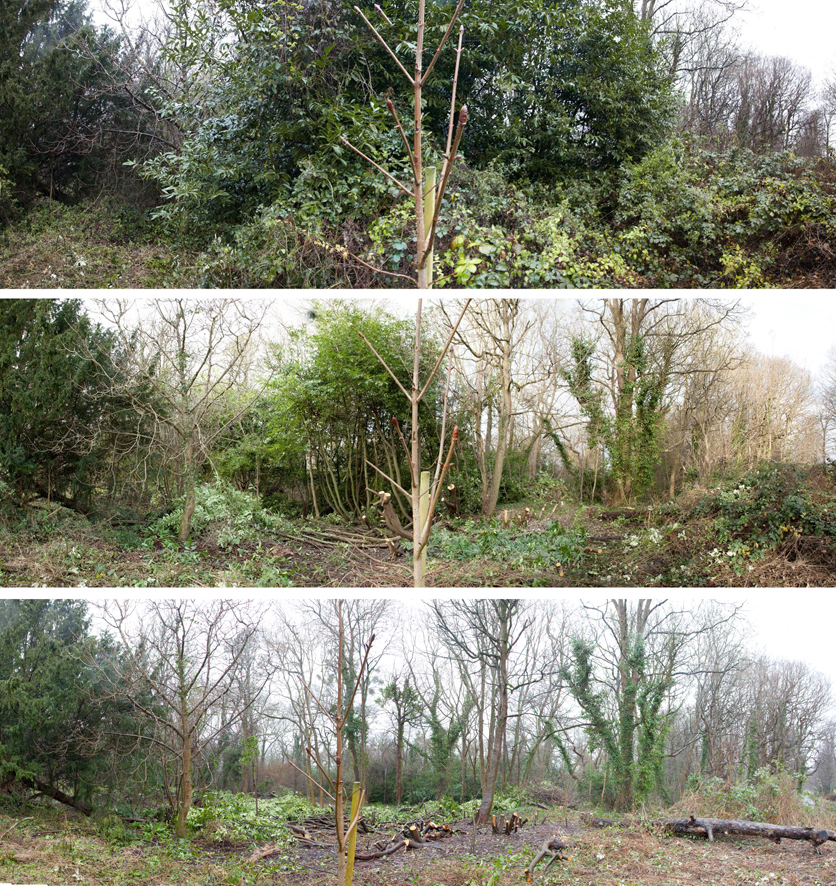
We are again grateful for such a good turnout at January’s working party, and especially to the many new volunteers who came along to lend a hand. This ended up being one of the toughest of the laurel-clearing working parties, with a thick and tangled mass of dense greenery to fell. The scale of the challenge is perhaps not fully demonstrated in our before and after images, but the impact on the site is marked.

Looking south from the main path through the woods towards the Circle before and after work

Looking south from the main path through the woods towards the Circle before and after work

Before and after work looking through Penpole Wood towards the Circle

Before and after work looking through Penpole Wood towards the Circle

Views of veteran trees through the area, and revealed vistas to important ornamental planting have all benefited from the work, as well as the long-term health and diversity of the woodland in this key location.

Although we only narrowly achieved our target of clearing the whole of the area around the Circle, a great deal of felled timber had to be cleared and reduced over subsequent weeks. We are grateful for Jim Ellis and Norman Routledge for having undertaken this, and enhanced the finished result.
The event also saw the planting of three new trees around the edge of the Circle and within the wood. As noted last month, these will supplement the native and ornamental species already growing here.

The Circle looking towards Kings Weston House before and after work

The Circle looking towards Kings Weston House before and after work

The laurels regress between December and January

The laurels regress between December and January

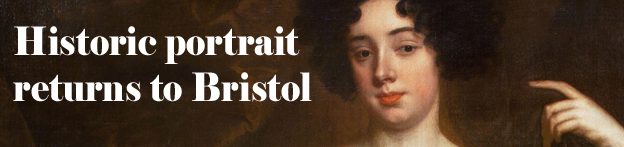
Historic painting returns to Bristol

The gallery of paintings in the Saloon of Kings Weston House is one of its highlights. Whilst there are literally dozens of portraits of members of the Southwell family, who owned the house and estate for the whole of the Eighteenth Century, this is just a fraction of their original collection.

The rooms throughout the mansion were filled with many paintings, with a strong emphasis on ancestral portraits. Today the family still owns a small collection of these, but many remain lost or in private collections; However, just occasionally, one comes to light…

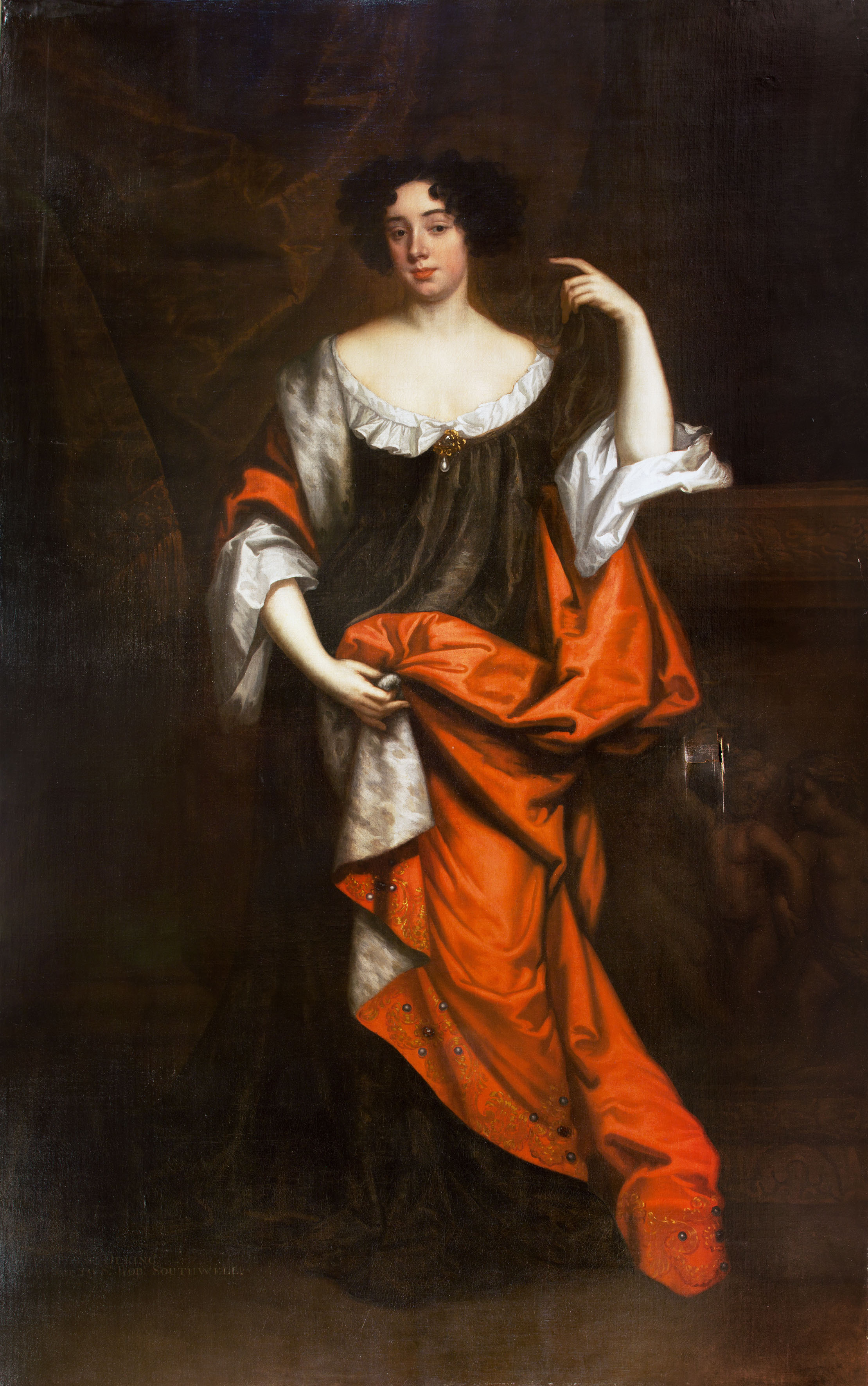
Most recently a painting came onto the market of Lady Elizabeth Dering, the Irish noblewoman who, in 1665, married the first of the family at Kings Weston, Sir Robert Southwell. There are already paintings of the couple in the house; a pair of beautiful and characterful works. The newly uncovered painting has a well documented history and can be tracked from its original execution to its final sale out of the family in 1834 following the death of the last of the direct line.

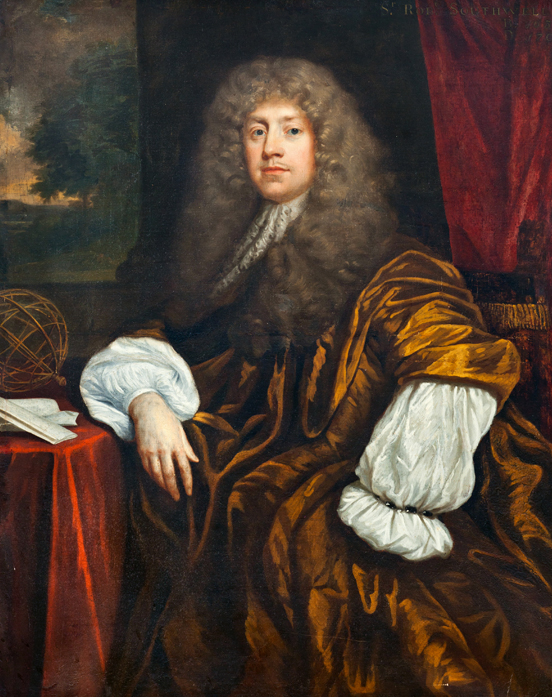
Elizabeth Dering, by Sir Peter Lely and "Mr Sonius"

Elizabeth Dering, by Sir Peter Lely and “Mr Sonius”

The painting itself is vast; Over seven feet in height it is almost life size. It carries the name and date of its sitter in the lower left-hand corner, and Elizabeth stares out of the canvas with almost-luminous skin, and a distant gaze. A striking red shawl wraps through the painting, but, unusually, the dress she wears is jet black and isn’t as splendid show of opulent colour as one might expect from such a bold painting.

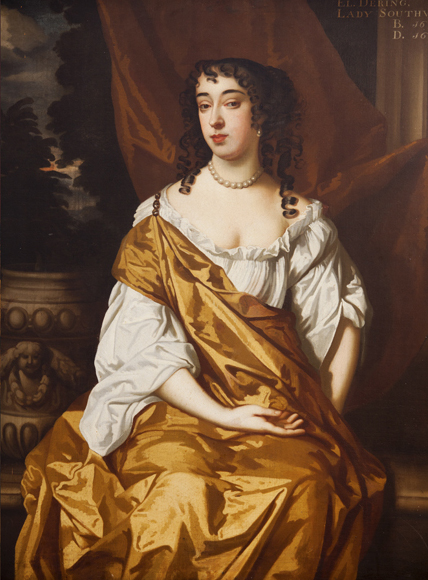
Elizabeth Dering, by Pooley, now in Kings Weston House.

Elizabeth Dering, by Pooley, now in Kings Weston House.

Clues to the painting’s origins are given in an early inventory of goods in the house compiled in 1695. With regard to the full-length portrait of Elizabeth it explains “the head done by Sir Peter Lely in 1680, a little before his death. The drapery by Mr Sonius”. Lely was the foremost court painter of his age, and his prolific output included the majority of the Royal family and nobility of Britain. At his death in November 1680 many of of the works in his studio were incomplete and finished by assistants, the Dering portrait no doubt amongst them. Elizabeth herself lived only a few months longer, dying in January 1681. It is therefore likely that the studio were instructed to complete the painting posthumously and the dark mourning dress of black symbolised the recent loss.

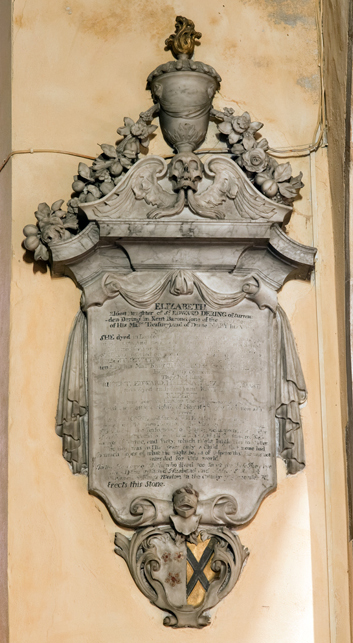
Elizabeth's memorial in Henbury Church

Elizabeth’s memorial in Henbury Church

The painting originally hung in the Southwell’s house in Spring Gardens, London, but quickly found its way to Kings Weston by the time the house was remodelled by Vanbrugh in 1712. All subsequent descriptions of the house mention it in the Breakfast Parlour overlooking the Severn; This space has since been opened out into what’s better known today as the Vanbrugh Room. When the last of the direct line of the family, Edward Southwell VI, Baron de Clifford, died in 1832 almost the entire contents of the house were auctioned in a lavish series of events in London. It appears that the Dering portrait was sold with one other of a similar size for the princely sum of £7!

The history of the painting since that auction remains uncertain. A number of auction stamps, and collection marks, on the timber stretcher hint at a long chain of subsequent ownership. No doubt in the future we may be able to find out who was interested enough in the sitter, or the portrait to own it, and who the mysterious painter, Mr Sonius was! The intention is that the painting will now return to Bristol. Plans are yet to develop for how public access and enjoyment of it can be arranged. At some point it would be wonderful to see it return to kings Weston in some form.

A love no longer evergreen

As with our work last year, this winter’s work in clearing the laurels has caused a little concern with regular park users. However it is key to understand how the problem has arisen in the first place.

Whilst much of the Kings Weston estate feels very wild it was not always the case. The whole of Penpole Wood and the Home Park were once managed pleasure grounds and were carefully maintained and embellished for well over four centuries. Penpole Wood, although partially ancient woodland, was set-out and maintained as part of the gardens to Kings Weston house.

Continuing clearance of invasive cherry laurel from Penpole Wood.

Throughout the Seventeenth and Eighteenth Centuries the Southwell family who owned the estate sought to enhance the promenades and avenues. They sought not only to demonstrate their mastery over nature, and impress visitors with the latest imported trees and shrubs. To enliven the walks in the winter months they sought to introduce verdant colour through the planting of evergreen shrubs as an understorey. As with the selection of exotic tree species they planted both native and imported varieties, and the legacy of what they placed in the ground is very much with us today. Although the laurel now dominates, this is the perfect time of year to identify more of the evergreen species that lend colour to the winter landscape and help us understand the design and layout of earlier ornamental planting schemes.
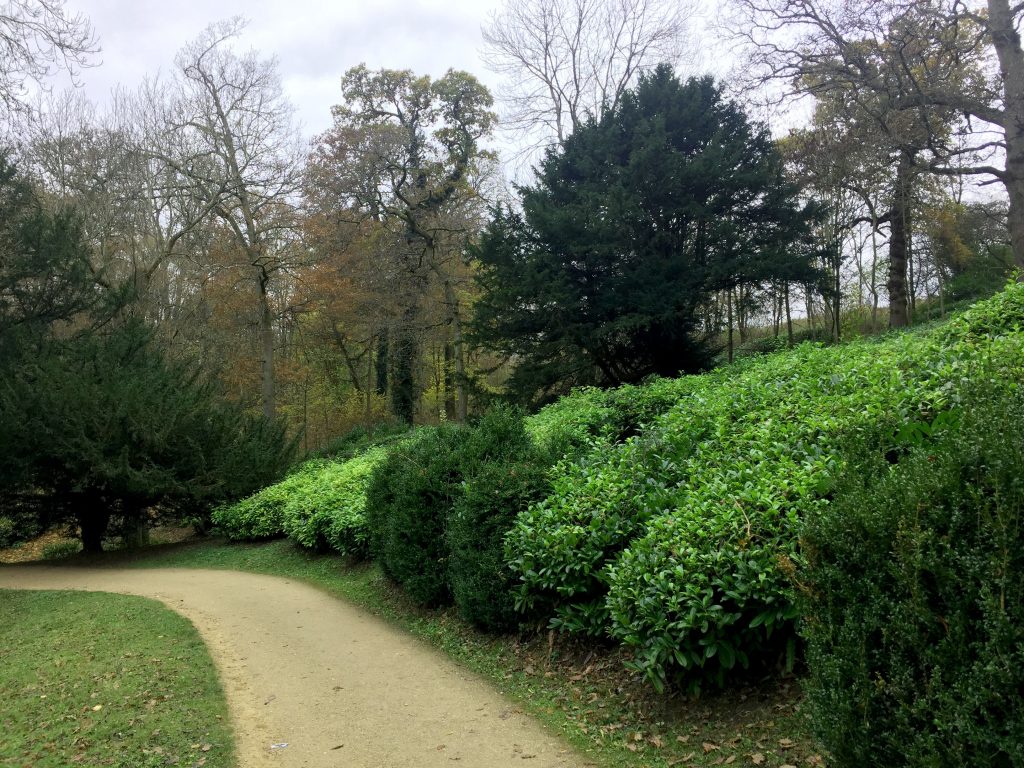
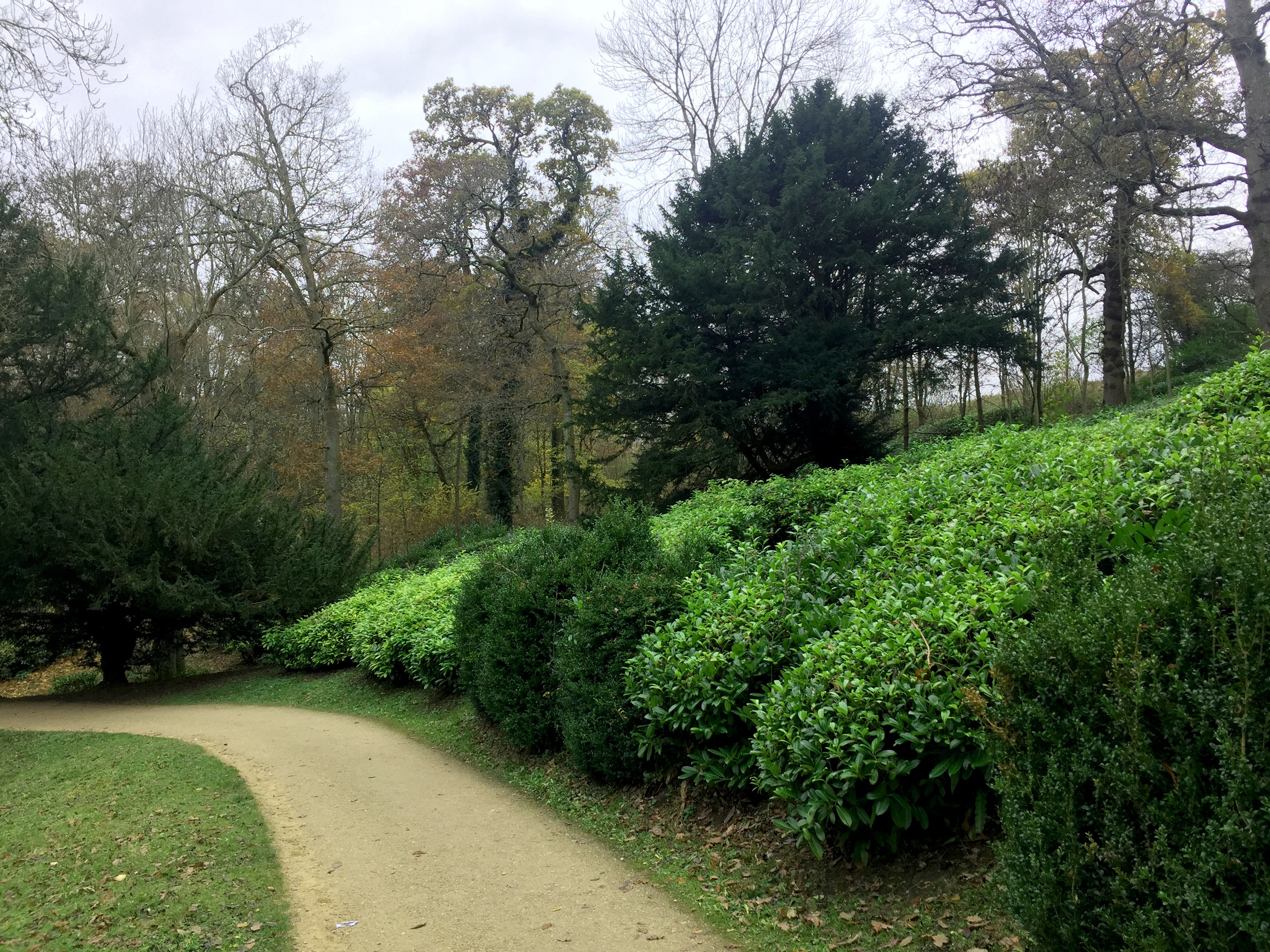
Below: A path at Newton St Loe where laurel and box are maintained to their originally intended C18th appearance. note also the use of yew trees picturesquely interspersed.

The Cherry Laurel we’re currently removing originally comes from Eastern Europe and Asia. It was used extensively at Kings Weston, and, when planted in the Eighteenth Century, would have been carefully cut and was intended to be maintained at a uniform height and scale. Many historic parklands retain this species, but only very few have the resources and patience to ensure they are trimmed as originally intended. A good example of the effect they would once have had can be gleaned from Newton St Loe, near Bath. Here Bath Spa University continues to manage the Capability Brown designed landscape in the traditional manner. When dealing with the monstrously large cherry laurels at Kings Weston it is difficult to imagine that they grew from such well-mannered shrubberies!
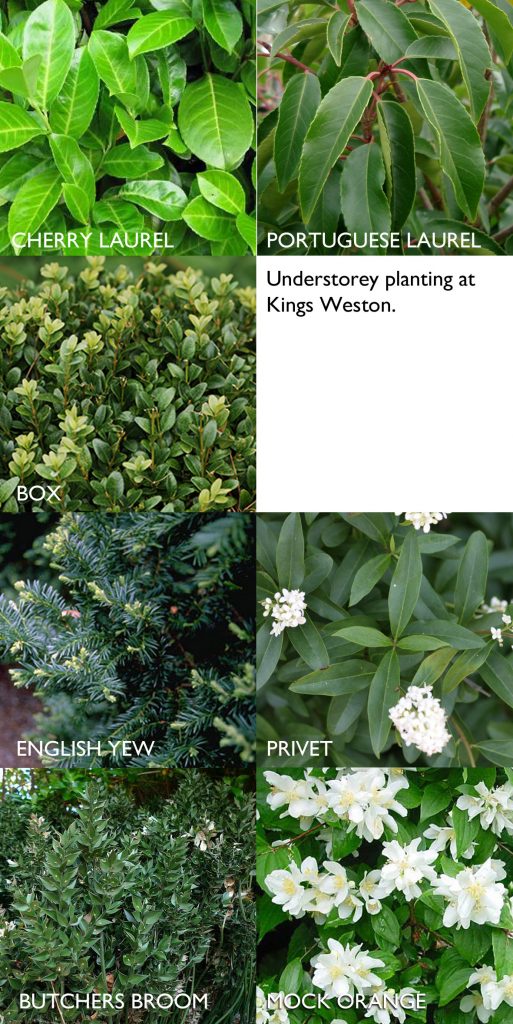
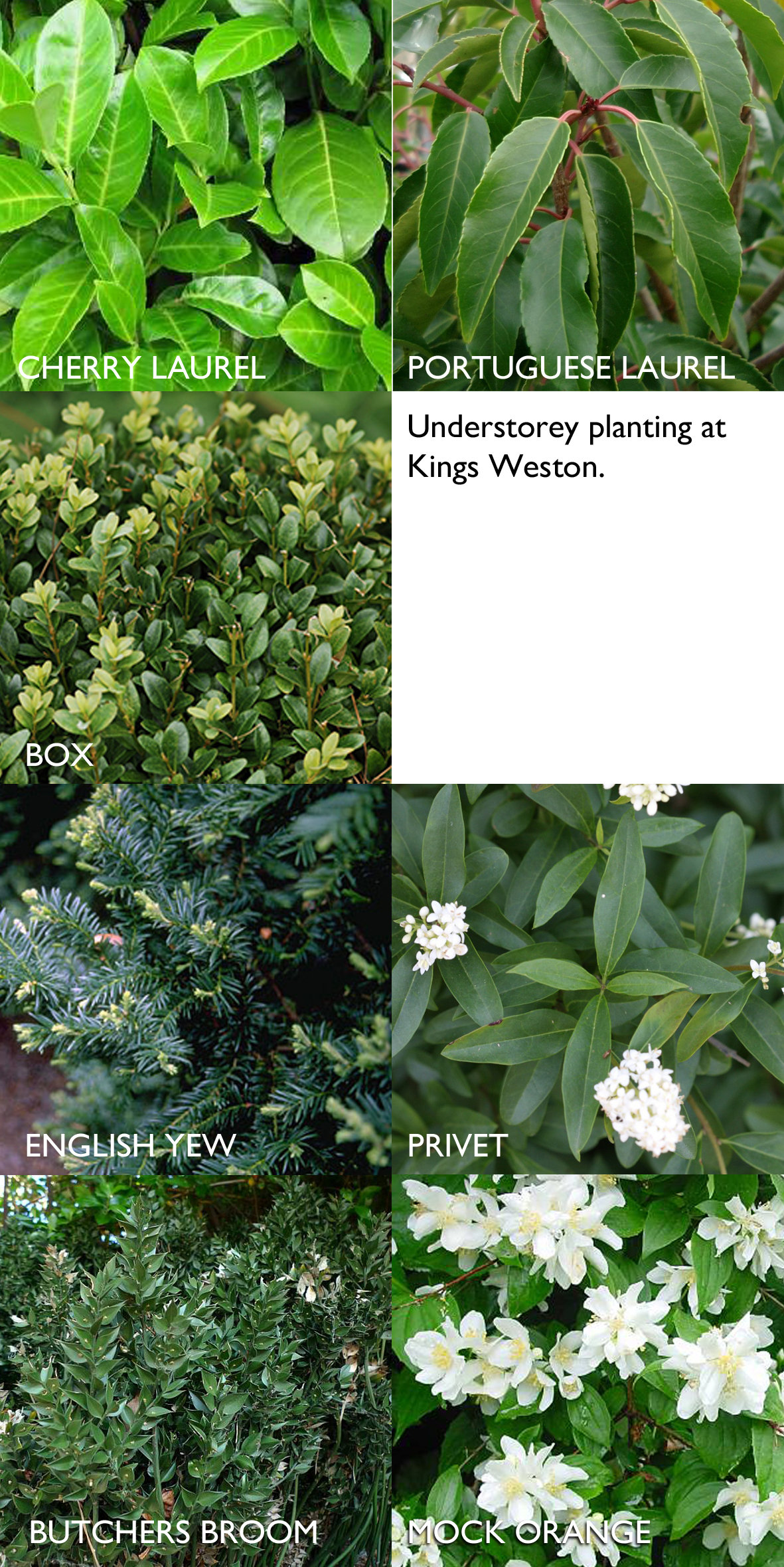
Also surviving within Penpole Wood are a number of Portuguese laurel. They too are an introduced species and would have been inter-planted to give variety of colour and texture with the cherry laurel. These are less invasive, and tend to be more compact, forming small trees with smaller, darker leaves.

Throughout the Georgian and Victorian period native species remained popular for understorey planting. Familiar hedging plants like box and privet can still be found, now growing wild, and interspersed through Penpole Wood, and behind the Echo. They’ve survived less well where out-competed by cherry laurel. Many of the English Yew within Penpole Wood are part of deliberate but long-forgotten planting schemes and have grown into maturing trees rather than the manicured bushes they were intended to form.

The native Butcher’s Broom was also a sought-after evergreen for ornamental planting. An unusual and distinctive plant with sharp spiny leaves and stiff branches it grows to about 2-3 feet in height in dense and well-defined patches. There are several remaining plants along the South Walk between the Echo and The Circle, but it survives less well in other parts of the estate where there has been greater competition for light.

Note also should be made of one other plant which still forms a notable and attractive component of the designed woodland areas: Mock Orange (Philadelphus coronarius). Although not evergreen it deserves mention here as a survival of Georgian and later planting schemes. A native of Southern Europe it is now naturalised in Penpole Wood and formerly flowered in sunny areas with richly scented white blooms. Our recent laurel clearance efforts also focussed attention on pruning a number of these plants along the main path through the woods. These should naturally regenerate into attractive and dense bushes. With the sunlight now able to penetrate into the woods these shrubs should again flower in coming years.
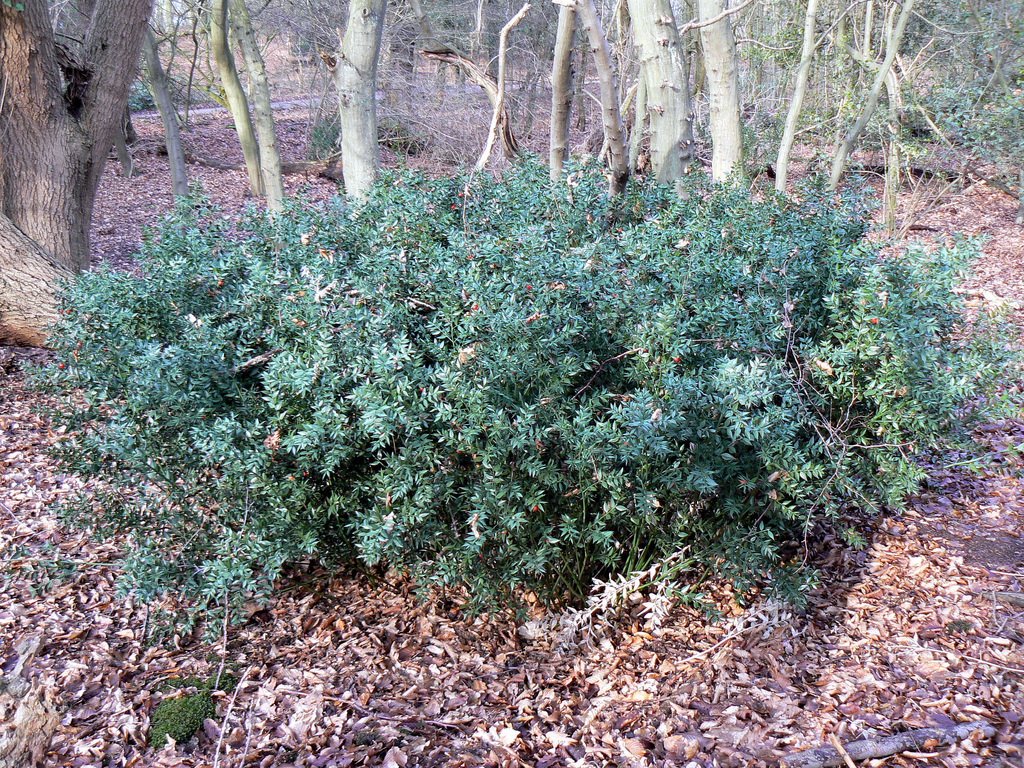
Below: A typical outcrop of Butcher’s broom (Ruscus aculeatus)

Evergreens will remain an important component of the Kings Weston landscape, though the problems with introduced species, and the decades-long neglect in maintaining them as originally planned, have distorted our perceptions of the woodland. Cherry laurel will continue to grow across the park, but the planters of the once-fashionable shrubs cannot have contemplated the damage they would cause to the landscape in the modern era. Now the dominant plant in many areas of the estate our love-affair with laurel has soured. It is our hope that, in reducing the coverage now, we will enable other species to take their place on the forest floor.

Need a niche new hobby for 2017?

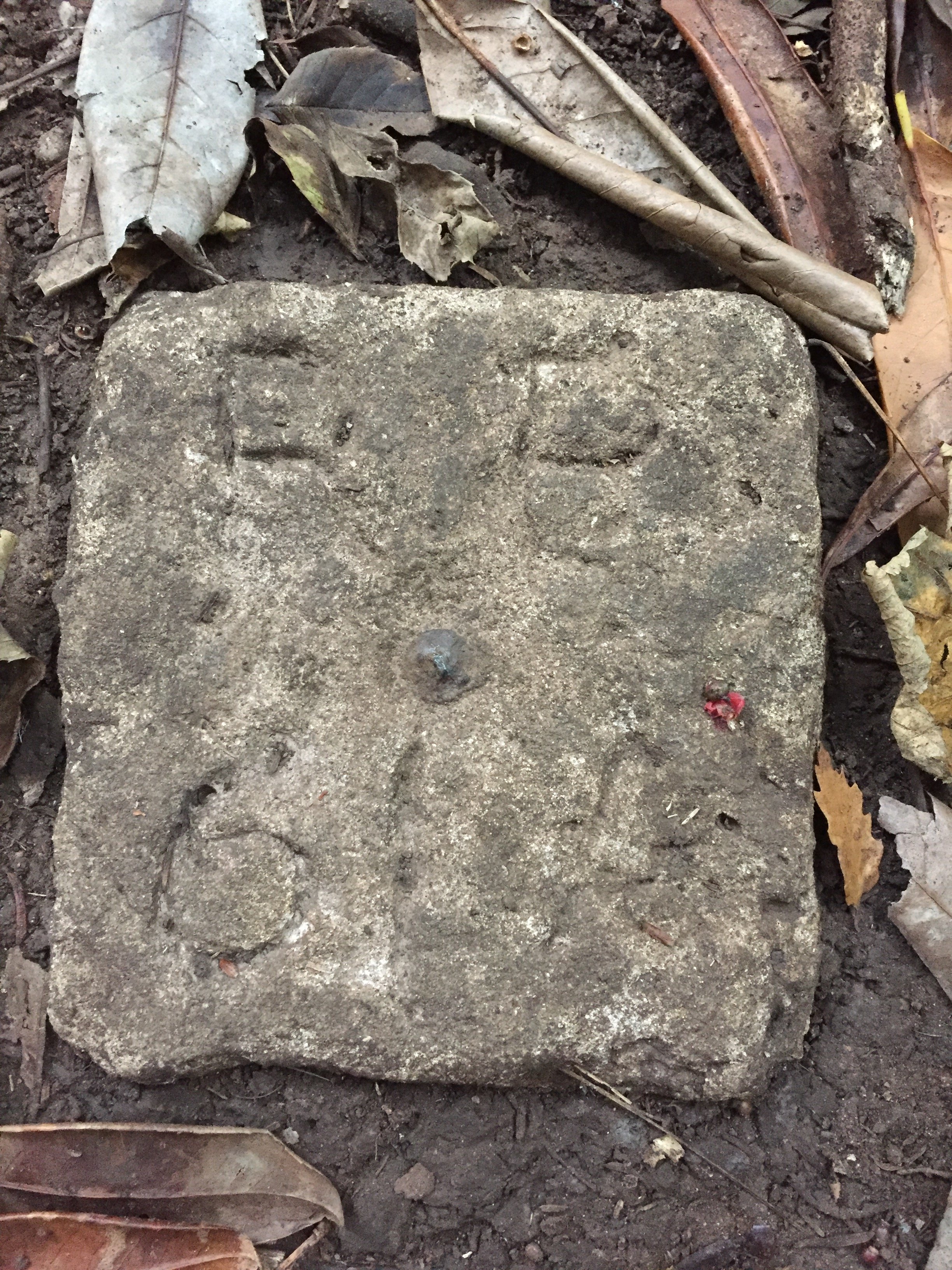
We’ve been asked on more than one occasion what small square

One of the concrete markers with a bronze pin and reference letters

concrete tiles scattered around the estate were for. Until recently we were unable to offer a definite answer. The guesses ranged from drain markers or boundary stones, to something related to the Second World War camps; but the fact is much more curious.

Immediately after the war the Ordnance Survey undertook the large-scale re-surveying of the whole of England. Rather than use more modern methods such as aerial photography, they chose to undertake the survey work by hand. Teams of surveyors were set up around the country and each task with verifying, or correcting, each and every house, fence-line, wall, railway road footpath, and a huge multitude of geographic features on every map on the national grid.

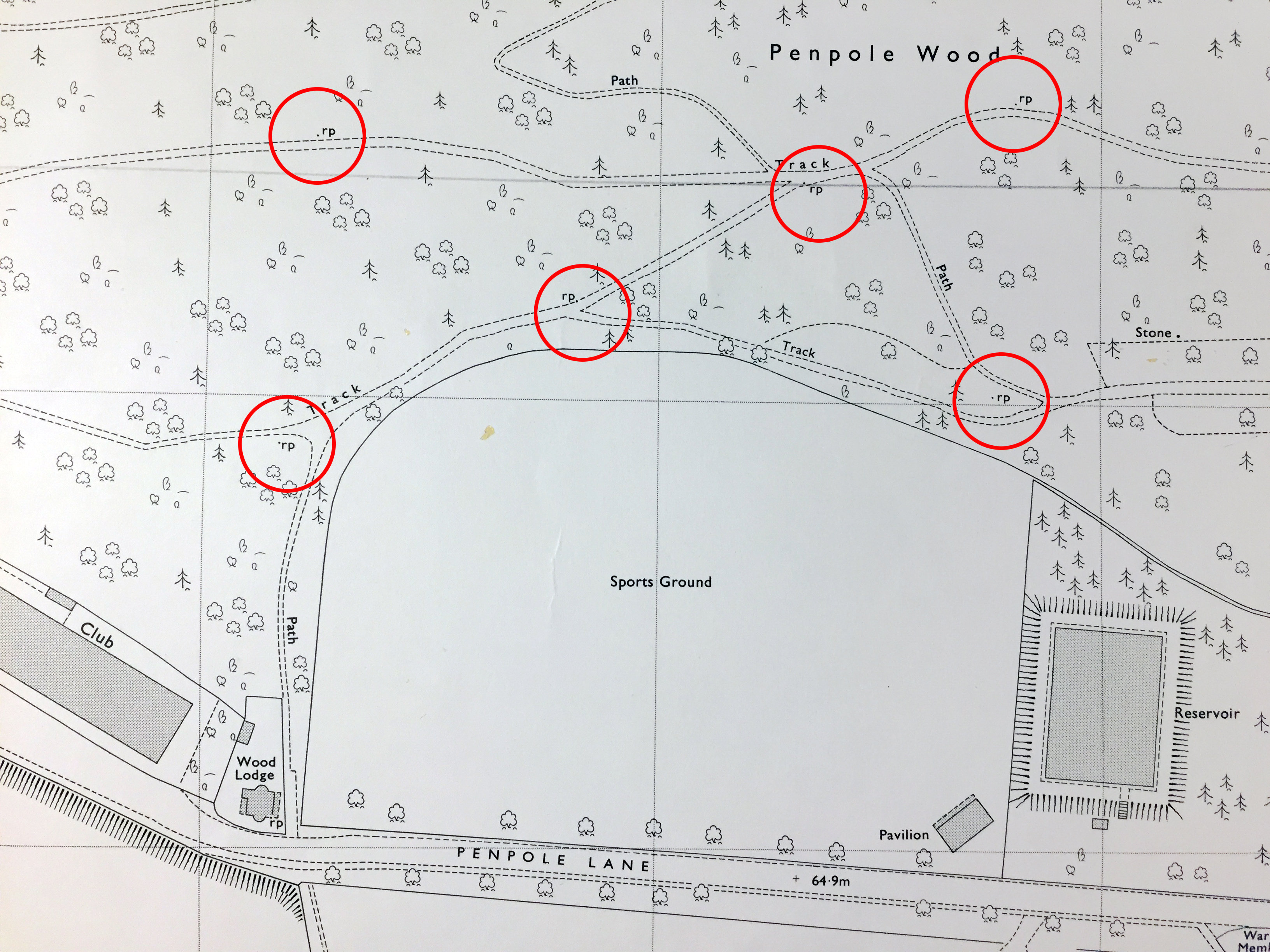
The surveying equipment relied on direct sight-lines between one fixed point and the next. Urban areas offered many building corners, and hard edges in which to fix the small metal surveying point, but in the forest, like in Penpole Wood, the survey teams had to make other arrangements.The local team of surveyors chose to mark these “Revision Points” by setting uniquely referenced concrete blocks set into the ground. At the centre of each was the metal pin representing the centre-point from which all their measurements were taken, and a reference number was marked in the surrounding concrete when still wet.

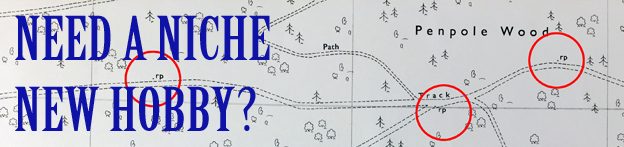
Looking closely at post-war maps of Bristol on the city’s Know Your Place website (The map layer described as “1947-1965 OS National Grid – limited coverage”) you can start picking out the huge number of Revision Points scattered across the estate and marked “r.p.”. So, before the hipsters jump on “Revision Point spotting” as a quirky new hobby why not track them down for yourselves, or just keep your eyes open for one of these odd little historic artefacts underfoot next time you’re walking around the estate.

Revision Points marked throughout Penpole Wood on the post-war ordnance Survey maps.

School Memories

We’re aware than many of our followers have fond memories of their time at Kings Weston house when it operated as a school between, 1949 and 1960. 
We’ve just collected a new photo for our archive showing a school group on the steps of the house in May 1952. All we know is that this was class IX, but does anyone recognise themselves, friends or relatives in this photo? 

A Delve into the Museum Stores

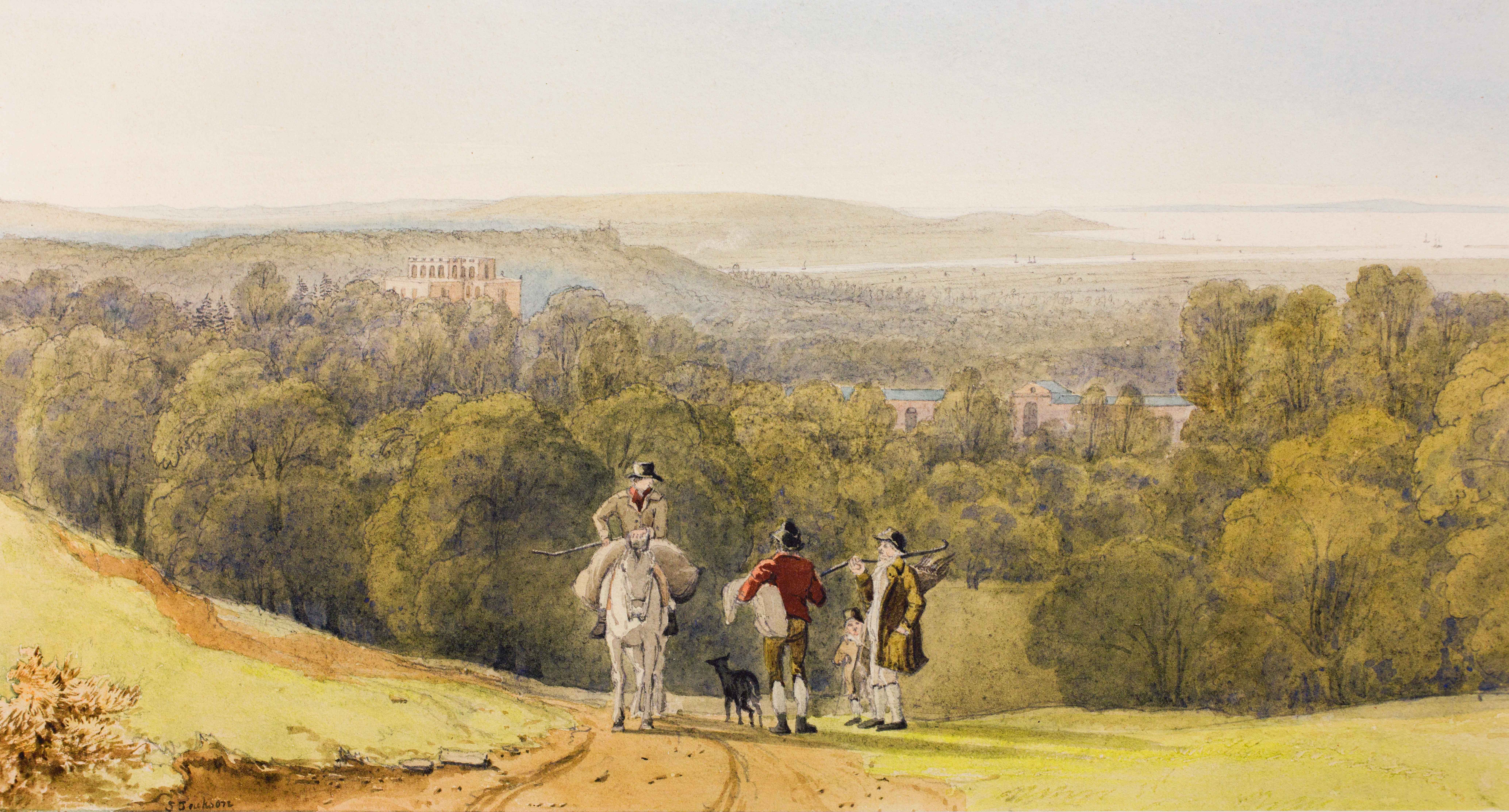
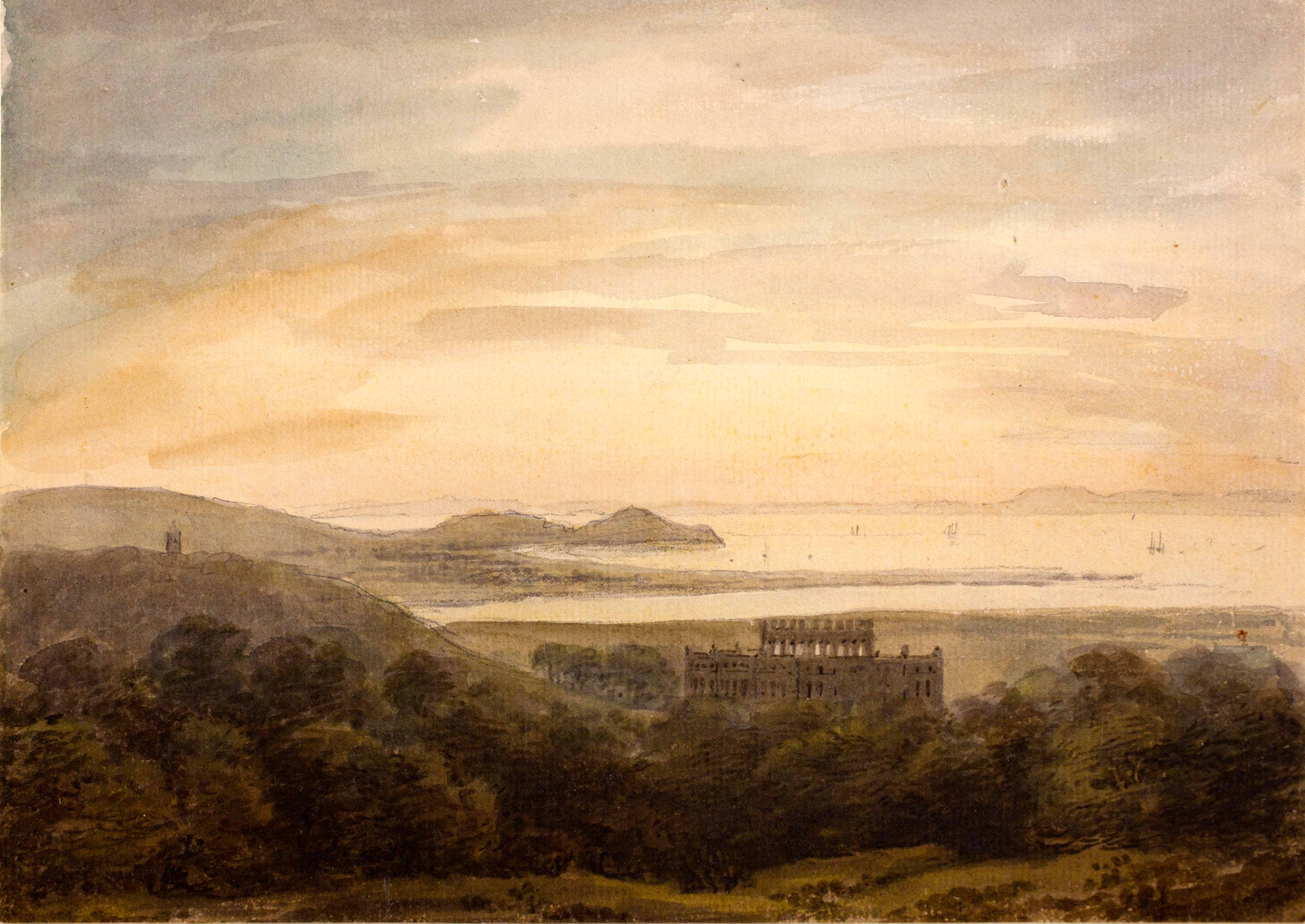
A recent visit to the back rooms of Bristol Museum and Art gallery has uncovered some interesting new finds. The museum holds an extensive collection of material on Kings Weston including paintings, prints, drawings, and artefacts. This particular visit was focussed on uncovering, and recording, some of the less well known images of the historic estate.

samuel-jackson-kingsweston-hill-copy
Above: The view from Kingsweston Hill, a watercolour from the late C18th by Samuel Jackson (BMAG K181). Below-right: Sunset from Kingsweston Hill, circa 1790,Nicholas Pocock (BMAG Mb1996)

pococke-sunsetThere are a number of memorable paintings in the collection, just a small number of which we share here. Most are from the estate at the height of its fame in the late Eighteenth century, with many by notable artists of the “Bristol School” such as Francis Danby, Samuel Jackson, and Nicholas Pocock.
Of special interest was a large portfolio of art etchings by the eminent artist Robert Charles Goff (1837-1922). Most of the dozens of etchings are little to do with Bristol, but are significant for their connection with the last members of the Miles family. The collection was gifted to the museum in 1936 by  Mrs Sybil Napier Miles, the wife of Philip Napier Miles the last private owner of the estate, and her sisters. Goff was their brother-in law, having married Sybil’s sister, Clarissa, in 1899.

Below: The Sentinels, Kings Weston, Robert Goff, 1907(BMAG Mb2555)
goff-1907-sentinels
The Goff’s and the Miles’s were close and Robert and Clarissa were frequent visitors to both Kings Weston, and Napier Miles’s villa at Alassio in Italy. On Robert’s death in 1922 Clarissa came to live permanently with her sister and brother-in-law at Kings Weston, and presumably brought the artist’s portfolio of work with her.

Sadly for Sybil, both her husband and sister died in 1935 within weeks of each other, leaving her with a huge estate and the contents of the house to manage alone. Evidently she sought to ensure that Goff’s artworks were kept together as a single archive and, in memory of her sister, donated then to Bristol Museum and Art Gallery the following year. In this way the provenance of the works can be directly connected back to the artist’s ownership.

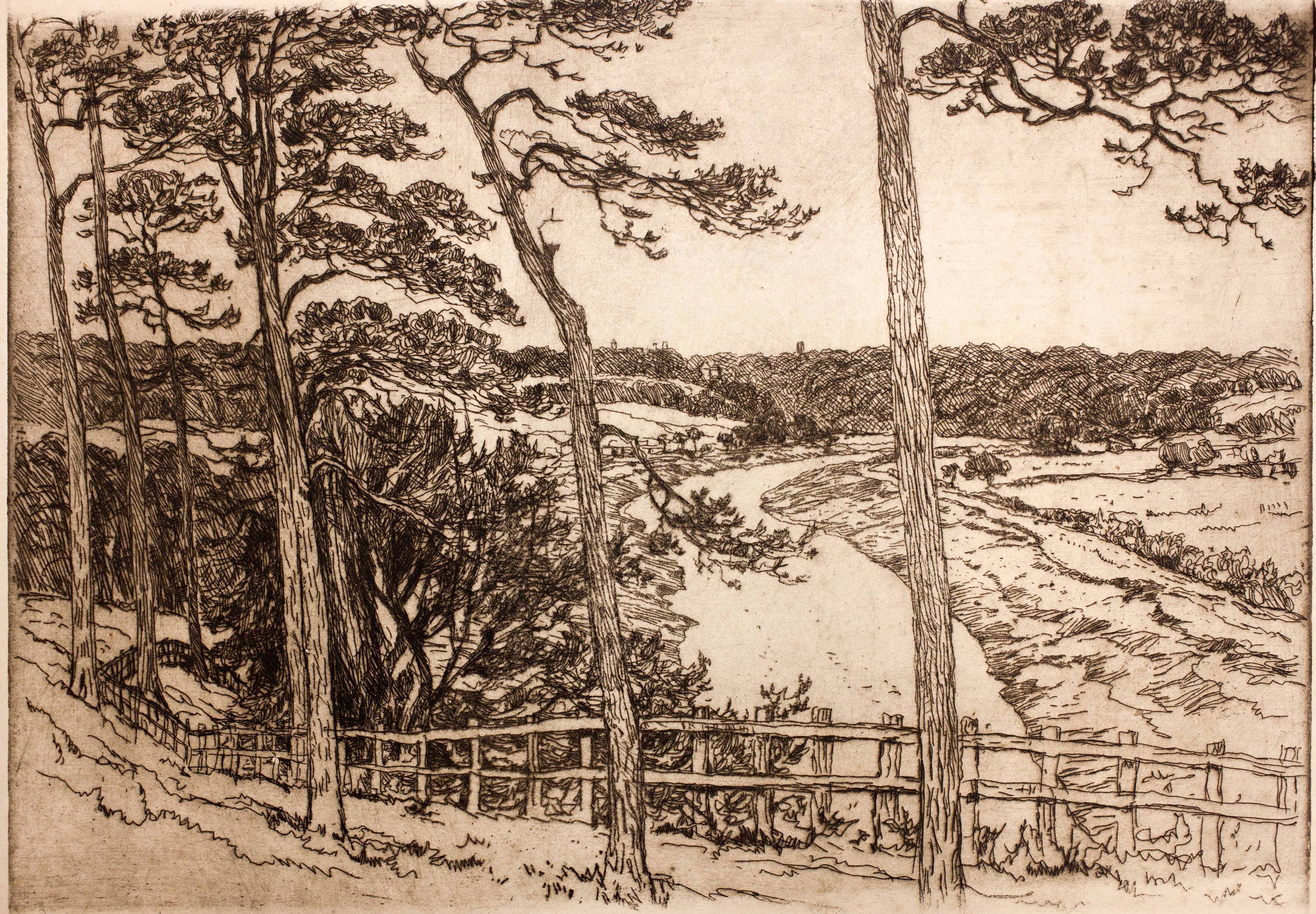
Amongst Goff’s works in Bristol museum are two etchings of Kings Weston. One, of 1907 we have discovered before and our Tree Trail guide sports a low resolution version of it, and the other completely new to us. This second view is taken from the Shirehampton Park side of the estate, where the parkland drops steeply down to Horseshoe Bend of the River Avon. It is a particularly pleasing composition with the once-famous pine trees framing glimpsed views back upstream to the Avon Gorge. This scene has sadly succumbed to the ravages of time and the Portway Road now passes through this very area.

In due course copies of all the artworks recorded will be uploaded to KWAG’s website to accompany the galleries of historic views.

Below: The Avon below Kings Weston, Robert Goff, drypoint etching. (BMAG Mb2552)

goff-shirehampton-park

New light on WWI Kings Weston auxiliary hospital. 

We’re very grateful for the following short report compiled by Ann Cunningham. Ann contacted us a short time ago and has helped add a new insight into the WWI years: 

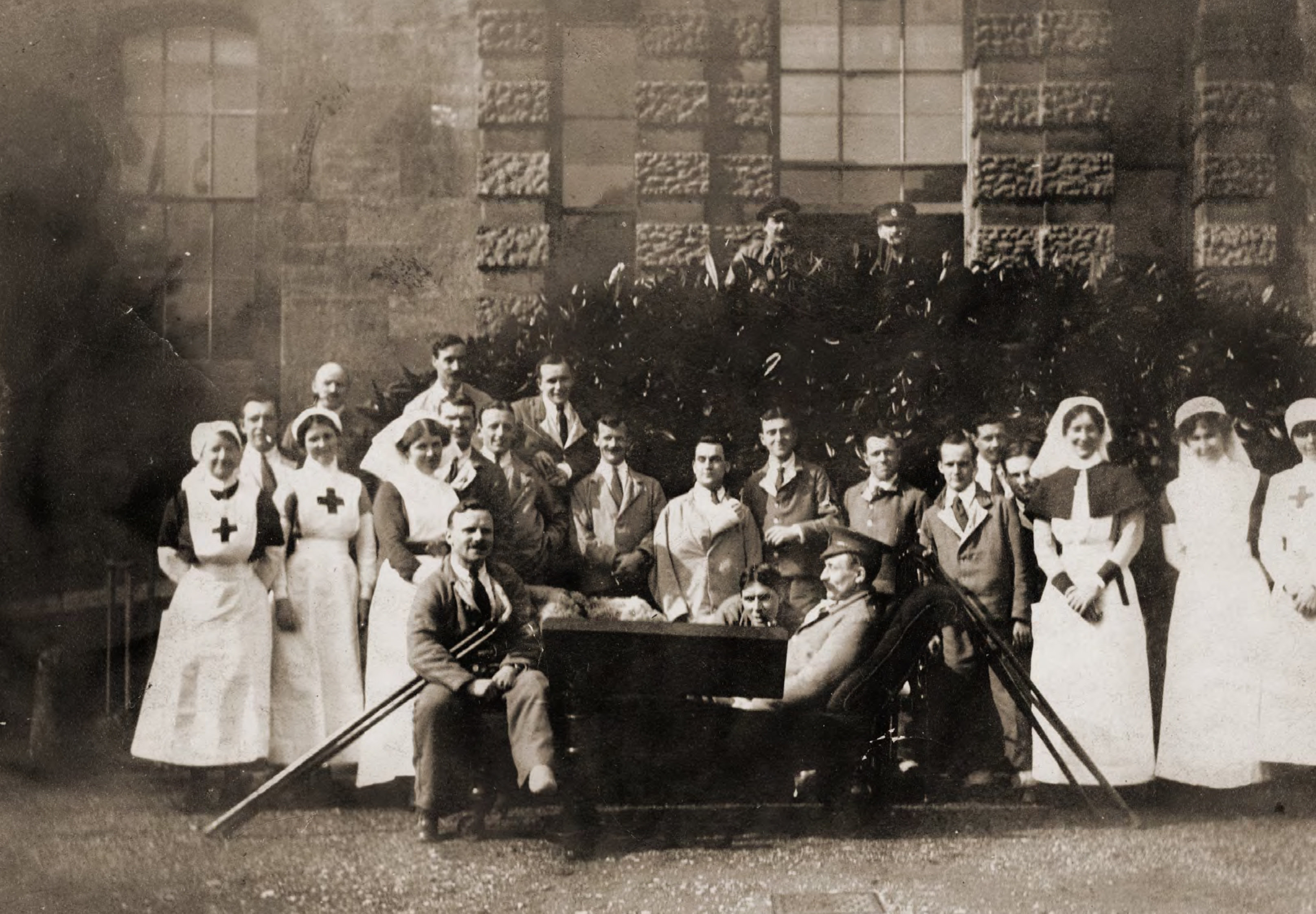
In 1914 Kings Weston House became an auxiliary hospital for wounded soldiers in WW1. From 1914 to 1919 there were many nurses and workers who came here to help and support the injured. After doing some research, I have found the following nurses that worked at the house. There are 7 in total.

Miss Hilda Prance

From May 2nd 1915 until June 1918, Hilda was here for approx 18 months.

Miss Mabel C N Moore

From May 2nd 1915 until June 1919

Miss Frances Geraldine Moore

From May 2 1915 to January 1917

Miss Ethel M. J Moore

From May 3rd 1915 to January 1917

Miss Alice Maud Muriel Borase

From Nov 1st to 18th 1916

Miss Joan Badock

Worked for one year in 1916

Miss Ethel Maud Adams

March 1918 to March 1919. Ethel was a Ward sister and also a night duty nurse.

Ethel was born in 1879 in Long Stock, Hampshire, England. Her parents were James and Susan Adams. She has the following brothers and sisters. Sarah, Annie Elizabeth, John George, and Herbert Evans.

Soldiers and nurses pose on the garden steps of Kings Weston House.


Ethel has been documented as being a Pioneer Nurse. In 1887 the first register for professional nurses was founded. It was the first in the world. It was called  the Royal British Nurses’ Association (RBNA). Its aim was to provide a snapshot of the nurses training and qualifications.

Ethel has been documented as registering in 1915, at this time it was voluntary, but by 1919 it was compulsory and finally in this year the Nurses Registration Act became law.

Further information can be found about Ethel and other pioneer nurses at http://www.kingscollections.org

Anyone that is interested in learning more about the Red Cross, what they did, or simply wanting to search for other nurses can visit: www.redcross.org.uk/About-us/Who-we-are/History-and-origin/First-World-War. Information has also been sourced from http://www.ancestry.co.uk

KWAG’s first World War exhibition boards can be viewed here

A view from an angle last enjoyed a generation ago; The garden front of Kings Weston over the recently relaid lawn after the ruins of QEH were recently removed.


Kings Weston Iron Bridge history

It is almost a year since the historic Iron Bridge  across Kings Weston Road was hit by a lorry and damaged an severed an important footpath. At last we have some good news to report: Bristol City Council highways team have now started commissioning survey work of the Grade II Listed structure in advance of physical work being undertaken to reopen it.

A structural survey is just one element of the package of information needed to ensure the most sensitive approach is taken in making repairs; A Listed building assessment and heritage report is also being undertaken by the city’s conservation team to ensure that the significance of the structure is understood, and to inform best practice in dismantling and reinstating damaged elements.

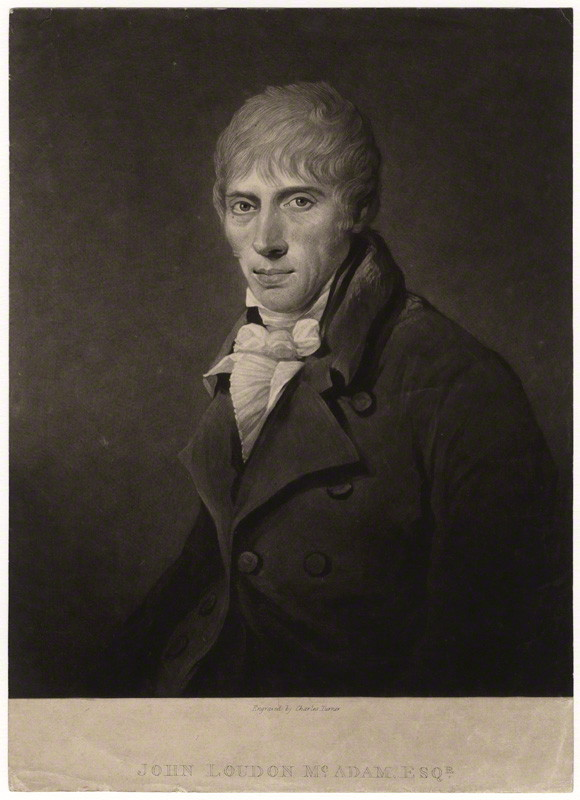
John Loudon McAdam (1756-1836)

The bridge was designed by the eminent highways engineer John Louden McAdam who, at the time, was the engineer tasked with improving the turnpike roads around Bristol. In 1819 the lane, a parish road between Kings Weston and Henbury, was turned into a turnpike road and work commenced to improve standards to justify the tolls levied on such routes.

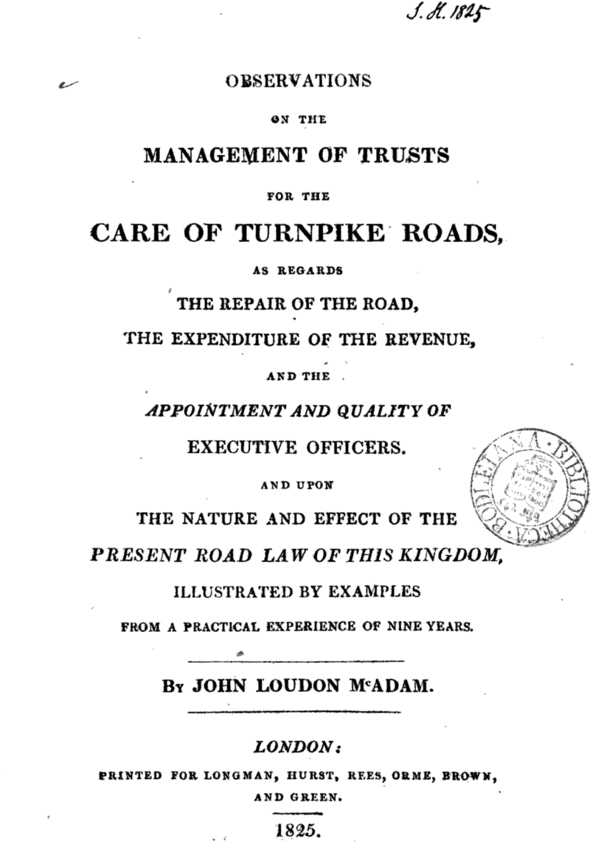
It wasn’t until 1821 that McAdam noted in his observations that labourers had begun lowering the hill and building walls at Kingsweston Hill. This would have formed the deep cutting through which the current road passes. In the following year he notes the formation of a new footpath in association with the same works which is likely to have been the track approaching the old inn from the Sea Mills direction. It’s probable that the iron bridge was installed at the same time, as the completion of these ambitious works. 

Title page of McAdam’s 1825 Observations


The bridge was constructed of more than 130 individual components of both cast and wrought iron. More technically advanced than most similar structures of the period it used a closed-mould casting technique which allowed the incorporation of strengthening flanges to the structure. New work has been undertaken by KWAG, in cooperation with the Council’s conservation team, that sheds light on the construction and fabrication of the bridge. Following a study of the structure a 3D model has been created which will now be used to inform the best approach to restoration. As you can see, for such a small structure, it’s surprisingly complex! 

The city’s highways officers are currently considering options to raise the bridge to remove the possibility of it being hit again in the future. There is also the potential that the whole of the bridge will need to be dismantled and removed before re-installation. As the project develops we hope to be able to report on progress, but physical work is unlikely to begin before spring 2017. 

exploded diagram undertaken by KWAG showing the construction of the Iron Bridge