
Both notable families of Kings Weston, the Southwell’s in the eighteenth Century and the Miles’s in the Nineteenth, were heavily involved in politics. As might be expected from any wealthy landholder, they were keen to protect their own interests as much as serve in the country’s interests. It’s not surprising therefore, to find that five owners of the estate would serve in the House of Commons, and two in the House of Lords.
Members of the Southwell family were also involved in court life and as part of Government outside of their constituency responsibilities. What’s perhaps odd to us today is that many communities they were elected to represent were very remote from their home.

Sir Robert Southwell retired to Kings Weston from Court life in London in 1679, relinquishing his Government roles and choosing not to stand again for elected as MP for Penryn in Cornwall where he’d served for six years. After William III took the throne he returned to government and was elected for Lostwithiel in 1685.
In 1702 his Son, Edward (1671-1730) was put forward as a candidate at Rye. The election went against him, but after a legal hearing in the elections committee the vote was overturned in his favour because of ‘illegal’ interference in the election. Again, Rye was very far from the Southwell’s interests and was probably what we’d consider a safe seat. Similar might be said for later elections as MP for Tregony in 1713, where he served a matter of months before a General Election, before finding favour in Preston.
As the 18th century progressed, power gradually transferred from the monarch to the House of Commons. Politics came more polarised, voters expected better representation, and political parties were a growing force. The importance of local people representing local interests also increased. Edwad Southwell II (1739-1754) was the first of his family to represent a local constituency.
When Edward was 33, one of the two MPs for Bristol, Thomas Coster, was reported in ill health and subsequently died. Even before the death was announced, Edward had already determined t throw his lot in and seek election to the vacant seat.
We’re fortunate to have a journal he kept, detailing the various machinations in the lead-up to the election in December. This gives a fascinating insight into the process and how Edward built alliances to gain support.
At the start of October, he begins:
“I had private acts and many affairs to settle to my steward Francis Benning at Kingsweston which inclined me to undertake the journey from London, but on the news he sent me of Mr Coster’s (The member of parliament) desperate state of health, I determined upon the journey after consulting my wife at how I should act in case of being invited to stand at the election, who freely bid me neither regard her nor her condition (she being then 6 months gone with child) nor my son, whereover my honour or credit or the service of my Country required my absence of stay. “

On arrival in Bristol 6th October he headed directly to the Tolsey on Corn Street where the magistrates of the city sat and much business where:
“Mr Berkeley stand me and I promised him and Mr Chester my Interest for the County which being so publick was much taken notice of. NB. Mr Coster was buried the night before at the Cathedral abd every bell in the City tolled for him from morning till night.”
He was disappointed to find that there was initially a lukewarm response to his interest, his closeness to Government and court life being held in some suspicion:
“Upon finding the name of a courtier was so obnoxious, I cooled much in my ambition of standing, I considered I was the King’s Servant, I had ever owed and paid him a personal duty and had ever gone to his court, and that I had my own principles and character to maintain as well as my duty to my country, and determined I would never yield up my respect to the King”

This might not have been an attractive attitude for the former supporters of Mr Coster, who were clearly looking for a more liberal representative in line with Whig politics. The Whig’s opposed absolute monarchy, championed parliamentary power, and individual liberty. He was forced into a position of defending his independence in order to find favour with them. Edward wrote,
“that if Mr Coster’s friends set up a man in my station, the magistrates could be able to make no opposition and that the party would take a moderate man, and were not as violent as I imagined. I told him I ever had and ever would pay a personal duty and respect to his Magesty and his Royal Family, that my place of Secretary of State for Ireland was for life and worth little more that 200 guineas per annum, and that I had refused applying for my father’s additional sallery of £300 pounds because I never would accept aan pension, but I would live independent.”
Mr Coster’s friends came round to the prospect of a gentleman of status representing them, declaring him their candidate albeit cautiously.
By November, election fever had taken over the City and Southwell found himself campaigning against Henry Coombe. Naturally, every opportunity was taken by candidates to influence voters and their supporters. Handbills and pamphlets were common, usually from alleged anonymous advocates of the candidates, particularly if they were more vicious in nature.

The house at Kings Weston came into its own at these times, offering the perfect showcase of the Southwell’s taste wealth, and influence, where voters could be entertained on a lavish scale. The Gloucester Journal reported “The Honourable Mr Southwell has kept open house at Shirehampton ever since he has declared. There are constantly employed a baker, a butcher, and two brewers to provide for the reception of all comers and goers”
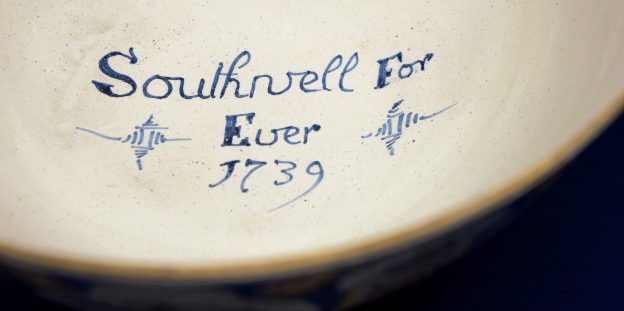
Another testament to the interest the election created is a punch bowl now in Bristol’s Museum and Art Gallery. It was commissioned from the Brislington pottery, famed for their tin-glazed ‘delft’ wares, and would have been recognisable as an expensive item at the time. Decorated in rich colours in the Chinese style of the outside, it’s only when the guests would have drained most of the contents they would discover the slogan “Southwell for ever” and the election date inside the bowl. Perhaps once they’d drunk so much, they might have been more susceptible to the political message held within.

He was declared winner on 12th December, 2651 votes to Combe’s 2203. His journal, now held in Bristol Archives, then transforms from a record of the campaign to a catalogue of the petitions and constituency work that were the inevitable outcome of political position.
Southwell remained true to his promise of independence, showing no consistency in supporting either Whig or Tory, Administration or Opposition, positions. Although perhaps true to the wishes and interests of Bristol, Southwell’s unreliability attracted few friends in the House. The 2nd Lord Egmont, related to Southwell by marriage, wrote dismissively of his kinsman:
“Southwell is a weak man. Has an affectation of being supposed to act according to his conscience, which directs him to vote one day for a proposition in a committee, and the very reverse the next day and in the House. They think him an honest man at Bristol but they have no opinion of his understanding and I believe if occasion were, he might be easily changed—But if not he will be as often for us as against us!”
Despite frustrating other politicians, Southwell maintained support from Bristol’s voters, representing the city until 1754, when, due to ill health, he chose not to stand. He died the following year.
It would be the same 2nd Lord Egmont who’d criticised him who would support Edwards son, Edward II (1738-1776) for election to Bridgewater in 1761. Seeing an opportunity to represent his native Gloucestershire, he declared as candidate two years later. He represented the county for thirteen years before being elevated to the House of Lords in April 1776 and vacating the seat.