
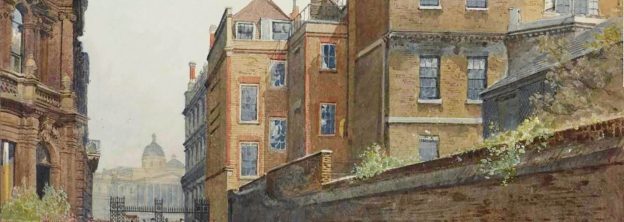
Kings Weston was the country estate of the Southwell’s from 1675 to 1832, but every landed family of note also maintained a London address. The Southwell’s were no exception, and their interest in London pre-dated their acquisition of Kings Weston.

Sir Robert Southwell made himself indispensable to the government of King Charles II on his return from his Grand Tour of Europe in 1662. By 1665 he had been knighted and held important government and diplomatic roles. Four years later he was sufficiently well off to purchase a lease from the Crown for his own property close to the heart of Court life in Whitehall.
He bought the reversionary lease on a parcel of land called Spring Gardens that backed on to St James’s Park. There was a brick-built house here, around 20 years old, and a small park, where he set up home.
Sir Robert’s circle of friends was drawn heavily from other members of the Royal Society. His interest in the Natural Sciences had encouraged him to become an early member of this auspicious group of learned gentlemen. One of his closest friendships was with Robert Hooke; Southwell was noted for his outgoing and genial character whilst Hooke was a man noted for his difficult and irritable temperament, but the two bonded over their interest in science.
Hooke was one of the most important and prolific scientists of the era. As well as interests in astronomy, geology, mechanics, and microscopy, Hooke was an accomplished architect, perhaps second only to Sir Christopher Wren at the time. Indeed, he succeeded Wren as Surveyor of the Royal Works in 1670. Perhaps his best known work is the monument to the Great Fire of London, still standing close to the site where the fire began. It was to his friend that, in 1674, Southwell turned to provide drawings for the rebuilding of his Spring Gardens house and paid him 5 guineas for his trouble.

A drawing survives today in Bristol Archives that likely represents Hooke’s plan for the building. It was a substantial town house for the era, its status marked by being set detached in its own grounds. It was designed with two wide frontages of seven bays each, set out over four floors, with the semi-basement housing services and the attic of garret floor being the usual servants’ accommodation. The family rooms occupied two floors: ground floor elevated above the street by nine steps and ’piano nobile’ at first floor equipped with a large dining room where grandstand views across St James’s Park could be obtained.

The external appearance of Sir Robert’s new house is detailed in an engraving of 1720, after his son Edward had inherited it but largely unchanged. Here it is in its ‘perfect’ state, before alterations and development around it. It was a smart but unostentatious building, brick-built but with stone quoins at its corners. As was fashionable at the time, it had a modillion course (a projecting cornice) supporting a hipped roof. The engraving shows a balustrade around the leads of the roof, providing an elevated position for guests to enjoy distant views across the park. The gardens around the house are depicted behind high walls, formally arranged, and with ornamental garden buildings dotted about.


As might be expected, land in London was valuable. Even though much of Court life moved away after Whitehall Palace burned, Westminster remained the seat of Government, and at the periphery of the Royal Park, land was in demand. The Southwell’s had begun capitalising on their central-London estate by gradually developing it with new houses. Already, in 1668, in Sir Robert’s time, new houses were built to let.
Initially, new houses were large, detached, and with their own gardens, but made inefficient use of the land. By the early 18th Century the market demand for courtly town houses had waned, replaced by a demand from politicians and civil servants for houses close to their places of work. Sir Robert’s grandson, also Edward (II), quickly reordered the London estate when he inherited in 1730. He set out a formal new street of smart terraced town houses preluded with a new chapel for its residents. He also allowed the gradual encroachment of buildings on the family’s home.

Spring Gardens house remained the family’s primary London residence, the family alternating between here and Kings Weston seasonally, or when business or society dictated. Significant sums were invested on extensive renovations in the early 1750s. It’s not clear who the architect of these works would have been, but both the interior and exterior were modernised in fashionable taste; hipped roofs were done away with or hidden behind Palladian parapets; an additional storey was added to the garden front; a new polygonal bay in the same elevation became its focal point, its crown ornamented with a stone balustrade.

Eventually, the street frontage of the house was bookended by more Georgian town houses, the only indication of its higher status being its set-back from the street. A rather unsightly high wall created some privacy from the pavement, whilst a long single-storey passage and pedimented entrance brought the front door directly to the street.


With Edward Southwell III’s elevation to the House of Lords as Baron de Clifford in 1776, the house now lacked the social status appropriate to his station, but on his untimely death the year later he left it to his wife Sophia; she appears to have been the last of the family to live there. Their son, Edward, 21st Baron de Clifford, the last of the Southwell’s of Kings Weston, built himself a new London residence in Carlton House Terrace in 1827.
The old house survived, converted to offices for the Admiralty, but was finally erased in favour of new purpose-built Admiralty offices. Today, the site lies beneath the northern wing of Admiralty Arch spanning The Mall connecting Buckingham Palace with Trafalgar Square.
