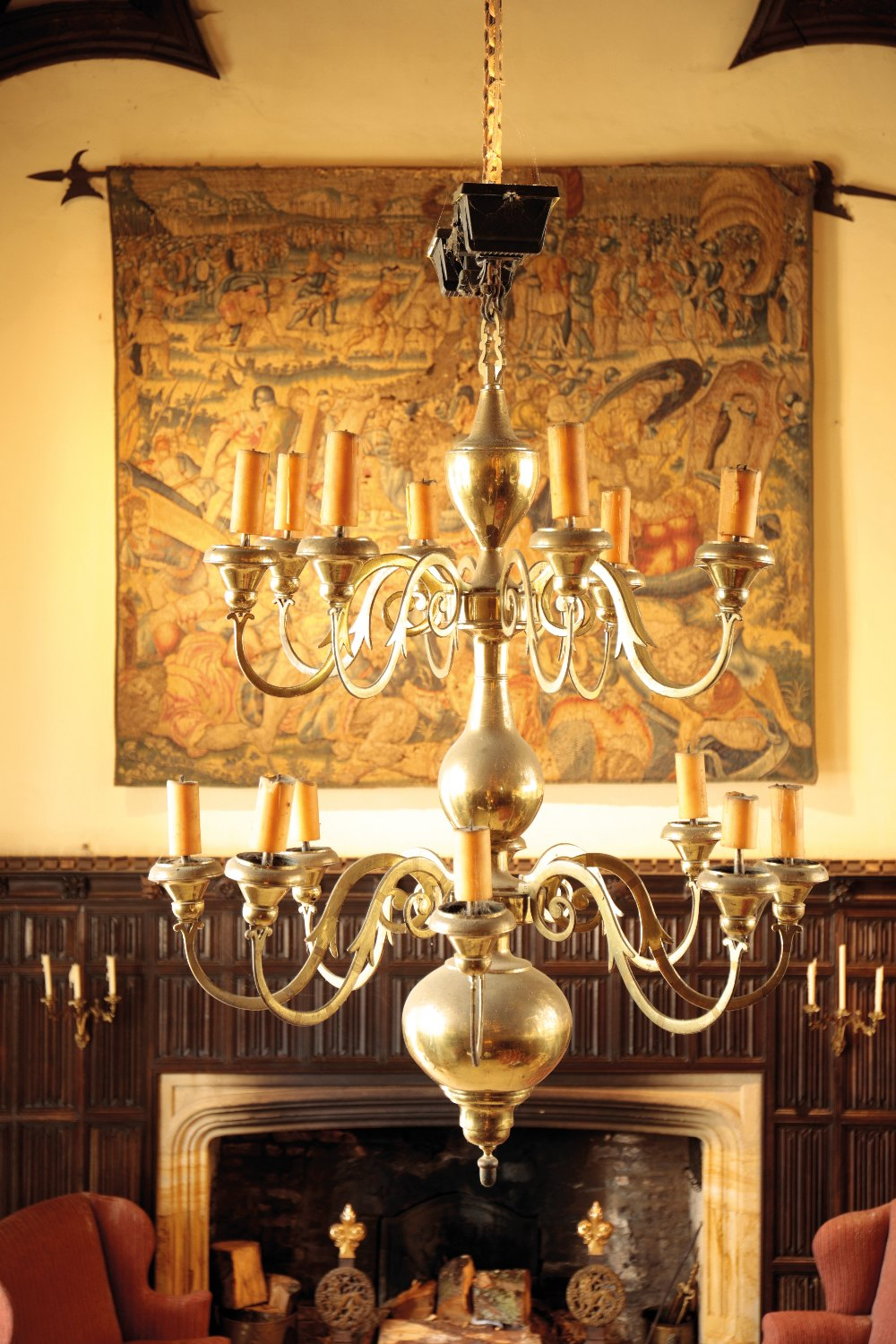
The chandelier from Kings Weston hanging at Athelhampton House.
We recently discovered an auction lot of Kings Weston interest was coming up for sale shortly. It was a shock to find that Athelhampton House in Dorset was selling its entire contents, amongst which is a brass chandelier which formed the centrepiece to the main hall of Kings Weston until recent times.
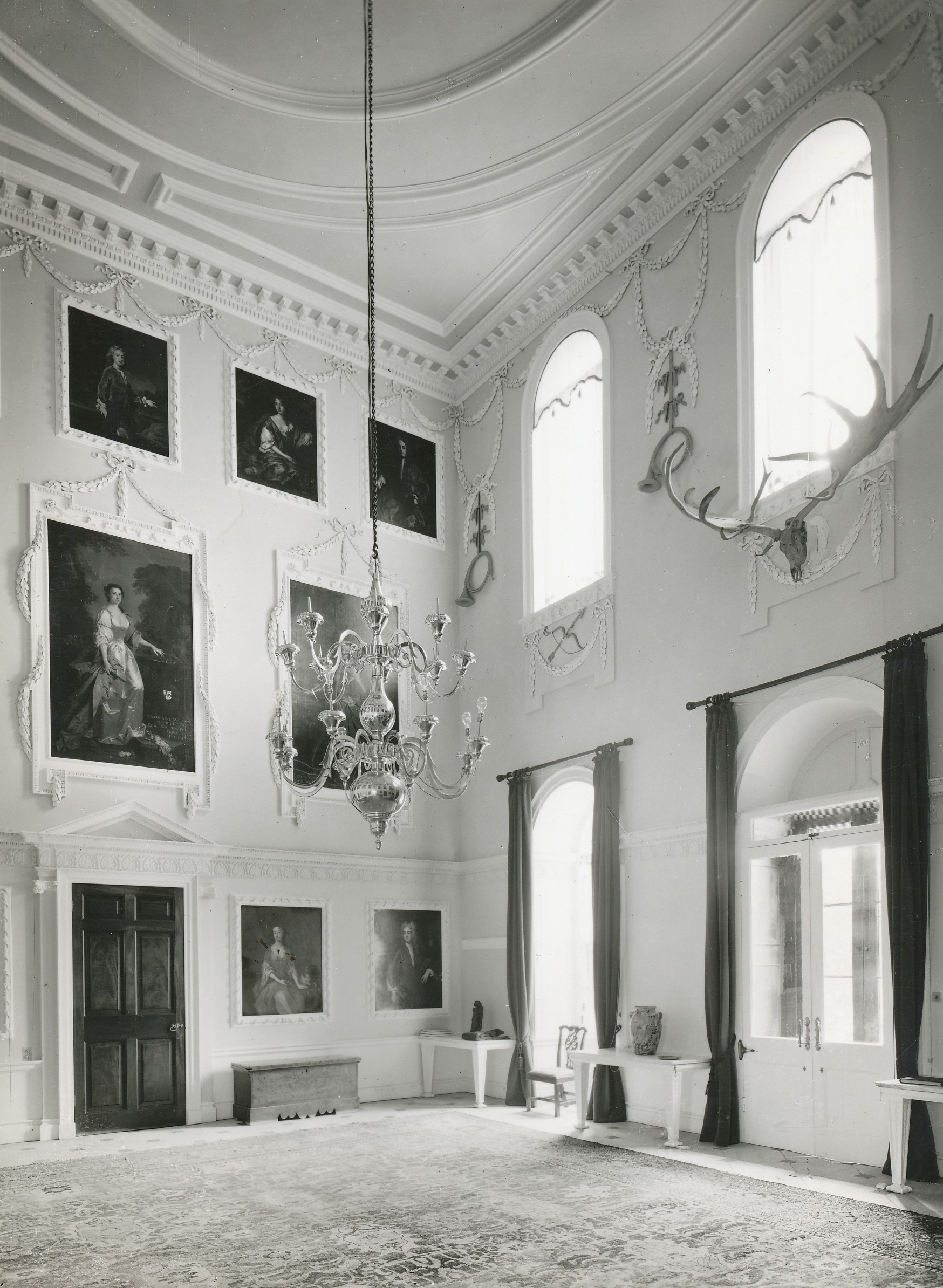
The chandelier was part of the redecoration of the house in the mid-Eighteenth Century and forms part of its original interior design scheme. It disappeared from the house sometime in the 1960s or 1970s, sold-off by Bristol Technical College during their occupation of the building; it was replaced by a rather depressing and incongruous light fitting until this was replaced with a more suitable modern chandelier in about 2000.
The chandelier in its original location in the hall at Kings Weston, 1927
We have known for some time that the original ended up at Athelhampton, though we’re also aware that there was never any Listed building consent for its removal. This has always led to the paradox that it was in another Listed building where it might contribute to the special interest, whilst it should still be in Kings Weston house. We assume that, as it is now being sold, that Historic England are satisfied that it’s not integral to Athelhampton’s importance as an historic property.
With the chandelier coming up for sale there are questions whether it should be returned to Kings Weston, having been removed without consent and against Listed Building legislation. For the moment the chandelier is up for sale by Duke’s auctioneers with a guide price of £2000-£4000. For anyone who might be interested in bidding on the lot and returning it to Kings Weston the auction is to be held on the 9th of this month, and it’s Lot 11 in the auction which will be held inside Athelhampton House. It’s worth noting that the lucky buyer is required to dismantle and remove the chandelier at their own cost.
The interior of Kings Weston House in about 1973 about the time it was taken on by Avon & Somerset constabulary, and with the incongruous modern lantern hanging in place of the original. At this time the paintings were removed for safety.
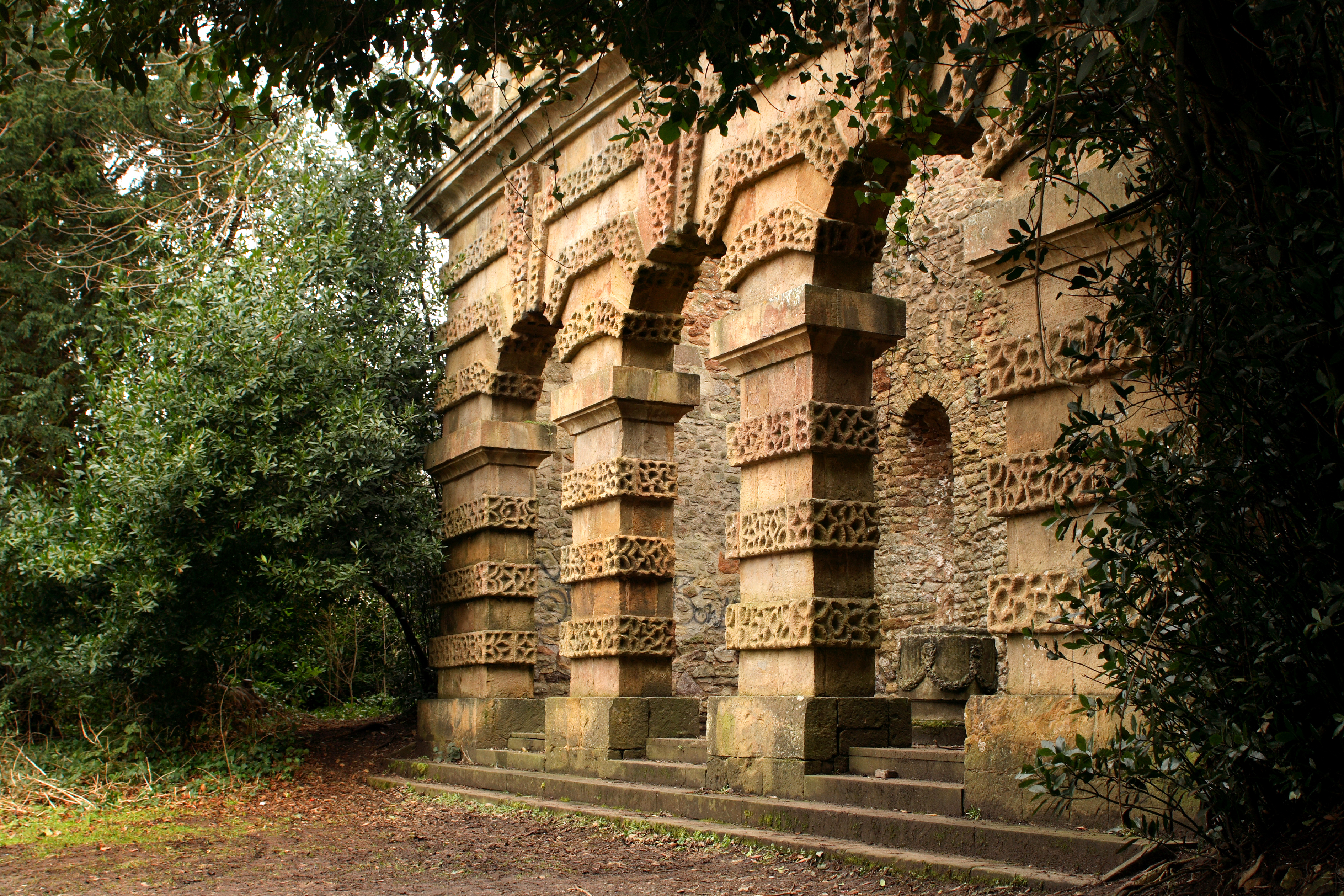
The Echo at the end of the gardens from the house, was an important addition to the Kings Weston landscape in about 1724. Edward Southwell had finished work on the house itself and moved in in 1716 with his new wife Anne Blathwayt. Sadly Anne died the year after and it was a little while before Edward returned to his architect, Sir John Vanbrugh, to turn his mind to further elaborating the estate.Plans began in about 1720 when Edward began buying up land to extend the parkland, and had a map drawn up to further this expansion. We know from this that the long axial path from the house terminated at nothing more than a wall dividing the grounds from a public lane behind; parts of this was can still be traced in the rear structure of the present Echo building.
The Echo today
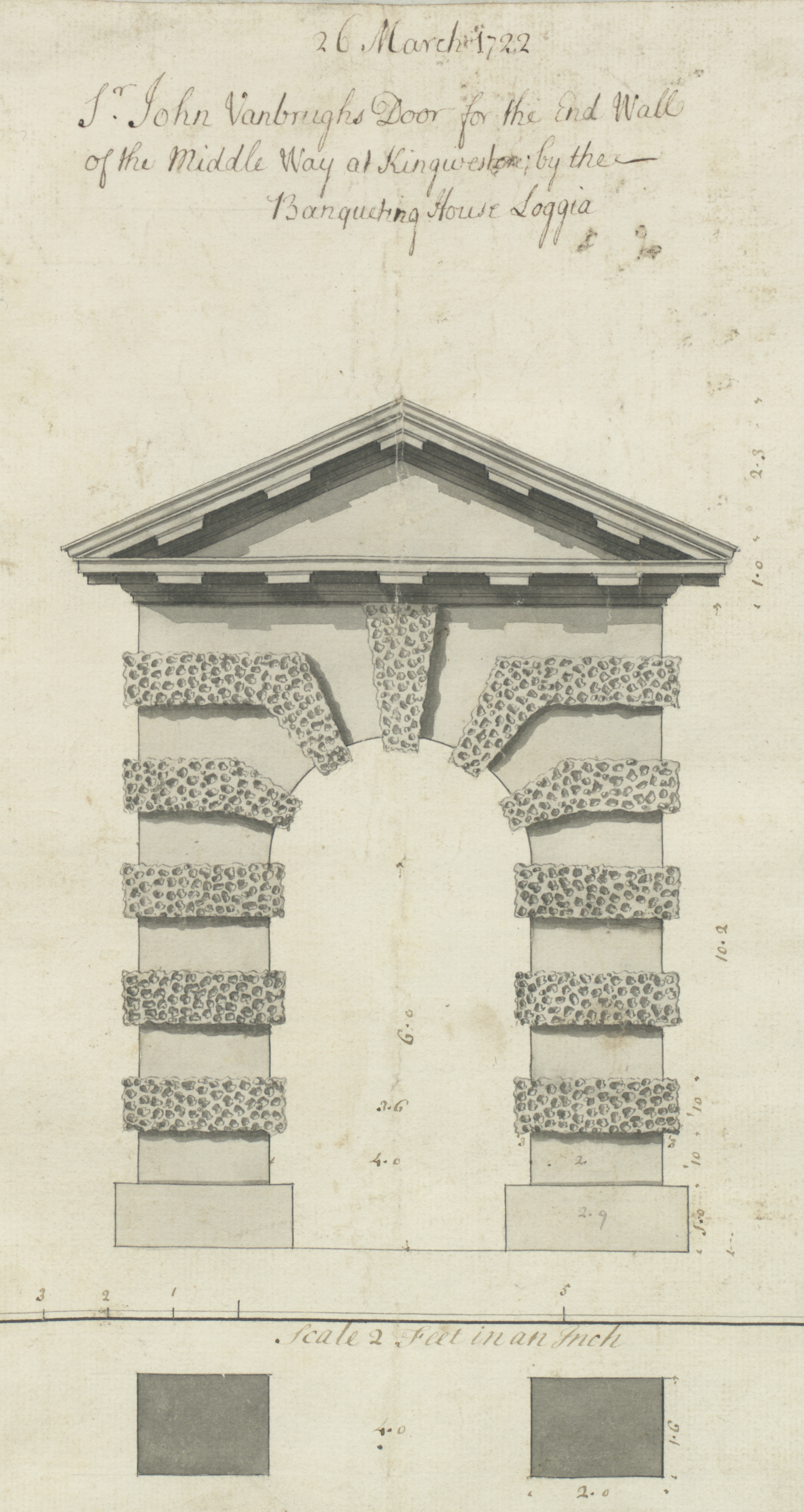
1724 proposal for an arched entrance gate by Sir John Vanbrugh. (Bristol Archives)
The echo at Kings Weston Was already a well knows acoustic feature. The gradually rising ground allowed sound to reflect back off the front of the house and echo back down the garden in a remarkable way. The termination of the axis from the house with a suitable celebration of this effect, and an eye-catcher from the house, would have seemed an ideal opportunity to provide an ornamental monument.
The Echo, as the pavilion was to become known, is one of the few buildings at Kings Weston where there are no original drawings known. In Bristol archives there is a design by Sir John Vanbrugh for another structure, an ornamental gateway that was to stand at the end of the terrace on the north side of the house; with its boldly handled rusticated piers and arches this has more than a passing resemblance to some of the features of The Echo. The drawing is dated 1724 and it is reasonable to assume that it echoed architectural developments at the other end of the garden at this time. This coming weekend we will try and compare the measurements of this drawing with those of the Echo and see what conclusions we might draw. The dramatic urns on the parapet of the finished building are also strongly redolent of Vanbrugh’s work, with a series of similar features in the gardens at Blenheim Palace.
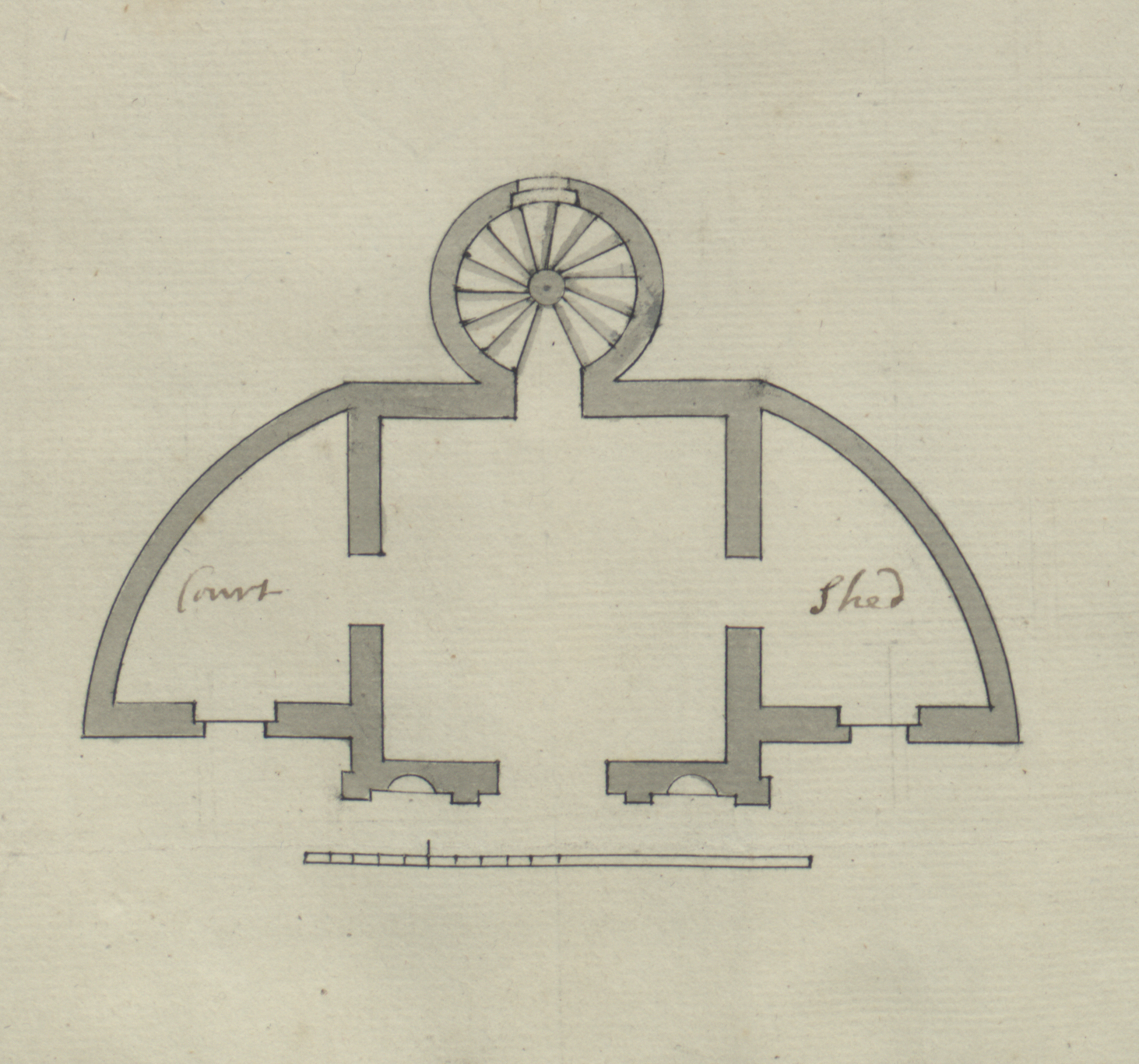
In the tradition of gardens at the time the Echo would have terminated the long axis through the landscape with a series of formal gardens either side of it. There never seems to have been a viewing terrace on the roof of the building, which might have capitalised on views back to the house and across the landscape towards Bristol. Another drawing in Bristol archives does show the plan of a garden pavilion that would have afforded this; it had a single ornamental frontage with odd carved rear walls and a stair tower at its rear, but, other than its inclusion with other known Kings Weston drawings, there is insufficient evidence to suggest it was even considered for Kings Weston.
Was this a plan for the Echo?
The little building served no more elaborate purpose than a place to sit, admire the view back towards the house, enjoy the echo, and perhaps enjoy a summer meal. The arches were never glazed in, but the roof, that once sheltered visitors, disintegrated and collapsed in the 1950s; the scars of this can still be seen in the structure today. Efforts to demolish the garden buildings in the 1970s were fortunately resisted, and eventually the Echo was patched-up and restored. The Echo remains an important landmark in the park, a focal point on the main walking circuit, and a Grade I Listed building. The gardens that once swept down the slope to the house have been overtaken by woodland, and views between the two buildings lost or diminished. Sadly the echo from which the building got its name has also been diffused. But this weekend we will be celebrating the building again by holding our Doors Open day event within it. Come along and find out more about the building and its history on one of our short tours to be running throughout the day.
Ahead of August’s Working party, when we’ll be returning to Penpole Point, KWAG have produced a model of the long-lost Penpole Lodge, a building that remains with us only in ruin today. As with the reproduction statue described last month the model is intended to broaden understanding of the lost feature, and show what an imposing architectural statement it once was. In 2012 KWAG fully revealed and recorded the ruins with the assistance of South Gloucestershire’s county archaeologist, but the area is beginning to succumb to undergrowth once more.
The building was designed by Sir John Vanbrugh as a belvedere and monumental landmark for Edward Southwell, and was designed to dominate the horizon in views from Kings Weston house. The building was a return commission for Vanbrugh who’d been responsible for the rebuilding of the house between 1712 and 1719. After its completion the pair looked to expand the parkland setting around the mansion and ornament it with fashionable garden structures, including Penpole Lodge.
Below: One of Sir John Vanbrugh’s proposals for penpole lodge showing the unexecuted colonnades on the shoulders of the gate
Below: one of Vanbrugh’s more robust designs for the building, circa 1724
Several drawings for the lodge exists showing variations on the design, one with a colonnaded veranda overlooking the Severn, but in the end a symmetrical tower built over an arched gate at the boundary of the private grounds was decided upon. It is dated to about 1724. Our reconstruction shows the building as-completed and recorded prior to demolition in the 1950s. We’re fortunate that students from Bristol University architecture school created a measured survey of the whole building in 1947, showing plans, sections, and key details, for it was to succumb to the wreckers in 1951 following decades of neglect, and the deprivations of wartime use by the Home Guard.
Whilst the Lodge appeared frequently in picture postcards of Penpole Point at the start of the Twentieth century these only captured the less ornamental side facing public common land. The façade facing Kings Weston house across the park was more refined and ornamental and only known to us through the 1947 drawings.
Penpole Lodge as backdrop to the stone dial on Penpole Point, circa 1905.
We reported a few months ago about the Urban Buzz project and the new wildflower meadow seeded below Kings Weston house; we’re glad to say that the first year has proved a success with a large number of new native annual wildflowers having bloomed over the last couple of months. Yellow rattle last month preceded an unprecedented show of poppies over the last couple of weeks, along with many others. It’s important to note that these flowers are only the annuals, with the majority of perennial wildflowers unlikely to show unto next summer. We look forward to see the results!
The wildflower meadow has leapt to life since seeding was carried out earlier this year.
It’s also been a pioneering year for the regrowth in Penpole Wood, where just three years ago there was nothing but cherry laurel. One of the advantages of re-covering areas we dealt with in 2016 is that we can appreciate quite what a difference volunteers have made. Although barren immediately after our operations areas have now exploded into new growth with many native woodland wildflowers broadening biodiversity, and offering new habitat and vitality to the woodland floor. If you can help identify some of these please let us know.
Of particular curiosity is the incredible growth of wild raspberries throughout the woodland areas. A resident told us some time ago that they recalled some that grew near the Echo, but the extent of the fruiting canes across the historic landscape is a surprise, particularly where the blight of laurel has been conquered.
Just a selection of the wild flowers and plants that have begun to recolonise cleared areas in penpole Wood.
In 1868 a fierce political fight broke out between Conservative and
Liberal supporters each eagerly supporting their candidates in the city’s
by-election. This was an age where electioneering could generate bitter
personal attacks and even physical violence and the 1868 election was amongst
the most divisive.
Standing as the Conservative Party candidate was John William Miles, brother of
Philip William Skinner Miles of Kings Weston House and resident there for much
of his life. The Miles family bought Kings Weston in 1834 after Lord de
Clifford had died in 1832 without an heir. John Miles’ brother, and
his father before him, had both represented the city for an unbroken period
between 1835 and 1852. John Miles no doubt wanted to continue the family’s
political legacy.
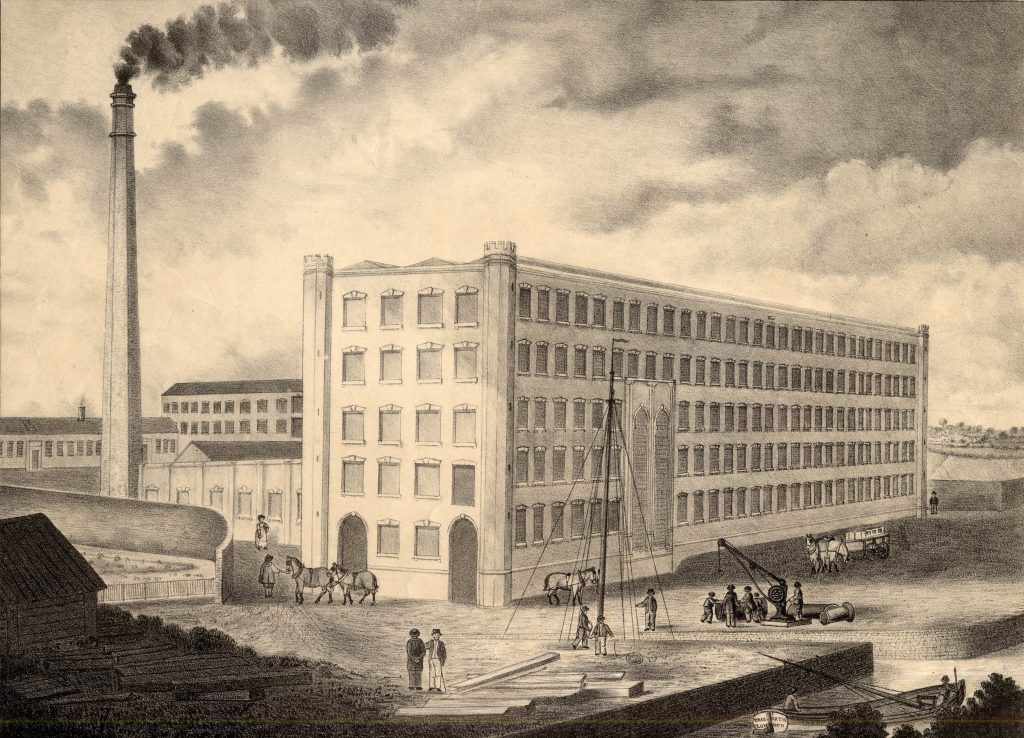
The Great Western Cotton Co, Barton Hill, that Miles helped found
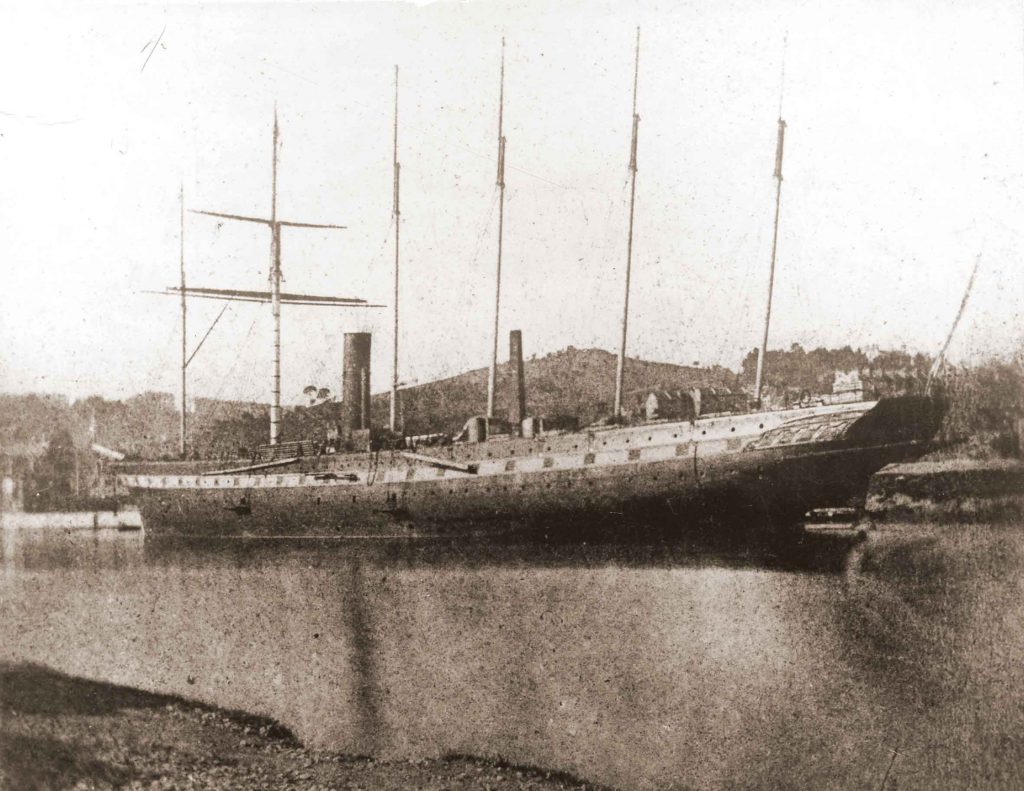
Like the other members of his family John Miles was keenly and actively involved in the industrial development of the city, but also worked tirelessly in modernising the farms at Kings Weston. He was director, at one time vice-chairman, of the Great Western Railway, a director of the Great Western Cotton Company, South Wales Union railway, and director of the Great Western Steamship Co; the SS Great Britain was registered in is co-ownership. He had been a member of the Bristol Docks committee and on the city’s council. He was a well-respected member of the mercantile class of the city, and would have made a popular choice to follow in his family’s political footsteps.
The SS Great Britain Shortly after launch in 1843. The ship was registered jointly in John William Miles’ name.
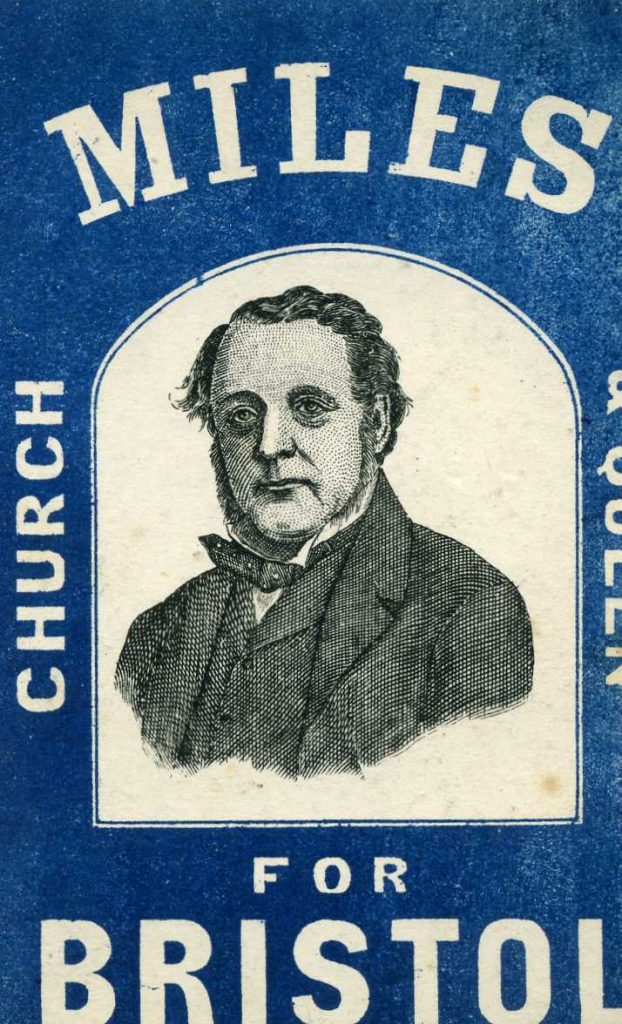
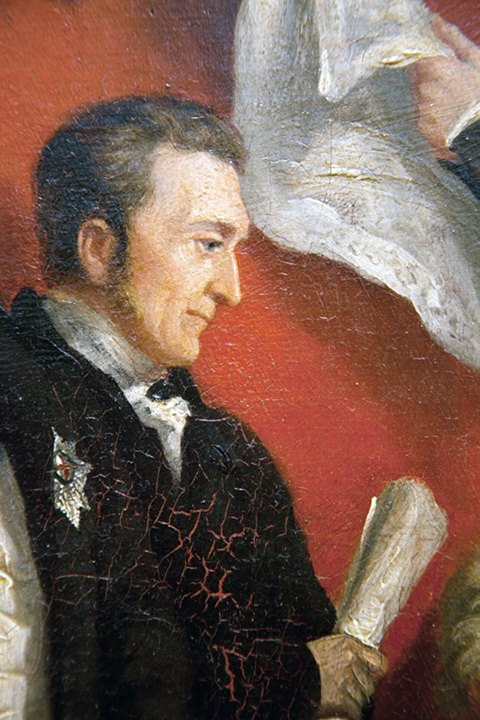
John William Miles portrait on a handbill for the 1868 by-election
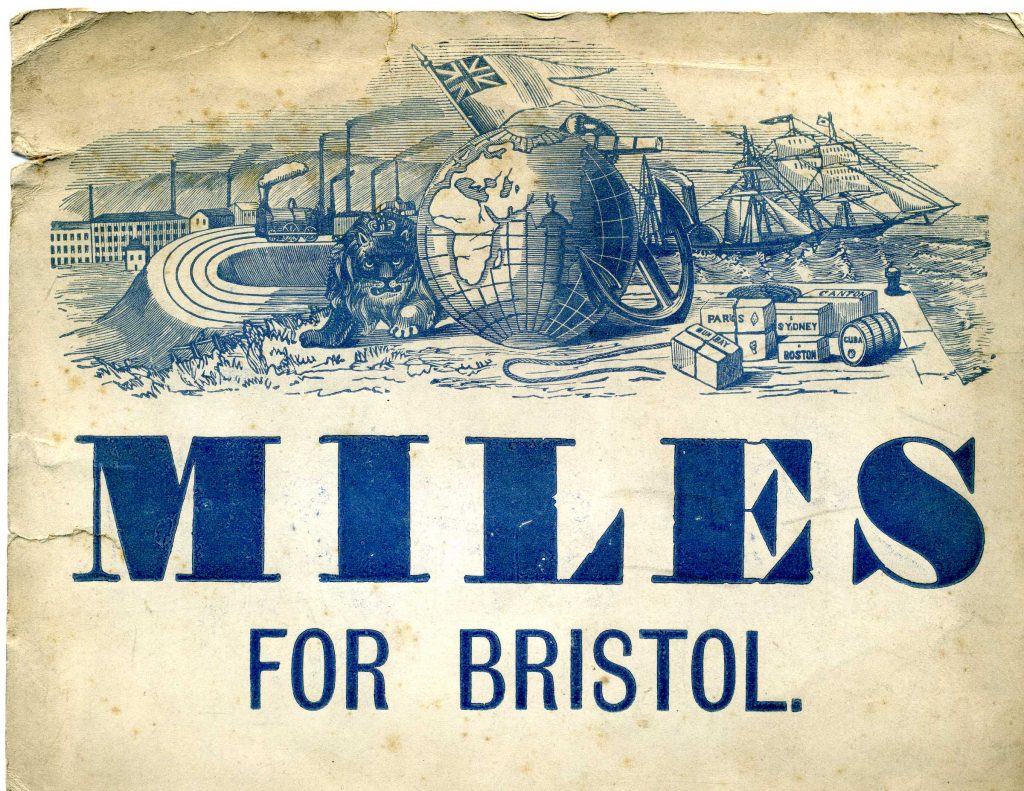
Against Miles the Liberals selected Samuel Morley, who today is best known for his statue in gardens in Lewins Mead. Campaigning was frenetic, with both parties producing handbills and posters both promoting their own candidate and demeaning the opposition. Miles handbills, many now in the collections of Bristol Museum, promoted him as a positive vote for industry and prosperity with images of shipping and the railways with which he was associated being popular motifs.
Several also carried images of the man taken from a contemporary engraving from which we could infer he was a stocky joyless looking gentleman. In reality he was well known for getting involved in family life, participating in theatrical performances, and took pleasure in breeding ferns and orchids; but perhaps the severity of the portrait suggested a man with more gravitas.
Miles’s industrial, railway, and maritime interests illustrated on a handbill along with an anchor: part of the family’s arms.
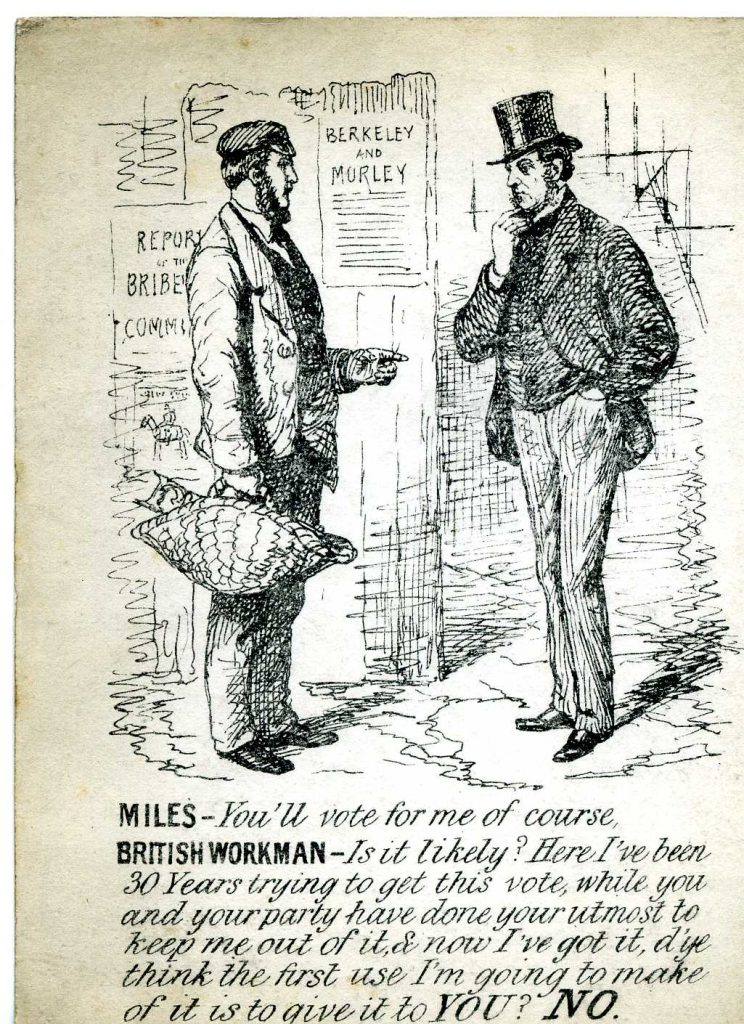
Liberal handbills criticising Conservative opposition to better representation.
His opponents sought votes from the working classes rather than those mercantile or gentry. They noted that the Conservatives had been against broader political representation and, even at this point in time there were only around 25,000 men in the city eligible to vote.
Polling day was 30th April 1868 and Miles attracted 5,173 votes to Morley’s 4,977. Almost immediately after the election results were announced there were claims of foul play. Mr Morley claimed his defeat was due to “an undue use of money, beer, and intimidation”. The House of Commons launched an investigation and, although Miles was inducted into the House, it was only so for less than two months before the result was declared void. The committee charged with investigating the election uncovered the hiring of “roughs” to intimidate voters, with wholesale use of treating to entice votes, and paying ineligible men to impersonate voters. Miles was, through his agents’ actions, found guilty of bribery.
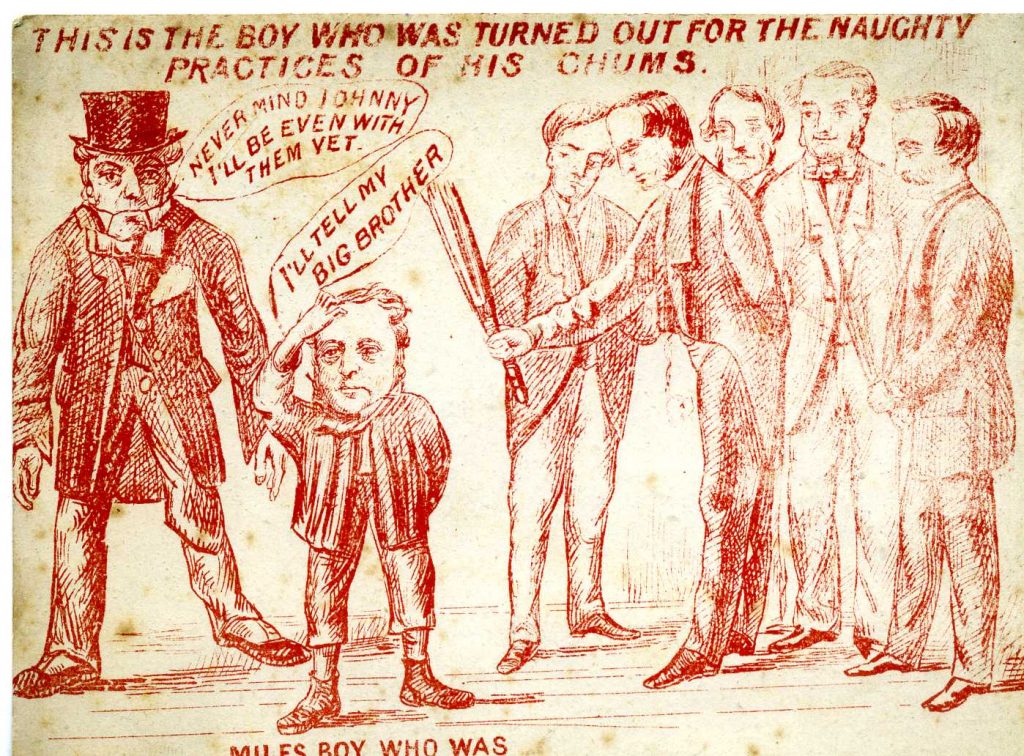
Handbill produced after the finding of bribery against the Miles camp, and showing both John William Miles and his elder brother Philip William Skinner Miles, both of Kings Weston house.
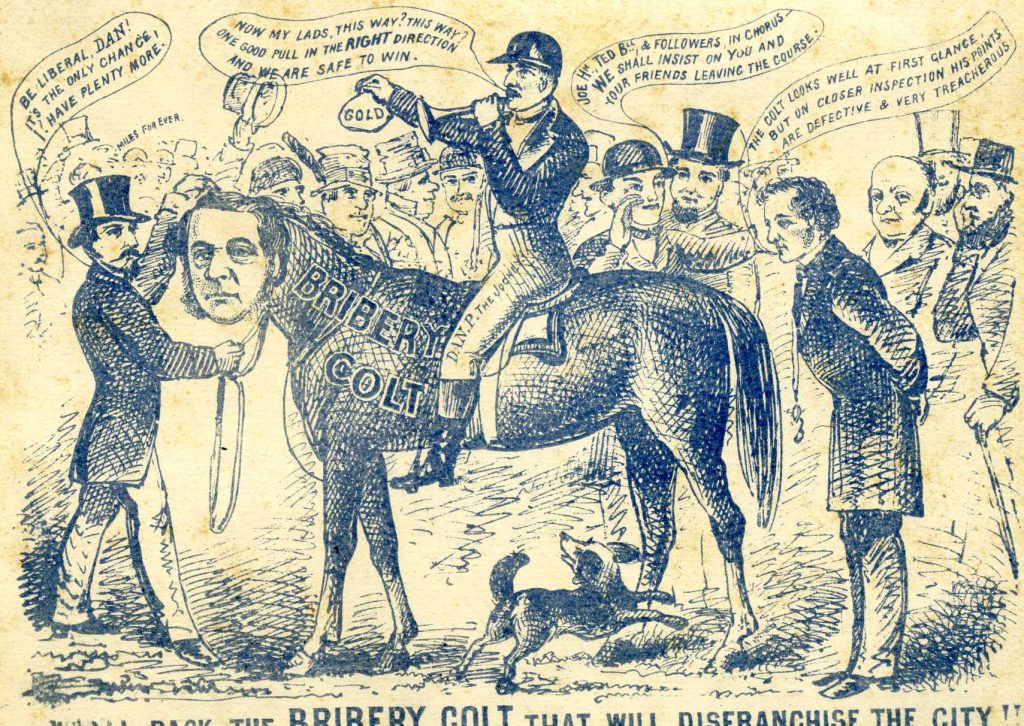
The election was not re-run, instead it was held back for the November General election. There was considerable ill feeling in all camps following the incident and, perhaps foolishly, Miles was fielded as the Conservative candidate again. This time the opposition had a cause and were vociferous in their condemnation of Miles. Numerous damning and sensationalist handbills were published, and the bitterness boiled over into violence and vandalism with damage to property. Unsurprisingly Miles’s vote collapsed and both candidates fielded by the Liberal Party came in ahead of him.
John Miles’ face superimposed on the colt of bribery in one of the most undignified of handbills against his election.
It was a sad end to the political ambitions of the Miles family who had previously been popular and well regarded representatives of their city. The actions of the party agents brought shame on the Miles family and on Kings Weston. John’s two months were the last time any resident of Kings Weston house represented Bristol in the House of Commons. John Miles returned to improving the agricultural progress of the Kings Weston estate, and died at Penpole House ten years later. He never married.
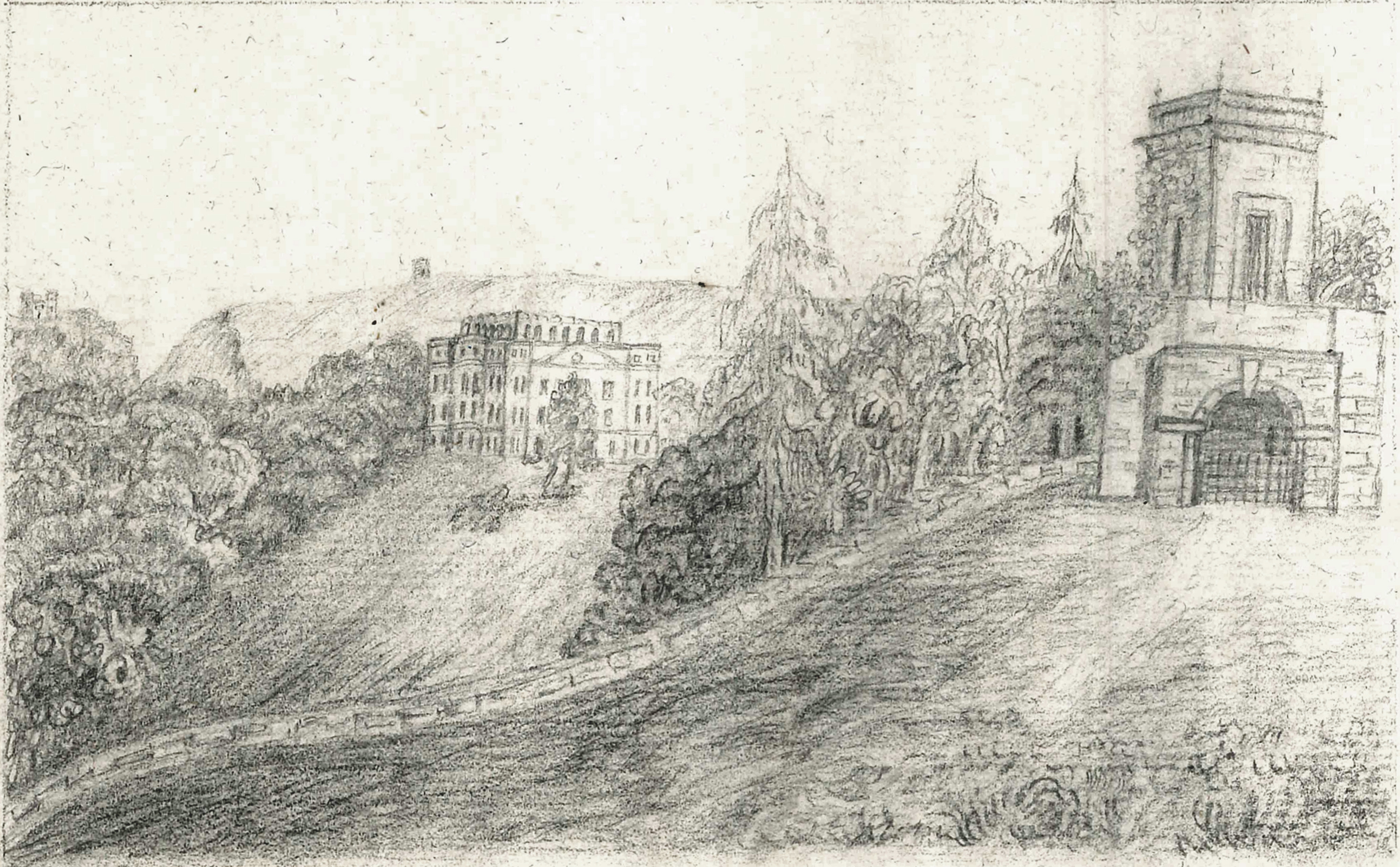
Something more new to the Kings Weston story is this small pencil sketch of the house viewed from Penpole Point. In the foreground is Penpole lodge, lost to the sledgehammers in 1951. Several similar views exist, but this one differs from all of them in the detail shown so must be an original scene. It dates to the 1820s and, in the distance, both Blaise Castle and the former windmill on the brow of Kingsweston hill can be seen. The windmill was partially reused during the Napoleonic wars as part of a signalling station, but disappeared soon after.
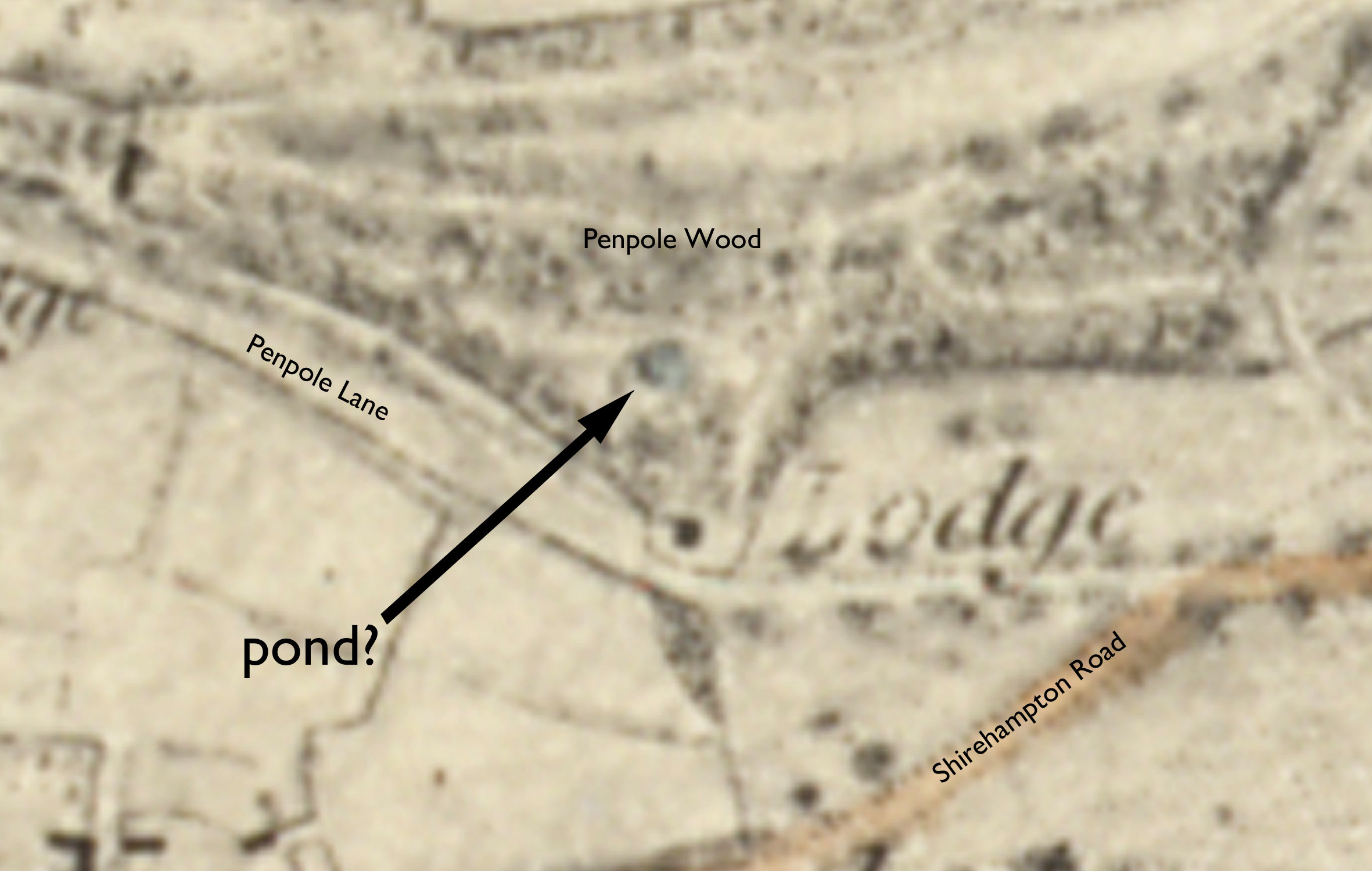
Something came to notice just recently that raises a few questions. A map of Bristol, an early production by the Ordnance Survey in 1826, has suggested a previously unknown garden feature in Penpole Wood. Looking closely at the detail it suggests that there may have been a pond in the area called Jubilee Clearing between Penpole Point and the cricket pitch.
Ordnance survey map of 1826 showing the whole of the Kings Weston Parkland Other maps and plans of the estate from similar dates show nothing in the area, lack detail, or are unreliable in what they show. That there is clearly an, albeit tiny, blue dot in the woods of such a highly detailed survey is strongly suggestive that such a water feature existed, though nothing can be seen above ground today.Detail of the 1826 map showing the possible pond feature hidden in the woods.
Edward Southwell, 21st Baron de Clifford
The area still retains a number of unusual specimen pine trees, unusual species only recently introduced to the country in the Nineteenth Century. Along with a glade with a water feature they might have made an attractive garden. In 1826 Kings Weston was owned by Edward Southwell IV, the 21st Baron de Clifford. One contemporary wrote of him:
“The great enjoyments of Lord de Clifford when at home was planting shrubs and trees. Many thousands were planted under his directions. I can picture him now as I often saw him, a little insignificant man riding on a very quiet horse followed by John Webb, his favourite groom, to superintend operations.”
It is possibly him responsible for laying out whatever garden might have formerly been in this area. We hope to be able to inspect the map, currently in the British library, to look closer at the detail and hopefully come up with some answers in the future.
Following from last month’s focus on the garden village connections with Kings Weston, and the genesis of Sea Mills, this month we look at Shirehampton Park. The land between Shirehampton Road and the River Avon had become part of the landscaped parkland around the house in the 1720s, with designed garden features, tree planting, and pleasure buildings dotted around over 100 acres. It’s even thought that at the banks of the Avon there was access directly to the park from the river at Crabtree Slip. The land was grazed by animals, but intended as a picturesque adornment to the wider Kings Weston Estate. This remained the situation even after the Port and Pier Railway was driven through the park in 1865, severing it from the riverside.
Shirehampton Park and the view across Horseshoe Bend. John Syer, circa 1860. Bristol Museum & Art Gallery.
It was Philip Skinner Miles, owner of Kings Weston, who promoted and financed the building of the railway through his land. Advantage was taken of this new mode of transport when, starting in 1865, Miles began opening the park for an annual horticultural show. A temporary railway platform was erected alongside the line where special trains would stop for visitors to the show could alight directly for the show ground in the “beech avenue” in Longcombe, a hidden hollow in the heart of Shirehampton Park.
Little changed until the Twentieth Century when Skinner Miles’ son, Philip Napier Miles leased land on in the park to the newly formed Shirehampton Golf Club. The club was formed in 1904 with nine holes, and, following its success, expanded quickly to a full eighteen. Napier Miles was happy to allow the recreational use of the park, but only formally joined the golf club in 1910, and almost immediately was elected club president for the next ten years.
The Shirehampton Park golf club house shortly after it was first built.
Surveyors in Shirehampton Park circa 1918 ahead of the Portway construction.
Sea Mills garden suburb was projected from 1918 on Miles’ land. Keen to support this model housing estate he sold his land to the Corporation at a reduced rate. As well as ensuring oversight of the quality and conditions of the new housing, he wanted to ensure that open green space and opportunities for recreation were accessible to the new residents. He made the decision to donate Shirehampton Park for the enjoyment of residents of Shirehampton and the new estate, though initially he appears to have been uncertain whether the best course of action was to pass the land to the Corporation, no doubt with covenants, or to the new National Trust established just eleven years previously. By July 1918 the Western Daily Press was able to announce that Napier Miles intended to hand to the National Trust a “considerable portion of Shirehampton Park having a frontage of about three quarters of a mile to the river, as a public park for the people of Bristol”.
There then followed a lengthy delay, of more than four years! It’ not immediately clear why this was, but it may have been connected with the driving of the Portway through the area and the substantial parts of Shirehampton Park that were required to enable this. The new road was cut deeply into the rock close to the railway, and the difficulty and cost of the works made a significant contribution to the road becoming the most expensive per-mile in the UK. Work had begun in 1919; it was a difficult undertaking, opening eventually in 1926 after repeated delays.
The cutting being driven through Shirehampton Park for the Portway. Samuel Loxton. 1920.
Fortunately for the people of Shirehampton and Sea Mills the delay in getting their park was less severe. Residents had begun moving into the new garden suburb in 1920, but it wasn’t until December 1922 that the Indenture gifting Shirehampton Park to the National Trust was signed. In it Napier Miles laid out clear conditions on his 98 acre gift; he ensured that the land was protected “as an open space for the benefit of the people of Shirehampton and the neighbourhood”; also that “golf shall be permitted to be played” subject to the continued enjoyment of the park by the public; and that no buildings were allowed to be erected “except such pavilions, bandstands, shelters, cloakrooms, lavatories” that the National Trust considered “conducive to the better enjoyment of the said park by those frequenting it”. With this condition it is implied that Napier Miles hoped that the land might fulfil a partial role as a municipal park as well as a golf course.
A printed Edwardian postcard showing Longcombe and “golf links”
Whilst the land continues as cherished open space the golf course use has the effect of marginalising the access Napier Miles might have envisaged in his gift. There remain public rights of way across the land for those that can find them, though paths are poorly marked and there is occasional conflict between sports and recreational use. It does continue under the ownership of the National Trust though, and Crabtree Slip wood is a rich natural woodland. Sea Mills also enjoys the gift of Three Acre Covert nearby, also forming a gift of green space from Napier Miles
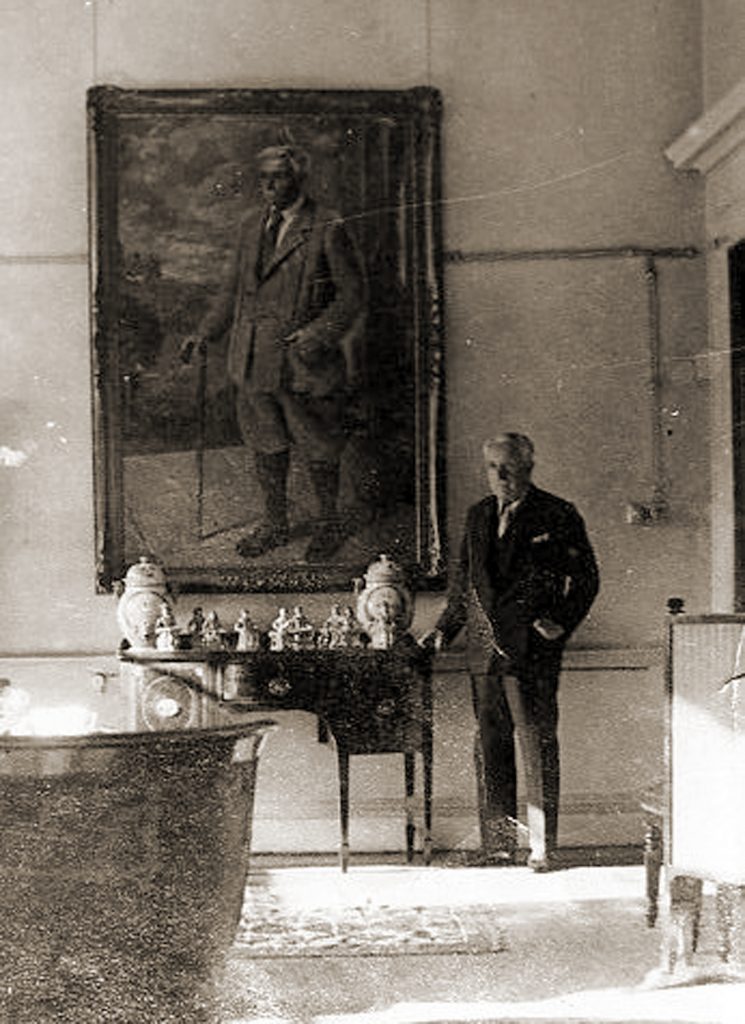
Philip Napier Miles in the dining room, now the Canaletto Room, at Kings Weston house
This year Sea
Mills estate celebrates its Centenary. The new suburb was built on land owned
by Philip Napier Miles, and, although not his project, saw the realisation of a
long-held ambition to create a garden village.
It’s not
clear what first inspired PN Miles to dream of developing his lands on along the
revolutionary principles of the Garden
City Movement, but he was an early adopter. Perhaps he’d read Sir Ebenezer Howard’s ‘To-morrow: a
Peaceful Path to Real Reform’ that set out the ideology of uniting the benefits of open
green space with new urbanization and industry. If he read it in its first year of
publication, in 1898, he was quick to respond as the architectural character of housing around
Avonmouth changed almost overnight, from traditional Victorian terraces, to new
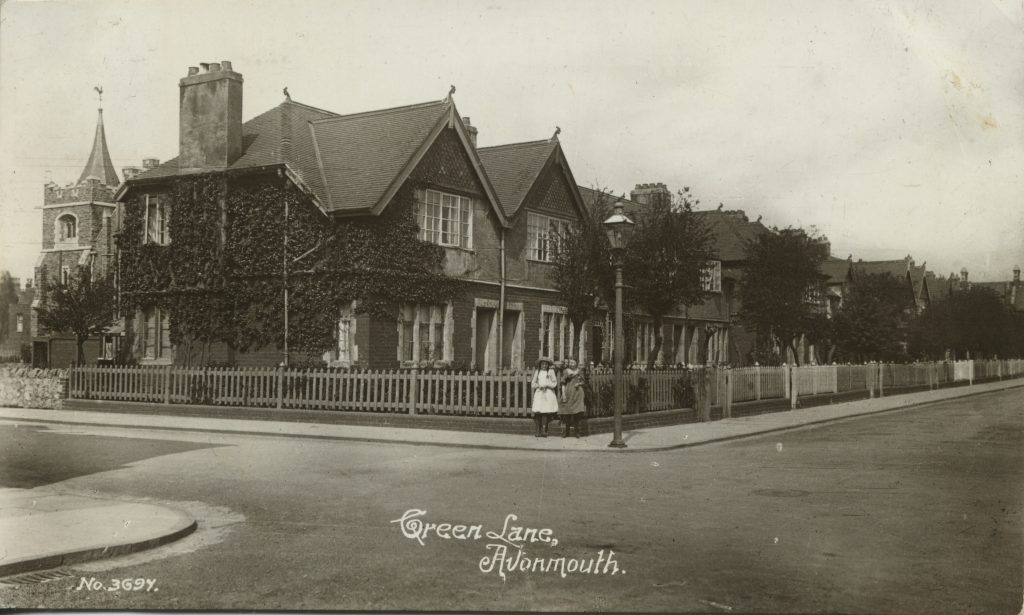
model housing in the Arts and Crafts style still found along Green Lane.
Green Lane, Avonmouth. Designed 1898 and seen here in about 1910
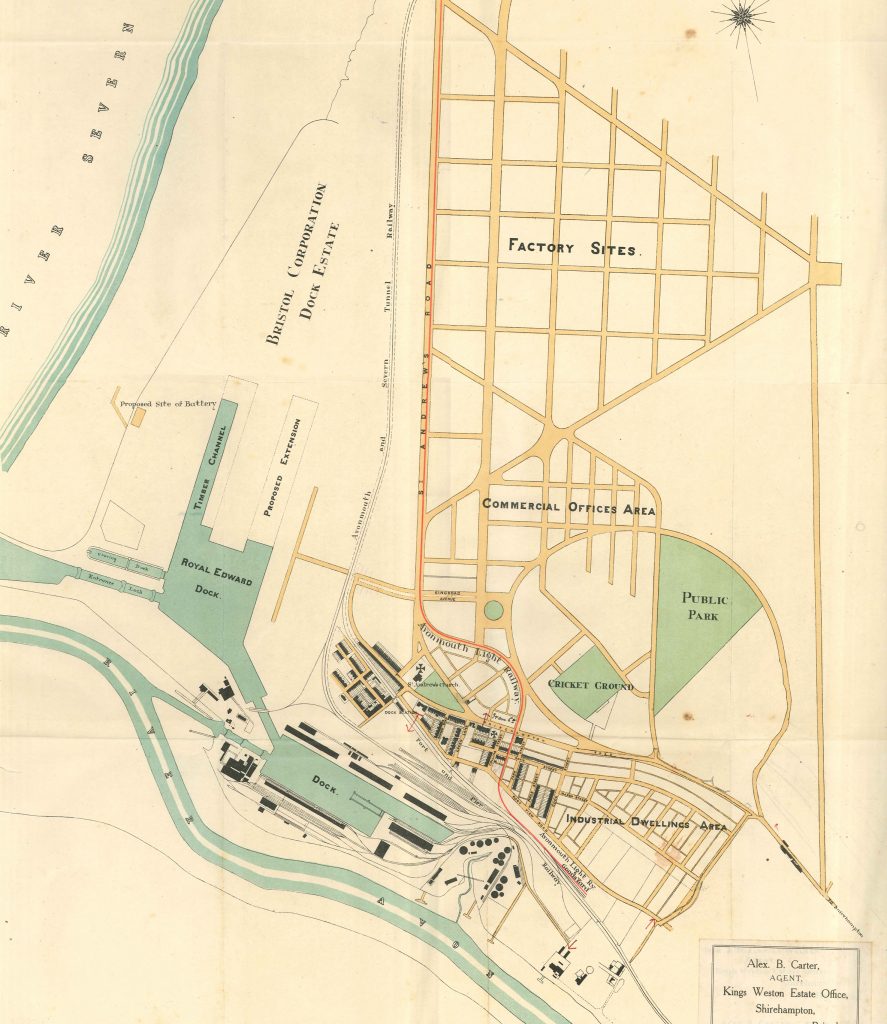
The 1903 plan to turn Napier Miles’ estate around Avonmouth into a new Garden City
The idea
quickly expanded and in March 1903 Miles published his grandiose plans for developing
thousands of acres of land around Avonmouth along Garden City ideals. This was
the same year as the foundation of Letchworth Garden City, the first realised
town plan using the same principles, and the architecture around Avonmouth is
still strongly reminiscent of the more famous settlement.
Although
heavily marketed the Avonmouth city project never really gained traction.
Investors were reluctant to commit to a damp, wet, floodplain that was only poorly
connected to the city centre of Bristol. However the wide streets, and elaborate
Edwardian architecture suggest at the aspirations Miles had.
Even as
Avomouth was undergoing tentative development another opportunity arose for
Miles to achieve his ambition; that being the Bristol Garden Suburb Ltd. Miles
was approached in 1909 by promoters of a smaller scale development inspired by the
garden-city principles that would provide pioneering artisan and workers
housing with high quality living conditions and generous gardens front and
back. Miles sold a portion of his estate off Station Road in Shirehampton at
extremely reduced cost to see if the experiment would succeed, and gave the
option to acquire more land if it was a success. The project was realised and
although only 44 houses had been built by 1913 it remained incomplete. Today
the garden village can best be seen around Passage Leaze where it has been
surrounded with later council estate development that muddies its real significance.
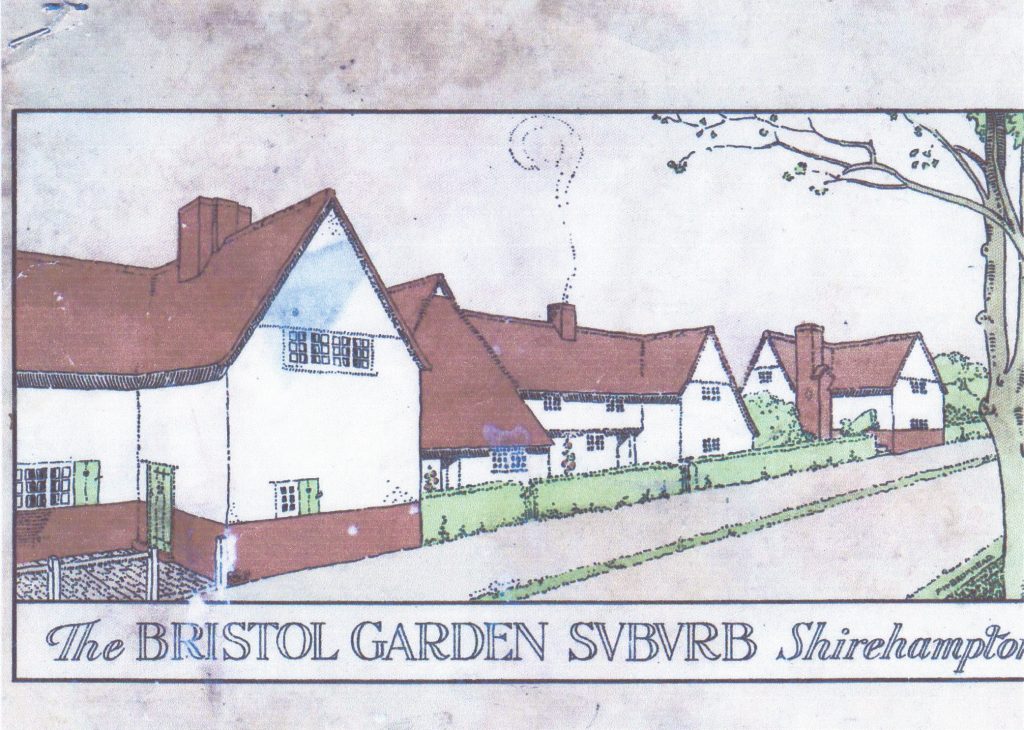
Houses on Springfield Avenue from the Bristol Garden Suburb Ltd prospectus.
Miles
remained committed to developing a much larger garden suburb on his own terms
and, in 1918 a new plan was formed to develop 350 acres of the Kings Weston
estate below Penpole Wood and where Lawrence Weston is today; 60 acres of this
were scheduled to be open green space. A 1919 newspaper report describes the
visit of the Garden Cities and Town Planning Association when Miles took the
opportunity to describe his plans and the progress then being made on them. The
first public building was to be a Trades Hall for the use of trade unionists,
new education facilities, communal laundries, baths, swimming pools a main
avenue of two miles in length, and a shopping centre were to incorporate
elements of the landscaped parkland below Kings Weston house.
Sadly there
aren’t any surviving plans for Miles’s ambitious scheme, but part of it was
realised in the form of about 100 houses below Penpole Point, around Bean Acre
and the western ends of Old Quarry Road and Kings Weston Aveunue; the latter being
the commencement of the 2-mile long avenue planned. The works were undertaken
by the Ministry of Munitions and it appears that Miles had limited control of
the appearance of their work driven by the wartime need to supply workers
housing for the Government zinc smelting works and the Mustard Gas factory at
Chittening.
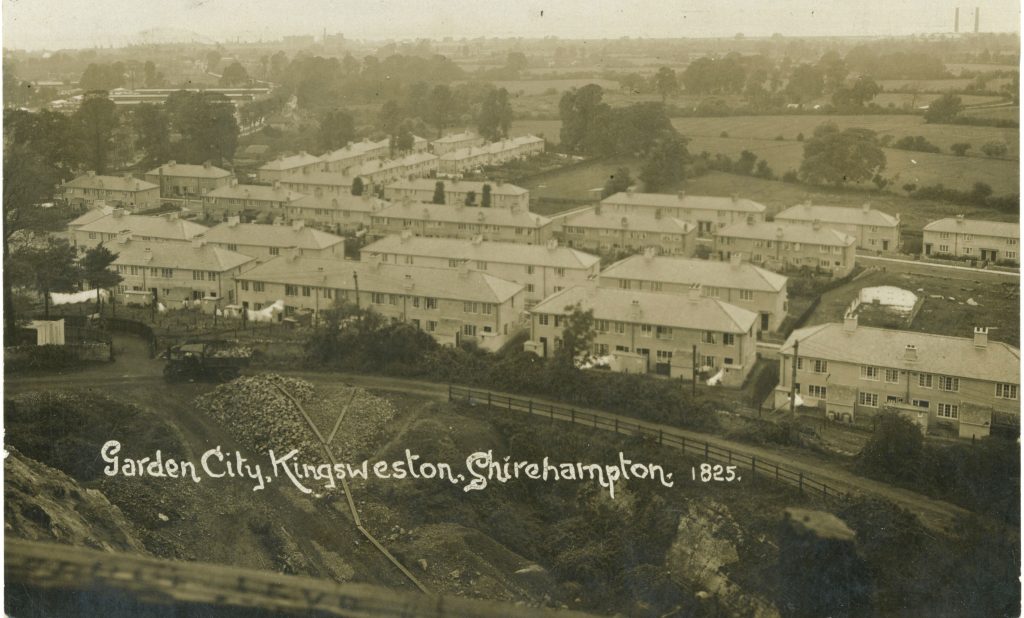
Kingsweston Garden Village seen from Penpole Point Above. Note the quarry that was brought back into use for the construction.
It’s not
known why the Kings Weston Garden City faltered after such grand plans,
especially following the 1919 Housing and Town Planning Act, promoted by politician
and doctor Christopher Addison, gave Local Authorities the power and money to
act to help resolve a chronic housing shortage. Instead Bristol Corporation focussed
attention on another large tract of Miles’s estate: Sea Mills. Miles bought
into the idea and he happily negotiated with the Council to sell the 205 Acres
of land required, but with three clear provisos that ensured he retained considerable
control of the design. These were: 1. “that no part of the said lands…shall
be used for any purpose other than that of a Garden Suburb”; 2. that the
density “shall amount on an average to not less than 8 and not more than 12 per
acre; 3. “that the said lands…shall be laid out and built upon in accordance
with a scheme which shall be previously prepared in consultation with the
Surveyor and Architect employed by the Vendor”.
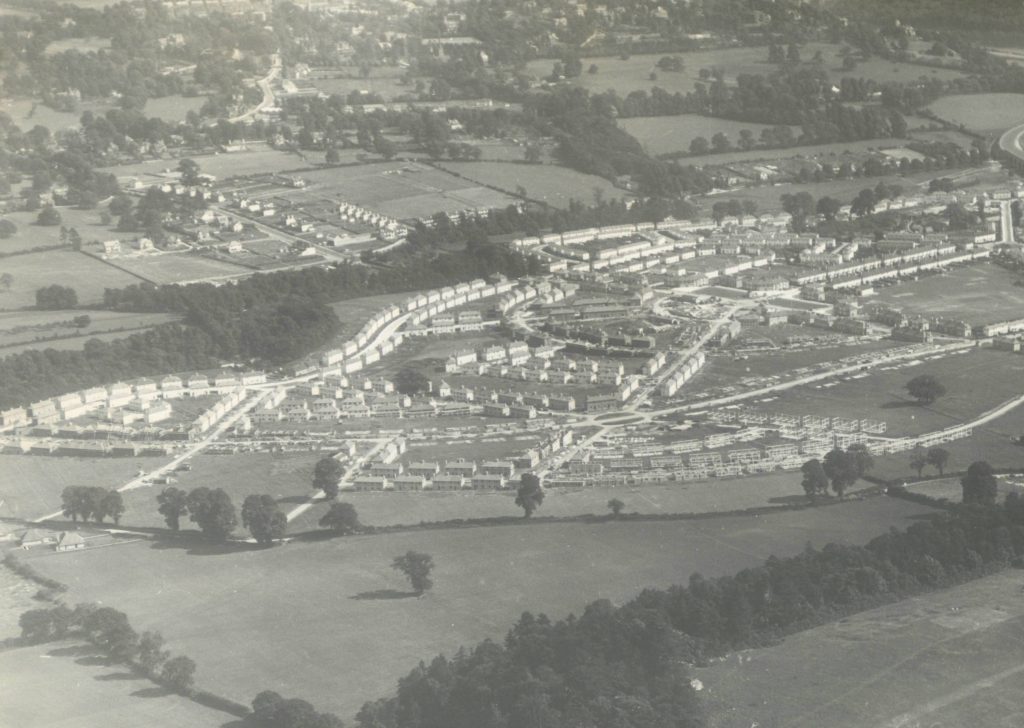
Sea Mills Garden Suburb during construction in the 1920s looking southwards with Kingsweston Hill in the right-foreground.
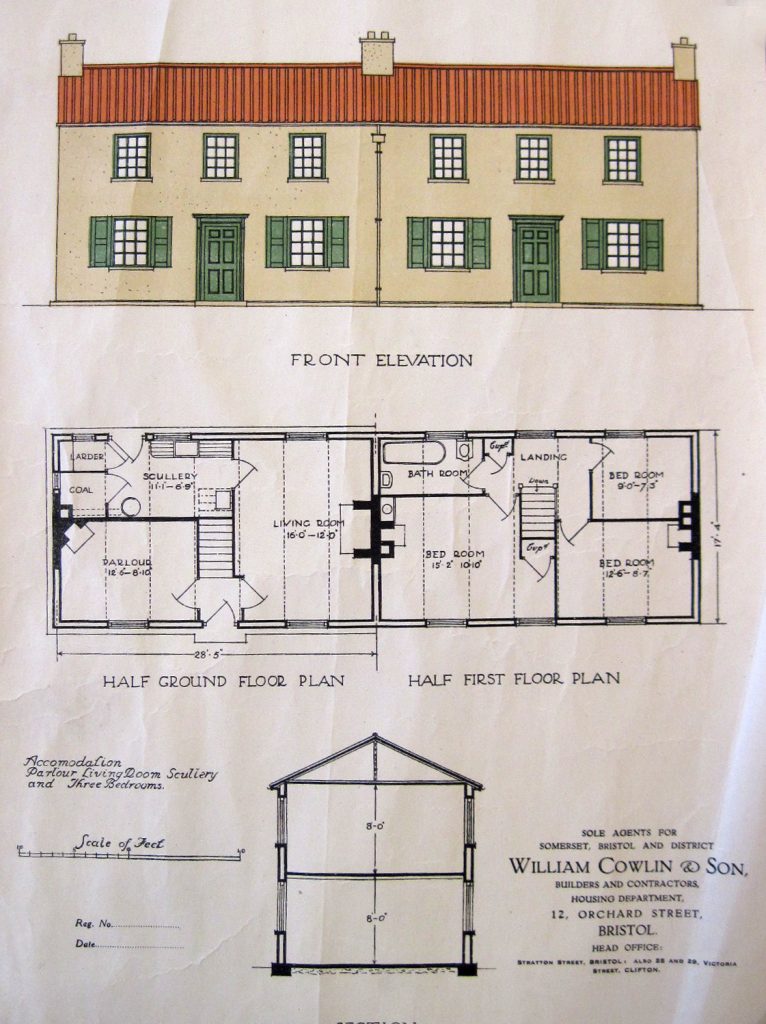
One of the house types that Philip Napier Miles was required to approve the design of.
In June 1919 the
architect of the social reforms that had enabled the foundation of Sea Mills,
Christopher Addison himself, cut the
first sod on Sea Mills Square and symbolically planted the ‘Addison’s Oak’. The
plans closely followed the Garden City principles, applied to a suburb, ensuring
generous green spaces, civic, educational and social buildings planned as a
unified and integrated whole. Miles further augmented the new suburb with the
gift of open spaces, and the donation of Shirehampton Park to the National
Trust for the enjoyment and recreation of the new residents.
In this Centenary year for Sea Mills it should not be underestimated the vision of men and women to provide humane, healthy, and dignified for their fellows. Amongst those people we should remember Philip Napier Miles and his devotion to the Garden City ideals; Sea Mills Garden Suburb must have given him pleasure as the most complete realisation of the dream he harboured for two decades.
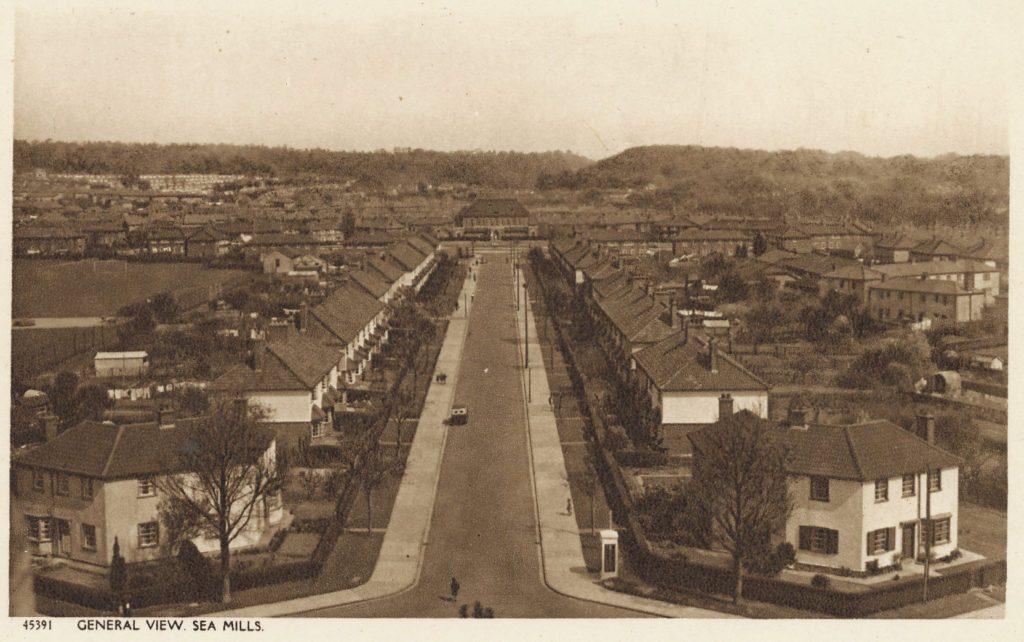
A view looking up St Edith’s Rd from the church of the same name, and towards the central square of Sea Mills.
The Centenary of Sea Mills is being celebrated by the Sea Mills 100 project with a series of events throughout the year, and the launch of a micro museum in a restored telephone box in the village centre. More information can be found here. For more information on Sea Mills suburb the Conservation Area Statement provides more detail.
Two items of Kings Weston interest recently appeared in
auction in Gloucestershire. Two paintings, both dating to the 1840s went under
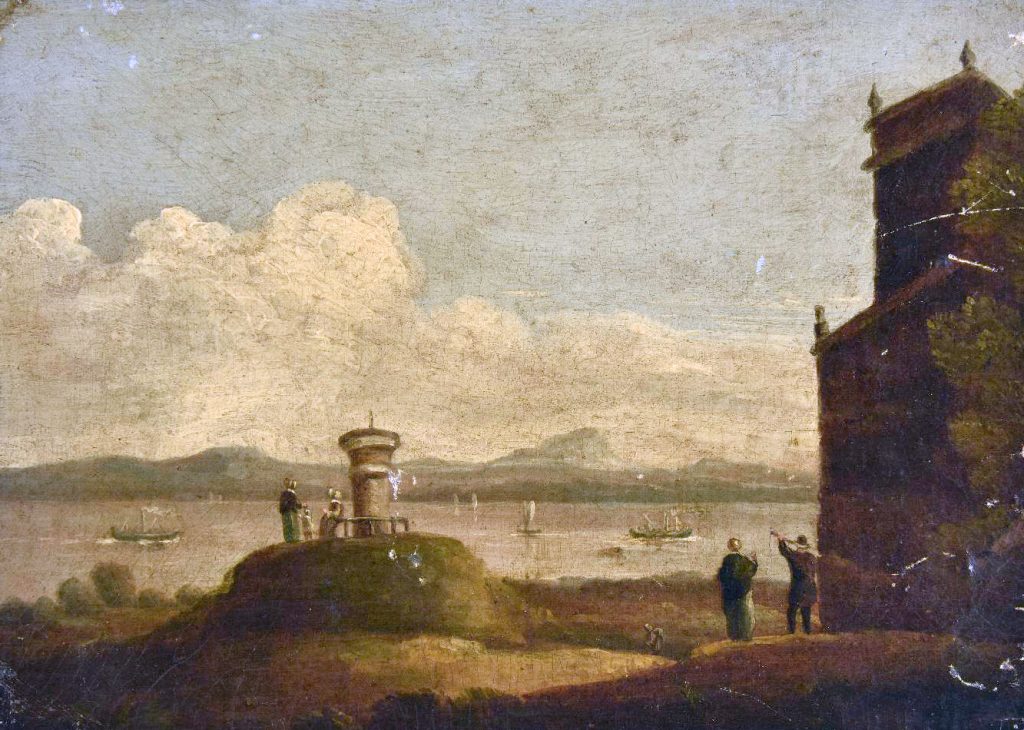
the hammer on the 7th. The first was a small and somewhat naive
depiction of Penpole Point in oil. This small painting was unsigned and a
little mangled. The view included Penpole Lodge and the dial further along the
ridge, but all concertinaed into a compressed space with some alarming perspective
at play! It was also odd in showing the dial raised on a mound, perhaps for
artistic effect as we know it never had this pronounced feature. The painting shows some of the many visitors
who came to Penpole Point to take in the views; one even holds a telescope to
out on the early steamships plying their
trade on the Severn.
Oil painting showing the view from Penpole Point. Penpole Lodge is on the right.
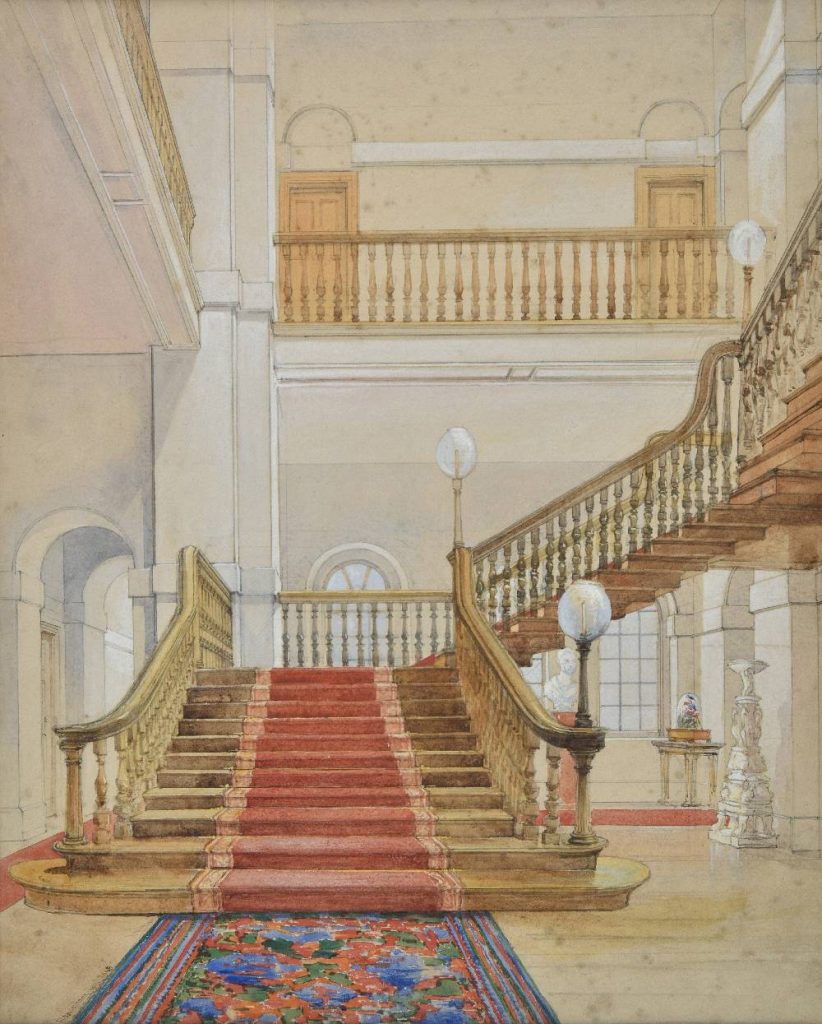
The other painting is a large watercolour depicting the
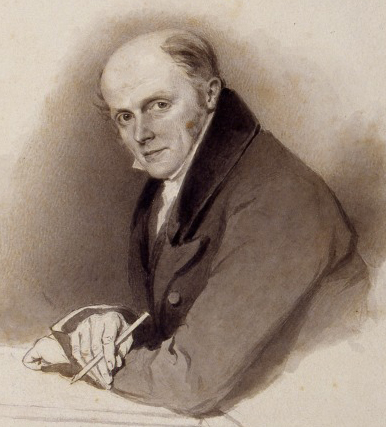
staircase in Kings Weston house by Thomas Leeson Rowbotham and is of historic
as well as aesthetic interest. Rowbotham (1782-1853) was born in Bath in 1782
where he worked as a teacher of painting. He lived in Bristol from about
1825-35, where he made many drawings for G. W. Braikenridge who famously
commissioned hundreds of paintings documenting the old city of Bristol in incredible
detail. Over 400 of Rowbothom’s paintings form part of the museum’s
Braikenridge collection. Rowbothom must have impressed the Miles family, owners
of Kings Weston from 1835, as he was commissioned to paint the interior of both
his mansions: Leigh Court and Kings Weston. A painting of the Drawing Room at
Leigh Court is in the Bristol Museum collections.
Rowbothom’s June 1848 view of the newly finished stair hall in Kings Weston house.
Thomas Leeson Rowbotham, 1782 – 1853
The Kings Weston painting is dated, June 1848, and this too is significant. After the death in 1845 of his father, Philip John Miles, his son, Philip William Skinner Miles decided to use his inheritance to refurbish Kings Weston as his new family home. Part of his works were to demolish the ancient arcades that filled the stair hall of the house and open up the space with wide galleries and a new top-lit ceiling. The centrepiece of the space was to remain the original staircase designed by Sir John Vanbrugh and installed by 1716. This work began in 1846 and concluded with a ceremonial dinner for the labourers on August 21st 1847; this was held in the George in Shirehampton and not in the house itself!
Skinner Miles appears to have commissioned Rowbothom to
record the brand new interior he has just created. Everything looks neat with
only a few belongings having yet been set up and paintings and furniture that
later occupied the space not yet installed. The gas lamps fitted to the stair
newels are feature now missing, but the scene is little changed today from
Rowbothom’s meticulous depiction of the newly finished hall.