Category Archives: Uncategorized

Kings Weston; Versailles of Bristol?

A book exists in Bristol Record Office called the Kings Weston Book of Drawings (KWBoD). It’s a fascinating volume comprising numerous original Eighteenth Century drawings for Kings Weston house and surrounding parkland features. The most visually attractive of the pageshosts a drawing for a pair of sphinx proposed for the “cheeks of the great steps”. Now long lost these once guarded the main entrance of the house before falling victim to changing fashion in the 1760s.
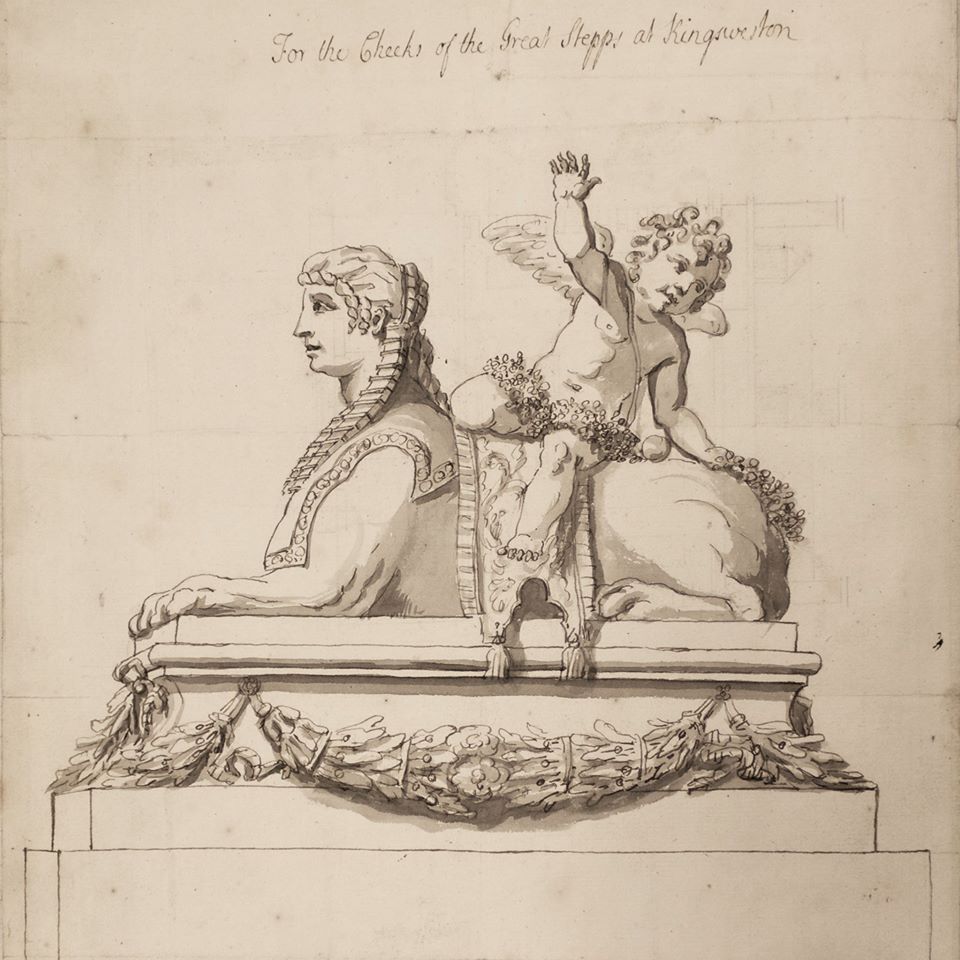
Drawing in the Kings Weston Book of Drawings, Courtesy of Bristol Record Office
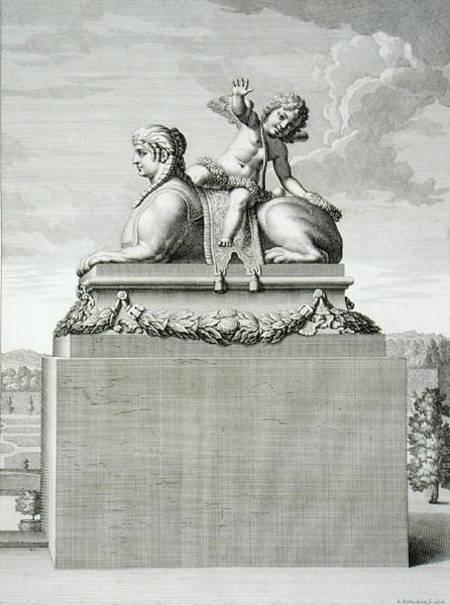
Drawing in the Kings Weston Book of Drawings, Courtesy of Bristol Record Office

STC170894

Print of the sphinx at Versailles, published by Jean Lepautre in Vues and Plans, 1667

However ornamental the pen-and-ink design held in the KWBoD is it was not an original one. It was copied, quite meticulously, from an engraving of an identical sphinx in the gardens of Versailles. The original designer was Louis Lérambert who in 1664 provided a wide range of sculptures to the palace, but it was through the engraver Jean Lepautre that the design arrived at Kings Weston.
Lepautre was a well regarded and successful designer and engraver operating in late Seventeenth Century France. He published a number of lavishly illustrated books focussing on Versailles, including his seminal work ‘Vues et Plans de Versailles’ in 1675. It was from this book that the designs for the Kings Weston sphinx had been copied.

This month we’ve made further discoveries linking the work of Lepautre to Kings Weston. By chance an engraving of his came up for sale. It depicted a design for a fictitious building not dissimilar to the Echo. With a new rigour we returned to Lepautre’s work and began reviewing it for any other commonalities. Trawling through the many hundreds of designs he produced there dozens for numerous garden pavilions, interiors, decorative motifs, and statuary. After a brief time we discovered an engraving of the imaginary ornamental urn illustrated here. It’s identical to one of the painted, gilded urns in the stair hall of Kings Weston House and is further evidence that Lepautre’s work was influencing designs during construction between 1712 and 1719..

Left: The painted urn in the stair hall at Kings Weston, circa 1719. Right, the engraving of an imaginary urn by Lepautre

Left: The painted urn in the stair hall at Kings Weston, circa 1719. Right, the engraving of an imaginary urn by Lepautre.

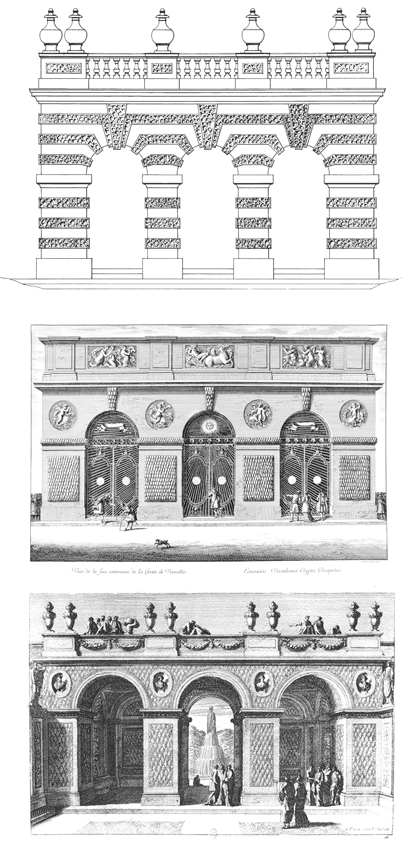
Lepautre’s oeuvre also contains another print of a building of particular interest, and one that would certainly have influenced the invention of his own Echo-like building that began our recent quest. The building is the Grotte de Tethys, an extravagant artificial cave designed for the gardens at Versailles by the architect Le Vau in 1666, and published in Vues et Plans . The grotto was set close to the palace and at the head of a long promenade stretching out into the park. The Echo would once have shared a similarly formal garden context terminating a long formal axis from Kings Weston house. Like the sphinx the symmetrical arrangement of parterres and “French alleys” were swept away in the 1760s during Edward Southwell III’s aggressive rebranding of the estate as vehemently English political powerbase.
Echo lepature comparison copy

Top: The Echo, designed circa 1724 Middle: Grotte de Tethys, Versailles, engraved 1675 Bottom: Design by Lepautre for a garden loggia. Undated

Features in both of Lepautre’s engravings, such as the triple-arched loggia, the rusticated stonework, cyclopean keystones, and the forest of urns feel very familiar when looking at the Echo. Could these ideas have been filtered through Vanbrugh’s genius to give Kings Weston its own little piece of Versailles? If so this influence can only have come through engravings because by the time the Echo was built the grotto at Versailles had been demolished for almost forty years.

One last piece of evidence supports Lepautre’s influence over Kings Weston and its gardens. In the 1834 auction catalogues that mark the end of the Southwell family’s reign there two books noted; Lot 764: Le Pautre’s designs – 1667 calf bound sold for £1.18.0 and Lot 765: Le Pautre’s designs – 1667 calf bound sold for £1.11.6. Sadly there is no mention of the Versailles book in the catalogues, but these earlier volumes are likely to have been Lepautre’s own designs compiled into the pattern books that helped spread his stylistic influence through Europe. Although we cannot be sure when they entered the Southwell’s library their appearance is unlikely to be coincidence. Could these have been the reference sources for more at Kings Weston than we are yet aware of?


Help us raise funds for our work

Since foundation in 2011 KWAG has always been keen to ensure that we don’t charge members for getting involved, but we do need to carry on operating and being able to realise our plans to conserve and enhance the estate. We are entirely dependant on volunteer donations and grants, but we need to turn over several thousand pounds a year to make sure we can still carry on benefiting the park.

We do have regular fund-raising events, but now we are asking if you are able to help support us further by considering giving us a donation. To enable this we have created a new and easy way to get donations to us via credit or debit card, or direct through Paypal.

If our work in the estate has impressed you and you would like to see it continue, if you’ve enjoyed one of our free guides and would like to see more in the future, or would like to see more bulb planting, bins, or any number of infrastructure works extended then please lend us your support. We promise to put your donation to the best use we can.

Thank you

To help us with your donation, please go to this secure site

Screen Shot 2015-02-22 at 15.34.28 copy


Spring dividends

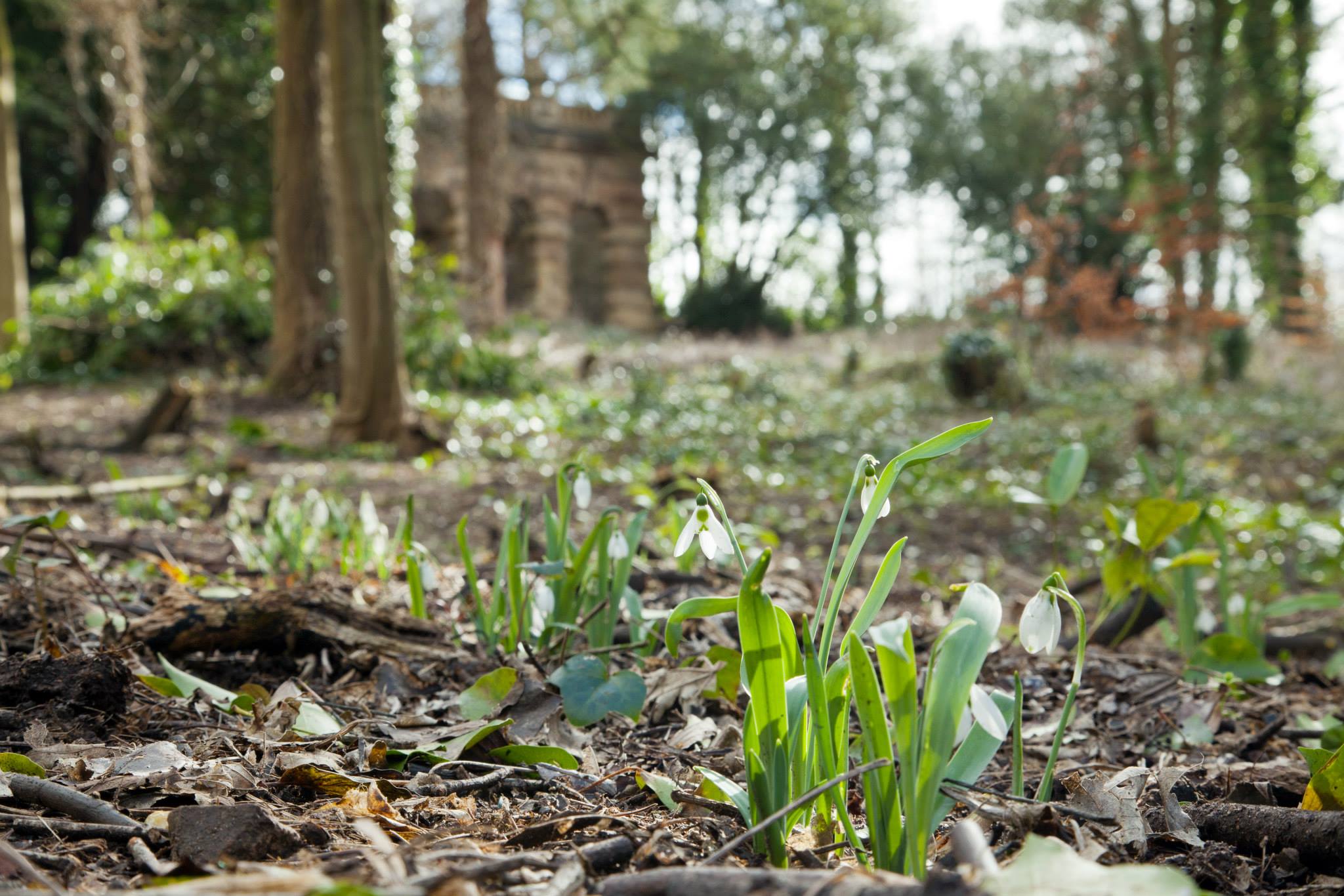
In October 2014 we set about planting over 12,000 spring bulbs. Right now we are enjoying the payback from that event with the snowdrops now flowering below the Echo. Not quite a carpet yet, but certainly a fantastic show for the first year.
Bluebells are already coming up thick under foot and should present a stunning display in the coming weeks.
We’ll keep you updated with how things develop with this album.

10960422_850582365008224_8151518867831002435_o

New arrivals!

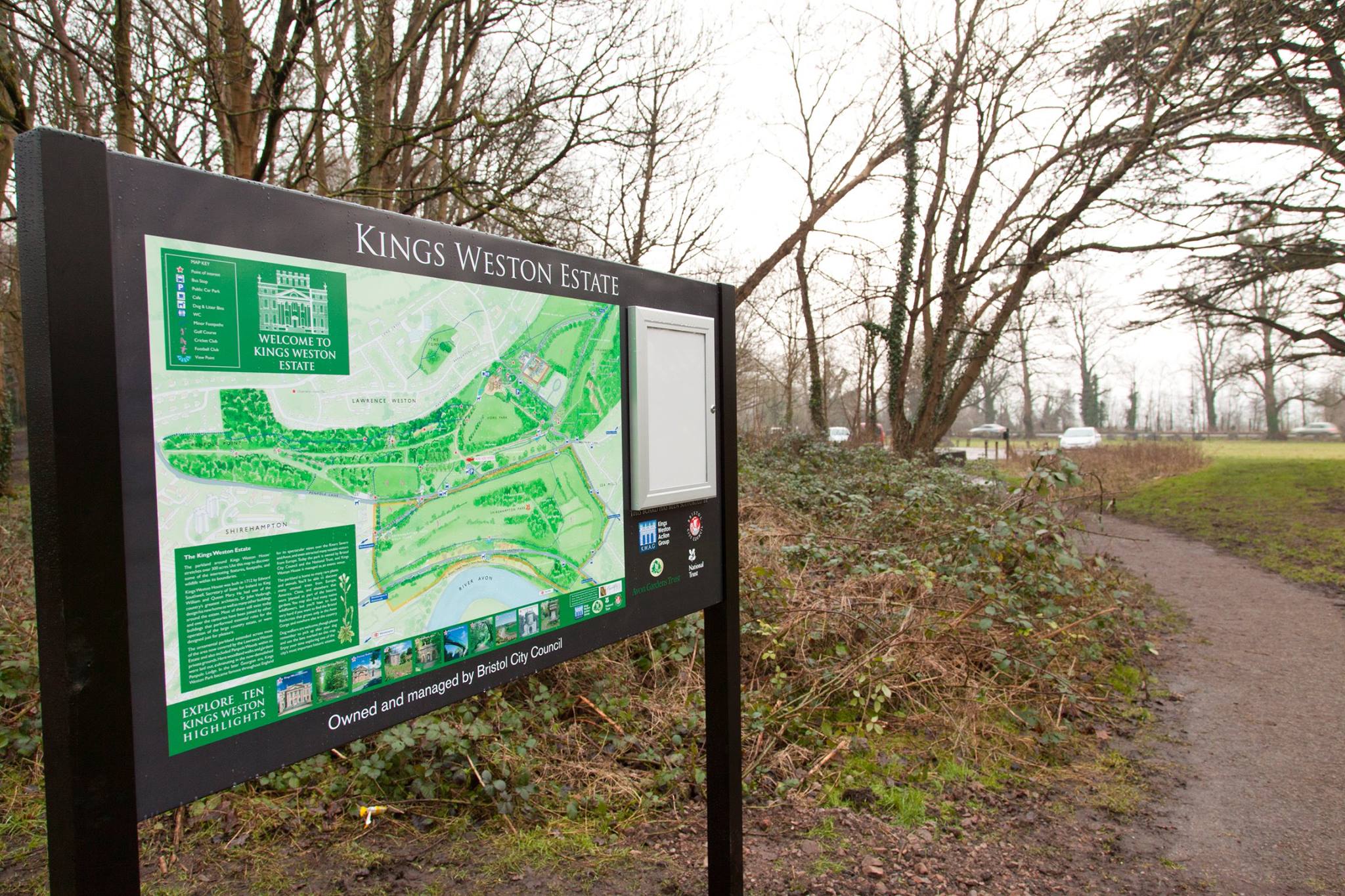
We were delighted to find that, finally, our long-awaited new map board has appeared in the park. The sign was kindly supported by a grant from the Avon Gardens Trust last year, and since then we’ve spent a long time designing and the artwork and making sure that it gives visitors a fresh and informative way to explore the estate. Based on the map we commissioned from local artist Dru Marland for our estate guide leaflets we’ve ensured that it’s been updated with all the recent changes, like the avenue and restored steps. As well as the usual information about car park, bust stop, bin and cafe locations we’ve also added our ten highlights of the park. It’s far from being an exhaustive list, but we hope it will encourage people to explore more of the 300 acre estate.

10847435_833037686762692_8456113309666395652_o

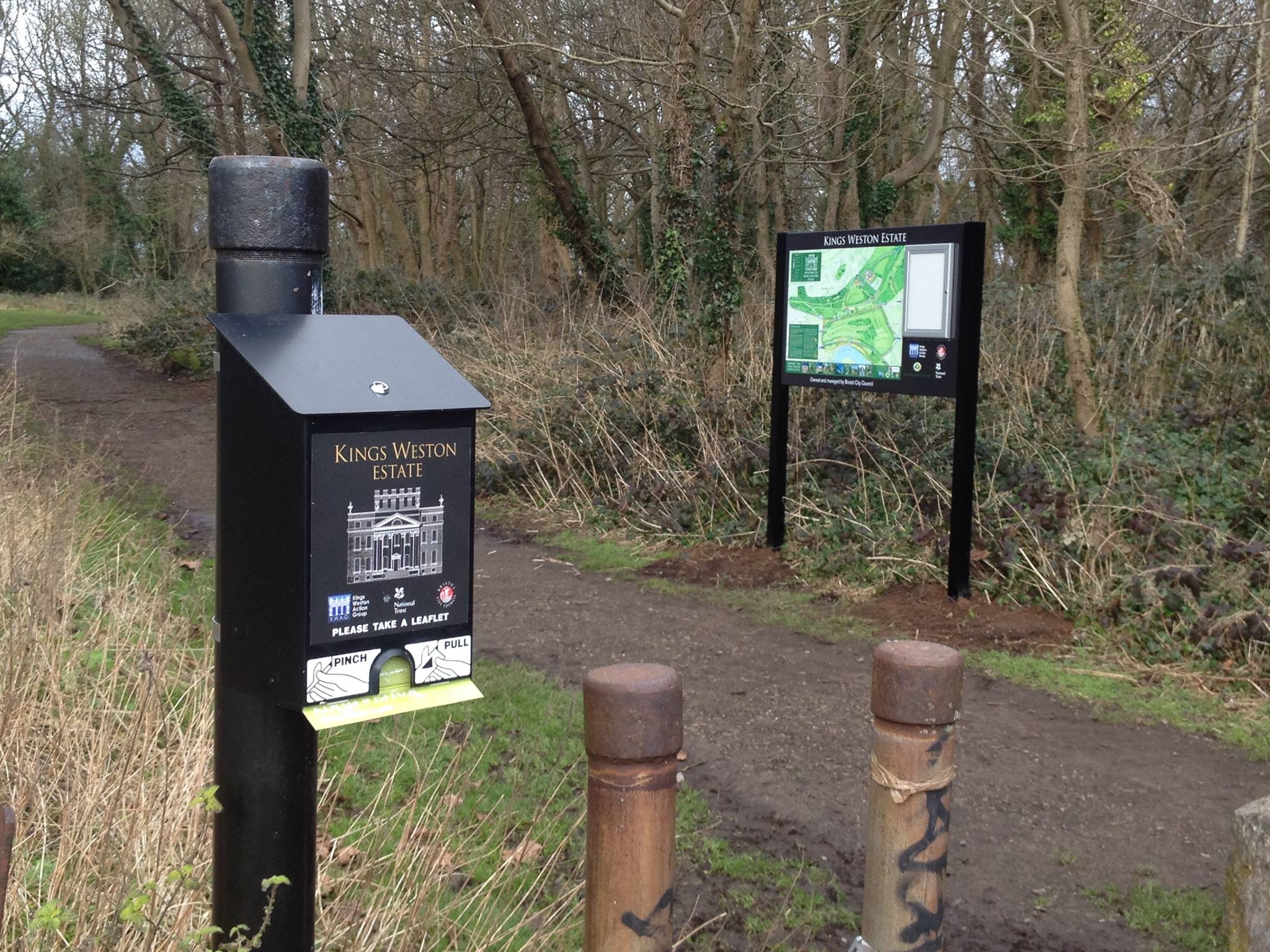
The board appeared mysteriously and without warning around the 21st January, and slightly in the wrong place! However as this second photo shows the sign company were very quick in moving it to the correct location when we asked. It now partners our existing leaflet dispenser as an information station at the entrance into the park from Shirehampton Road car park, just on The Circle.

1399686_838177222915405_4487364451748820138_oWe’re hugely grateful to the Avon Gardens Trust for their support in this project, and also to Bristol Council parks department for working with us in finalising the design and procuring the board on our behalf.

Another arrival has come in the form of a leaflet holder for the cafe at the House. It’ll show off our free guides and other leaflets to best effect, and will help keep the cafe tidy too!

kings weston house kingsweston

New animation of Elizabethan Kings Weston

A bit of an experiment on our web site, but this is the first ever MOVIE we’ve hosted here.

Over the last few years we’ve undertake a lot of research that has changed knowledge about the buildings and landscape around Kings Weston. A hugely important part of testing our theories, and exploring new ideas has been the use of 3D computer modelling. We’ve posted still images of this work before, but now we can share something a little more exciting!

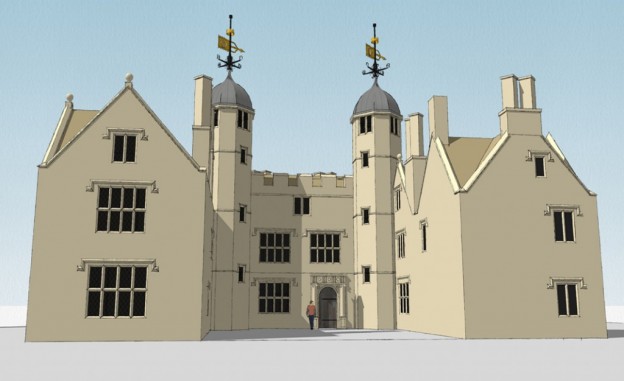
This short movie is an accurate reconstruction of the Elizabethan mansion at Kings Weston based on all available data we have on it. It is, most famously, illustrated in an engraving of 1711, but other information also exists in the form of drawn plans, and descriptions of the interior of the house before it was completely demolished in 1713 to make way for the present building.


This animation shows how prominent the pair of viewing towers were, and the intended castle feel in the inner courtyard, then the main entrance to the building. It is interesting to note that when the same courtyard was redesigned by Sir John Vanbrugh he chose to repeat the idea, and echo ancient castle architecture in his own designs.  The two towers are still evoked by the arcaded chimney when viewed from the rear of the house today.

More info on the early history of the house and its illustrious owners can be found on our dedicated web page.

STEP BUILDING BEGINS

January 2015. A 2-day step building epic

Our first working Part event of 2015 was something a little different. With the support of The Conservation Volunteers we were led in a two-day step-building course which has trained us up to complete a long set of steps that will restore an early Georgian Footpath through Penpole Wood.

The path links the main, top path through the woods, and one that clings to the hillside about halfway down and dates from the mid Eighteenth Century. The linking path between the two appeared on maps until the 1970s and has gradually fallen out of use as trees have fallen across it and the path surface degraded.

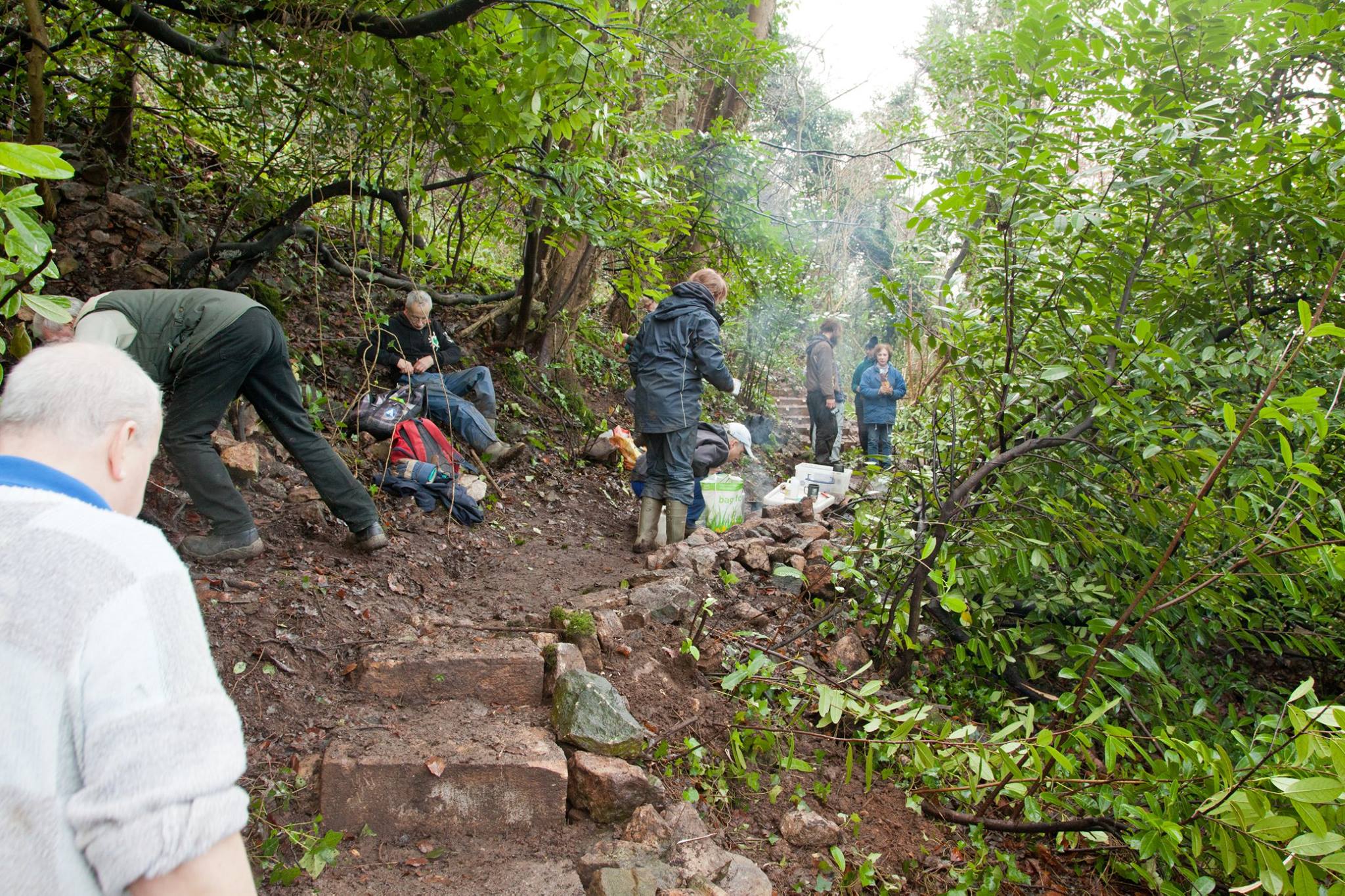
Our January work is just the start of this project to reinstate it. We installed about 20 steps over the two-day  training course which covered the two most hazardous areas on the route. The bottom part of the path had been lost beneath laurels and rubble, but now has fifteen new wooded steps allowing safe traffic to the main part of the path, and the top section where it meets the main Penpole Wood footpath has also got much improved access.

We are really grateful for The Conservation Volunteers for training us in this work and we hope to be able to complete the path with the remaining 40 steps over this year.

Take a look at our full gallery of work-in-progress shots here.

Coffee break time looking from the new stone steps towards the timber ones in the distance. The stones, relics of the demolition of Penpole Lodge, lie scattered around

Coffee break time looking from the new stone steps towards the timber ones in the distance. The stones, relics of the demolition of Penpole Lodge, lie scattered around

Spot the difference

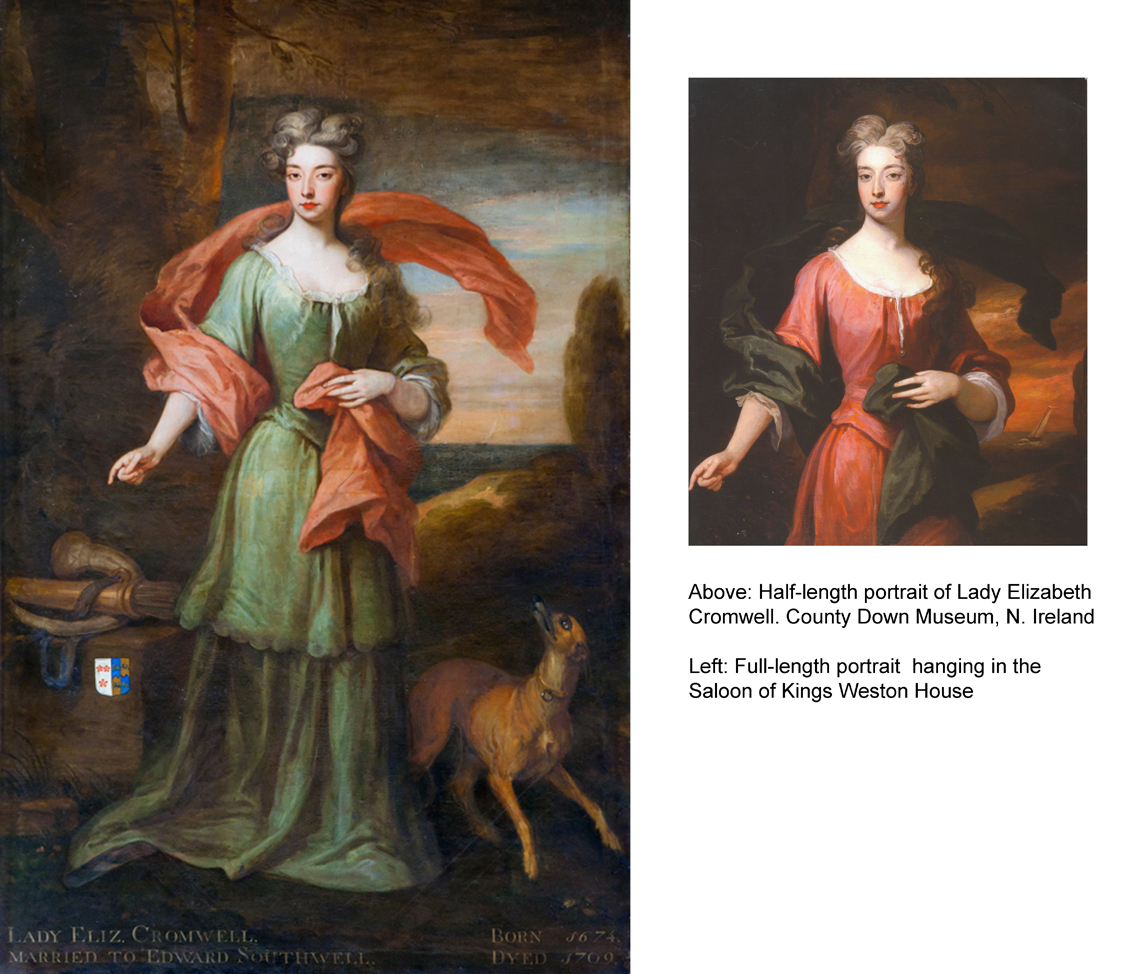
Kings Weston House is still host to an incredible collection of family portraits of the Southwell family who lived there between 1679 and 1833. But their likenesses can be found elsewhere too. A recent trip to Downpatrick, Northern Ireland, uncovered a little sister portrait to the vast canvas by Sir Godfrey Kneller in the Saloon at Kings Weston. The paintings depict Lady Elizabeth Cromwell, wife of Edward Southwell who rebuilt Kings Weston.

The two paintings are shown together here, probably for the first time since they were painted, and the similarities are striking. The Kings Weston Painting is signed by the artist Kneller, but the other, held in the County Down Museum, is not. The latter is likely to have been made as a copy at some point in time though it’s history has not yet been unravelled.
The same museum also has a matching painting of Edward Southwell, identical in detail of the one of him hanging at Kings Weston, but the pose is reversed! This probably shows that it was copied from a contemporary engraving, rather than directly from the original as his wife’s may have been.

An article about the Downpatrick paintings is available to download, though sadly the author appears to have been unaware of the Kings Weston paintings when they were writing it. http://www.kwag.org.uk/wp-content/uploads/2014/02/Downpatrick-museum-paintings-reduced2.pdf


New historical resources now on-line

We have now added a new selection of important historical documents to our downloads area including catalogues to a glittering fourteen day auction of the entire contents of Kings Weston House! The auctions took place in 1833 and 1834 following the death of the last of the direct line of the Southwell family, Edward Southwell IV, 21st Baron de Clifford.

The auctions detail almost all of the furnishings, artworks, books and personal items built up by the Southwell family since the Seventeenth Century and include some keen insights into the development of the family’s house and estate over the Century.

Amongst the five thousand books from the library are rare volumes by famous friends of the various family members, books on art and architecture relating to the design of the house and grounds, and with a wide range of languages represented, suggesting the taste and education of the owners.

To see these new documents head here